
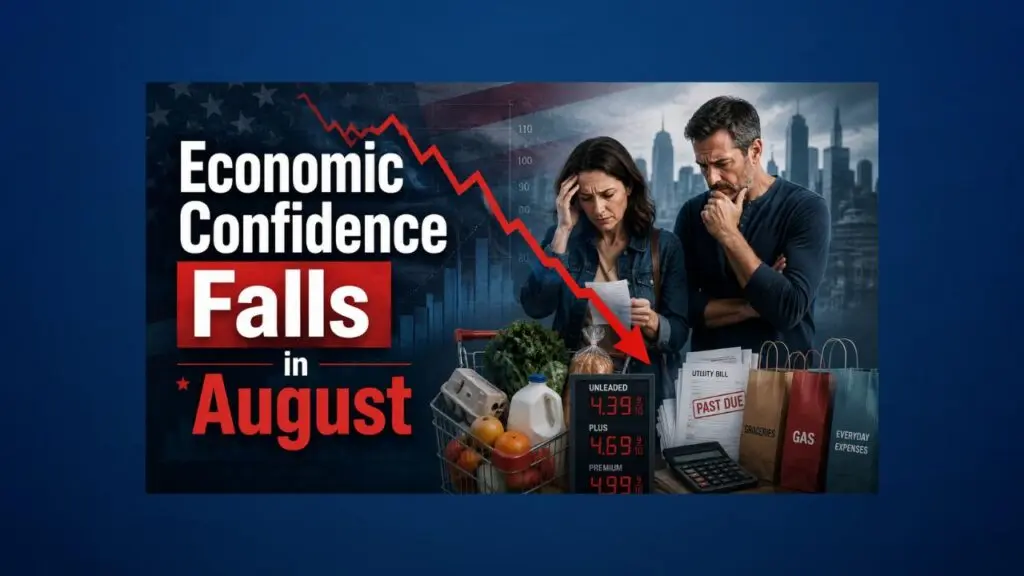

WASHINGTON — Economic confidence among American consumers declined notably in August, retreating from mid-summer optimism as fewer adults evaluated current national financial conditions positively and a solid majority expressed growing anxiety about the months ahead.
According to the latest findings from the Rasmussen Reports Economic Index, the benchmark fell to 104.2 this month. This represents a downward slide of more than two points compared to July and underscores a cooling sentiment from a four-year high of 115.9 recorded in July 2025.
While macroeconomic outlooks are turning increasingly pessimistic, secondary metrics from the same survey reveal a complex and somewhat paradoxical economic landscape. Even as confidence slips, separate measures tracking consumer spending, personal financial expectations, and workplace optimism demonstrate surprising resilience.
Conducted on August 5, 2026, by Pulse Opinion Research, the Rasmussen Reports survey sampled 1,500 American adults. The data carries a margin of sampling error of plus or minus three percentage points at the 95% confidence level.
Executive Overview: A Dual Narrative of Macro Anxiety and Micro Resilience
The prevailing sentiment among U.S. adults heading into the late summer months is defined by a dichotomy between broad economic perceptions and personal financial realities. On a macro level, Americans are looking at national economic indicators with a critical eye. Inflationary pressures, shifting geopolitical landscapes, and political polarization continue to weigh heavily on public perception.
However, on a micro level—focusing on personal household budgets, individual career trajectories, and lifestyle satisfaction—the average American appears considerably more upbeat.
- The Decline in National Sentiment: The Rasmussen Economic Index’s drop to 104.2 highlights mounting unease. Just 35% of U.S. adults now rate the national economy as “excellent” or “good,” a five-point drop from July. Conversely, those describing the economy as “poor” rose four points to 36%.
- The Political Shift: Views on the economy remain deeply partisan, though the ideological makeup of who feels confident has completely inverted since the October 2024 presidential election.
- The Spending Paradox: Despite deteriorating views of the broader economy, the Rasmussen Spending Index ticked upward in August to 110.9—marking a one-point gain over July and standing more than 14 points above its cyclical low from February 2021.
- Personal Optimism: Majorities of Americans continue to report that life is “pretty good,” expect to secure pay raises without changing jobs, and anticipate having discretionary funds left over after servicing monthly debts.
Detailed Chronology: Tracing the Volatility of the Rasmussen Economic Index
To fully understand the weight of the August 2026 data, it is necessary to examine the historical volatility of the Rasmussen Reports Economic Index over the past several years. The index has served as a barometer of American sentiment through monumental economic shocks, political transitions, and shifting monetary policies.
The Pandemic Era and Subsequent Recovery
- January 2020: The index reached a soaring peak of 147.8 just prior to the global onset of the COVID-19 pandemic, reflecting robust consumer confidence and a booming labor market.
- 2020–2022 Disruption: Following sweeping business shutdowns and subsequent inflationary spirals, the index experienced severe contractions. By July 2022, economic confidence hit a multi-year nadir, plunging to a dismal 78.6 as cost-of-living concerns dominated household conversations.
- The 2024 Inflection Point: As macroeconomic conditions gradually stabilized, the index began a protracted climb, culminating in a four-year high of 115.9 in July 2025.
The 2025–2026 Trajectory
The descent from the July 2025 peak has been gradual but steady. By July 2026, the index had softened, before experiencing the sharper two-point drop captured in the August 2026 survey data.

When broken down by specific forward-looking metrics, the August data reveals deep-seated apprehension regarding the immediate future:
- Short-Term Outlook: Only 24% of respondents believe the economy is currently getting better—a three-point decline from July.
- Pessimism on the Rise: Over half of all respondents (54%) expect economic conditions to worsen in the coming months.
- Stagnation Expectations: An additional 19% anticipate that conditions will remain largely unchanged.
This erosion of faith in the national trajectory is mirrored in Rasmussen’s separate measure tracking the overall direction of the country. Only 34% of respondents in August reported that the United States is headed in the right direction, marking a four-percentage-point decline from July.
Supporting Context & Metrics: Partisan Realignments and Consumer Behavior
One of the most striking elements of the August 2026 economic data is the profound realignment in how voters view the economy through a political lens.
The Great Partisan Flip
Economic confidence in the United States has long been correlated with which political party holds the White House, but the magnitude of the recent shift highlights deep ideological divisions in economic perception.
- Republican Sentiment Surge: Currently, 53% of self-identified Republicans rate the economy as good or excellent.
- Democratic and Independent Hesitancy: By comparison, only 28% of Democrats and 26% of unaffiliated, non-aligned voters share that positive assessment.
These figures represent a striking reversal from the pre-election period in October 2024. At that time, just 20% of Republicans held a positive view of the economy, compared to 59% of Democrats. In the span of less than two years, Republican confidence has surged by 33 percentage points, while Democratic confidence has plummeted by 31 points. This dynamic illustrates how political identity continues to heavily color financial sentiment, often independent of raw economic data.
Consumer Spending Defies Gloom
Despite macro-level pessimism, American consumers continue to open their wallets. The Rasmussen Spending Index rose to 110.9 in August, demonstrating that negative headlines regarding the national economy have not translated into a broad retrenchment in consumer behavior.
Key spending metrics from the August survey include:
- Spending Intentions: Thirty-five percent (35%) of Americans expect to increase their spending during the coming month, a figure unchanged from July.
- Cautious Consumers: Nineteen percent (19%) expect to scale back their spending, while 43% anticipate keeping their spending levels steady.
- Debt and Savings: Nearly half of all respondents—49%—expect to have money left over at the end of the month after all debts are settled. This is down just one point from July. Meanwhile, 37% admit they will not have leftover funds, and 14% remain unsure.
Official Statements and Societal Outlooks
While financial indices provide a quantitative look at the American psyche, supplemental polling data released alongside the August economic report offers a broader view of how citizens perceive their personal lives, career trajectories, and generational prospects.

Workplace Optimism and Pay Rises
Despite worries over the broader economic climate, the American workforce remains remarkably confident in its immediate earning potential. Recent Rasmussen polling indicates that a strong majority of U.S. workers expect to secure a pay raise within the next year. Crucially, most of these workers believe they will achieve these financial gains through wage growth in their current positions, rather than needing to navigate a competitive job market by changing employers.
This internal confidence points to a resilient labor market where skilled workers retain sufficient leverage to negotiate higher compensation, buffering households against inflationary pressures.
Life Satisfaction and Generational Views
Beyond the ledger, the survey highlights a generally positive outlook on everyday life. A clear majority of Americans continue to evaluate their personal life satisfaction favorably. Furthermore, when polled on generational milestones, respondents broadly view young adulthood as the prime period of life—reflecting a cultural emphasis on health, mobility, and foundational life experiences.
Future Outlook: What Lies Ahead for the U.S. Economy?
As the United States enters the final stretch of the third quarter of 2026, economists, policymakers, and financial analysts will be closely monitoring whether the divergence between macro pessimism and micro resilience can be sustained.
Several key questions emerge from the August data:
- Will Spending Fatigue Set In? If consumers continue to feel that the national economy is worsening and that conditions are deteriorating, will this eventually bleed over into consumer spending? Historically, a widening gap between economic confidence and spending behavior eventually corrects itself—either through improving sentiment or a contraction in retail activity.
- The Political Impact of Economic Perception: With midterm and local political cycles constantly evolving, the stark partisan divide in economic evaluations will likely remain a central fixture of political discourse. The ability of either political coalition to bridge this perceptual gap will heavily influence public trust.
- Monetary Policy and Inflation Pressures: Central bankers will have to weigh consumer resilience against underlying anxieties. While workers feel confident about securing raises, the persistent expectation among 54% of adults that conditions will worsen suggests that cost-of-living concerns have not fully dissipated.
For now, the American consumer remains a study in contrasts: outwardly cautious and critical of the nation’s macroeconomic trajectory, yet inwardly confident, employed, and continuing to spend. Whether this delicate equilibrium holds through the autumn will depend heavily on upcoming labor market reports, retail earnings, and inflation metrics.

0 Comments