
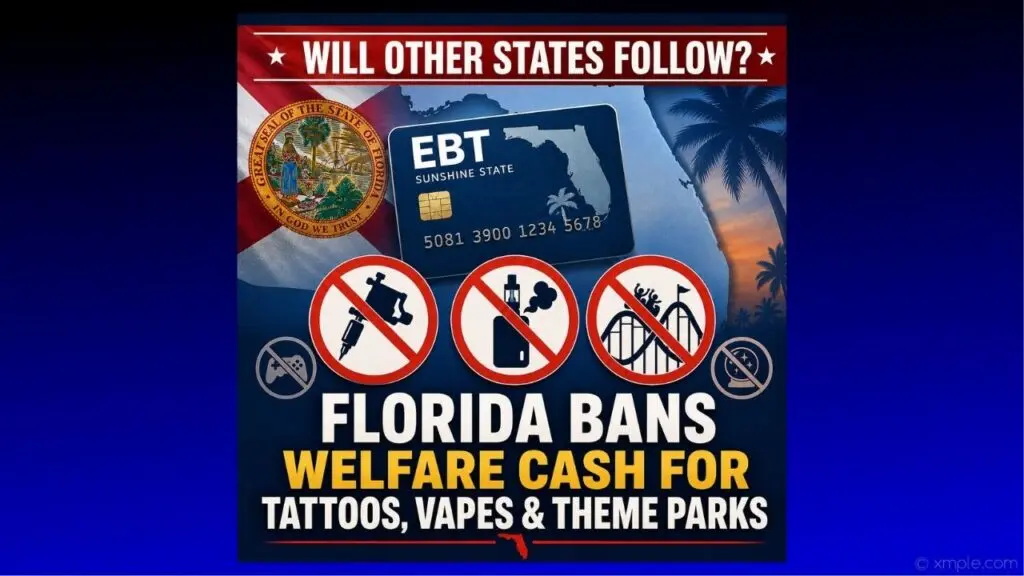

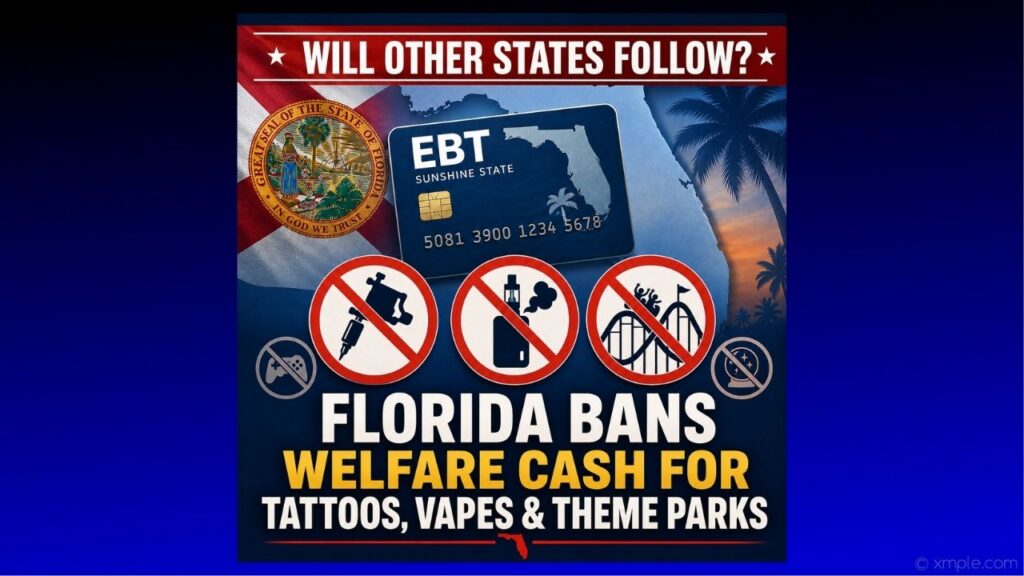
TALLAHASSEE, Fla. — Florida has officially cemented its position as the first state in the nation to implement a comprehensive ban blocking welfare cash benefits from being spent on a wide array of non-essential goods, recreational activities, and luxury services. Under a directive championed by Governor Ron DeSantis, recipients of state welfare funds are now strictly prohibited from utilizing their Electronic Benefit Transfer (EBT) cards to purchase tattoos, body piercings, vaping products, video games, theme-park admissions, pornography, and psychic services.
This policy shift represents a profound tightening of oversight regarding how taxpayer-funded safety-net resources are utilized. While federal and state governments have long maintained baseline restrictions on EBT card usage—such as prohibitions against purchasing alcohol, lottery tickets, and gambling services—Florida’s latest framework establishes an unprecedented level of item-level scrutiny.
The initiative has immediately vaulted Florida to the forefront of a burgeoning national debate over welfare reform, accountability, and the proper boundaries of government assistance. As the Trump administration urges governors nationwide to emulate Florida’s model, the policy is drawing intense scrutiny from policymakers, taxpayers, and welfare advocates alike, igniting discussions that extend far beyond the Sunshine State.
Executive Overview
To understand the mechanics and magnitude of Florida’s new policy, it is essential to distinguish between the various streams of public assistance. The newly restricted funds are funneled through Temporary Cash Assistance (TCA), Florida’s iteration of the federal Temporary Assistance for Needy Families (TANF) block grant.
TCA differs fundamentally from the Supplemental Nutrition Assistance Program (SNAP), commonly known as food stamps. While SNAP funds are strictly earmarked for the purchase of eligible food products to support household nutrition, TCA provides direct cash assistance intended to cover broader, basic living expenses. These core expenses traditionally include housing, utilities, clothing, and essential household needs.
Despite this intended purpose, previous regulatory frameworks often left a significant gap in item-level enforcement. EBT cards issued for cash assistance could technically be used at various retail and service locations with minimal oversight regarding the specific nature of the transaction, provided the location itself was not entirely barred.
Florida’s new mandate closes this gap by legally binding TCA recipients to a strict definition of "basic living expenses." By explicitly barring transactions related to leisure, entertainment, body modification, and alternative services, the state aims to ensure that public assistance directly fulfills its statutory mission: serving as a temporary bridge to self-sufficiency for vulnerable children and families.
Detailed Chronology: The Evolution of EBT Oversight in Florida
The implementation of Florida’s comprehensive welfare spending restrictions is the culmination of years of incremental policy shifts designed to safeguard public funds and restore public trust in welfare programs.
Phase 1: Baseline Federal and State Restrictions
Historically, federal law mandated very few point-of-sale restrictions for cash welfare programs, leaving states with wide latitude. Over the past decade, however, states began facing pressure to curb egregious abuses of EBT cards. Florida was among the early movers to ban the use of cash-assistance cards at liquor stores, casinos, strip clubs, and gambling establishments. These location-based bans prevented recipients from physically withdrawing cash or swiping cards in environments clearly detached from basic family needs.
Phase 2: Identifying the Item-Level Gap
Despite location-based restrictions, enforcement loopholes persisted. Recipients could still withdraw cash from standard Automated Teller Machines (ATMs) or make purchases at multi-department retailers where restricted items could theoretically be acquired alongside legal goods. Furthermore, digital transactions, online services, and specialized brick-and-mortar storefronts—such as tattoo parlors, vape shops, and psychic reading rooms—remained technically accessible if they processed payments through generic merchant category codes.
Phase 3: The DeSantis Administration’s Directive
Under the leadership of Governor Ron DeSantis, state agencies undertook a rigorous review of expenditure patterns within the TCA program. Recognizing that public assistance funds were occasionally subsidizing non-essential, recreational, and sometimes controversial services, the administration drafted an expanded prohibitions list.
The resulting policy explicitly outlaws the use of TCA EBT cards for:
- Tattoos and Body Piercings: Categorized as elective cosmetic procedures rather than essential health or living needs.
- Vaping Products: Excluded from basic health and household provisions.
- Video Games and Theme-Park Admissions: Identified as discretionary entertainment luxuries, carrying particular resonance in a tourism-centric state like Florida.
- Pornography and Adult Entertainment: Expanding existing moral and legal exclusions into digital and alternative formats.
- Psychic Services: Classified as non-essential, speculative services outside the scope of basic family support.
With these additions, Florida has established the most stringent item-level EBT expenditure barrier in the United States, effectively redefining how state-administered federal funds are protected at the point of sale.
Supporting Context & Metrics: The National Landscape
Florida’s bold regulatory step has dramatically shifted the spotlight onto how other states manage their federal welfare allocations. According to recent federal assessments, the current national landscape regarding EBT and TANF oversight is characterized by stark inconsistencies.
Data compiled by federal oversight bodies indicates that 27 states currently enforce virtually no EBT location restrictions beyond the bare minimum mandated by federal law. Furthermore, the vast majority of U.S. states impose zero item-level limits on TANF cash purchases, meaning recipients in those jurisdictions face few technological or regulatory hurdles if they choose to spend cash assistance on non-essential goods and services.
| Oversight Category | Florida’s Approach (Current) | National Average (Majority of States) |
|---|---|---|
| Location Restrictions | Comprehensive (Bars bars, casinos, adult venues) | Varies widely; 27 states rely only on federal minimums |
| Item-Level Spending Limits | Strict (Bans tattoos, vaping, video games, theme parks, psychics) | Largely absent; few states track itemized purchases |
| Cash Assistance Intent | Strictly bound to housing, utilities, clothing, and food | Broadly interpreted; often lacks granular tracking |
| Audit & Compliance | Heightened point-of-sale filtering and transaction monitoring | Standard periodic sampling and post-hoc auditing |
This regulatory fragmentation has fueled a persistent national debate. Proponents of strict oversight argue that lax controls invite systemic abuse, erode public confidence in the social safety net, and ultimately jeopardize political and financial support for families who genuinely require assistance. Conversely, some critics and social welfare advocates have historically raised concerns that heavy-duty technological restrictions and monitoring can create administrative burdens or stigmatize recipients.
However, the political momentum is increasingly favoring reform. The Trump administration has actively stepped into the fray, formally urging governors across the country to follow Florida’s lead and enact rigorous guardrails to ensure that taxpayer dollars are directed exclusively toward genuine need.
Official Statements and Stakeholder Perspectives
The rollout of Florida’s welfare restrictions has catalyzed intense dialogue among political leaders, policy analysts, and reform advocates.

Ann Vandersteel, co-founder of the American Made Foundation, emphasized the broader implications of Florida’s policy during a recent evaluation of national assistance programs. According to Vandersteel, the Sunshine State’s actions have successfully ignited a long-overdue national conversation regarding fiscal responsibility within welfare systems.
"This should ignite a much larger national debate," Vandersteel stated, framing the issue around the fundamental distinction between taxpayer-funded luxuries and genuine emergency assistance.
Vandersteel outlined several critical focal points that policymakers must confront moving forward:
- Common-Sense Distinctions: Establishing clear legal boundaries that separate emergency family sustenance from discretionary personal consumption.
- Model Adoption vs. Defense of Status Quo: Pressuring governors nationwide to decide whether they will adopt accountability models similar to Florida’s or continue defending welfare systems devoid of meaningful spending controls.
- Restoring Public Trust: Addressing how lax oversight directly invites fraud, damages taxpayer trust, and threatens the long-term viability of assistance programs for the truly needy.
- Preventing Permanent Dependency: Evaluating whether modern welfare frameworks successfully operate as temporary stepping stones to self-sufficiency or whether they risk morphing into permanent systems of generational government dependency.
- Targeting True Need: Ensuring that every available public dollar reaches vulnerable children and families rather than being absorbed by bureaucratic waste or inappropriate expenditures.
The Accountability Paradox: Micro-Tracking vs. Macro-Spending
Taking the debate a step further, Vandersteel raised a provocative systemic critique that resonates deeply with fiscal conservatives: If modern government technology is sophisticated enough to track, restrict, and audit how struggling, low-income families spend a few hundred dollars in public assistance, why does the broader apparatus of government routinely fail to account for billions of dollars flowing through large-scale contractors, non-profit organizations, child-welfare agencies, and sprawling bureaucratic programs?
This paradox touches a nerve in contemporary fiscal policy. While individual welfare recipients face mounting digital scrutiny at the cash register, major institutional recipients of government grants—such as third-party vendors, administrative contractors, and charitable subcontractors—often operate under far less granular itemized oversight. Proponents of Florida’s law argue that tightening controls at the individual level is a necessary first step toward restoring institutional integrity, while reformers suggest that comprehensive accountability must eventually apply to every tier of government expenditure.
Future Outlook: Will Other States Follow Florida?
As Florida establishes itself as the pioneer of item-level EBT restrictions, the eyes of the nation turn toward state legislatures across the country. The success, administrative feasibility, and public reception of Florida’s TCA reforms will likely serve as a blueprint—or a cautionary tale, depending on the political perspective—for other conservative and purple states.
Several key developments will shape the future trajectory of this policy area:
- Legislative Replication: Lawmakers in multiple states are reportedly drafting model legislation inspired by the DeSantis administration’s directives, aiming to introduce similar item-level bans during upcoming legislative sessions.
- Federal Pressure and Incentives: With the Trump administration actively championing state-level EBT reform, federal agencies may look toward establishing new guidelines, reporting metrics, or block-grant flexibilities that encourage or reward states implementing stricter expenditure controls.
- Technological Adaptation: Retailers and payment processors operating within Florida are adapting their point-of-sale software to automatically flag and reject prohibited category codes when a TCA EBT card is presented. The technological smoothness of these transactions will be a critical metric for evaluating the policy’s practical viability.
- Litigation and Legal Challenges: Civil liberties and welfare advocacy groups are closely monitoring the implementation of the ban. Potential legal challenges focusing on privacy rights, administrative overreach, or statutory interpretation could test the legal boundaries of state authority over federal block-grant disbursements.
Conclusion
Florida’s decisive action marks a watershed moment in the history of American welfare policy. By drawing a sharp, enforceable line between essential living expenses and discretionary luxuries, the state has initiated a profound recalibration of the social contract. Whether other states will embrace Florida’s common-sense model or double down on traditional, permissive welfare administration remains one of the most pressing questions in modern American governance. What is certain, however, is that the debate over accountability, taxpayer stewardship, and the true purpose of public assistance has been fundamentally transformed.

0 Comments