
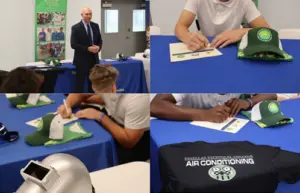

ST. PETERSBURG, Fla. — In an inspiring display of community collaboration and educational outreach, the Florida Department of Juvenile Justice (DJJ), in partnership with Pinellas Technical College (PTC) and key regional stakeholders, recently hosted a momentous Signing Day event. The gathering celebrated students from the Britt Technical Youth Academy who have committed to pursuing higher education and advanced vocational training through the newly expanded Florida Youth College initiative—formerly known as Project Anchor.
This landmark event highlights a transformative shift in the juvenile justice landscape, pivoting away from traditional punitive measures and toward rehabilitation, skill acquisition, and economic empowerment. By bridging the gap between residential commitment programs and technical higher education, the initiative provides vulnerable youth with the tools, credentials, and confidence needed to secure meaningful employment, break the cycle of recidivism, and become productive, contributing members of society.
Executive Overview: A Paradigm Shift in Juvenile Rehabilitation
The concept of a "Signing Day" has historically been reserved for elite high school athletes committing to collegiate sports programs. However, over the past decade, forward-thinking educational institutions and public agencies have adopted the tradition to celebrate academic and vocational commitments. When applied to the juvenile justice system, a signing day carries profound symbolic and practical weight. It marks a public declaration of change, a recommitment to personal growth, and a tangible step toward a self-sustaining future.
At the heart of this initiative is the Florida Youth College, a workforce education and credentialing program spearheaded by the DJJ. Through this program, residents at the Britt Technical Youth Academy—a specialized, career- and technical-education-focused residential commitment facility—gain direct access to accredited courses and high-value industry certifications through Pinellas Technical College.
By targeting youth who have completed their secondary education, the program bridges the critical transition gap between confinement and re-entry into the community. Rather than releasing young adults back into society with limited prospects and high vulnerability to systemic pitfalls, the DJJ-PTC partnership ensures they leave with recognized professional credentials, a competitive edge in the job market, and a renewed sense of purpose.
Detailed Chronology: The Evolution of Project Anchor into the Florida Youth College
To fully understand the significance of the St. Petersburg Signing Day event, it is essential to examine the strategic evolution of the program that made it possible.
The Genesis: Project Anchor (August 2022)
In August 2022, the Florida Department of Juvenile Justice launched Project Anchor, an ambitious statewide initiative designed to revolutionize workforce education and career readiness for youth in residential commitment programs. Developed initially as a foundational partnership with Tallahassee State College, Project Anchor sought to dismantle the barriers that historically prevented justice-involved youth from accessing higher education.
Recognizing that gainful employment is one of the single most effective deterrents against recidivism, the DJJ engineered Project Anchor to deliver certified vocational training directly inside or adjacent to residential facilities. The curriculum was meticulously designed to align with high-demand regional industries, ensuring that upon program completion, students would possess skills immediately marketable to local employers.
Expansion and Rebranding: The Birth of the Florida Youth College
Building upon the early successes and scalability of Project Anchor, the department initiated a statewide expansion, rebranding the effort as the Florida Youth College. This name change reflected a broader vision: to elevate the academic and vocational standing of participating students, framing their educational journey not merely as job training, but as a legitimate collegiate experience.
To date, the Florida Youth College has admitted nearly 500 youth across its participating sites. The integration of Pinellas Technical College into this network marks a major milestone, bringing world-class technical education infrastructure, experienced instructional staff, and robust local employer networks to the students at the Britt Technical Youth Academy.
Supporting Context & Metrics: Addressing Recidivism Through Workforce Development
The urgency and importance of initiatives like the Florida Youth College are underscored by decades of criminological and sociological research. Traditional juvenile detention models that focus exclusively on confinement without robust rehabilitative programming often fail to address the root causes of delinquent behavior: poverty, lack of educational attainment, limited economic mobility, and social isolation.
The Economic Imperative of Vocational Credentials
In today’s hyper-competitive labor market, a high school diploma alone is frequently insufficient to secure a living-wage job, let alone a sustainable career path. For justice-involved youth, the employment barrier is even steeper due to social stigmas and gaps in work history.
By acquiring high-value industry-recognized credentials—ranging from construction trades and information technology to culinary arts and automotive technology—students bypass traditional entry-level hurdles. They enter the workforce as skilled technicians, instantly transforming their economic outlook.
Statistical Impacts on Recidivism
Empirical studies consistently demonstrate that education is a primary driver in reducing recidivism rates among juvenile offenders. According to national evaluations by organizations such as the Council of State Governments Justice Center, youth who participate in post-secondary education and vocational training programs while committed are significantly less likely to reoffend compared to their peers who receive no such training.
By embedding colleges like PTC directly into the juvenile justice framework, Florida is leading a national movement toward data-driven, outcome-oriented rehabilitation that prioritizes human capital development.
Official Statements: Perspectives from State Leaders and Educators
The success of the Florida Youth College and the recent Signing Day event is the direct result of tireless coordination between state leadership, educational administrators, and legislative champions.
DJJ Leadership
DJJ Secretary Eric Hall emphasized the transformative philosophy guiding the department’s modern operations:
"DJJ is proud to partner with Pinellas Technical College in providing transformative opportunities for Britt Technical Youth Academy students to pursue a college education. This partnership underscores DJJ’s commitment to accelerating academic achievement for the students we serve and helping them create lasting and meaningful change in their lives."
Secretary Hall’s remarks reflect a broader institutional understanding that rehabilitation must be active, empowering, and forward-looking. By opening the doors to higher education, the DJJ is actively dismantling the "school-to-prison pipeline" and replacing it with an "achievement pipeline."
Legislative Support
The initiative has also garnered high-level praise from Florida lawmakers who recognize the long-term fiscal and social benefits of investing in at-risk youth. State Representative Berny Jacques noted the foundational importance of the collaboration:
"The educational opportunities at Pinellas Technical College that will be made available to these youth who have completed their secondary education will cultivate a foundation for their successful futures. I applaud the partnership between the Department of Juvenile Justice and Pinellas Technical College to find innovative ways to best serve the youth in the department’s care."
Institutional Dedication
On the ground level, educational institutions play a vital role in translating policy into practical, life-changing realities. Sylester “Boe” Norwood, Pinellas Technical College St. Petersburg Campus Director, highlighted the mutual benefits of the partnership for both the students and the broader community:
"The partnership between Pinellas Technical College and DJJ will result in success not only for the students but for our community. Our partnership will help students gain a competitive edge and give them a second chance at a better life and to make their families proud."
Director Norwood’s comments emphasize that workforce education is a community-building enterprise. By filling critical labor shortages with well-trained, highly motivated graduates, PTC and the DJJ are simultaneously strengthening the local economy and uplifting families.
Voices from the Frontlines: Students and Families Share Their Stories
While executive endorsements and statistical metrics provide the macro-level justification for the Florida Youth College, the true measure of the program’s success lies in the personal testimonies of the students and families whose lives have been directly touched by it.
A Student’s Perspective
For a participating student at the Britt Technical Youth Academy, the Signing Day event represented a vital turning point—a moment to look past past mistakes and focus on a horizon of possibility:
"This program will benefit me in the future by helping me to provide for myself and my family. It will help me make better decisions and become a positive role model."
This sentiment captures the core psychological shift fostered by the program: the transition from feeling trapped by circumstance to recognizing personal agency and responsibility.
A Parent’s Perspective
The relief and cautious optimism felt by families cannot be overstated. For parents who have watched their children struggle with the legal system, programs like this offer a renewed sense of hope. The parent of a Britt Technical Youth Academy student shared their heartfelt reaction:
"My son was doing stuff he shouldn’t have been doing, but he’s witty and wise. When he came to the program, I could see that he was learning and changing. I know he’s in good hands. I’m thankful he’s getting another chance, and I hope he continues doing the same when he comes back home."
These personal accounts validate the multi-generational impact of educational intervention. When a young person is equipped to succeed economically, entire family structures are stabilized, breaking entrenched cycles of generational disadvantage.
Future Outlook: Scaling Success and Expanding Horizons
As the Florida Youth College program approaches its next phase of development, the momentum generated by the Pinellas Technical College Signing Day event serves as a blueprint for future expansion.
Scaling Statewide Infrastructure
With nearly 500 youth admitted since the inception of Project Anchor, the DJJ is actively looking to deepen its existing institutional partnerships and forge new alliances with state colleges and technical centers across Florida’s 67 counties. The goal is to ensure that no matter where a youth is placed within the residential commitment network, equitable access to high-value workforce education is guaranteed.
Strengthening Employer Partnerships
An essential component of the program’s future outlook is the continuous cultivation of direct pipelines to local employers. By working hand-in-hand with regional chambers of commerce, trade associations, and corporate partners, the DJJ and PTC aim to establish guaranteed interview programs, apprenticeships, and mentorship networks for Florida Youth College graduates. Ensuring that a credential directly translates to a job offer is the ultimate benchmark of programmatic success.
Conclusion
The collaboration between the Florida Department of Juvenile Justice and Pinellas Technical College stands as a shining example of what can be achieved when public agencies and educational institutions refuse to write off troubled youth. By providing structured pathways to higher education and meaningful employment, the Florida Youth College is not only changing individual lives—it is building a safer, stronger, and more prosperous Florida for generations to come.

0 Comments