

Executive Overview: The Price of Public Safety in High Springs
The historic city of High Springs, Florida, finds itself at a critical and highly contentious crossroads. Facing an unprecedented fiscal crisis characterized by a looming debt of approximately $5 million, city administrators and commissioners are weighing an extreme measure: the complete dissolution of the High Springs Police Department (HSPD) and the High Springs Fire Department. Under this proposal, the city’s localized public safety operations would be dismantled, with municipal law enforcement duties transferred to the Alachua County Sheriff’s Office (ACSO) and fire rescue operations absorbed by Alachua County Fire Rescue.
This potential shift has sent shockwaves through the quiet, close-knit community of roughly 6,200 residents. The High Springs Police Department is not merely a municipal utility; it is a historic institution that has protected and served the community for 136 years. For many residents, the department represents the bedrock of local autonomy, civic identity, and personal security.
As the High Springs City Commission prepares for a decisive meeting on Monday night, the debate has transcended simple budgetary arithmetic. It has evolved into a profound philosophical conflict between fiscal survival and the preservation of localized public safety. To many who call High Springs home, the prospect of losing their dedicated police officers and firefighters feels less like a strategic administrative reorganization and more like an existential threat to their way of life.
Detailed Chronology: The Genesis of a Fiscal Crisis
The current emergency did not develop overnight, but rather represents the culmination of mounting structural deficits, escalating operational costs, and long-term debt accumulation.
[Years of Structural Deficits & Capital Debt]
                    │
                    ▼
[Discovery of ~$5 Million Municipal Debt Liabilities]
                    │
                    ▼
[Administrative Review: Emergency Services Identified as Major Cost Drivers]
                    │
                    ▼
[Proposal to Outsource Police & Fire to Alachua County]
                    │
                    ▼
[Thursday Night Community Town Hall: Intense Public Backlash]
                    │
                    ▼
[Monday Night Commission Meeting: Decisive Vote on Departmental Survival]
The Accumulation of Debt
Over the past decade, High Springs—like many small, rapidly growing municipalities in Florida—has struggled to balance the demand for modernized infrastructure with a limited tax base. Capital improvement projects, rising pension obligations, and the inflating costs of keeping emergency services equipped with up-to-date technology have steadily chipped away at the city’s financial reserves. Recent audits and administrative reviews revealed that the city’s outstanding debt liabilities had climbed to an unsustainable $5 million.
The Outsource Proposal Emerges
Faced with the prospect of municipal insolvency, city leaders began auditing all municipal operations to identify potential cost-saving measures. Because public safety consistently constitutes the largest portion of the city’s general fund expenditures, the police and fire departments naturally became the primary targets for consolidation.
In early 2026, the City Commission initiated preliminary discussions with Alachua County officials to explore the feasibility of a contract-for-service model. Under such an agreement, the Alachua County Sheriff’s Office would absorb the municipal patrol zones, and Alachua County Fire Rescue would assume responsibility for local fire suppression and emergency medical services.
The Thursday Night Flashpoint
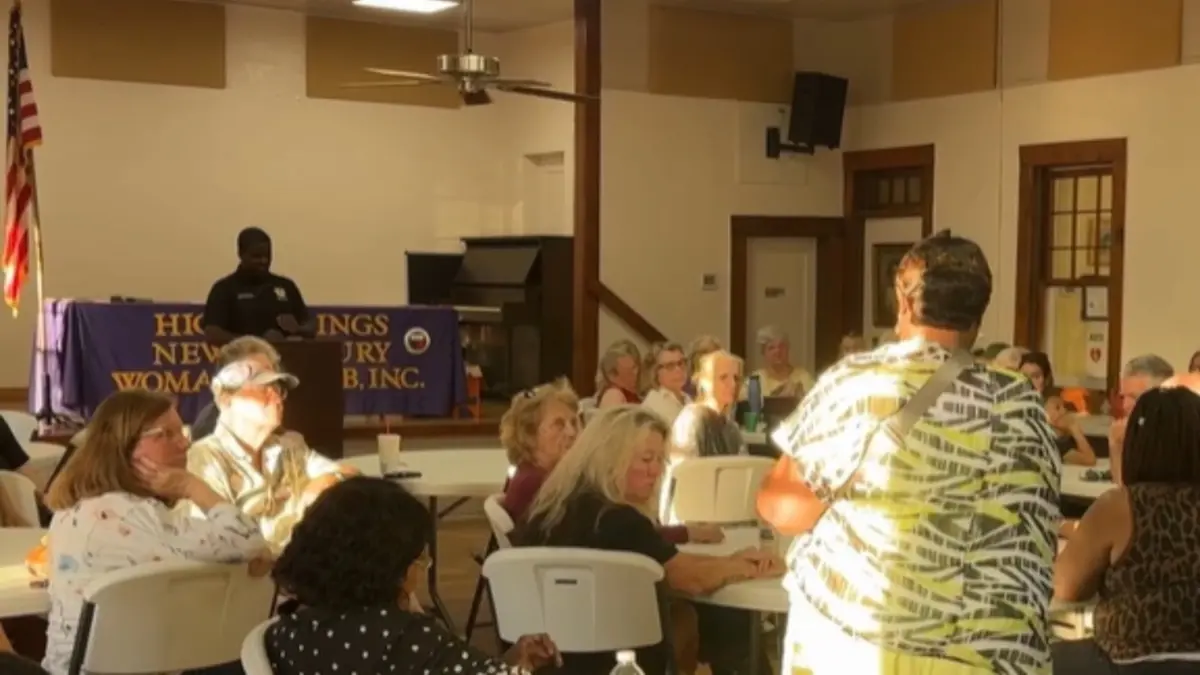
The severity of the crisis became public during an emotional community meeting on Thursday night. Hundreds of local residents packed the venue, seeking answers from city administrators and expressing solidarity with local officers and firefighters. The atmosphere was charged with anxiety and anger as residents confronted commissioners over how the city’s finances had deteriorated to this point.
During the meeting, local police officers took the podium to outline what they characterized as irreplaceable losses for the community if the department were disbanded. They highlighted localized outreach programs, school safety presence, and rapid response times that a county-wide agency, managing a much larger geographic jurisdiction, might struggle to replicate.
The Countdown to Monday’s Vote
Following the emotional testimony of Thursday night, the battleground now shifts to the upcoming City Commission meeting scheduled for Monday night. This meeting is poised to be one of the most consequential in the city’s modern history, as commissioners will formally deliberate on whether they can realistically fund the HSPD and fire services for the upcoming fiscal cycle, or if they must initiate the transition to county-level services.
Supporting Context & Metrics: Analyzing the $5 Million Deficit and the Mechanics of Contract Policing
To understand the gravity of the decision facing High Springs, it is essential to examine both the financial metrics of the city’s deficit and the operational realities of transitioning from a municipal police force to a county contract model.
The Financial Landscape of High Springs
For a municipality with an estimated population of just over 6,000, a $5 million debt burden is a staggering structural obstacle.
- Tax Base Limitations: High Springs relies heavily on property taxes and municipal utility fees. Unlike larger metropolitan areas, it lacks a dense commercial tax base or significant industrial revenue streams to absorb sudden financial shocks.
- The Cost of Autonomy: Operating an independent, 24/7 police department requires significant capital expenditure. This includes not only salaries and benefits for sworn officers and support staff, but also the maintenance of a specialized fleet, dispatch infrastructure, evidence storage facilities, and compliance with stringent state licensing and training mandates.
| Metric | High Springs Police Dept. (Current) | Alachua County Sheriff’s Office (Proposed Transition) |
|---|---|---|
| Years of Service | 136 Years | Established 1824 (County-wide) |
| Primary Jurisdiction | Incorporated High Springs City Limits | Unincorporated Alachua County & Contracted Municipalities |
| Response Model | Dedicated local patrol with hyper-localized geographic focus | Zone-based county patrol with broader regional dispatch priorities |
| Community Programs | Local school presence, civic events, direct merchant engagement | Standard county-wide outreach, dependent on contract specifications |
The Operational Trade-Offs of Contract Policing
Contracting municipal law enforcement to a county sheriff’s office is a well-established practice across the United States, often praised for its "economies of scale." Proponents argue that county agencies can provide specialized services—such as homicide investigations, K-9 units, SWAT response, and advanced forensics—more cost-effectively than a small municipal agency.
However, opponents point out several distinct disadvantages that directly impact the quality of life in small towns:
- Response Times: While emergency priority calls (Priority 1) are generally dispatched rapidly regardless of the agency, non-emergency calls or minor property crimes may experience delayed response times under a county model, as deputies are frequently diverted to higher-priority incidents elsewhere in the county.
- Loss of Local Control: Under a municipal police department, the Chief of Police reports directly to the City Manager and City Commission, giving local residents a direct voice in law enforcement priorities. Under a county contract, the Sheriff is an independently elected constitutional officer, meaning the city yields direct administrative control over policing policies and personnel assignments.
- Community-Centric Presence: Small-town police officers often possess deep, generational knowledge of local families, business owners, and recurring community issues. This hyper-local relationship is difficult to maintain when patrol zones are staffed by rotating county deputies who may not have the same personal investment in the town’s daily life.
Official Statements: Voices from a Community in Turmoil
The human cost of the proposed cuts was laid bare during Thursday’s town hall, where residents and law enforcement officials voiced their fears, frustrations, and hopes.
Resident Testimonials
For many residents, the presence of a local police department is a primary factor in their sense of personal safety and community pride.
Jessica Hall, a High Springs resident who attended the meeting, expressed a sentiment shared by many in the crowd:
"We cannot afford to live in the city without protection. I wouldn’t want to live here. The thought of not having our own officers, who know our streets and our families, is terrifying."
Another resident, Holly Cason, spoke directly to the psychological toll the proposal is taking on families, particularly regarding the safety of the town’s youth:
"Scared. I mean, it’s scary to think that that could happen here in our town of High Springs, that we had a police department for over 100 years. The thought of losing it is just unbelievable. It’s scary, and I’m scared for the kids. Our officers are part of the fabric of this community; they are in our schools, at our parades, and on our street corners."
Perspectives from the Front Lines
Officers of the High Springs Police Department also spoke out, attempting to remain professional while facing the potential loss of their livelihoods and the dissolution of their historic department. Officers detailed the intangible services they provide daily—services that rarely show up in municipal budget spreadsheets.
They emphasized their active role in local schools, their immediate presence at community events, and their ability to respond to local calls within minutes. They urged residents to stay engaged and encouraged their fellow officers to maintain their professionalism and "keep their heads up" despite the cloud of professional uncertainty hanging over them.
Future Outlook: The Looming Monday Vote and Its Broader Implications
As High Springs counts down to the critical City Commission meeting on Monday night, both city leaders and residents are preparing for a confrontation that will shape the town’s trajectory for decades to come.
Potential Scenarios Following the Commission’s Decision
                      [Monday Night Commission Vote]
                                    │
           ┌────────────────────────┴────────────────────────┐
           ▼                                                 ▼
[Option A: Disband & Outsource]                   [Option B: Retain Local Services]
  • Begin transition to ACSO/ACFR                   • Implement emergency tax hikes
  • Inventory & transfer physical assets            • Deep cuts to non-essential services
• Negotiate severance & deputy lateral hires • Restructure the $5M debt liability- Scenario A: The Commission Votes to Disband. If the commission determines that the $5 million debt leaves them with no viable alternative, they will vote to initiate contract negotiations with Alachua County. This will trigger a complex transition phase. The city will need to draft interlocal agreements detailing the exact level of coverage ACSO will provide, negotiate the transfer or sale of municipal police assets (vehicles, equipment, and station facilities), and address the employment status of current HSPD officers, some of whom may be offered lateral transitions into the Sheriff’s Office.
- Scenario B: The Commission Votes to Retain Local Services. If commissioners bow to intense public pressure and vote to keep the departments active, they will immediately face the daunting task of balancing the budget through alternative, likely painful, means. This path would necessitate severe cuts to other municipal departments (such as parks and recreation, public works, and administrative services), the implementation of aggressive debt-restructuring plans, or a substantial increase in municipal property taxes and utility fees—a move that could spark a different kind of public backlash.
The Broader Trend of Municipal Consolidation
The crisis in High Springs is not an isolated incident, but rather a reflection of a growing national trend. Small municipalities across Florida and the wider United States are increasingly finding themselves squeezed between stagnant revenue streams and the skyrocketing costs of maintaining independent emergency services.
As technology, training standards, and equipment costs continue to rise, more small towns may be forced to make the same painful calculation: sacrificing municipal autonomy and local history at the altar of fiscal survival.
For the people of High Springs, however, the immediate concern is not national trends, but the safety of their own streets. Residents have mobilized, organizing campaigns on social media and coordinating attendance for Monday’s meeting. They plan to utilize the public comment period to make a final, passionate plea to save their police and fire departments, determined to preserve a 136-year legacy of local protection.

0 Comments