

Executive Overview
In the ongoing discourse surrounding housing affordability, municipal policies are rarely examined through the lens of micro-regulatory burdens. While national headlines frequently focus on zoning laws, material shortages, and labor deficits, subtle local code requirements often impose hidden costs that systematically price everyday buyers out of the market.
Nowhere is this dynamic more vividly illustrated than in a pending development appeal currently before the Jacksonville City Council. At the center of the dispute is a local home builder seeking to construct single-family residences across 19 vacant properties situated on the city’s Northside. Under normal circumstances, filling in infill lots within an established neighborhood would be celebrated as a win for urban revitalization, property tax expansion, and housing supply.
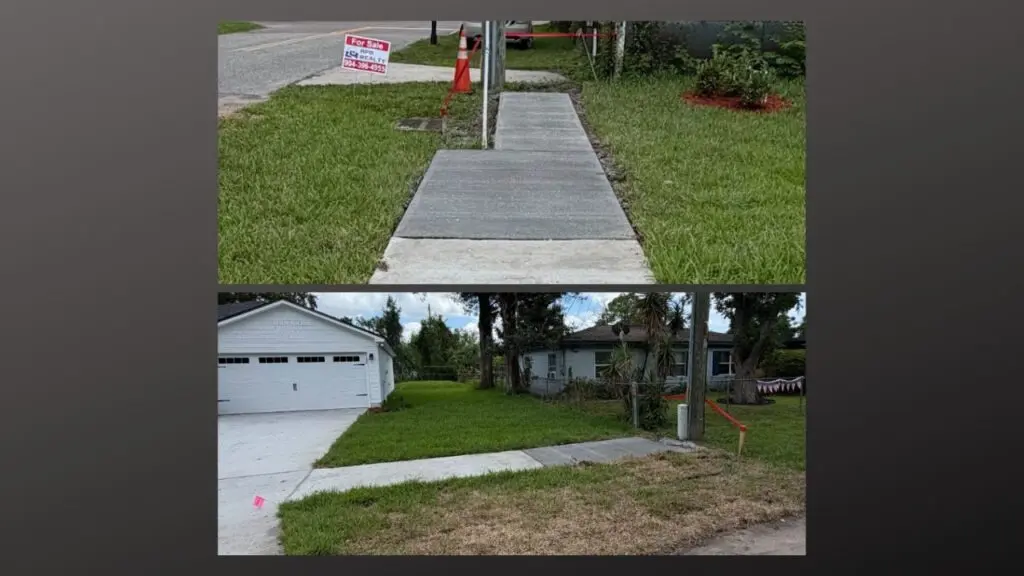
However, the project has hit a bureaucratic roadblock. The City of Jacksonville is conditioning its approval on a mandate that the builder construct isolated segments of concrete sidewalks along the properties’ frontages. On paper, sidewalks are universally understood as civic enhancements. They protect pedestrians, promote public health, encourage physical activity, and connect neighborhoods to vital commercial, educational, and recreational hubs.
Yet, as this case demonstrates, applying a broad-brush mandate to fragmented infill development creates an absurdity: sidewalks to nowhere.
The properties in question are located in a 1950s-era subdivision characterized by a patchwork of scattered homes, overgrown vacant lots, roadside drainage ditches, and unpaved or poorly maintained municipal streets that the city itself refuses to service. There are no existing sidewalks in the immediate area. There are no master-planned pedestrian networks for these segments to plug into. Even more problematic, the physical geography of the right-of-way—cluttered with open drainage swales and utility poles, entirely lacking standard curb-and-gutter infrastructure—makes the installation of functional pedestrian pathways structurally nonsensical.
When municipal agencies enforce rigid infrastructure requirements devoid of contextual reality, the only guaranteed outcome is inflation. Forcing builders to install disconnected slabs of concrete levies an unnecessary financial penalty on home construction. These costs do not vanish into thin air; they are directly absorbed into the final purchase price of the homes, further eroding housing affordability in a market already strained by economic pressures. This Jacksonville appeal offers a clear test case for local policymakers: will they cling to arbitrary, check-the-box regulations, or will they adopt a pragmatic approach that balances genuine public safety with economic common sense?
Detailed Chronology: The Anatomy of an Infill Infrastructure Dispute
To understand how a routine home-building initiative transforms into a high-stakes policy showdown, one must trace the timeline of the Northside development project and the longstanding regulatory frameworks governing Jacksonville’s public works.
1. The Roots of a Legacy Subdivision
The genesis of the property dispute stretches back decades. The 19-parcel assembly on the city’s Northside was originally platted in the 1950s—an era when suburban expansion followed different engineering standards, zoning ideas, and civil expectations. Unlike modern master-planned communities designed from scratch with synchronized stormwater management, unified utility grids, and comprehensive multi-modal transportation networks, these mid-century plats developed organically and unevenly.
Over the decades, development in the area occurred in fits and starts. Some lots were built out with single-family houses, while others remained vacant, transitioning into wooded patches or open lots bordered by natural terrain. Crucially, the public infrastructure serving these streets never received the comprehensive modernization seen in newer subdivisions. In fact, the municipality itself classifies the streets as unmaintained by the city, leaving residents to navigate a patchwork of localized infrastructure issues without standard municipal upkeep.

2. The Infill Initiative and the Permitting Clash
In an effort to revitalize these long-dormant properties, a local residential builder stepped forward with plans to construct modern, single-family homes across the 19 parcels. For housing advocates, urban planners, and economists, infill development is widely regarded as the gold standard for sustainable growth. It utilizes existing land, taps into pre-existing utility lines, prevents suburban sprawl, and adds much-needed inventory to a constrained housing market.
However, as the builder moved through the standard pre-application and developmental review phases, city planners and engineering bureaucrats flagged a mandatory code requirement: the inclusion of frontage sidewalks.
Discussions between the builder and municipal departments quickly stalled. The developer pointed out the physical impossibility of constructing a functional sidewalk network under the current site conditions. The city regulators, bound by strict interpretations of the municipal code, countered that standard frontage improvements are non-negotiable for new construction permits, regardless of surrounding context.
3. Escalation to the City Council
Unable to secure administrative relief or common-sense variances through the standard planning department channels, the developer exercised their right to appeal the decision. This elevates the dispute from a routine bureaucratic disagreement to a legislative showdown before the Jacksonville City Council.
Elected officials are now tasked with weighing the rigid enforcement of text-book municipal code against the physical, economic, and logistical realities on the ground. The outcome of this appeal will establish a critical precedent for how Jacksonville handles infill development across its historic and legacy neighborhoods, determining whether future builders will be forced to pave disconnected patches of concrete or whether policy will finally adapt to context.
Supporting Context & Metrics: The Physical and Economic Realities
The core argument against the city’s mandate rests on two interconnected pillars: physical feasibility and economic efficiency. When both pillars are examined closely, the municipal requirement crumbles under the weight of its own impracticality.
The Geography of Disconnection
Walkability is a system, not a standalone slab of concrete. For a sidewalk to serve its intended purpose—protecting human life and facilitating mobility—it must be part of an integrated, continuous network. A sidewalk that begins abruptly at a property line and terminates five parcels later in an overgrown ditch does not enhance safety; it creates an illusion of pedestrian infrastructure that terminates in a hazard.
A site survey of the Northside neighborhood reveals a landscape fundamentally unsuited for isolated sidewalk segments:
- Absence of Terminus Points: There are zero existing sidewalks in the immediate vicinity. A pedestrian walking along the proposed new segments would be forced directly into unpaved shoulders or open roadways the moment they stepped off the builder’s property.
- Drainage and Utility Conflicts: Sidewalks require a stable, properly graded sub-base and coordination with storm drainage systems. At the subject properties, open drainage ditches and utility poles occupy the exact spatial footprints where sidewalks would ordinarily be engineered. Moving these utilities or filling in essential drainage swales would require massive, multi-thousand-dollar civil engineering overhauls.
- The Missing Curb-and-Gutter Problem: Modern sidewalks work in tandem with conventional curb-and-gutter systems. These features manage street runoff, define the edge of the vehicular right-of-way, and provide a vertical buffer between moving traffic and pedestrians. The streets fronting these 19 parcels entirely lack curb-and-gutter improvements, meaning any poured sidewalk would sit flush with or awkwardly adjacent to unimproved, drainage-heavy terrain.
The Economics of Mandated Waste
From a purely economic perspective, forcing a builder to install infrastructure that provides zero utility is an irrational allocation of capital. Building residential sidewalks involves significant direct and indirect costs:

- Materials and Labor: Pouring concrete requires site grading, framing, pouring, curing, ADA-compliant ramp construction, and debris removal.
- Engineering and Permitting: Designing around existing utility poles and drainage ditches requires specialized civil engineering surveys and customized permitting waivers.
- Liability and Maintenance: Once built, property owners or local jurisdictions assume liability and long-term maintenance burdens for infrastructure that serves no functional community purpose.
When these expenses are aggregated across a 19-parcel development, the financial impact is substantial. For a local builder operating on tight profit margins, these forced expenditures must be offset to maintain business solvency. Consequently, the cost of building disconnected sidewalks is directly capitalized into the sale price of the newly constructed homes.
In an economic climate where every thousand-dollar increment prices hundreds of potential working-class families out of homeownership, imposing thousands of dollars in regulatory overhead for useless concrete is more than just bad policy—it is a direct contributor to the housing affordability crisis.
Official Statements and Institutional Perspectives
The clash over Jacksonville’s sidewalk mandate brings into sharp relief the philosophical divide between rigid municipal bureaucracy and practical market realities.
The Developer and Industry Perspective
Representing the development community, industry advocates argue that municipal agencies have lost touch with common-sense governance. Speaking on the disconnect between code enforcement and physical reality, local stakeholders have repeatedly challenged the rationale of city planners.
"Sidewalks improve safety when they connect people to schools, parks, businesses, and other places they need to go," note industry observers close to the appeal. "But requiring isolated stretches of concrete that connect to nothing makes housing more expensive without delivering the connected pedestrian system used to justify the expense."
The frustration among builders centers on the arbitrary nature of the enforcement. When questioned about the engineering logic or public safety benefit of sidewalks that open into drainage ditches, the response from municipal enforcers often boils down to a circular administrative argument: Because the code says so.
"Instead, bureaucrats decree installing sidewalks that go nowhere in areas that make no sense. Why? Because they said so. What is their reasoning? There isn’t one. What about the added cost for homes? Not our problem." This sentiment captures the deep-seated exasperation shared by developers who find themselves caught between rigid bureaucratic fiat and economic stewardship.
The Municipal Bureaucracy View
From the perspective of city planners and public works officials, code enforcement is viewed through a lens of long-term vision and standardization. Municipal engineering departments typically operate under master plans that anticipate eventual, multi-decade transformation of urban spaces. The rationale often put forward by city regulators is that piecemeal infill development represents an opportunity to lay down the foundational pieces of future infrastructure.
Under this long-termist theory, if every builder installs sidewalk segments along their respective frontages over a period of 20 to 30 years, the gaps will eventually close, resulting in a fully connected pedestrian network.

However, critics of the city’s stance point out the fatal flaw in this bureaucratic idealism: it ignores the immediate financial harm inflicted on today’s home buyers to pay for a speculative, decades-away infrastructure dream—especially in areas lacking basic foundational elements like curbs, gutters, and proper drainage. By shifting the burden of long-term municipal master-planning onto individual infill lot buyers, the city effectively uses private residential capital as a substitute for public capital improvement projects.
Future Outlook: Implications for Jacksonville and Beyond
The pending Jacksonville City Council appeal is far more than a localized zoning dispute over 19 Northside lots; it is a bellwether for urban development policy across Florida and the broader United States.
1. The Precedent for Infill Development
If the Jacksonville City Council upholds the planning department’s mandate, it will send a chilling signal to infill developers throughout the region. Builders will think twice before attempting to revitalize legacy neighborhoods, vacant lots, and unserviced legacy plats if they know they will be hit with arbitrary infrastructure demands that inflate construction costs. The ultimate loser in that scenario will be the Jacksonville housing market, which desperately needs diverse, attainable infill housing to accommodate its rapid population growth.
Conversely, if the City Council votes in favor of common-sense relief—granting a waiver or variance for the sidewalk requirement due to the proven physical and economic impracticalities—it could open the door to a more rational, flexible approach to urban planning. Such a decision would signal that Jacksonville is willing to prioritize housing affordability and practical engineering reality over rigid, rote bureaucracy.
2. Policy Reform Opportunities
To prevent similar standoffs in the future, municipal leaders should consider structural reforms to local development codes:
- Contextual Variance Pathways: Establish streamlined administrative waiver processes for infill projects where existing physical constraints (such as open ditches, lack of curbs, and absent surrounding networks) make pedestrian infrastructure structurally unviable.
- In-Lieu Fee Alternatives: In situations where sidewalks are genuinely desired for future master plans but impossible to build immediately, allow developers to contribute a proportional, fair-share fee into a dedicated municipal fund used to build cohesive pedestrian networks where they are actually needed, rather than forcing disconnected slabs of concrete onto isolated lots.
- Holistic Infrastructure Assessments: Require municipal public works departments to evaluate the cumulative connectivity of a neighborhood before imposing frontage requirements, ensuring that private capital is only demanded when public utility is genuinely delivered.
Conclusion
Sidewalks are undeniably vital arteries of safe, vibrant communities. But pouring concrete for the sake of administrative compliance—while driving up the cost of housing for families striving for the American Dream—is an exercise in regulatory theater. As the Jacksonville City Council weighs this critical Northside appeal, the choice before them is stark: enforce a disconnected rulebook that penalizes affordability, or champion a pragmatic path forward that respects both economic reality and common sense.

0 Comments