WASHINGTON — In a decisive legislative maneuver aimed at solidifying the Sunshine State’s status as the undisputed epicenter of aerospace innovation, U.S. Senator Ashley Moody (R-Fla.) has officially introduced the STARS Act. This high-stakes legislative initiative is specifically designed to designate Florida as the permanent home for the newly conceptualized U.S. Space Academy.
The establishment of the academy stems from a landmark executive order signed by President Donald Trump in late August, a directive intended to fundamentally transform how the United States prepares its military and civilian aerospace workforce. The planned institution carries a dual mandate: to educate and rigorously train cadets destined for service in the United States Space Force, and to cultivate a robust, highly specialized talent pipeline for the National Aeronautics and Space Administration (NASA) and the burgeoning commercial space sector.
Senator Moody’s legislative push represents the vanguard of a unified, multi-pronged campaign by Florida’s political, economic, and industrial leadership. By tethering the proposed academy to the state’s existing infrastructure, proponents argue that Florida offers an unmatched ecosystem for aerospace education. As the federal government evaluates prospective sites through an ongoing Request for Information (RFI) process, the Sunshine State is locked in a competitive race against other aerospace-heavy regions across the nation.
This comprehensive report examines the geopolitical and industrial implications of the STARS Act, traces the chronology of Florida’s aggressive campaign, analyzes the economic metrics underpinning the state’s bid, and evaluates the broader strategic trajectory of American space dominance in the 21st century.
Detailed Chronology: From Executive Order to Legislative Action
The roadmap toward the establishment of the U.S. Space Academy has accelerated rapidly over the past several months, driven by shifting national security priorities and the exponential growth of commercial space operations.
Late August: The Presidential Directive
The foundational momentum for the academy materialized when President Trump signed an executive order formally establishing the framework for the U.S. Space Academy. Recognizing that the rapid militarization and commercialization of orbit require an entirely new paradigm of human capital development, the administration called for a dedicated institution to train the next generation of space operators, engineers, and strategists.
Early September: Ground Zero on the Space Coast
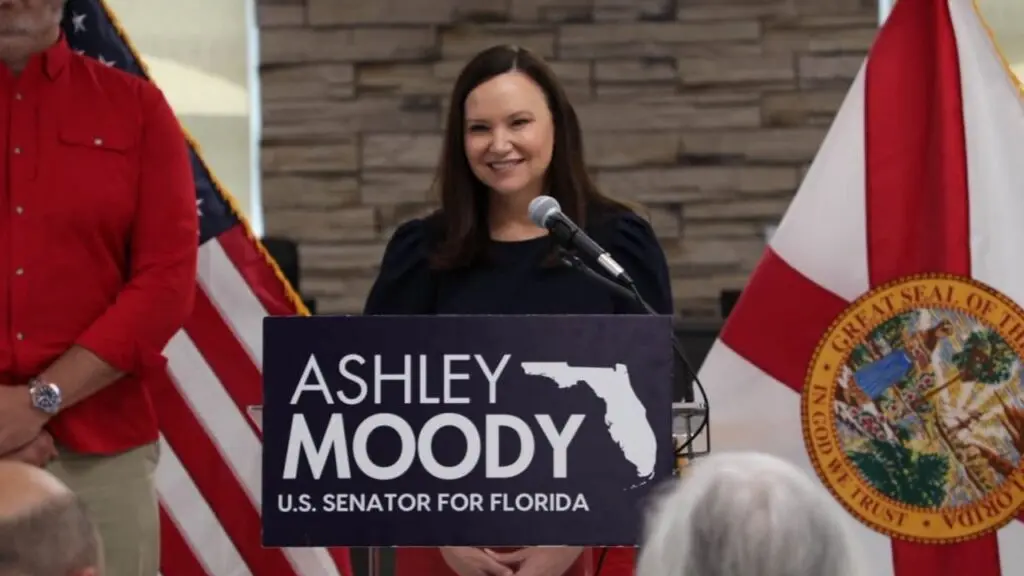
Sensing an immediate opportunity to anchor this strategic national asset within her home state, Senator Moody wasted no time. On September 8, she appeared alongside Space Florida CEO Rob Long and a coalition of prominent aerospace industry leaders on Florida’s Space Coast. The high-profile gathering served as a dual-purpose platform: to promote Florida’s logistical superiority as a host site and to signal to the federal government that the state’s political machinery was fully mobilized behind the bid.
Mid-September: Legislative Translation
Following her return to Washington, D.C., Senator Moody fulfilled her earlier commitments by formally filing the STARS Act. This legislative action directly intersects with federal administrative channels, specifically responding to the formal Request for Information (RFI) issued by federal agencies tasked with determining the academy’s eventual physical footprint.
While the executive order leaves the final determination open—instructing federal officials to compile exhaustive recommendations regarding site selection and organizational structure—Moody’s bill seeks to preemptively steer congressional intent toward the Atlantic seaboard of Florida.
To understand the gravity of the STARS Act, one must examine the staggering concentration of aerospace assets already operating within Florida’s borders. The state’s pitch is not merely political; it is rooted in practical economics, operational proximity, and physical infrastructure that cannot be easily replicated elsewhere.
The Aerospace Ecosystem of Florida’s Space Coast
At the heart of Florida’s bid are two legendary installations that have anchored American space exploration for decades:
Kennedy Space Center (KSC): NASA’s premier multi-user spaceport, which has evolved from a government-exclusive launch site into a bustling commercial space hub hosting multiple private operators.
Cape Canaveral Space Force Station (CCSFS): The primary launch range for United States military and intelligence payloads, overseen by the Space Launch Delta 45.
These federal installations are complemented by a dense cluster of commercial infrastructure. Major aerospace players—including SpaceX, Blue Origin, Boeing, and United Launch Alliance (ULA)—maintain extensive manufacturing, testing, and launch facilities along the Space Coast.
Academic Integration and Research Pipelines
A successful academy requires more than launch pads; it demands rigorous academic backing. Florida boasts a formidable network of higher education institutions deeply integrated into aerospace research and development. Universities such as the University of Central Florida (UCF), Embry-Riddle Aeronautical University, the Florida Institute of Technology (FIT), and the University of Florida produce a massive share of the nation’s aerospace engineering graduates.
Locating the U.S. Space Academy in Florida would allow cadets and students to engage in hands-on, real-world internships, cooperative research agreements, and direct transitions into both military and private-sector roles without relocating across the country.
Moody’s Broader Legislative Portfolio
The STARS Act is not an isolated policy proposal; it represents the crown jewel in a systematic legislative campaign led by Senator Moody to structurally link Florida to the future of American space policy. Her broader portfolio includes:
Tax-Exempt Bonds for Spaceport Facilities: Legislation designed to unlock private and municipal capital for the modernization and expansion of spaceport infrastructure.
The Space Ready 2.0 Act: A forward-looking proposal aimed at empowering NASA to accept voluntary private-sector financial and material contributions to accelerate critical infrastructure projects.
The CAPE Canaveral Act: An ambitious legislative push seeking to physically relocate the national headquarters of NASA from Washington, D.C., directly to Florida’s Space Coast, placing federal administrators on the front lines of launch operations.
Official Statements and Industry Perspectives
The introduction of the STARS Act has drawn sharp focus from federal lawmakers, state officials, and aerospace executives alike, all of whom recognize the immense prestige and economic windfall associated with hosting a national military-academic institution.
Upon formally filing the legislation, Senator Moody emphasized the historical and strategic significance of the Sunshine State:
"I’ve just officially filed the STARS Act to bring the U.S. Space Academy to Florida. Florida is America’s gateway to the final frontier—that’s why it’s so important that the next generation of space leaders are trained in the Sunshine State."
Moody’s sentiments were echoed by Space Florida CEO Rob Long during their joint appearance on the Space Coast. Long emphasized that the integration of civil, military, and commercial entities within Florida creates an environment where students can experience the entire lifecycle of a space mission—from theoretical design to orbital insertion.
"We are not just talking about classrooms and simulators," industry representatives noted during the rollout. "We are talking about an operational theater where cadets can walk out of a lecture hall and witness a heavy-lift rocket launch across the lagoon. That is an educational experience that no other state can offer."
Furthermore, members of Florida’s bipartisan congressional delegation have steadily ramped up pressure on the executive branch, lobbying NASA Administrator Jared Isaacman and defense officials to prioritize operational efficiency and logistical synergy over political patronage when selecting the final site.
Future Outlook: The Battle for the Academy
As the federal government sifts through responses to the Request for Information, the race for the U.S. Space Academy enters a critical phase. While Florida enjoys distinct structural advantages, other states with strong aerospace presences—such as Alabama, Texas, and Colorado—are mounting their own aggressive lobbying campaigns to secure the institution.
Challenges and Next Steps
The primary hurdle facing the STARS Act is navigating the traditional legislative calendar in Washington while parallel executive branch evaluations move forward. The executive order mandates a thorough review of organizational structures and site criteria, meaning that final decisions will likely hinge on cost-benefit analyses, land availability, and long-term strategic readiness assessments conducted by the Department of Defense and NASA.
If successful, the passage of the STARS Act and the subsequent selection of Florida as the academy’s home will fundamentally cement the state’s economic and geopolitical dominance for generations to come. It will inject millions of dollars in federal investments into local economies, create thousands of high-paying jobs, and ensure that the architects of humanity’s future in the cosmos receive their foundational training where American spaceflight first took flight.
As the Department of Defense and federal administrators weigh their options, Senator Moody and her congressional allies remain steadfast in their mission. For Florida, the message to Washington is clear: the gateway to the final frontier is already built—it simply awaits its academy.



0 Comments