

Executive Overview
Despite enduring relentless passenger volumes that continue to hover near historic highs, North American airports have managed a remarkable turnaround in traveler sentiment. According to the newly released 2026 J.D. Power North America Airport Satisfaction Study, overall traveler satisfaction has experienced a notable upward trajectory across virtually all airport categories. Leading this charge is Tampa International Airport (TIA), which clinched the highest ranking in passenger satisfaction among large North American airports.
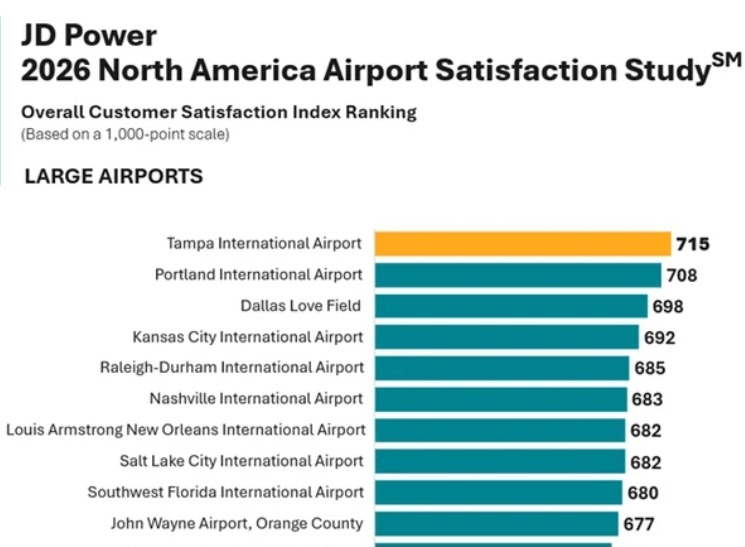
Scoring an impressive 715 out of a possible 1,000 points, Tampa International outpaced fierce competition, leaving behind prominent facilities like Portland International Airport and Dallas Love Field. This year’s study underscores a broader industry-wide evolution: years of aggressive capital improvement projects, terminal modernizations, and strategic local branding are finally paying dividends for weary travelers.
Far from being overwhelmed by the post-pandemic surge in travel demand, North American aviation hubs have leaned into modernization. The results of the 2026 study—drawn from more than 24,000 completed surveys administered between July 2025 and July 2026—reveal that strategic investments in infrastructure, intuitive signage, and localized dining options are transforming the notoriously stressful airport journey into an experience that travelers increasingly enjoy, and crucially, one that drives substantial retail spending.
Detailed Chronology and Study Methodology
To understand how airports reached this milestone in traveler satisfaction, it is essential to examine the rigorous methodology and timeline underpinning the 2026 J.D. Power study.
The Evaluation Period
The data collection phase for the 2026 study spanned a full year, running continuously from July 2025 through July 2026. During this twelve-month window, researchers captured the shifting dynamics of air travel across seasonal peaks, holiday rushes, and summer vacation migrations. The final dataset comprises 24,710 completed surveys from residents of the United States and Canada who traveled through at least one qualifying domestic or international airport during the evaluation period.
The Core Evaluation Pillars
J.D. Power evaluates overall satisfaction by examining seven distinct core dimensions of the airport experience:
- Ease of travel through the airport (security checkpoints, walking distances, and bottleneck management).
- Trust in the airport (reliability, communication during disruptions, and overall operational transparency).
- Terminal facilities (cleanliness, seating availability, restrooms, and ambient environment).
- Airport staff (helpfulness, courtesy, and availability of customer service personnel).
- Ground transportation experiences (parking availability, rideshare pickup zones, and rental car accessibility).
- Food, beverage, and retail offerings (variety, pricing fairness, and quality of concessions).
- Arrival experiences (baggage claim efficiency and exit flows).
Categorical Breakdown
To ensure an equitable comparison, J.D. Power segments airports into three distinct tiers based on annual passenger throughput:
- Mega Airports: Facilities handling at least 33 million passengers annually.
- Large Airports: Facilities serving between 10 million and 32.9 million passengers annually.
- Medium Airports: Facilities handling between 4.5 million and 9.9 million passengers annually.
Within these categories, the 2026 study recorded a tangible year-over-year surge in customer approval: satisfaction scores rose by 14 points among mega airports, 13 points among large airports, and 16 points among medium airports compared to the previous study cycle.

Supporting Context & Metrics: The 2026 Leaderboard
The competitive landscape of North American aviation is fiercely contested, with regional hubs and massive international gateways alike vying for top honors. The 2026 study highlights clear front-runners across each classification tier.
Large Airports: Tampa Takes the Crown
In the large-airport category—traditionally characterized by high passenger volumes that strain mid-sized footprints—Tampa International Airport dominated the field with a stellar score of 715 out of 1,000. TIA’s success is widely attributed to its seamless integration of high-capacity automated people movers, intuitive terminal layouts, and a deliberate cultivation of local Florida culture within its retail and dining sectors.
Trailing closely behind TIA were:
- Portland International Airport (PDX): Securing the second-place position with a score of 708, Portland continues to win praise for its iconic sustainable architecture, community-focused vendor selection, and legendary carpet-inspired design aesthetics.
- Dallas Love Field (DAL): Rounding out the top three in the large category with a score of 698, offering efficient boutique-style operations relative to its larger Texas neighbors.
Mega Airports: Consistency at the Top
Among the behemoths of the skies—the mega airports handling upwards of 33 million travelers yearly—Minneapolis-Saint Paul International Airport (MSP) captured the crown for the third consecutive year, posting a robust score of 684. MSP has long served as a benchmark for how massive facilities can maintain operational fluidity and passenger comfort.
The remainder of the mega-airport podium featured:
- Detroit Metropolitan Wayne County Airport (DTW): Securing second place with a score of 663, largely driven by its world-class McNamara Terminal architecture and efficient transit systems.
- Phoenix Sky Harbor International Airport (PHX): Landing in third place with a score of 642, heavily praised for its recent modernization efforts and integration of local desert-inspired aesthetics.
Medium Airports: Charleston Leads the Pack
In the medium-airport category—where personalized service and compact layouts often yield high marks—Charleston International Airport (CHS) led the pack with a score of 712, narrowly missing the overall top score achieved by Tampa.
The medium-tier leaders included:
- Ontario International Airport (ONT): Capturing second place with a score of 705, demonstrating Southern California’s demand for efficient, less congested alternatives to major metropolitan hubs.
- Indianapolis International Airport (IND): Claiming third place with a score of 695, a perennial favorite known for its striking architectural design and swift security processing.
The Financial Impact of Satisfaction: The "Perfect" Passenger Economy
Beyond qualitative bragging rights, the 2026 study uncovers a direct, quantifiable correlation between passenger satisfaction and terminal commerce. Airports that successfully elevate the traveler experience unlock significant economic windfalls for concessionaires and airport operators alike.
According to the data:
- Passengers who rated their overall airport experience as "perfect" spent an average of $47.60 inside the terminal.
- In stark contrast, travelers who described their experience as merely "just OK" spent an average of just $27.38—a spending drop of over 42%.
However, achieving a "perfect" score remains an elite achievement. The study revealed that only 12% of total airport journeys managed to secure a flawless satisfaction rating from surveyed travelers. This statistic highlights both the immense challenge facing airport operators and the substantial untapped revenue potential awaiting those that can bridge the gap between an ordinary trip and an exceptional journey.
Official Statements and Industry Insights
The remarkable resilience and evolution of North American airports have been heavily shaped by a decade-long capital investment cycle. Industry leaders point to systemic modernization as the primary catalyst behind the 2026 score increases.
Michael Taylor, managing director of travel, hospitality, and retail at J.D. Power, contextualized the findings by highlighting the long-term strategic commitments made by airport authorities across the continent:
"For the better part of the last decade, nearly every airport, from the largest international hubs to midsized airfields, has undertaken a significant capital improvement project aimed at streamlining passenger flow, adding attractive food and beverage options, and improving the overall passenger experience."
Taylor noted that these multi-billion-dollar investments were not merely cosmetic; they directly targeted the friction points that historically frustrated travelers—such as convoluted terminal layouts, inadequate seating, and limited culinary choices.
Furthermore, the study emphasized that travelers are responding exceptionally well to sense-of-place architecture and local commerce. Airports that incorporate regional architecture, artwork reflective of the home city, and partnerships with beloved local eateries consistently outperformed generic, cookie-cutter terminals.
The data confirms that food, beverage, and retail satisfaction increased by an average of eight points across all airport categories in 2026. Travelers demonstrated a clear preference for a hybrid retail model: a curated mix of regionally authentic restaurants and businesses blended seamlessly with familiar, trusted national brands. Additionally, clear signage and intuitive spatial layouts emerged as foundational drivers of traveler trust, drastically reducing terminal anxiety and facilitating smoother pedestrian traffic flows.

Future Outlook: The Next Horizon for Airport Design and Operations
As the aviation industry looks beyond 2026, the benchmarks established by Tampa International, Minneapolis-Saint Paul, and Charleston International signal a new baseline expectation for travelers. The days of treating airports merely as utilitarian transit sheds are definitively over.
1. The Continuation of Capital Modernization
With passenger volumes projected to climb even higher in the latter half of the decade, airport authorities cannot afford to rest on their laurels. Upcoming infrastructure projects will increasingly focus on predictive capacity management, touchless biometric boarding solutions, and advanced baggage tracking systems designed to eliminate bottlenecks at arrival.
2. Hyper-Localization of Concessions
The proven financial returns of passenger satisfaction—specifically the nearly $20 spending premium realized by "perfect" airport experiences—will drive airport commercial developers to double down on local partnerships. Future terminals will likely feature rotating pop-up shops celebrating regional artisans, craft breweries, and farm-to-table dining concepts that give travelers an immersive taste of the city they are visiting or departing from.
3. Sustainability and Passenger Wellness
As environmental consciousness grows among travelers, future airport designs will prioritize sustainable building materials, natural lighting, indoor biophilic green spaces, and dedicated quiet zones. Airports like Portland International have already paved the way; future mega-developments will treat passenger psychological well-being and environmental stewardship as core operational metrics rather than secondary considerations.
Ultimately, the 2026 J.D. Power North America Airport Satisfaction Study proves that deliberate, traveler-centric investment yields profound rewards. By modernizing physical facilities, honoring local cultural identities, and prioritizing frictionless navigation, airports across the continent are successfully turning the turbulence of record-breaking crowds into smooth skies for the modern traveler.

0 Comments