

Executive Overview
In a decision with profound implications for the national balance of power, a Missouri state judge has cleared the way for a highly controversial, Republican-drawn congressional map to be used in the upcoming November general elections. The ruling, handed down by Cole County Circuit Judge Daniel Green, represents a decisive victory for the state’s Republican establishment and national party strategists. By rejecting a legal challenge that sought to put the Republican-friendly district boundaries to a statewide vote of the people, the court has solidified a redistricting plan designed to expand the GOP’s narrow majority in the U.S. House of Representatives.
The judicial intervention marks a critical juncture in a multi-state, mid-decade redistricting push catalyzed by former President Donald Trump. The newly approved boundaries, which have already been utilized during the August primary elections, aggressively restructure Missouri’s congressional districts to target long-serving Democratic Representative Emanuel Cleaver of Kansas City.
The legal battle centered on a fundamental constitutional dispute: whether the citizens of Missouri possess the right to challenge legislatively enacted congressional maps via a public referendum. Secretary of State Denny Hoskins, a Republican, previously rejected a petition containing thousands of voter signatures aimed at forcing the map onto the November ballot. Hoskins asserted that the Missouri Constitution does not permit public referendums on matters of congressional redistricting. In his Wednesday ruling, Judge Green fully aligned with the Secretary of State’s interpretation, setting the stage for an immediate appeal to higher courts as the clock ticks down to the general election.
Detailed Chronology
The road to Judge Green’s ruling is a complex narrative of executive interventions, legislative maneuvering, grassroots mobilization, and high-stakes legal battles.
[2020 Census] ---> [Original 6-2 Map Drawn] ---> [Trump Urges Mid-Decade Redraw]
                                                            |
                                                            v
[Judge Green Upholds Map] <-- [Hoskins Rejects Petition] <-- [Gov. Kehoe Calls Special Session]
The Post-2020 Baseline and the Trump Intervention
Following the 2020 federal decennial census, the Missouri General Assembly established a congressional map that maintained the state’s long-standing partisan division: six reliably Republican seats and two Democratic strongholds centered in the state’s major urban centers of St. Louis and Kansas City.
However, the political landscape shifted dramatically when Donald Trump publicly urged Republican governors and legislative leaders in conservative-leaning states to aggressively redraw congressional boundaries mid-decade. The goal was unambiguous: maximize partisan advantage to secure a sturdier Republican majority in the U.S. House of Representatives.
The Special Session and Legislative Realignment
Responding to the national call to action, Missouri Governor Mike Kehoe used his executive authority to convene a special legislative session dedicated exclusively to congressional redistricting. Overcoming internal divisions between moderate Republicans and hard-right members of the General Assembly, legislative mapmakers drafted a revised map that dismantled the existing boundaries of the 5th Congressional District, held by Democrat Emanuel Cleaver since 2005. The legislature passed the aggressive new map, which was promptly signed into law by Governor Kehoe.
The Grassroots Pushback and the August Primaries
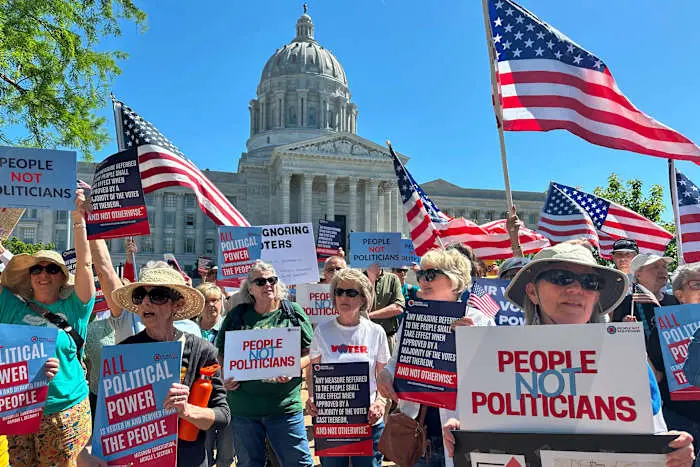
The passage of the revised map triggered immediate pushback from voting rights advocates, Democratic organizations, and non-partisan civic groups. Opponents launched a massive statewide petition drive, successfully gathering tens of thousands of signatures from Missouri voters. The objective was to invoke the state’s referendum process, which allows citizens to suspend newly enacted laws and place them on the ballot for a statewide vote.
The petition was submitted to the office of Secretary of State Denny Hoskins. However, on the day of the state’s August primary elections—which were conducted under the newly drawn district lines—Hoskins officially rejected the petition. Hoskins argued that congressional redistricting is a unique constitutional duty delegated strictly to the legislature, rendering it immune to the citizen-led referendum process.
The Judicial Validation
Faced with the rejection of their petition, proponents of the referendum filed an emergency lawsuit in Cole County Circuit Court, seeking to compel Hoskins to place the referendum on the November ballot and halt the implementation of the new map.
Following expedited arguments from both sides, Judge Daniel Green issued his Wednesday ruling. In a concise decision, Green validated Hoskins’ administrative rejection, ruling that the Missouri Constitution does not provide a mechanism for voters to overturn congressional maps via a public referendum.
Supporting Context & Metrics
To fully comprehend the impact of Judge Green’s ruling, it is necessary to examine the specific geographic and demographic changes engineered by the new map, alongside the broader historical and national contexts.
Dismantling the 5th Congressional District
The primary target of the revised map is Missouri’s 5th Congressional District, a seat historically anchored in the diverse, Democratic-leaning urban core of Kansas City.
Under the new configuration:
- Urban Fragmentation: Portions of Kansas City have been systematically carved out and reassigned to two neighboring congressional districts currently represented by conservative Republicans.
- Rural Extension: To compensate for the lost urban population, the remainder of the 5th District has been stretched far to the east, absorbing deeply conservative, rural counties.
- Demographic Disruption: According to an analysis by the Associated Press, approximately 59% of the voters in the newly configured 5th District are entirely new to the constituency. This massive influx of rural, conservative voters is designed to dilute the urban Democratic base, rendering the seat highly competitive for Republicans.
| District Configuration | Urban Core Share | Rural/Suburban Share | Democratic Margin (Est.) |
|---|---|---|---|
| Pre-Revision Map | High (Kansas City Core) | Minimal | Safe Democratic (+15) |
| Revised Map | Fragmented | Expansive (Eastern Rural) | Highly Competitive (Toss-up) |
The real-world political impact of this geographical shift was evidenced in the August primaries. State Senator Rick Brattin, a staunch conservative, secured the Republican nomination for the reshaped 5th District. Meanwhile, Representative Emanuel Cleaver ran unopposed for the Democratic nomination, setting up a high-stakes November showdown on turf heavily altered to favor the Republican challenger.
Historical Precedent: The 1922 Referendum
The legal dispute over the referendum process forced historians and legal scholars to look back more than a century. The last time a Missouri congressional redistricting plan was subjected to a voter referendum was in 1922.
In that instance, Missouri voters successfully rejected a congressional map passed by a Republican-led legislature. However, legal experts note a key distinction: the legal validity of the 1922 referendum petition was never challenged in court. Consequently, Judge Green’s ruling represents the first definitive judicial interpretation of this constitutional boundary in modern Missouri history.
[1922 Referendum] -----------------------------------------> [2026 Legal Battle]
- Voters successfully rejected GOP map.                      - SOS Hoskins rejects petition.
- Legal validity of petition was never challenged in court.   - Judge Green rules referendum unconstitutional.
- Established a historic but untested precedent.             - Establishes new modern legal precedent.
The National Mid-Decade Redistricting Landscape
Missouri is not an isolated battleground. The state’s mid-decade redistricting effort is part of a coordinated national strategy. Missouri was the second state, following Texas, to redraw its congressional boundaries mid-cycle at the behest of Donald Trump.
Currently, Republicans are leveraging newly enacted maps in eight states to secure up to 16 additional seats in the U.S. House of Representatives:
- Texas
- Missouri
- North Carolina
- Ohio
- Florida
- Tennessee
- Louisiana
- Alabama
In contrast, Democratic counter-redistricting efforts have faced significant judicial and legislative setbacks, with the party projecting potential gains of only up to six seats, primarily concentrated in California and Utah.
Official Statements and Legal Arguments
The courtroom battle in Cole County featured highly sophisticated constitutional arguments from some of the state’s and nation’s leading political attorneys.
The State’s Defense
The Missouri Attorney General’s office, led by Republican Catherine Hanaway, represented Secretary of State Hoskins. The state’s legal team argued that the U.S. Constitution and the Missouri Constitution vest the power of congressional redistricting solely within the legislative branch.
According to the state’s brief:
"Congressional redistricting is a core legislative duty. The citizen referendum process, while a vital tool for ordinary statutory matters, cannot be used to usurp or veto a federally mandated legislative function without explicit, unambiguous constitutional authorization."
The Republican Party’s Intervention
Attorneys representing national, congressional, and state Republican committees intervened in the lawsuit to defend the map. John Gore, a prominent attorney representing the Republican interests, emphasized the severe administrative disruption that would occur if the court blocked the map so close to the general election.
Gore argued:
"To change district boundaries after the primary elections have already been certified and conducted under the new map would inflict widespread voter confusion and cause an irreparable erosion in public confidence in the integrity of the state’s elections. The logistical impossibility of reverting to old maps at this late stage makes the plaintiffs’ requested relief entirely impractical."
The Plaintiffs’ Position
Attorneys representing the voting rights advocates and citizens who organized the petition drive argued that the Secretary of State’s rejection of the signatures was an undemocratic overreach. They maintained that the right of referendum is a foundational check on legislative power.
In their filings, the plaintiffs argued:
"The Missouri Constitution explicitly reserves the power of referendum to the people to approve or reject at the polls any act of the legislative assembly. By carving out congressional redistricting from this democratic check, the state is insulating partisan gerrymandering from the consent of the governed."
Future Outlook
While Judge Green’s ruling represents a major victory for the Republican Party, the battle over Missouri’s congressional boundaries is far from over.
The Appellate Trajectory
Attorneys for the plaintiffs have indicated their intention to immediately appeal Judge Green’s decision. Given the proximity of the November elections, any appeal will likely be placed on an expedited track, potentially bypassing the state court of appeals to be heard directly by the Missouri Supreme Court. Legal analysts suggest that the high court will face intense pressure to issue a definitive ruling before county election clerks begin printing ballots for general distribution.
Implications for the November Elections
If Judge Green’s ruling stands, the immediate political battlefield will favor the GOP. The newly configured 5th District will test Representative Cleaver’s ability to build coalitions among rural voters who have never voted for him before. If State Senator Rick Brattin successfully flips the seat, it will validate the Republican strategy and contribute directly to the party’s efforts to maintain control of the U.S. House.
However, political analysts caution that mid-decade redistricting carries inherent risks. Historically, the political party of the president faces headwinds during midterm elections. If voter turnout dynamics shift, highly engineered districts can sometimes behave unpredictably, particularly in a volatile national political climate.
Long-Term Constitutional Consequences
Beyond the immediate electoral outcomes, the final resolution of this case will establish a lasting legal precedent. If the Missouri Supreme Court upholds Judge Green’s ruling, it will permanently close the door on the citizen referendum as a tool to combat partisan gerrymandering in Missouri. This would leave federal courts and future legislative majorities as the only avenues for challenging congressional boundaries, fundamentally altering the balance of power between Missouri citizens and their elected representatives for decades to come.

0 Comments