

Executive Overview
On Friday, August 14, 2026, search teams operating on the treacherous slopes of Broad Peak in northern Pakistan recovered the remains of American mountaineer Mallory Geis. Geis, 31, was the final missing member of a 10-person international climbing expedition that was catastrophically swept away by a massive avalanche on July 31, 2026. The recovery of her body brings a somber end to a grueling, multi-week search-and-rescue operation conducted under extreme high-altitude conditions.
The ill-fated expedition was led by the world-renowned Nepalese mountaineer Nirmal “Nimsdai” Purja, whose high-profile guiding agency has attracted global attention to the extreme risks of commercialized high-altitude climbing. Geis, an aspiring high-altitude athlete, was making her first attempt at conquering an 8,000-meter peak in the Karakoram Range.
The disaster, which claimed the lives of all ten team members, ranks among the deadliest single-incident tragedies in the history of Broad Peak. It has reignited an intense international debate regarding the safety protocols of commercial expeditions, the impact of climate change on Karakoram weather patterns, and the heavy reliance on local volunteer rescue teams who risk their lives to retrieve the fallen.
Detailed Chronology
[July 31, 2026] ────────────────> [August 1–10, 2026] ───────────> [August 11, 2026] ───────────> [August 14, 2026]
Avalanche strikes team            High-altitude search underway      Candlelight vigil held          Mallory Geis's remains
on Broad Peak; 10 killed.         amid extreme weather.              in Islamabad, Pakistan.         recovered by volunteers.
The Fateful Ascent: July 31, 2026
The expedition, comprised of international clients and highly experienced sherpas, departed Camp 3 in the early hours of July 31, aiming for the summit of Broad Peak (8,051 meters / 26,414 feet). Weather forecasts had indicated a narrow window of stable conditions, prompting several teams on the mountain to push upward.
At approximately 10:30 AM local time, as the team navigated a steep, exposed snow slope below the col, a massive slab avalanche was triggered above them. The sheer volume of snow and ice swept the entire 10-member rope team down the mountain’s sheer face. High-altitude porters (HAPs) at lower camps reported hearing a thunderous roar, followed by a cloud of ice dust that obscured the upper mountain for hours.
The Desperate Search and Rescue Campaign
Immediate rescue efforts were severely hampered by unstable snowpacks and secondary avalanche risks. In the days following the disaster, elite Pakistani military helicopter pilots from the 5th Army Aviation Squadron conducted aerial reconnaissance flights, but extreme altitude and turbulent winds prevented them from landing or deploying long-line rescue systems near the debris field.
Ground search operations fell to a courageous group of local high-altitude volunteers and seasoned Balti climbers. Operating in the "Death Zone"—altitudes above 8,000 meters where oxygen is scarce and the human body rapidly deteriorates—the recovery team systematically searched crevasses and avalanche debris. Over the first ten days of August, nine bodies were successfully located and brought down to lower camps under perilous conditions.
Mourning in the Capital: August 11, 2026
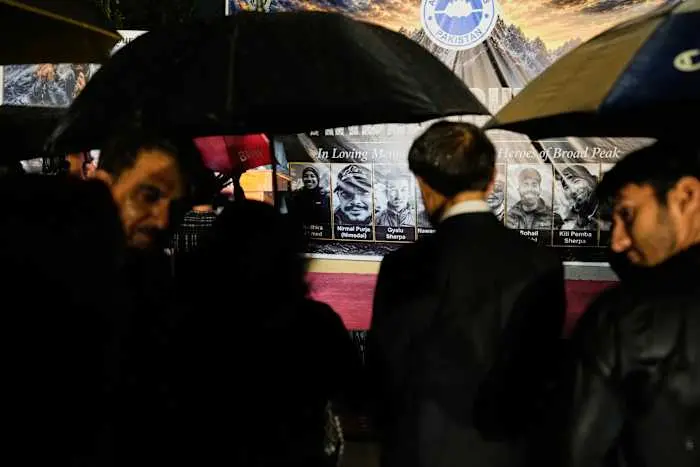
While the search for Geis continued, a solemn candlelight vigil was held in the capital city of Islamabad on Tuesday, August 11. Organized by the mountaineering community and diplomatic representatives, the event honored the lives of the ten climbers.
Nepalese Ambassador to Pakistan, Rita Dhital, attended the memorial, placing flowers alongside portraits of the deceased. In an emotional address, Dhital praised the bravery of the rescue workers and emphasized the deep, tragic bond shared by the global climbing community.
The Final Recovery: August 14, 2026
On Friday, August 14, Irfan Arshad Khan, President of the Alpine Club of Pakistan, officially confirmed that volunteer searchers had located Geis’s remains. Found partially buried in a deep crevasse at approximately 7,400 meters, her body was carefully secured and transported down to Base Camp, concluding a painful chapter for the families of the victims.
Supporting Context & Metrics
The Dangerous Profile of Broad Peak
Broad Peak, the world’s 12th highest mountain, is part of the formidable Gasherbrum massif in the Karakoram Range. While statistically considered less technical than its notorious neighbor K2, Broad Peak presents unique hazards that are frequently underestimated by commercial clients.
| Mountain Metric | Broad Peak Statistics & Details |
|---|---|
| Elevation | 8,051 meters (26,414 feet) |
| Location | Gilgit-Baltistan, Pakistan / Xinjiang, China |
| First Ascent | June 9, 1957, by an Austrian Expedition |
| Key Hazards | Avalanche-prone col, narrow summit ridge, extreme exposure |
| Historical Fatality Rate | Approximately 5.5% (deaths per summit ratio) |
The bottleneck below the summit col is a notorious terrain trap. When heavy winter snows are followed by rapid summer warming, the snowpack becomes highly unstable, creating prime conditions for wet slab avalanches.
The Karakoram Climate Shift
Meteorologists and glaciologists point to a disturbing trend in the Karakoram Range: rising global temperatures are altering the structural integrity of the mountains. Historically, the Karakoram was known for the "Karakoram Anomaly"—a phenomenon where its glaciers remained stable or grew, unlike those in the warming Himalayas.
However, recent data shows that rising summer temperatures are causing rapid permafrost degradation. This leads to:
- An increase in unpredictable serac (ice cliff) collapses.
- Frequent rockfalls due to the melting of ice that holds loose rock faces together.
- More frequent and larger wet-snow avalanches during the peak mid-summer climbing season of July and August.
[Rising Summer Temperatures]
       │
       ├─> [Permafrost Degradation] ──> [Unpredictable Serac Collapses]
       │
       └─> [Rapid Snowpack Melting] ───> [High-Volume Wet Slab Avalanches]
The Commercialization Dilemma and Nirmal Purja
The disaster has also brought intense scrutiny to the business model of high-altitude guiding. The expedition was organized under the umbrella of Nirmal "Nimsdai" Purja’s brand. Purja achieved global superstardom in 2019 by climbing all 14 of the world’s 8,000-meter peaks in just 189 days—a feat chronicled in the hit Netflix documentary 14 Peaks: Nothing Is Impossible.
While Purja’s achievements popularized high-altitude mountaineering, critics argue that the commercialization of these extreme peaks has democratized access to individuals who may lack the rigorous, multi-year alpine training required to survive unexpected disasters. The presence of wealthy clients on crowded, fixed-rope routes can lead to bottleneck delays, increasing their exposure to objective hazards like avalanches and falling ice.
Official Statements
The recovery of Mallory Geis’s body prompted a series of official statements from diplomatic, regulatory, and mountaineering bodies, reflecting both grief and a call for structural reforms.
Alpine Club of Pakistan
Irfan Arshad Khan, President of the Alpine Club of Pakistan, commended the local climbers who executed the recovery:
"The recovery of Mallory Geis was an extraordinary act of bravery by our local high-altitude volunteers. These men put their own lives on the line, navigating unstable terrain in the wake of a devastating avalanche, to ensure that a grieving family in America could receive closure. We owe them our deepest gratitude, but we must also ask how we can better protect both our guests and our local workers in the future."
Nepalese Diplomacy
Nepalese Ambassador to Pakistan, Rita Dhital, spoke of the shared grief and the inherent dangers of the profession during her address in Islamabad:
"Mountaineering is a bridge of friendship between Nepal and Pakistan, but today it is a bridge of shared sorrow. The loss of ten bright lives on Broad Peak is a profound tragedy for the global climbing family. We must continue to support the families of the fallen, and we must work hand-in-hand with Pakistani authorities to enhance safety standards, weather forecasting, and rescue infrastructure in these high mountains."
The Geis Family
In a statement released through the U.S. Embassy in Islamabad, the family of Mallory Geis expressed their profound heartbreak and gratitude:
"Mallory was a force of nature who dreamed of standing among the giants of the Karakoram. While we are devastated by her loss, we find comfort in knowing she died pursuing her deepest passion. We are eternally grateful to the Pakistani volunteers who risked everything to bring her home to us. We ask for privacy as we grieve our beloved daughter, sister, and friend."
Future Outlook
The Broad Peak disaster of 2026 is poised to be a turning point for high-altitude tourism in Pakistan. As the country seeks to rival Nepal’s lucrative mountaineering industry, it faces growing pressure to implement stringent regulatory reforms.
Proposed Regulatory Reforms
In the wake of the tragedy, the Ministry of Tourism for Gilgit-Baltistan, in consultation with the Alpine Club of Pakistan, is considering several key policy changes:
- Strict Experience Prerequisites: Implementing mandatory requirements for international clients. Under proposed rules, climbers would be barred from booking permits for Pakistani 8,000-meter peaks unless they can prove they have successfully summited at least one 7,000-meter peak.
- Liaison Officer Reform: Ensuring that government-appointed Liaison Officers (LOs) stationed at base camps are certified mountaineers capable of enforcing safety protocols and turn-back times, rather than administrative officials.
- Mandatory GPS Tracking: Requiring all climbers on 8,000-meter peaks to carry active, satellite-enabled GPS tracking devices to expedite search-and-rescue operations in the event of an avalanche.
Professionalizing Rescue Infrastructure
Currently, search-and-rescue operations in Pakistan rely heavily on the military’s aviation wing and informal networks of local volunteers. Experts argue that the country must transition toward a dedicated, civilian-led mountain rescue service.
Funding such an initiative could be achieved by allocating a percentage of peak permit fees—which currently run into thousands of dollars per climber—directly into a specialized rescue fund. This fund would provide local High-Altitude Porters (HAPs) with advanced medical training, state-of-the-art rescue gear, and comprehensive life insurance policies.
Conclusion
The recovery of Mallory Geis closes a tragic chapter on Broad Peak, but the lessons of the 2026 disaster will reverberate through the climbing world for years to come. As climate change continues to destabilize the world’s highest peaks and the allure of the "Death Zone" draws ever more adventurers, the balance between human ambition and nature’s unforgiving reality remains as fragile as ever.

0 Comments