

Executive Overview
On Saturday, August 22, 2026, the boundary between biological human limits and synthetic kinetic capability was permanently redrawn at the National Speed Skating Oval in Beijing. On the opening day of the second annual World Humanoid Robot Games, Chinese-engineered humanoid robots shattered long-standing human athletic world records, including Usain Bolt’s legendary 100-meter sprint record and Javier Sotomayor’s historic high jump benchmark.
The five-day event, featuring more than 2,000 humanoid robots from 16 nations, is far more than a sporting curiosity. It serves as a high-stakes, state-backed exhibition of China’s rapidly maturing robotics ecosystem. Taking place in the iconic "Ice Ribbon"—originally built for the 2022 Winter Olympics—the games are unfolding against a backdrop of intense geopolitical friction. As Beijing showcases its dominance in hardware manufacturing and artificial intelligence, Washington is moving aggressively to cordon off its domestic market from Chinese robotics, citing severe national security risks. The resulting clash highlights a brewing technological Cold War, where the battleground is defined not just by microchips, but by the autonomous machines that run on them.
Detailed Chronology of the Games
The opening day of the 2026 World Humanoid Robot Games delivered a series of rapid-fire, record-breaking performances that stunned spectators and demonstrated the exponential pace of robotic evolution over the past twelve months.
[Trial Phase]       Honor Humanoid Sprints 100m in 9.32s (Peak Speed: 14.5 m/s)
        │
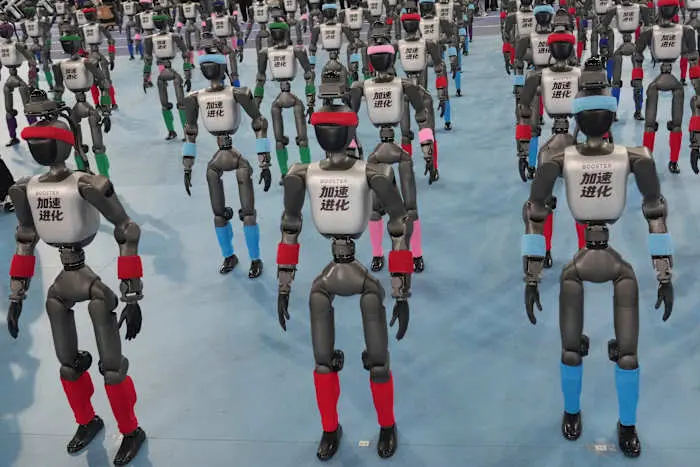
[Opening Ceremony]  Hundreds of Humanoids March in Synchronized Formation
        │
[100m Finals]       X-Humanoid Wins Gold in 9.39s (Beating Bolt's 9.58s Human Record)
        │
[High Jump]         X-Humanoid Clears 2.88m (Beating Sotomayor's 2.45m Human Record)
The Trial Runs: Honor Sets an Unofficial Benchmark
Before the gates officially opened to the public, the athletic capabilities of modern bipeds were put on display during closed-door trials. A humanoid developed by the Chinese consumer electronics giant Honor completed the 100-meter sprint in a staggering 9.32 seconds.
During this run, the robot reached a peak velocity of 14.5 meters per second (approximately 32.4 mph). To put this in perspective, Usain Bolt’s peak speed during his 9.58-second run in 2009 was 12.42 meters per second. The Honor machine achieved this through a combination of ultra-lightweight carbon-fiber composite limbs and proprietary high-torque density actuators, which allowed for a stride frequency that biological muscles simply cannot replicate without tearing.
The Opening Ceremony: A Swarm of Precision
The official opening ceremony commenced on Saturday morning with a massive, highly synchronized display. Hundreds of humanoid robots marched onto the field in flawless, military-style formation. Unlike previous iterations of robotic showcases, which relied on pre-programmed, localized positioning systems, this demonstration utilized a decentralized swarm intelligence network. The robots adjusted their spacing, posture, and gait in real time, reacting to minor wind resistance and turf variations without a single collision or mechanical stumble.
The Official 100m Sprint: Sinking Below the 9.4-Second Barrier
While Honor’s trial run turned heads, the official competition saw Beijing-based startup X-Humanoid capture the gold and the official tournament record.
In the 100-meter final, the X-Humanoid biped crossed the finish line at 9.39 seconds, officially eclipsing Usain Bolt’s 17-year-old world record of 9.58 seconds. High-speed cameras captured the robot’s gait, which featured a brief "flight phase"—where both feet were off the ground simultaneously—resembling human sprinting mechanics but executed with a level of rotational joint velocity that exceeds human physical limitations.
The High Jump: Defying Gravity and Previous Iterations
Shortly after the sprint, X-Humanoid secured another historic milestone in the standing high jump. The company’s specialized high-jump variant cleared a bar set at 2.88 meters (9.45 feet), comfortably surpassing Cuba’s Javier Sotomayor’s 1993 human world record of 2.45 meters.
Perhaps more shocking than beating the human record was the year-on-year progress of the technology itself. In the inaugural 2025 edition of the games, the best high-jump result recorded by any humanoid was a modest 0.95 meters. The jump to 2.88 meters in 2026 represents a 203% increase in vertical jump capability in just twelve months, underscoring the rapid breakthroughs in capacitor-driven power delivery and dynamic landing stabilization.
Supporting Context & Metrics
The World Humanoid Robot Games do not exist in a vacuum. They are strategically timed to coincide with the 2026 World Robot Conference in Beijing, where global enterprises showcased approximately 3,000 robotic products. This concentration of technology highlights China’s aggressive strategy to monopolize the global robotics supply chain.
China’s Supply Chain Hegemony
China currently manufactures the vast majority of the world’s humanoid robots. This dominance is driven by several structural advantages:
- Colocated Component Ecosystems: In tech hubs like Shenzhen and the Yangtze River Delta, actuator manufacturers, sensor designers, battery suppliers, and assembly plants operate within miles of one another.
- Low Bill of Materials (BOM): Western robotics firms often struggle with high prototyping costs. Chinese firms leverage massive domestic industrial capacity to produce harmonic drive gears, planetary gearboxes, and frameless torque motors at a fraction of Western costs.
- Rapid Iteration Cycles: The transition from a digital CAD design to a physical, walking prototype can take as little as two weeks in China, compared to months in North America or Europe.
| Metric / Parameter | Human World Record | Humanoid Robot Record (Aug 2026) | Primary Technological Enabler |
|---|---|---|---|
| 100m Sprint Time | 9.58 seconds (Usain Bolt, 2009) | 9.32 seconds (Honor, Trial) / 9.39 seconds (X-Humanoid, Official) | High-torque density brushless motors; Sim-to-Real reinforcement learning models. |
| High Jump Height | 2.45 meters (Javier Sotomayor, 1993) | 2.88 meters (X-Humanoid) | Ultra-capacitor energy storage; advanced hydraulic/electric hybrid actuators. |
| Max Sprint Velocity | ~12.42 m/s (Human limit) | 14.50 m/s (Robotic limit) | Carbon-fiber structural optimization; high-frequency joint oscillation control. |
The American Counter-Offensive: A "Robotic Iron Curtain"
As Chinese robots break athletic records, the geopolitical rift between Washington and Beijing is deepening. The United States government increasingly views Chinese humanoid robots not as athletic marvels or industrial helpers, but as dual-use military platforms and data-harvesting vectors.
                   [U.S. National Security Apparatus]
                                   │
         ┌─────────────────────────┴─────────────────────────┐
         ▼                                                   ▼
[FCC Import Ban (July 2026)]                    [Pentagon Blacklist (Unitree)]
- Restricts new Chinese humanoids               - Labels Unitree as PLA-linked
- Cites data harvesting & espionage - Restricts defense-related contracts- The FCC Import Ban: In July 2026, the U.S. Federal Communications Commission (FCC) announced a sweeping ban on the import of new foreign-made humanoid robots. Citing national security risks, the FCC argued that these machines—equipped with high-definition cameras, LiDAR, microphone arrays, and constant cloud connectivity—could act as mobile espionage platforms, mapping sensitive American infrastructure and household layouts.
- The Pentagon Blacklist: The U.S. Department of Defense recently added Unitree, one of China’s premier commercial humanoid makers, to its list of companies deemed to have active ties to the Chinese People’s Liberation Army (PLA). This designation restricts Unitree from participating in any U.S. defense-related supply chains or research contracts.
Official Statements and Public Sentiment
The events in Beijing have elicited starkly contrasting reactions from corporate executives, geopolitical actors, and the public.
The Corporate and State Narrative
Chinese manufacturers and state media have framed the records as a triumph of domestic innovation and a testament to the country’s industrial strategy. Following the record-breaking sprint, an engineering representative from X-Humanoid stated:
"The 9.39-second sprint is not just a victory of speed; it is a victory of mathematical optimization. Our control algorithms compute balance adjustments 2,000 times per second. We have proven that silicon-based systems can run faster and jump higher than biological systems. The physical limits of the human body have been surpassed."
Beijing has also fired back at Washington’s regulatory crackdowns. A spokesperson for China’s Ministry of Foreign Affairs condemned the FCC ban and the blacklisting of Unitree:
"The United States is once again abusing the concept of national security to suppress competitive Chinese enterprises. Humanoid robotics is a field meant to benefit all of humanity—assisting in eldercare, disaster relief, and manufacturing. By erecting a ‘robotic iron curtain,’ the U.S. is only isolating itself from the future of technological progress."
Domestic Public Reception: From Skepticism to Awe
For the spectators filling the stands of the National Speed Skating Oval, the games provided a tangible, sometimes disquieting look into the future.
Li Yanfeng, a Beijing resident who works in education, reflected on her shifting perspective:
"At first, I wasn’t very accepting of artificial intelligence. I was even a bit resistant to it, because of the possibility that it might replace or displace humans. But now that I see this development is unstoppable, I decided to come and take a look. Seeing them run so fast… it makes you realize the future is arriving much faster than we planned."
Another spectator, Yang Shangzheng, expressed pure amazement at the mechanical progress:
"These sports are perfectly normal for humans, but now robots can do them. I find it amazing. Watching them jump nearly three meters into the air is like watching a sci-fi movie come to life right in front of you."
Future Outlook: The Chasm Between Athletics and Utility
Despite the eye-catching headlines generated in Beijing, leading roboticists urge caution when translating athletic records into real-world utility.
[Controlled Athletic Environments]              [Unstructured Real-World Environments]
- Perfectly flat, high-grip tracks             - Uneven terrain, debris, and stairs
- Single-task optimization (sprinting)         - Multi-modal task execution (manipulation)
- Pre-defined, predictable paths               - Dynamic, unpredictable human interaction
- High-frequency tethered power options        - Strict battery constraints (1-2 hour limits)
The "Sim-to-Real" Challenge
Sprinting in a straight line on a high-grip track or jumping over a static bar are highly optimized, single-task functions. In contrast, the real-world deployment of humanoids in factories, warehouses, and homes requires multi-modal adaptability.
- The Manipulation Gap: A robot that can run a 100-meter dash in nine seconds may still struggle to perform basic tactile tasks, such as folding laundry, unscrewing a jar, or picking up fragile objects of varying weights.
- Energy Density Constraints: The high-torque bursts required for record-breaking runs draw immense amounts of power. Currently, most advanced humanoids can only operate for one to two hours on a single charge under normal working conditions, and far less when performing high-intensity athletic feats.
- The Edge-Case Problem: Unlike a controlled track, real-world environments are chaotic. Navigating a cluttered home, negotiating uneven terrain, or reacting to a falling object requires cognitive processing and real-time path planning that remains a bottleneck for current AI models.
The Impending Market Balkanization
As the tech war intensifies, the robotics industry is poised to split into two distinct, non-overlapping ecosystems:
- The Western Sphere: Led by companies like Boston Dynamics, Figure, Tesla (with its Optimus platform), and Agility Robotics. This ecosystem will rely on domestic supply chains or "friendly" manufacturing hubs in Mexico, Vietnam, and Taiwan. It will prioritize high-end sensor suites, proprietary US-developed AI models, and strict compliance with Western cybersecurity standards.
- The Eastern Sphere: Dominant in volume and hardware cost-efficiency, led by Chinese giants like Unitree, X-Humanoid, UBTECH, and Kepler. This ecosystem will cater to the domestic Chinese market, the Global South, and regions less aligned with US security policy. It will leverage unparalleled manufacturing speed to drive down prices, aiming to make humanoids an affordable consumer commodity.
While the World Humanoid Robot Games have proven that machines can run faster and jump higher than the best athletes in human history, the true race has only just begun. The winner of this sprint will not be the company that builds the fastest robot on a synthetic track, but the nation that successfully integrates these autonomous machines into the fabric of daily economic life.

0 Comments