

Executive Overview
On Saturday, August 22, 2026, the Seattle Mariners ushered in a new era of franchise pitching, calling up their highly touted left-handed prospect, Kade Anderson, for a high-stakes Major League Baseball debut against the Chicago Cubs. At just 22 years old, the former Louisiana State University (LSU) standout and third overall selection in the 2025 MLB Draft became the first player from his draft class to reach the major leagues.
Anderson’s debut arrived at a critical juncture for the Mariners (62-68), who found themselves locked in a fierce late-August postseason push, trailing the Houston Astros by three games in the American League West and sitting just two games back of the final wild-card spot.
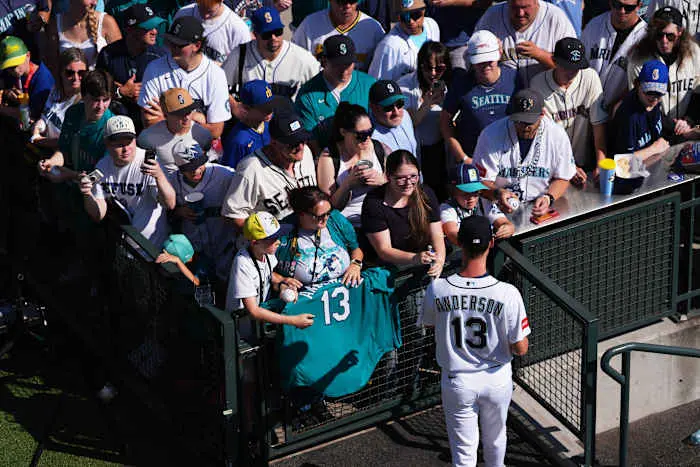
Playing in front of a sold-out crowd of 45,681 fans at T-Mobile Park, Anderson showcased the poise, electric stuff, and fan-first character that have defined his rapid ascent through the minor leagues. Before even throwing his first official pitch, Anderson broke standard pre-game protocol by signing autographs for young fans in the bullpen—a nod to his own childhood in Slidell, Louisiana.
On the mound, he delivered a commanding performance, pitching 5 2/3 innings, striking out five, and leaving to a thunderous standing ovation. Although back-to-back solo home runs in the sixth inning cut his night short, the Mariners ultimately secured a thrilling 5-4 walk-off victory, magnifying the significance of Anderson’s debut and injecting fresh life into Seattle’s playoff aspirations.
Detailed Chronology
[Pre-Game Bullpen] ──> [Innings 1-2] ───────> [Inning 3] ─────────────> [Innings 4-5] ───────> [Inning 6] ───────────> [Post-Game]
Signs autographs;      Composed start;        Arozarena robs         Dominant stretch;       Surrenders 2 HRs;       Mariners win 5-4
warmups finish early   retires side cleanly   Amaya of home run      cruises through lineup  exits to ovation        via walk-off
The Pre-Game Gesture: A Nod to Slidell
Long before the first pitch crossed the plate, Kade Anderson demonstrated a level of composure rare for rookies making their major league debut. After completing his warm-up tosses in the bullpen ahead of schedule, the young southpaw did not retreat to the dugout or isolate himself in focus. Instead, he walked over to the outfield wall to interact with a group of eager young fans, signing autographs and exchanging brief words.
For Anderson, this was not a distraction, but a responsibility. Growing up in Slidell, Louisiana, opportunities to attend Major League games were rare. He recalled spending his childhood chasing autographs from LSU Tigers baseball players in Baton Rouge, an experience that shaped his view of professional athletes. By giving back to the Seattle crowd before his first MLB appearance, Anderson established an immediate connection with the Pacific Northwest faithful.
Innings 1–5: Poise and Defensive Heroics
When Anderson finally took the mound in the top of the first inning, any rookie jitters were quickly dispelled. Relying on a sharp, biting slider and an active fastball, he kept the Chicago Cubs’ hitters off-balance. His command was evident early, as he retired the side with minimal resistance, displaying a smooth, repeatable delivery that has made him the envy of scouting departments across the league.
The defining moment of his early outing came in the top of the third inning. Facing Cubs catcher Miguel Amaya, Anderson surrendered a deep, towering fly ball to left field that looked destined to clear the wall. Seattle’s star left fielder, Randy Arozarena, tracked the ball to the track, timed his leap perfectly, and reached over the wall to rob Amaya of a solo home run. A relieved Anderson tipped his cap to Arozarena, acknowledging the spectacular play that preserved his clean sheet.
       [ Outfield Wall ]
             |
     ( Arozarena Leaps )  <-- Robs Amaya of solo HR in the 3rd
             |
     [ Outfield Track ]
Through five innings, Anderson was in complete control. He navigated the Cubs’ lineup with veteran efficiency, limiting hard contact and utilizing his defense effectively.
The Sixth-Inning Hurdle
As the game entered the sixth inning, manager Dan Wilson elected to send Anderson back out to the mound. The rookie had thrown roughly 70 pitches and was throwing, in Wilson’s words, "extremely well."
However, the third turn through a major league lineup often presents unique challenges. Pete Crow-Armstrong led off the frame with a sharp double down the line, narrowly missing a home run of his own. While Anderson retired the next hitter, the fatigue of his high-intensity debut began to show. He surrendered back-to-back solo home runs, prompting Dan Wilson to pull the young lefty after 81 pitches.
As Anderson walked off the field, the crowd of 45,681 rose to its feet, delivering a resounding standing ovation. His final line—5 2/3 innings, three earned runs, five strikeouts, and zero walks—kept the Mariners in a position to win, setting the stage for a dramatic 5-4 walk-off victory in the late innings.
Supporting Context & Metrics
The Historic Double-A Campaign
To understand why the Mariners felt comfortable thrusting a 22-year-old into a high-leverage August playoff race, one must look at Anderson’s unprecedented run in the minor leagues.
After being drafted third overall out of LSU in 2025, Anderson bypassed Triple-A entirely, spending the bulk of the 2026 season with the Double-A Arkansas Travelers. In the Texas League, Anderson put up video-game-like numbers that made his promotion inevitable.
| Metric | Double-A Statistics (Arkansas Travelers) |
|---|---|
| Starts | 18 |
| Record | 10–1 |
| Earned Run Average (ERA) | 1.06 |
| Innings Pitched | 93.1 |
| Strikeouts (SO) | 135 |
| Walks (BB) | 13 |
| Strikeout-to-Walk Ratio | 10.38:1 |
Anderson’s 1.06 ERA is one of the lowest marks in Double-A history for any pitcher with at least 90 innings pitched. His exceptional control—demonstrated by a microscopic 1.3 walks per nine innings (BB/9)—convinced the Mariners’ front office that his command would translate immediately to the big-league level.
Pitch Analysis: The High-Spin Slider
During his debut on Saturday, Anderson’s pitch mix lived up to the scouting reports. Of his 81 pitches, his slider was the standout offering.
- Total Strikeouts: 5
- Strikeouts via Slider: 3
- Total Whiffs Generated: 6
- Key Characteristic: High spin rate with late horizontal sweep, making it highly effective against both right- and left-handed hitters.
By utilizing his slider as a put-away pitch and establishing his fastball on the edges of the plate, Anderson proved he could generate swings-and-misses against elite big-league hitters without relying solely on raw velocity.
Official Statements
Following the game, the atmosphere in the Mariners’ clubhouse was a mix of relief and excitement. Managers, players, and Anderson himself reflected on the significance of the night.
Mariners Manager Dan Wilson praised the rookie’s poise under pressure:
"The way he used all of his stuff, you saw everything today. He wasn’t afraid to throw anything in any count, and I just thought for a first time out there, he looked very, very comfortable, and that’s a great sign. We sent him back out for the sixth because he was throwing the ball extremely well, and even when they got to him, he handled that adversity like a professional."
Kade Anderson spoke candidly about his pre-game autograph session and his connection to the fans:
"That’s what it’s all about at the end of the day, to go out there and pitch for the fans. Growing up in Slidell, I didn’t get to see a ton of big-league games, but I remember hounding those LSU guys for autographs. You just have to give back to those kids."
Reflecting on Randy Arozarena’s spectacular home-run-robbing catch in the third inning, Anderson added:
"I thought it was way gone. I’m honestly grateful that ball stayed in the park. Randy saved me there, no doubt about it."
Addressing the gravity of his debut during a tight playoff race, Anderson showed a team-first mentality:
"The team was counting on me for a big game today. These games matter, especially when the season is getting shorter and shorter. I understood that going in. Obviously, it’s a big day for me, but it’s an even bigger day for this organization."
Future Outlook
Impact on the Mariners’ Postseason Push
The Mariners’ 5-4 victory over the Cubs, combined with Anderson’s strong showing, provides a massive psychological and tactical boost for Seattle. With only a few weeks remaining in the regular season, the Mariners’ starting rotation has been under immense pressure. By proving he can compete at the major league level, Anderson gives Seattle a legitimate, high-upside starter to deploy down the stretch.
If the Mariners are to close the three-game gap on the Houston Astros in the AL West or secure the final wild-card spot, they will need consistent, deep starts to protect an overworked bullpen. Anderson’s ability to limit walks and navigate lineups efficiently suggests he can provide exactly that.
Long-Term Projection
At 22 years old, Kade Anderson is poised to become a cornerstone of the Mariners’ pitching staff for years to come. Seattle has built a reputation for developing elite young arms, and Anderson fits the mold perfectly. His combination of an advanced pitch mix, exceptional command, and an unshakeable mental makeup suggests that Saturday’s debut was merely the opening chapter of a long, distinguished Major League career.
As the 2026 season enters its final, decisive month, all eyes in the Pacific Northwest will remain fixed on the young left-hander from Louisiana, whose journey from chasing autographs in Baton Rouge to signing them in the T-Mobile Park bullpen has captivated the baseball world.

0 Comments