
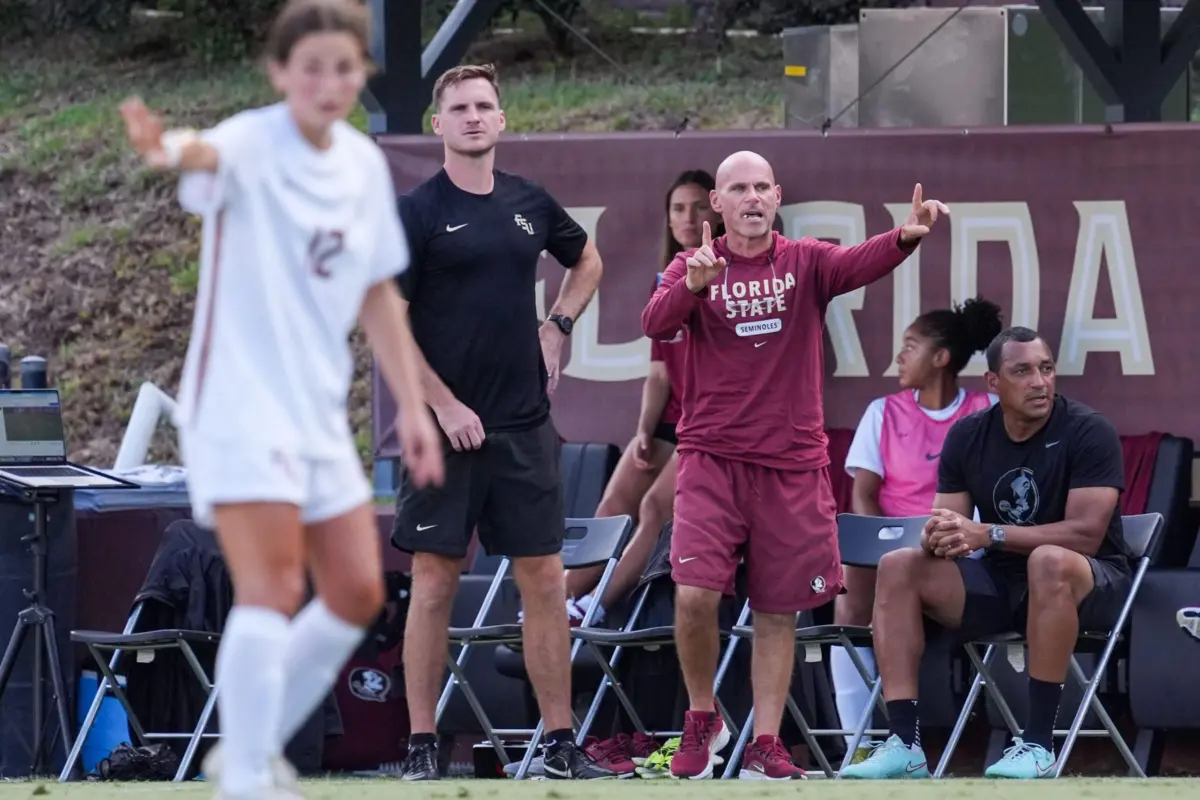

Executive Overview
GAINESVILLE, Fla. — In a stunning reversal of historical dominance on a humid Thursday evening at Donald R. Dizney Stadium, the University of Florida women’s soccer team delivered a masterclass in tactical discipline and opportunistic finishing, defeating No. 3-ranked Florida State 3-1. The victory marks a monumental watershed moment for the Gators, halting a demoralizing eight-game losing skid against their fiercest in-state rivals and securing UF’s first triumph over the Seminoles since 2015.
For Florida State, the defeat was nothing short of seismic. Not only did the loss surrender regional bragging rights, but it also obliterated two of the most impressive statistical pillars in the modern collegiate soccer landscape: FSU’s 36-game regular-season non-conference winning streak came to an abrupt halt, and the reigning national powerhouse stumbled to a 3-1 record on the young campaign. Meanwhile, the Gators improved to 2-1, injecting a massive surge of momentum and credibility into head coach’s program under the bright lights of an electric, capacity-crowd rivalry atmosphere.
From the opening whistle, the contest was defined by a stark contrast in execution. Florida established an aggressive, high-pressing tempo that unsettled a heavily rotated Seminoles lineup. Kyra Taylor engineered a career-defining performance for the hosts, netting a brace that paved the way for the upset, while a suffocating defensive block neutralized FSU’s star-studded attacking front. Though Florida State mounted a spirited push in the second half—highlighted by a late freshman goal to break the shutout—the deficit proved insurmountable.
This comprehensive report examines the tactical blueprint of the match, a granular chronological breakdown of the pivotal moments, advanced metric evaluations, and an forward-looking analysis of what this monumental upset means for both programs as they navigate the rigorous challenges of the 2024 season.
Detailed Chronology of the Match
First Half: High-Press Intensity and Early Breakthroughs
The opening stanza was characterized by an immediate tactical chess match. Florida State head coach rolled out a heavily reshuffled starting XI, looking to inject fresh legs and varied tactical dimensions into the pitch. Sophomore Kate Ockene drew the start between the posts, shielded by a backline featuring freshman Bridget Mutipula, junior Janet Okeke, and senior Kansas transfer Olivia Page—the latter marking a crucial return to the starting defensive unit.
The Seminoles’ midfield featured a fluid configuration of sophomore Nyanya Touray, senior Memphis transfer Ashley Henderson, junior Peyton McGovern, junior Daytona State transfer Shaneil Buckley (earning her first start of the season), and junior Xavier transfer Sam Erbach. Up front, a veteran trio of senior Kentucky transfer Tanner Strickland, junior Tennessee transfer Anaiyah Robinson, and junior Wrianna Hudson shouldered the attacking responsibilities.
Despite the pedigree on paper, it was the Gators who dictated the terms of engagement from the outset. Florida’s tactical blueprint relied on a relentless, organized press that choked FSU’s midfield distribution channels and forced hurried clearances. The sustained pressure quickly yielded dangerous territory around the Seminoles’ penalty area.
The breakthrough arrived in the 22nd minute. At 21:58, Florida capitalized on a well-executed set-piece opportunity. Mia Gray delivered a pinpoint, bending corner kick directly into the danger zone, where Kyra Taylor rose above her marker to direct a precise header past Ockene. The goal ignited the home crowd, staking the Gators to a 1-0 advantage and sending shockwaves through the FSU technical area.
Stung by the deficit, Florida State attempted an immediate response. Just under two minutes later, at 23:53, Buckley found herself free on a blistering counter-attack, breaking away for a golden one-on-one opportunity against the Gators’ netminder. However, under heavy pressure from recovering defenders, Buckley’s final effort drifted wide, squandering the equalizer.
FSU continued to probe for openings as the half progressed. In the 28th minute (27:48), Erbach carved out another promising look at goal, unleashing a venomous strike from outside the box that sailed agonizingly wide of the right upright. As the referee blew the halftime whistle, Florida maintained their slender 1-0 lead, having successfully frustrated the nation’s third-ranked side through disciplined defensive shapes and clinical transition play.
Second Half: Tactical Adjustments, Insurance Strikes, and Late Drama
Recognizing the urgent need for a shift in momentum, Florida State emerged from the locker room with noticeably higher energy and tactical intent. The Seminoles vastly improved their passing sequences, dominating territorial possession and pinning the Gators deep in their own half for prolonged stretches.
The surging pressure nearly bore fruit at 55:47. Touray orchestrated a brilliant individual run, driving directly at the heart of the Florida defense before unleashing a curling shot toward the bottom center of the net. The Gators’ goalkeeper was forced into a desperate, diving parry, resulting in an FSU corner kick that the orange-and-blue defense ultimately scrambled clear.
Despite controlling the early exchanges of the second frame, FSU was hit with a devastating counter-punch just past the hour mark. At 61:49, Florida executed a textbook transition. Zoe Main slipped a clever through-ball into the path of a streaking Taylor, who collected possession and coolly slotted her second goal of the evening past a helpless Ockene. The dagger made it 2-0, firmly shifting the psychological advantage back to the hosts.
As the clock ticked deeper into regulation, Florida State pushed numbers forward in an increasingly desperate search for a lifeline, leaving massive spaces in transition. The Gators ruthlessly exploited this tactical vulnerability in the 79th minute (78:46). Dymond Montelene capitalized on a disorganized FSU defensive transition, weaving through a retreating backline before firing a low, driven shot past the goalkeeper to extend the lead to a stunning 3-0.
With the match seemingly out of reach, the Seminoles refused to surrender quietly. The reigning powerhouse salvaged a measure of pride in the 83rd minute (82:27). Freshman Ryder Ajeto injected a late spark of life into the visiting side, finding space inside a crowded penalty box to steer home her second goal of the season. The strike sliced the deficit to 3-1 and forced a nervy final minutes for the home faithful.
However, the late surge proved to be too little, too late. Florida’s backline absorbed the final waves of FSU pressure, expertly managing the game down to the final whistle to secure a historic 3-1 victory.
Supporting Context & Statistical Metrics
A deep dive into the match statistics reveals a surprisingly even distribution of attacking opportunities, highlighting just how clinical the Gators were compared to their high-profile opponents.
Statistical Breakdown Table
| Metric | Florida Gators | Florida State Seminoles |
|---|---|---|
| Goals Scored | 3 | 1 |
| Total Shots | 14 | 8 |
| Shots on Goal | 8 | 5 |
| Saves | 4 | 5 |
| Corner Kicks | 4 | 6 |
| Fouls Committed | 11 | 9 |
| Yellow Cards | 2 | 1 |
Analyzing the Numbers
While Florida State actually held a slight edge in territorial control during the second half—manifesting in six total corner kicks to Florida’s four—the Seminoles lacked their customary efficiency in the final third. FSU registered eight total shots, placing five on target, but failed to crack a resolute Florida defensive block anchored by stellar goalkeeping and disciplined center-back play.
Conversely, the Gators maximized their offensive efficiency. Florida generated 14 total shots, putting an impressive eight on frame against Ockene. Kyra Taylor’s brace anchored an attacking display that exposed uncharacteristic vulnerabilities in FSU’s rotational defensive structure.
Furthermore, the historical context of these metrics cannot be overstated. FSU’s streak of 36 consecutive regular-season non-conference victories—a testament to the program’s ironclad consistency under elite coaching over nearly half a decade—evaporated in the Gainesville humidity. For a program accustomed to blowing past regional opponents with relative ease, the defeat serves as an urgent wake-up call regarding the razor-thin margins at the elite level of NCAA Division I women’s soccer.
Post-Match Reflections & Future Outlook
The Repercussions for Florida State
For head coach and the Seminole faithful, the immediate aftermath of the match requires hard introspection. While the decision to rotate personnel—introducing players like Olivia Page to the backline and handing Shaneil Buckley her first start in the midfield—was designed to build depth and test combinations ahead of conference play, the early-season chemistry issues were glaring.
The defensive breakdowns that led to Florida’s transition goals are uncharacteristic of a program that prides itself on suffocating defensive structures. Yet, history suggests that elite programs often utilize early-season adversity as fuel for championship runs. FSU will not have long to lick its wounds. The Seminoles face a short recovery window before returning to action on Friday, September 6, when they travel to Athens, Georgia, to face a formidable University of Georgia squad. That SEC road test will provide an immediate litmus test of how resilient this iteration of Florida State truly is.
The Springboard for Florida
For the University of Florida, this victory transcends a standard early-season win; it is a program-defining statement. Snagging a result against a top-three opponent—let alone breaking a nine-game losing streak against their most bitter rival—instantly validates the tactical direction of the coaching staff and restores the Gators to national relevance.
With their record moving to 2-1, Florida has proven that they possess the tactical discipline, physical resilience, and clinical finishing required to compete with the absolute elite of collegiate soccer. As the Gators look ahead to the remainder of their non-conference slate and the grueling gauntlet of Southeastern Conference play, the confidence gained from dismantling a national powerhouse will serve as an invaluable cornerstone for the rest of 2024.

0 Comments