
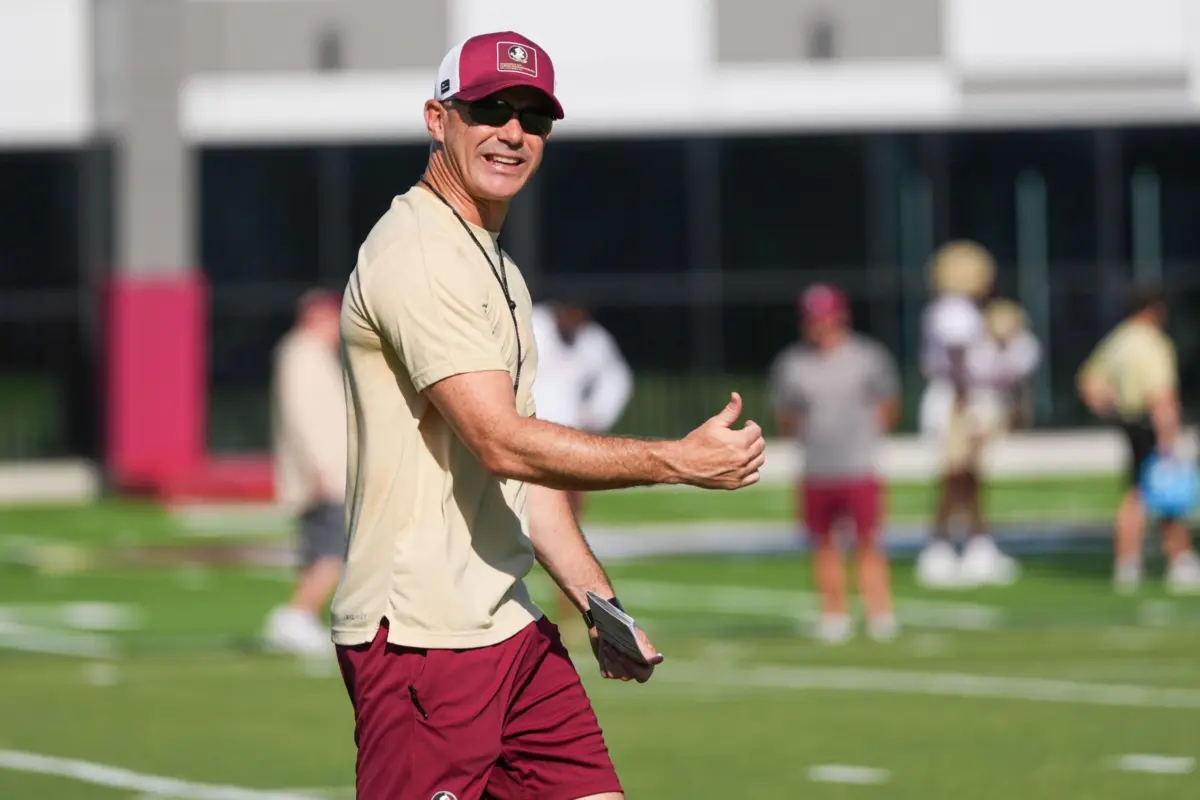

As the Florida State Seminoles officially ushered in game week on Monday, head coach Mike Norvell met with local media for the first time since the conclusion of fall camp, setting the stage for Saturday night’s season opener against New Mexico State at Doak Campbell Stadium. With the grueling preseason firmly in the rear-view mirror, Norvell’s messaging was direct, authoritative, and centered on internal execution rather than external chatter. The program enters the 2026 campaign with a renewed sense of identity, a stabilized quarterback room led by unquestioned starter Ashton Daniels, and a palpable shift in organizational philosophy regarding transparency, roster deployment, and youthful integration.
Perhaps the most striking development of the week is Norvell’s definitive confirmation that Florida State will not release a traditional weekly depth chart ahead of Saturday’s kickoff—a policy that the coaching staff intends to maintain for the entirety of the 2026 season. Citing the fluid nature of modern personnel groupings and a desire for absolute precision, Norvell argued that rigid depth charts fail to accurately capture how modern rosters are utilized. Furthermore, the FSU head man addressed lessons learned from difficult prior campaigns, the physical development of a promising freshman class, and the tactical deployment of a versatile tight end room. With kickoff slated for 7 p.m. under the Saturday night lights, the Seminoles are eager to translate months of sweat equity into tangible on-field success.
Detailed Chronology
The transition from the monotony of fall camp to the hyper-focused urgency of game week represents a critical psychological pivot for any major college football program. For Florida State, that transition crystallized over the weekend with a comprehensive mock game that Norvell described as one of the cleanest operationally since his arrival in Tallahassee.
On Monday morning, the Seminoles officially shifted gears, diving into the comprehensive preparation required to host New Mexico State. Norvell addressed reporters with a steady confidence, noting that the urgency displayed during Sunday night’s mock simulation must now be sustained across five days of elite practice habits. The team is hyper-aware of the unique challenges posed by a Week 0/Week 1 schedule structure, which demands immediate, high-level output before navigating an early-season conference slate.
Throughout fall camp, the coaching staff placed a heavy emphasis on structural continuity, ensuring that headset communication, sideline personnel adjustments, and situational substitutions were ironed out. Because FSU boasts experienced veterans across nearly every position group, the operational learning curve for newcomers has been significantly mitigated. As Monday’s meetings concluded and the team hit the practice fields, the overarching directive from the coaching staff was clear: minimize self-inflicted errors, respect the opponent, and execute the game plan with surgical precision.
Supporting Context & Metrics
The Depth Chart Revolution
By far the most notable operational shift announced during Monday’s media availability was Florida State’s decision to permanently scrap the traditional weekly depth chart. When pressed by reporters on whether the absence of a depth chart would extend beyond Week 1, Norvell confirmed that it is the staff’s intention to forgo public depth charts for the duration of the 2026 season.
Norvell explained that the decision stems from a combination of accuracy and tactical realism. Operating out of four distinct offensive personnel groupings—and matching defensive variations—means that a static two-deep list fails to reflect how players actually cycle through the game plan.
"Right now, guys know where they are. Every player wants more. That’s what it should be," Norvell stated. "You should want to be the starter. You should want to be the guy that plays the most plays… if we come out with a depth chart today that says, well, this is what it looks like. Throughout the course of the week, there’s ups, downs, whatever that might be. Somebody puts themselves in position, well, the best players are going to play."
This merit-based approach eliminates arbitrary labels and forces players to earn their snaps daily on the practice field, ensuring that internal competition remains razor-sharp from August through November.
Roster Construction, Freshmen Impact, and the 5-for-5 Rule
The abolition of traditional depth charts intersects directly with how Florida State plans to deploy its youngest talent. The modern landscape of college football, influenced by evolving roster rules and the elimination of rigid redshirt restrictions for early-season participation, allows coaches to evaluate and play freshmen without crippling long-term eligibility planning.
Norvell highlighted several true freshmen who have carved out immediate roles:
- Jasen Lopez: Has consistently flashed explosive playmaking ability and is currently positioned to handle punt-return duties alongside Jayvan Boggs.
- Izayia Williams: Returned from a minor fall camp injury with explosive momentum, quickly establishing himself as a rotational factor on defense.
- Jordan Crutchfield: Showcased high-level maturity and consistency during early scrimmages, earning the trust of the defensive staff.
- Daylen Green: Expected to immediately contribute significantly across various special teams units.
- Malachi Marshall: Arriving on campus as a summer enrollee, Marshall faced a massive information influx but has not only grasped the offensive playbook but physically transformed, gaining 18 pounds since his arrival and firmly entering the backup quarterback conversation behind Ashton Daniels.
Tight End Flexibility
Another vital metric of FSU’s offensive complexity is the maturation of the tight end room. Norvell pointed to the unit as an underrated strength that provides vital tactical versatility. Returner Landen Thomas is playing the best football of his career, bolstered by the dynamic transfer addition of Desirrio Riles. Meanwhile, Chase Loftin—who spent last season transitioning from wide receiver as he physically developed—has bulked up past 230 pounds. Despite battling a minor camp injury, Loftin has surged back into form, joining freshmen like Xavier Tiller to give FSU an interchangeable, physical group of blockers capable of stretching the field and creating space in multiple personnel packages.
Official Statements
Mike Norvell on Team Identity and Ashton Daniels’ Leadership
Addressing the development of starting quarterback Ashton Daniels—who was named the unquestioned starter exiting spring ball—Norvell praised the signal-caller’s command of the offense and his ability to elevate his teammates.
"You want to see a guy that’s going to continue to grow, take the reins of an offense, make the guys that are out there better by how he communicates, how he plays, the decisions that he makes," Norvell said. "I think he’s had plenty of those moments and opportunities that this team is excited to follow him, push and fight for him. He’s playing at a high level in his operation of the things that we’re asking him to do…"
Reflecting on Past Lessons and Close Losses
When asked to compare his confidence level heading into this season with the anxieties of 2024 and 2025, Norvell offered a candid, analytical breakdown of how past failures have shaped the current roster’s psychological resilience.
In 2024, the Seminoles struggled mightily in the "moments of truth"—the critical junctures when momentum shifted and adversity struck. In 2025, while the team played at a remarkably high level during stretches, a compounding series of missed opportunities, disciplinary lapses, and five excruciating one-score losses ultimately defined the record. Norvell emphasized that those heartbreaking defeats came down to microscopic details, coaching adjustments, and execution under pressure.
"This year’s team… I feel as good as I felt in a few years of what I think it’s going to look like," Norvell admitted. "There are some positions that we know we’re going to need to stay healthy. I like the depth, the first two deep, but then, there’s some positions where you might have to rely on some really young inexperienced players… But this is a group that I’m definitely confident in what they’re going to be able to accomplish."
Future Outlook
As the calendar turns toward Saturday night’s 7 p.m. kickoff against New Mexico State, the immediate future for Florida State revolves around establishing a dominant tone and validating the rigorous standards set during fall camp. While New Mexico State head coach Tony Sanchez has boasted about fielding arguably the best defensive front of his five-year tenure, the Seminoles are focusing inward, prioritizing elite preparation over external scouting reports.
Looking further ahead, the absence of a public depth chart and the integration of a battle-tested roster—featuring returners returning from devastating injuries like Ja’Bril Rawis, Quindarrius Jones, Deamontae Diggs, and Caleb LaVallee—provide FSU with unprecedented tactical flexibility. If the Seminoles can successfully navigate the physical demands of Week 0, avoid the discipline-driven pitfalls that plagued previous autumns, and harness the explosive energy of their freshman contributors, Florida State will enter conference play with the momentum necessary to reassert its dominance on the national stage.
The stage is set in Tallahassee. The script has been rewritten. Now, it is time for the 2026 Seminoles to let their play do the talking.

0 Comments