

Executive Overview
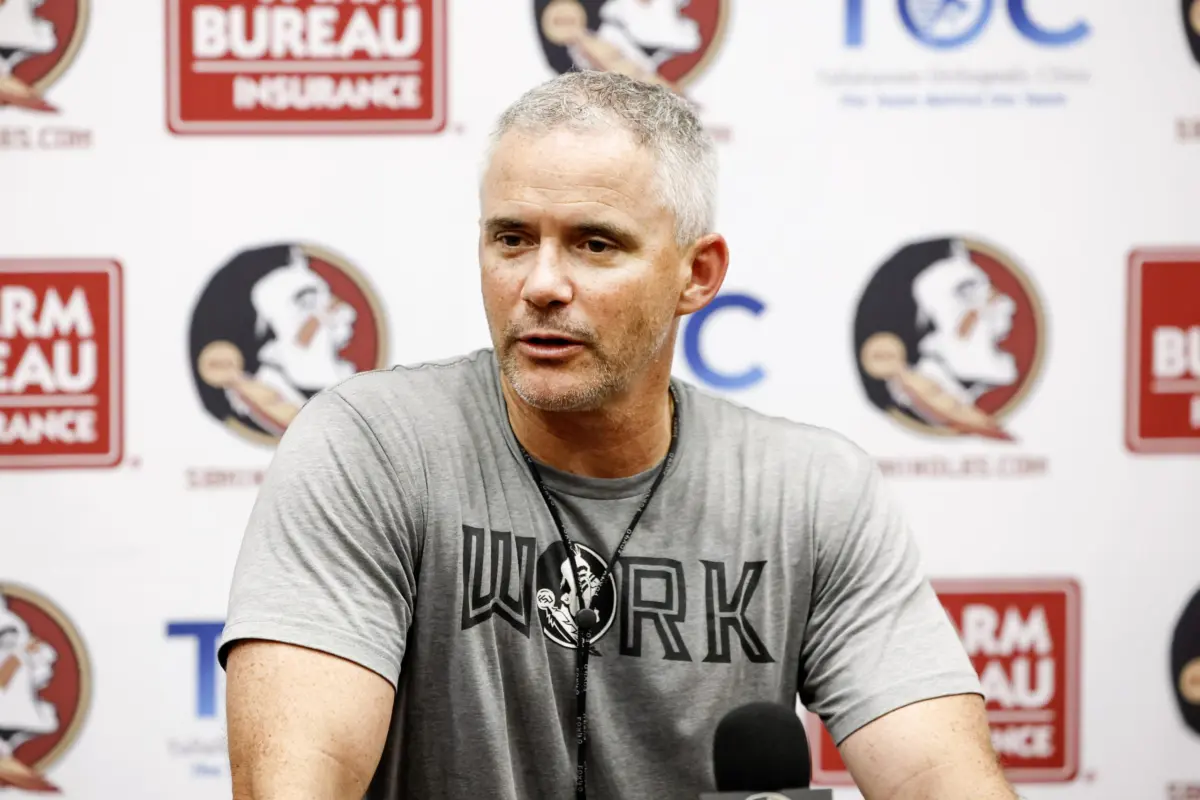
As head coach Mike Norvell strides into what many analysts and insiders consider a defining, make-or-break campaign for the Florida State Seminoles, his public rhetoric remains steadfastly optimistic. Stepping to the podium ahead of the 2026 season, Norvell has consistently projected a calm, authoritative self-assurance. He speaks in glowing terms about his roster’s returning veterans, the high-upside potential of incoming transfers and freshmen, and the hard-earned lessons extracted from a tumultuous two-year stretch that tested the foundations of the program. According to Norvell’s public-facing narrative, these elements combine to form a clear recipe for a bounce-back autumn.
Yet, a profound disconnect exists between the coach’s verbal optimism and his operational reality. A closer examination of Norvell’s actions reveals a program rapidly retreating behind an impenetrable wall of secrecy—a sharp, dramatic pivot from the culture of radical transparency that defined the early years of his tenure in Tallahassee.
For the first five seasons of Norvell’s leadership, the Florida State football program operated with a refreshing openness that set a gold standard in modern collegiate athletics. Reporters, beat writers, and media personnel were granted extensive access to spring and preseason workouts, routinely observing three full practices every single week. This accessibility persisted through wildly contrasting organizational environments: it was present during the grueling initial rebuild, remained fully intact throughout the magical 13-0 run to the Atlantic Coast Conference championship, and continued unchanged amid the devastating 2-10 collapse of the 2024 season.
That era of openness is officially over. Ahead of the 2025 season, FSU abruptly slashed media viewing access, transforming itself overnight into one of the most tightly guarded, inaccessible programs in the Football Bowl Subdivision (FBS). Now, as the calendar turns deeper into his tenure, Norvell is accelerating this isolationist strategy. During a Monday media availability session, the embattled head coach dropped another bombshell: Florida State will not release an official depth chart for the entirety of the 2026 season.
While a handful of major college football programs occasionally delay publishing depth charts until kickoff of their season openers in an effort to withhold granular personnel details from opponents, an outright, season-long refusal to release depth charts is virtually unprecedented in major-conference football. Coupled with reduced media access, alterations to weekly television programming, and a stark contrast in cultural transparency from other athletic programs on campus, Norvell’s defensive posture tells a compelling story. Words may project confidence, but actions tell the true story of a coach feeling the intense, suffocating heat of the hot seat.
Detailed Chronology: The Erosion of Transparency in Tallahassee
To understand the magnitude of Florida State’s current information blackout, one must trace the timeline of media relations under Mike Norvell from his arrival in Tallahassee to the present day. When Norvell was hired away from Memphis ahead of the 2020 season, college football was wrestling with unprecedented challenges brought on by the COVID-19 pandemic. Despite logistical hurdles, Norvell established a baseline of trust with the Fourth Estate that quickly became a hallmark of his cultural footprint.
The Era of Open Doors (2020–2024)
During his first five campaigns, Norvell bucked the paranoid, paranoid-shielded trends of modern college football coaching. While contemporary peers hid practices behind towering tarps, encrypted video feeds, and closed gates, Norvell welcomed the press. Reporters covering the Seminoles were permitted to watch the vast majority of spring drills and preseason camp sessions in their entirety. During the regular season, media members routinely attended three full practices per week.
Crucially, this access was never weaponized or made conditional based on wins and losses. Media members were courtside and field-side throughout the arduous foundational phase when the program was desperately accumulating talent and shedding dead weight. They were there to witness the agonizing close losses, the internal cultural shifts, and the grueling offseason workouts.
More importantly, that exact same open-door policy remained firmly in place during the historic 2022 and 2023 campaigns, which culminated in a legendary 19-game win streak, an ACC title, and a bitter, controversial exclusion from the College Football Playoff. Even more telling, that transparency survived the catastrophic freefall of the 2024 season, where a roster plagued by injuries and regression stumbled to a dismal 2-10 record.
Throughout that nightmare campaign, reporters continued to walk onto the practice fields three times a week. The presence of the media had zero correlation to the fluctuations of the scoreboard. The implied premise was simple: Norvell believed in his coaching methodology, his culture, and his players so thoroughly that he did not fear outside eyes watching the sausage get made.
The 2025 Inflection Point
The seismic shift occurred quietly ahead of the 2025 season. Without extensive public fanfare or elaborate explanation, the open-door policy was unceremoniously dismantled. Practices that were once open three times a week were suddenly locked down. Access was restricted to brief, highly curated viewing windows—often limited to the first fifteen minutes of stretching and individual drills—effectively shutting down any meaningful journalistic evaluation of scheme installation, positional battles, or tactical adjustments.
In a single offseason, Florida State transformed from one of the most accessible programs in the country into a black box. The decision baffled local and national reporters alike, especially given the historical precedent. The argument that media access somehow negatively impacted on-field performance held zero empirical weight; after all, the exact same media access policies had coincided with both a 13-0 championship season and a 2-10 disaster.
The 2026 Information Blackout
If the 2025 season represented a scaling back of access, the 2026 announcements marked a full-scale descent into informational isolation. On a Monday media session that sent shockwaves through the FSU beat, Norvell confirmed that the program has completely abandoned the practice of releasing depth charts for the upcoming season.
This move pushes the boundaries of modern college football gamesmanship. While programs like Clemson, Alabama, or Ohio State occasionally play coy with depth charts during game-week preparations—often listing co-starters with "OR" designations or rolling out placeholder rosters—an outright, proactive policy banning depth charts for an entire season is a radical departure from standard operational procedure. It strips fans, opponents, broadcasters, and historians of a basic administrative tracking tool that has existed for generations of gridiron history.
The information squeeze hasn’t stopped at the practice fields and depth charts. Even auxiliary program properties have felt the chill. Inside Seminole Football, the weekly coach’s show, was quietly converted into a closed studio production this season, completely eliminating the live in-person audience that historically injected energy into the broadcast. Technical hiccups compounded the distance, with the season’s premier episode plagued by an awkward audio delay. Inch by inch, brick by brick, the barriers between the Florida State football program and the public are being bolted shut.
Supporting Context & Metrics: A Contrast in Program Culture
The tightening grip around the football program becomes even more pronounced when viewed within the broader ecosystem of Florida State University athletics. While Norvell builds a fortress around the football facility, other high-profile programs on the very same campus are moving in the exact opposite direction.
Consider the FSU men’s basketball program. Entering his second season at the helm, head basketball coach Luke Loucks has enthusiastically embraced the role of the media-friendly ambassador of Tallahassee athletics—a crown once proudly worn by Norvell himself. Loucks has instituted an open-door policy for basketball practices that feels like a throwback to early-era Norvell football. Media members can essentially attend practices whenever they wish, and messaging from the basketball staff is transparent, conversational, and accessible.
This stark institutional contrast highlights that FSU athletic administration does not have a blanket, campus-wide mandate for isolationism. The decision to seal off the football program is an isolated, highly personal directive originating directly from Norvell’s office.
Furthermore, quantitative metrics of program performance paint a clear picture of why a coach might feel the psychological need to pull up the drawbridge. After climbing to the apex of the sport with a 13-0 record in 2023, the Seminoles plummeted back to earth with the aforementioned 2-10 campaign in 2024. While the program sought to recalibrate during the 2025 season, the margin for error in the modern, name-image-likeness (NIL) and transfer-portal era of college football is razor-thin.
When a program invests tens of millions of dollars into facilities, coaching salaries, and roster construction, a two-year downward trajectory brings immense institutional pressure. Job security is fleeting in the Atlantic Coast Conference, and boosters are notoriously impatient. By choking off the flow of information, Norvell is attempting to manage the narrative, insulate his players from external noise, and guard against any perceived competitive disadvantage—however minor—that public clarity might afford opponents.
Official Statements & Rationales: Decoding Norvell’s Explanations
Faced with mounting questions regarding his unprecedented decision to withhold depth charts for the entirety of the 2026 season, Mike Norvell used his Monday press conference to address the elephant in the room. Unsurprisingly, the head coach rejected the notion that the policy stems from fear of outside scrutiny or media pressure, framing the decision instead as an internal motivational strategy designed to benefit the players.
"Right now, guys know where they are. Every player wants more. That’s what it should be," Norvell told reporters on Monday. "You should want to be the starter. You should want to be the guy that plays the most plays. But also, on the flip side of it, if we come out with a depth chart today that says, well, this is what it looks like. Throughout the course of the week, there’s ups, downs, whatever that might be. Somebody puts themselves in position, well, the best players are going to play."
Norvell elaborated on the fluidity of a modern football roster during preseason camp, arguing that static pieces of paper do a disservice to the daily competition required to earn playing time.
"Just go have a great week. Whatever personnel groupings, if you’re a starter in, then you’re a starter. If you’re not, then continue to work and get better and put yourself in that position."
Analyzing the Rhetoric
While Norvell’s defense sounds noble on the surface—emphasizing a meritocracy where every practice rep matters and depth charts do not dictate destiny—it collapses under even modest scrutiny.
In reality, college football players possess an intimate, highly accurate understanding of the internal pecking order long before any public document is ever printed. They share locker rooms, compete directly against one another in daily scrimmage settings, and watch the film. They know precisely where they stand in the rotation. Withholding a depth chart from the media and the public does absolutely nothing to alter the psychological reality of the locker room.
Furthermore, every major college football coach in America manages weekly roster fluidity, internal competition, and the psychological fragility of backups. Yet, virtually all of them manage to release depth charts.
Therefore, Norvell’s rationale reads less like an innovative player-development philosophy and more like a carefully crafted rationalization for institutional defensiveness. By framing the information blackout as a protective measure for the athletes, Norvell attempts to deflect legitimate journalistic inquiries about an increasingly paranoid operational philosophy.
Future Outlook: The Stakes of the 2026 Season
Ultimately, Mike Norvell’s aggressive pivot toward absolute secrecy is a classic symptom of high-stakes pressure. Coaches do not build fortresses when they feel secure, relaxed, and confident in the stability of their empires; they build fortresses when they feel vulnerable, hunted, and acutely aware that the margins separating survival from termination have evaporated.
The irony of Norvell’s current trajectory is profound. The foundation of his early success in Tallahassee—the very magic that galvanized a dormant fan base and resurrected a historic brand—was built on a platform of fearless transparency. He proved to the college football world that a program could win big without adopting the paranoid, bunker mentality favored by traditional power-brokers. He invited the world in, backed up his words with on-field execution, and rode a 19-game win streak to the precipice of national immortality.
Now, as the walls continue to close in, that foundational philosophy has been thoroughly abandoned. The open doors have been bolted shut. The practices are hidden behind closed gates. The television show has been pulled into a sterile studio. And the depth charts have been permanently locked away.
Words are cheap in the hyper-competitive ecosystem of the Atlantic Coast Conference. Mike Norvell can step to the podium every Monday and project an air of unshakeable confidence, speaking poetically about roster depth, lessons learned, and cultural resilience. But his actions speak with a much louder, more revealing voice.
As the Seminoles kick off the 2026 campaign, the shroud of secrecy hanging over Tallahassee serves as an unmistakable neon sign. Mike Norvell knows what is at stake. He knows the clock is ticking, the fans are restless, and the program’s immediate future hangs in the balance. By battening down the hatches and locking out the world, Norvell has made his bed—and this autumn, he will have to live with whatever results follow, entirely on his own terms.

0 Comments