

Executive Overview
NEW YORK — Aryna Sabalenka has spent the better part of the summer looking like a woman completely untethered from the relentless pressures of professional sport. On her widely followed Instagram account, the world’s top-ranked women’s tennis player offers a portrait of serene leisure: lounging in designer bikinis in picturesque Mediterranean settings, posing fashionably in high-end couture, and vacationing in Greece alongside her fiancé. To the casual observer, life off the court looks idyllic.
On the court, however, the narrative is starkly different.
Entering the final Grand Slam of the year at the U.S. Open, the 28-year-old Belarusian is enduring her most turbulent competitive stretch in recent memory. Having failed to advance past the fourth round in her last several tournaments, Sabalenka arrives in New York looking distinctly vulnerable. She now faces a daunting historical challenge: attempting to become the first woman to capture three consecutive U.S. Open singles titles since Serena Williams achieved the feat from 2012 to 2014.
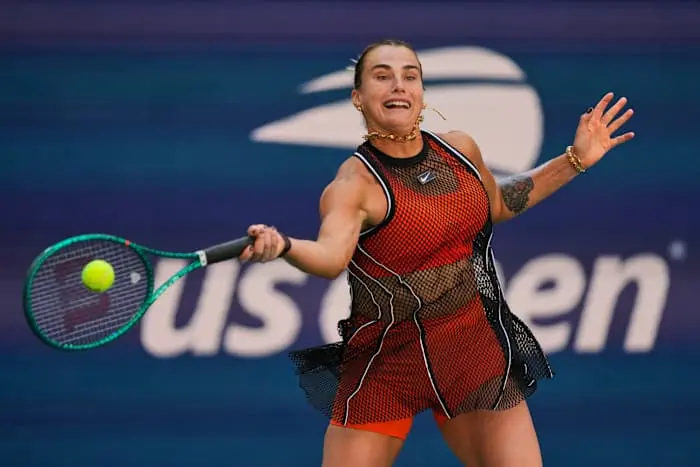
Yet, any suggestion that she is shaken, distracted, or spiraling is met with characteristic defiance. When queried by reporters about her sudden dip in form, Sabalenka offered a blunt retort: "Maybe there’s something wrong with people." Addressing critics who took aim at her bold, black mesh-covered court attire in New York, she doubled down on her autonomy: "Who cares about people, right? All matters for me is that I love it."
As Sabalenka steps onto the hard courts of Flushing Meadows, she does so with her coveted No. 1 ranking hanging in the balance, a restless field of pursuers closing in, and a narrative of lifestyle versus labor trailing her every move. This is the story of how tennis’s apex predator reached a critical crossroads—and why writing her off prematurely would be a grave miscalculation.
Detailed Chronology: From Early-Season Dominance to a Summer Slump
To understand Sabalenka’s current predicament, one must look back at the trajectory of her 2026 campaign, which initially promised complete, unassailable dominance.
The Spring Highs
Sabalenka launched the year with the ferocious intent that has come to define her career. Though she stumbled slightly at the Australian Open—falling in a hard-fought final to Kazakhstan’s Elena Rybakina—she quickly righted the ship during the grueling North American spring hard-court swing. Displaying an irresistible blend of baseline power and tactical maturity, Sabalenka captured back-to-back prestigious titles at Indian Wells and Miami, solidifying her grip on the summit of the WTA rankings.
Even when she was ousted in the fourth round of Wimbledon by Naomi Osaka, the defeat was largely contextualized as a minor blip on grass—a surface that has historically challenged the raw, flat trajectory of her groundstrokes. Analysts and fans alike assumed she would seamlessly transition back to her spiritual home: the fast, high-bouncing hard courts of North America, where her brute force has traditionally overwhelmed opponents.
The Mid-Summer Slide
Instead, the wheels unexpectedly came off.
The trouble began in Toronto at the National Bank Open, where Sabalenka was upset in the fourth round by Ekaterina Alexandrova. While a loss to a crafty veteran can happen to anyone, her performance in Cincinnati a week later signaled deeper-seated issues. Facing Czech player Sara Bejlek, Sabalenka uncharacteristically blew leads in both sets, crumbling down the stretch and visibly flashing the frustrated body language that had largely plagued her early-career losses years prior.
Her exit in Ohio left the tennis world buzzing with speculation. Had the physical demands of her schedule caught up to her? Was her legendary mental fortitude cracking under the immense weight of expectations?
When pressed by the press corps to diagnose her sudden vulnerability, Sabalenka kept her cards close to her chest. She refused to offer explicit excuses, yet openly acknowledged that all was not well behind the scenes.
"It wasn’t the best period," Sabalenka admitted candidly during her pre-tournament press conference in New York. "I don’t want to defend myself, but obviously I just don’t want to talk about that period. I’ve been dealing with several things."
Supporting Context & Metrics: The Price of Fame and the Social Media Scrutiny
Sabalenka’s rapid ascent to the top of women’s tennis has fundamentally transformed her life. At 28 years old, she commands multi-million-dollar endorsement portfolios, global brand partnerships, and a cultural footprint that extends far beyond sports media.
However, this commercial success has created a double-edged sword. In an era where athletes’ personal lives are broadcast in real-time via TikTok, Instagram, and X (formerly Twitter), every vacation, luxury outfit, and leisure moment is hyper-analyzed by a public that demands total athletic asceticism.
Following her summer losses, social media pundits and traditional commentators alike began questioning whether Sabalenka was spending too much time curating her off-court persona and not enough time fine-tuning her game.
The Defense from Within
Few people are better positioned to defend Sabalenka than her close friend and fellow WTA star Paula Badosa, who has frequently appeared alongside her in those very same viral vacation photos. Badosa forcefully pushed back against the narrative that Sabalenka’s lifestyle is corrosive to her competitive drive.
"She’s still No. 1 in the world. So I think the results are there," Badosa noted sharply when asked about the criticism. "Of course, everyone is going to expect for her to win every tournament. That’s very, very difficult. And at the moment, that one player is not winning what they expected. Of course, they’re saying that it’s because of the photo shoots or the TikToks and all this stuff."
Badosa pointed out the blatant hypocrisy of sports fandom: "I’m not going to lie, she’s been doing that since she was maybe out of the top 100. And when she was winning, nobody says anything, you know? And when she loses a couple of matches, it’s because of that. I think it’s none of it."
The Statistical Reality
Sabalenka’s dominance over the past three seasons remains unquestioned, yet her current ranking cushion is eroding. With fierce competitors like Elena Rybakina and Jessica Pegula stringing together deep tournament runs through the summer, the points gap at the top of the WTA ladder has narrowed significantly.
A lackluster performance at Flushing Meadows could mathematically strip Sabalenka of the No. 1 ranking she has fought so valiantly to attain and protect. The statistical pressure is immense, but history suggests that Sabalenka thrives when backed into a corner.
Official Statements: Defiance, Mental Reset, and Hard Lessons
Rather than ducking the mounting questions about her form, Sabalenka met the media head-on in New York, projecting an aura of calculated fearlessness. She views her recent slump not as a catastrophic failure, but as a necessary crucible that will forge her into a more formidable competitor.
"Who cares, right?" Sabalenka said, brushing off the critics who project their anxieties onto her results. "Yeah, I didn’t perform my best. These tough lessons are definitely going to make me way, way stronger and working even harder."
She emphasized that her primary focus over the past fortnight has been internal—specifically recalibrating her cognitive approach to high-stakes tennis.
"I work on my mental side of the game. I was trying to reset my mind and to come back stronger, so it’s only going to make me stronger. It’s only a matter of time for me to come back."
New York has historically been the theater of her greatest triumphs. It was here in 2024 that she shattered her Grand Slam hard-court glass ceiling by defeating Jessica Pegula in a pulsating final to claim her first U.S. Open crown. She returned the following year, displaying nerves of steel to defend her title against Amanda Anisimova.
When asked if the magic of Flushing Meadows could catalyze her resurgence, Sabalenka flashed a knowing smile. For her, adversity is simply part of the competitive contract.
"Well, that’s the beauty of the sport," she reflected. "Throw tough challenges at me, I will come back only stronger."
Future Outlook: Can the Queen of Hard Courts Defend Her Throne?
As the 2026 U.S. Open unfolds under the bright lights of Arthur Ashe Stadium, Aryna Sabalenka stands at the most critical juncture of her professional life.
The obstacles before her are formidable:
- The Historical Precedent: Matching Serena Williams’ feat of three consecutive titles requires navigating seven matches of elite, hyper-focused competition against opponents who have nothing to lose and everything to gain.
- The Ranking Threat: With Rybakina and Pegula breathing down her neck, she must go deep into the second week to secure her grip on the World No. 1 ranking.
- The Psychological Hurdle: She must translate her defiant off-court rhetoric into clean, clinical execution on the court, shaking off the ghost of her early-summer vulnerabilities.
Yet, to write off Aryna Sabalenka based on a turbulent four-week summer stretch ignores the very DNA of a champion. She is a player forged in fire, possessing one of the most devastating offensive arsenals the women’s game has ever witnessed.
Whether she hoards the championship trophy on the final Sunday in New York or falls short in her historic quest, one thing is certain: Sabalenka will do it entirely on her own terms—mesh outfit, social media posts, and unyielding fire included.

0 Comments