
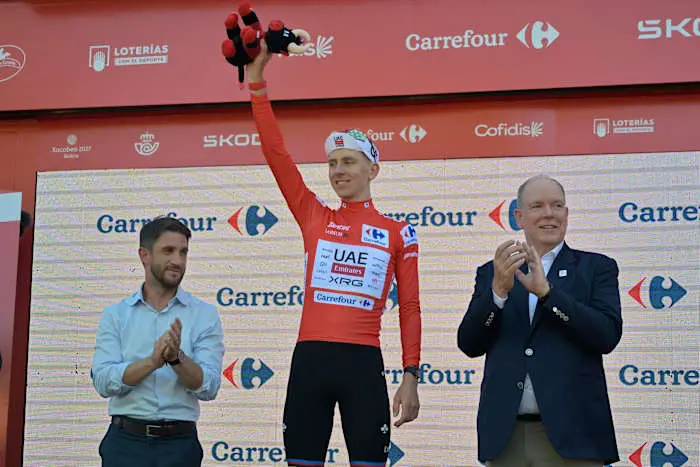

XERACO, Spain — In a dramatic twist that has sent reverberations across the international cycling community, five-time Tour de France champion Tadej Pogačar was forced to abandon the Vuelta a España on Saturday following a high-speed crash during the eighth stage.
The Slovenian superstar, riding for UAE Team Emirates, was the overwhelming favorite to secure the final Grand Tour crown missing from his glittering palmarès. Holding a commanding lead of nearly four minutes over his nearest general classification rivals, Pogačar’s catastrophic exit 33 kilometers from the finish line in Xeraco abruptly halts his historic bid to join cycling’s most exclusive club: the elite cohort of riders who have conquered all three Grand Tours—the Giro d’Italia, the Tour de France, and the Vuelta a España.
What was anticipated to be a routine, sprinter-friendly transitional stage along the sun-drenched Mediterranean coast instead devolved into a day of mourning for cycling purists, a chaotic scramble for the red jersey, and a sobering reminder of the unforgiving physical toll exacted by the sport at its highest level.
Executive Overview
The eighth stage of the 2026 Vuelta a España, covering a flat 171-kilometer (106-mile) route from Puçol to Xeraco, was designed to offer the peloton’s fast men a brief respite before the race plunged back into the punishing Pyrenean climbs. Instead, it will be remembered as the day the race lost its defining protagonist.
With approximately 33 kilometers remaining on the stage, a sudden disturbance in the peloton sent shockwaves through the front of the pack. Pogačar, navigating near the head of the race to stay out of trouble, was launched over his handlebars in a sickening crash. Initial television broadcasts and eyewitness accounts indicated that the UAE Team Emirates leader sustained heavy impacts to his head, left arm, and shoulder.
Despite valiant initial efforts to remount his bicycle, the visible severity of his injuries and an inability to bear weight on his arm forced a swift and heartbreaking resolution. Pogačar abandoned the race, walking gingerly toward a race ambulance accompanied by medical personnel.
The immediate fallout was monumental. Movistar’s Enric Mas inherited the red leader’s jersey, becoming the first Spanish rider to lead the Vuelta since Jesús Herrada in 2018. Meanwhile, the general classification was blown wide open, leaving a vacuum at the top of the race and casting an immediate shadow of uncertainty over the remainder of the three-week Spanish national tour, which concludes in Granada on September 13.
Detailed Chronology of Stage 8 and the Incident
The day began under idyllic late-August skies in Puçol, with the Mediterranean breeze gently rustling the palm trees and a relaxed atmosphere permeating the start village. For Tadej Pogačar, the morning carried the comfortable aura of a leader in absolute control. He had established a formidable cushion of 3 minutes and 50 seconds over Movistar’s Enric Mas, having stamped his authority on the opening week with characteristic panache.
The stage profile—entirely flat and tracing the eastern coast of Spain toward Xeraco—was earmarked for the sprinters’ teams, who immediately took control of the pace to reel in the day’s breakaway. For the first two-thirds of the stage, the peloton rolled along at a controlled tempo, riders chatting in clusters, drinking bidons, and managing the sapping Mediterranean heat.
The Crash at Kilometer 138
The tranquility evaporated with brutal suddenness at roughly 3:45 local time, with 33 kilometers left on the road to Xeraco.
According to preliminary race analysis and high-definition broadcast footage, the incident occurred near the front third of the main bunch as the peloton negotiated a slight narrowing in the road infrastructure. Pogačar appeared to swerve sharply to his right to avoid an unidentified obstruction or a sudden deceleration by a rider immediately ahead of him.
His front wheel clipped an adjacent bicycle or clipped the road edge, causing the Slovenian to lose instantaneous control. Lacking any time to brace himself, Pogačar was catapulted violently over his handlebars. He tumbled through the air before slamming hard onto the asphalt, absorbing the brunt of the kinetic energy with his left shoulder and head.
Several other riders were caught in the ensuing domino effect, skidding across the tarmac and tangling in a mass of carbon fiber and limbs, but the cameras—and the collective anxiety of the cycling world—were instantly locked on the red jersey lying motionless on the side of the road.
The Moments of Anguish
For several agonizing seconds, Pogačar remained prone on the tarmac as race doctors and UAE Team Emirates support staff rushed to his side. The champion slowly rose to a sitting position, visibly grimacing and holding his left arm in a protective, unnatural posture that immediately suggested a clavicle fracture or severe joint separation.
In a display of his legendary toughness, Pogačar attempted to defy his injuries. With the assistance of a teammate, he stood up, accepted a replacement bicycle, and tried to pedal. However, the physical reality quickly intercepted his competitive instinct. Unable to pull on the handlebars or absorb the minor vibrations of the road with his left arm, he stopped after a few pedal strokes, dismounted in clear distress, and walked slowly toward the waiting ambulance.
Race organizers officially confirmed his withdrawal minutes later, plunging the Vuelta into a radically altered reality.
Supporting Context & Metrics: The Grand Tour Quest Halted
To understand the magnitude of Pogačar’s exit, one must examine the unprecedented trajectory of his 2026 season and his historical ambitions within the sport.
Entering the Vuelta a España, Pogačar was operating at a level of athletic dominance rarely witnessed in modern cycling history. In July, he secured his third consecutive Tour de France victory, matching the legendary overall record of five career Yellow Jerseys. Earlier in the spring, he authored a masterclass at the Giro d’Italia, crushing the field en route to the Maglia Rosa.
Having skipped the Vuelta since his Grand Tour debut at the race in 2019—where he finished a breakthrough third overall and won three stages as a 20-year-old prodigy—Pogačar returned to Spain specifically to complete the elusive Triple Crown. Only eight men in the history of cycling have won all three Grand Tours over the course of their careers:
- Jacques Anquetil
- Felice Gimondi
- Eddy Merckx
- Bernard Hinault
- Alberto Contador
- Vincenzo Nibali
- Chris Froome
- Primož Roglič
Pogačar was poised to become the ninth. His statistical dominance heading into the eighth stage underscored just how comfortable that bid had been:
- Time Gap: 3 minutes, 50 seconds ahead of Enric Mas (Movistar)
- Stage Wins in 2026 Grand Tours: Multiple victories across both the Giro and Tour de France
- Nearest Competitors (Post-Stage 8):
- Enric Mas (Movistar): Now leading the race
- Felix Gall: Second overall, trailing Mas by 1:11
- Primož Roglič: Holding third place overall, poised to capitalize on his compatriot’s misfortune
Furthermore, the absence of his traditional arch-rival, Jonas Vingegaard—who was forced to skip the Vuelta entirely following his own severe crash during the Tour de France earlier this summer—had cleared the path for what many analysts projected to be an unopposed coronation in Madrid.
Official Statements and Immediate Reactions
The cycling world was quick to react to the catastrophe in Xeraco, with team management, rival riders, and race organizers expressing shock and solidarity.
UAE Team Emirates Management Statement:
"Tadej has been taken to a local medical facility for comprehensive diagnostic imaging following his crash on Stage 8. Initial assessments confirm significant impact trauma to the left shoulder and arm region. Our primary concern at this moment is the health and well-being of our rider. Further medical bulletins will be released as soon as clinical evaluations are complete."
Rival team directors and riders expressed profound sympathy, acknowledging that the race has fundamentally changed character with its central star sidelined.
Enric Mas (Movistar Team), speaking after inheriting the red jersey:
"Nobody ever wants to take the leader’s jersey under these circumstances. We came here to race against the best rider in the world, and Tadej was operating on another level. Seeing him crash and knowing the extent of his pain is a dark moment for the race. My thoughts are with him, and I hope for a very speedy recovery."
The stage itself continued to its conclusion despite the somber mood enveloping the finish line in Xeraco. In the bunch sprint, Cofidis rider Bryan Coquard delivered a tactical masterclass, timing his surge to perfection to claim the stage victory ahead of Mads Pedersen (Lidl-Trek) and Jordi Meeus (Red Bull-Bora-Hansgrohe). Yet, the podium ceremonies were subdued, stripped of the usual unbridled jubilation as the cycling world digested the day’s monumental loss.
Future Outlook: What Next for Pogačar and the Vuelta?
As the Vuelta a España pivots into its second week, the immediate sporting landscape has been completely redrawn.
The Battle for Red
With Tadej Pogačar out of contention, the race for the red jersey is suddenly wide open. Enric Mas inherits a fragile psychological and tactical advantage, but the Movistar leader will find himself under intense scrutiny from a hungry peloton. Austria’s Felix Gall sits 1:11 back, while veteran Slovenian powerhouse Primož Roglič lurks menacingly in third place, possessing the tactical acumen and team depth required to control a three-week race through the mountains. The upcoming Pyrenean stages will now serve as a tactical free-for-all, with aggressive racing guaranteed as rival teams sense a rare window of opportunity.
Pogačar’s Medical and Recovery Timeline
For Pogačar, the immediate future centers on medical diagnostics and orthopedic evaluation. A suspected collarbone fracture or severe acromioclavicular (AC) joint separation would not only end his 2026 season prematurely but could also necessitate surgical intervention and a prolonged rehabilitation period.
Given that the autumn monuments—such as Il Lombardia, where Pogačar has traditionally reigned supreme—are just around the corner in October, his ambitions to close out the year with another one-day classic triumph now hang in the balance. More critically, the cycling world will anxiously await updates regarding whether this injury will disrupt his foundational winter preparation for the 2027 campaign.
A Historic Milestone Delayed
The quest for the Triple Crown remains unfulfilled. While Pogačar’s career remains one of the most decorated in the annals of the sport, Saturday’s crash serves as a brutal reminder of cycling’s inherent volatility. No matter how immense a rider’s talent, the road is a cruel equalizer where history can be rewritten in a fraction of a second.
As the Vuelta snakes its way toward the high peaks and eventual finish in Granada on September 13, it does so in the shadow of what might have been—a historic coronation cut heartbreakingly short by the merciless laws of the tarmac.

0 Comments