

Executive Overview
In a decisive move aimed at unlocking real estate development and addressing urban stagnation along one of its most prominent thoroughfares, the Gainesville City Commission has voted to initiate the elimination of the 100-foot historic buffer zones surrounding the University Heights Historic Districts. The landmark 5-1 decision targets a policy established in 2017 that effectively capped building heights and restricted architectural density along the north and south sides of University Avenue.
For years, University Avenue has presented a stark visual and economic divide. While the southern corridor has transformed into a booming, transit-oriented arterial lined with eight- to ten-story mixed-use complexes catering to the University of Florida community, the northern corridor has remained frozen in time. Predominantly characterized by low-slung, single-story structures—including smoke shops, liquor outlets, and aging retail units—the northern strip has struggled to attract private capital or high-density housing proposals.
Under the approved motion, city planning staff have been directed to draft a land development code amendment that entirely removes the 100-foot buffer constraints within University Heights. Proponents argue that the legacy buffers created artificial development bottlenecks, resulting in blighted parcels, inefficient land utilization, and missed tax revenues. Critics and preservationists, however, maintain caution regarding the potential impact of high-density construction directly adjacent to historic neighborhoods.
The policy shift signifies a broader municipal pivot toward aggressive urban infill, density-driven economic development, and modern land-use efficiency along Gainesville’s primary academic and commercial spine.
Detailed Chronology & Legislative Mechanics
                         BUFFER AMENDMENT TIMELINE

   2017             PRESENT ACTION           INTERMEDIATE REVIEWS        JANUARY 2027
     |                    |                           |                       |
     v                    v                           v                       v
┌───────────┐      ┌──────────────┐          ┌──────────────────┐     ┌──────────────┐
│ 100-ft    │  ──► │ Commission   │  ──────► │ • Historic Board │ ──► │ Deadline for │
│ Buffers   │      │ Votes 5-1    │          │ • Plan Board     │     │ Final Return │
│ Enacted   │      │ to Repeal    │          │ • City Comm. Vote│     │ & Enactment  │
└───────────┘      └──────────────┘          └──────────────────┘     └──────────────┘
The 2017 Buffer Ordinance and Its Original Intent
The roots of the current policy debate trace back to 2017, when the Gainesville City Commission enacted a 100-foot buffer zone policy designed to insulate the University Heights Historic Districts from towering adjacent developments. As mid-rise and high-rise apartment complexes began proliferating near the University of Florida campus, municipal leaders sought a compromise between neighborhood preservation and commercial growth.
The 2017 ordinance mandated a transitional physical boundary: within 100 feet of an established historic district boundary, building heights were strictly suppressed to three stories (with a narrow exception allowing four stories in specific sectors of the southern historic district). Only after clearing this 100-foot perimeter could developers utilize the underlying base zoning entitlements. While intended to create a soft, step-down architectural transition between high-density corridors and quiet historic residential streets, the buffers ultimately generated unintended spatial and economic consequences along University Avenue.
The Thursday Commission Session & Eastman’s Deadline Motion
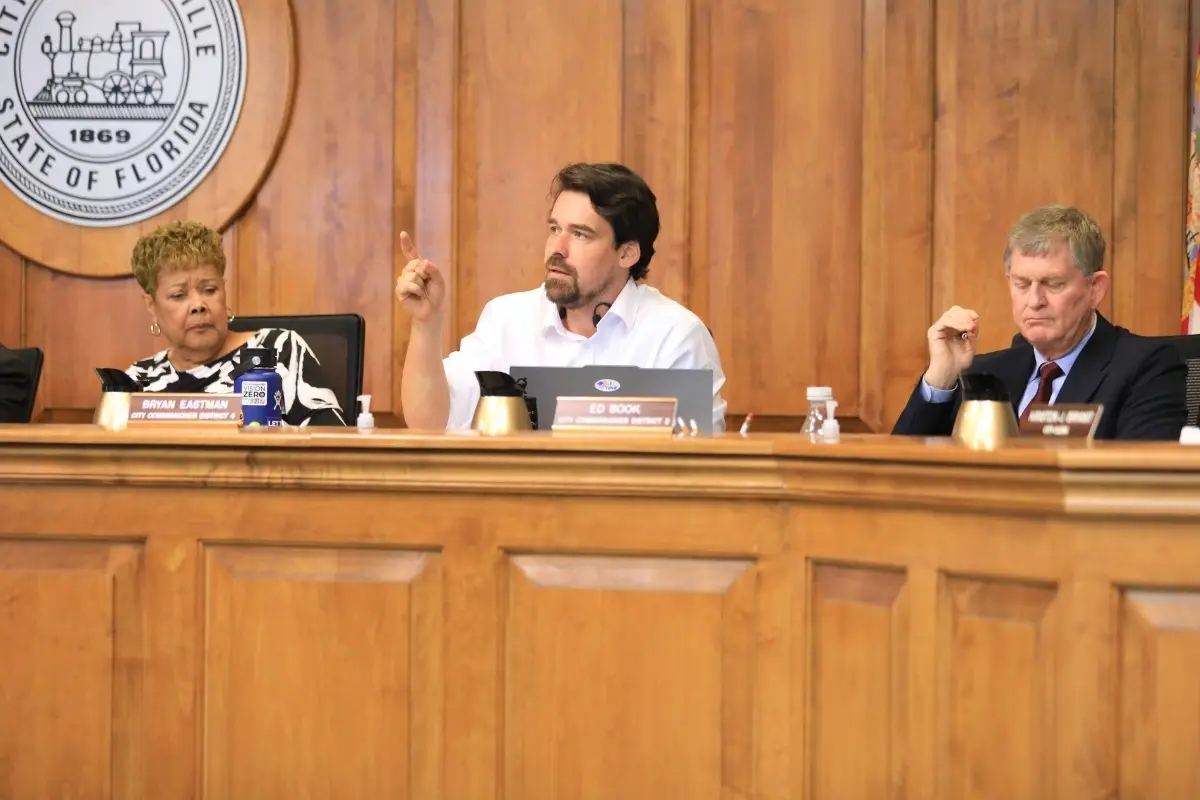
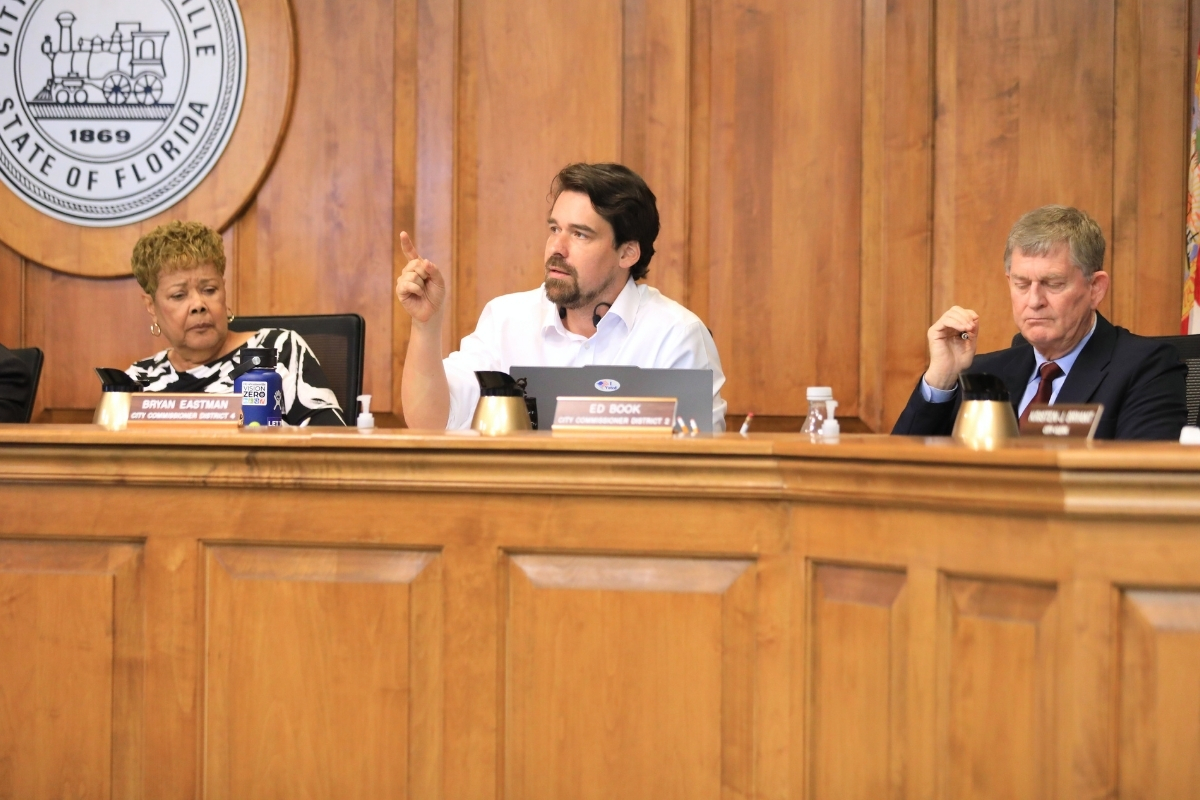
During a pivotal Thursday commission session, the debate over urban stagnation reached a tipping point. Commissioner Bryan Eastman introduced the core motion directing staff to draft the regulatory language needed to dismantle the University Heights buffers completely.
Reflecting growing frustration among commissioners regarding municipal administrative delays, Eastman included an explicit binding clause in his motion: city staff must return the completed code amendment for formal review and final commission action no later than January 2027.
"We asked about alcoholic beverage establishments two years ago," Eastman noted during the proceedings, highlighting how prolonged administrative studies have historically slowed commercial revitalizations along the corridor. Eastman emphasized that setting a hard timeline was essential to prevent critical urban planning revisions from sitting indefinitely in administrative queues.
The motion passed in a 5-1 vote. Commissioner Ed Book cast the sole dissenting vote, while Commissioner Desmon Duncan-Walker was absent from the rostrum.
The Regulatory Pathway Ahead
With the commission’s directive established, the repeal of the buffer zone must navigate a multi-tiered public and administrative review process before becoming law:
- Staff Drafting: City planning staff will draft the specific legal amendments modifying the Land Development Code to remove the historic buffer overlay within University Heights.
- Historic Preservation Board Review: The advisory board will review the proposed text to evaluate its historical impact and provide formal recommendations.
- City Plan Board Evaluation: As the city’s primary advisory body on land use and zoning, the Plan Board will conduct public hearings to evaluate consistency with Gainesville’s Comprehensive Plan.
- Final City Commission Vote: The City Commission will hold official public hearings and cast the decisive vote to enact the ordinance into municipal law.
Supporting Context & Tax Revenue Metrics
Architectural Paradox: North vs. South University Avenue
The real-world manifestation of the 2017 buffer rules created a sharp architectural and economic divergence along University Avenue.
- The South Side: Unencumbered by restrictive step-backs along major nodes, the southern flank of the avenue transformed into a modern high-density residential and retail sector. Towering eight- to ten-story developments now house thousands of residents, providing immediate access to transit, campus, and ground-floor commercial amenities.
- The North Side: Entangled in the complex geometry of the 100-foot buffer zones, the northern side of University Avenue experienced virtual development stagnation. Capital investment retreated, leaving behind decades-old, one- and two-story commercial facilities, convenience outlets, smoke shops, and vacant structures.
       NORTH VS. SOUTH UNIVERSITY AVENUE DEVELOPMENT DENSITY

       [NORTH SIDE: Stagnant Infill]
       ┌──────┐  ┌──────┐  ┌──────────────┐
       │1-Story│  │2-Story│  │ Smoke / Liquor│  ◄── Depressed Property Taxes
       └──────┘  └──────┘  └──────────────┘      (e.g., $3,540 / yr)
  ═════════════════════════════════════════════════════════════════════  [University Ave]
       [SOUTH SIDE: High-Density Mixed-Use]
       ┌──────────────────────────────────┐
       │                                  │
       │    8 to 10-Story High-Rises      │  ◄── Significant Tax Yields
       │   (Residential + Mixed Commercial) │      (e.g., $816,000 / yr)
       │                                  │
       └──────────────────────────────────┘
Comparative Economic Analysis: Property Tax Disparities
The fiscal impact of this zoning disparity is illustrated by municipal tax assessment data along University Avenue. High-density, multi-story developments generate substantial recurring tax revenue for municipal services, whereas underutilized single-story parcels yield negligible returns for the city’s general fund.
| Property Name / Identifier | Building Height / Use | Parcel Location / Characteristics | 2025 Municipal Property Tax Paid |
|---|---|---|---|
| The Standard | 8–10 Stories / Mixed-Use Residential | South Corridor Node | $816,000 |
| Sweetwater | 10 Stories / Mixed-Use Residential | South Corridor Node | $403,000 |
| The Hub | 8 Stories / Mixed-Use Residential | SE Corner University Ave & SW 12th St | $256,000 |
| Jungle Boys Parcel | 1 Story / Cannabis Dispensary | North Corridor (Zoned U9; buffer-restricted) | $6,686 |
| Gator Beverage | 1 Story / Retail Liquor | North Corridor (Directly across from The Hub) | $3,540 |
The economic contrast is starkest at the intersection of University Avenue and SW 12th Street. On the southeast corner, The Hub—an eight-story modern structure—contributed $256,000 in direct municipal property taxes to the City of Gainesville for 2025. Directly across the street on the northern side, Gator Beverage—a single-story commercial structure—contributed just $3,540 over the same annual period. Similarly, the nearby single-story parcel housing the Jungle Boys cannabis dispensary generated $6,686 in 2025 municipal property taxes.
Both the Gator Beverage and Jungle Boys properties sit on land designated under base zoning to accommodate structures up to eight stories with standard density bonuses. However, the legacy 100-foot buffer rules severely constrained the practical development envelope of these properties.
Spatial Mechanics of U9 Zoning and Geometric Buffer Constraints
The primary underlying land-use designation along this section of University Avenue is Urban 9 (U9) zoning. Under standard municipal guidelines, U9 zoning grants land owners key development rights:
- Base Entitlement: Automatic right to construct up to six stories by right.
- Bonus Entitlement: Ability to scale up to eight stories through standard municipal development bonuses (such as incorporating affordable housing units, energy-efficiency certifications, or structured public parking).
However, when the 100-foot historic buffer overlay is applied atop U9 parcels, it creates an intricate architectural conflict. Because the boundaries of the University Heights Historic Districts feature jagged, non-linear property lines, the 100-foot buffer boundary cuts irregularly through commercial parcels along University Avenue.
                  PARCEL IMPACT OF HISTORIC BUFFER

        [ Historic District Boundary (Irregular Geometry) ]
   ─────────────────┐                 ┌───────────────────────
                    │  100-FT BUFFER  │
                    ▼  OVERLAY ZONE   ▼
      ┌──────────────────────────────────────────────────┐
      │ Restricted Height Zone: Max 3 Stories            │
      ├──────────────────────────────────────────────────┤ ◄── Buffer Line
      │ Base U9 Zoning: Up to 8 Stories (With Bonuses)   │
      └──────────────────────────────────────────────────┘
      [ Parcel Fronting University Avenue ]
To build on a buffer-encumbered parcel under the 2017 rules, a developer would have to construct a complex "wedding cake" structure—building only three stories within the front 100 feet, and then stepping up to six or eight stories on the rear portion of the lot. For many typical commercial lot sizes along the northern strip, executing these multi-tiered step-backs proved architecturally impractical and economically unviable.
City staff originally suggested a partial modification: revising the buffer rules to allow eight-story buildings on U9 and Downtown-zoned properties within the buffer zone. However, commissioners pointed out during deliberations that base U9 zoning already allows eight-story structures via bonuses, and virtually no Downtown zoning exists within the specific University Heights buffer boundary. Consequently, staff conceded that removing the buffer entirely yields practically the same land-use outcome as the proposed revision, while eliminating unnecessary regulatory complexity.
Official Statements & Stakeholder Perspectives
Mayoral and Commission Directives
Members of the City Commission expressed unified concern over the continued deterioration of the northern University Avenue corridor under the current regulatory framework.
"We know what we currently have is not optimal for much of anybody. We have buildings on that side of University Avenue that are already for sale or falling down. It is the kind of empty that’s not getting better."
— Harvey Ward, Mayor of Gainesville
Mayor Ward further addressed the historic preservation balance, arguing that maintaining low-density buffer zones had failed to achieve its intended neighborhood preservation goals. He noted that neighboring historic residential districts gain little protection from preserving dilapidated commercial parcels, stating that residents in historic neighborhoods likely find low-slung smoke shops and vacant retail lots just as incompatible with neighborhood character as a modern six- to eight-story mixed-use building.
Commissioner Casey Willits echoed these concerns, emphasizing that regulatory barriers had induced artificial economic paralysis along a vital transit corridor. Willits noted that he and his colleagues perceived a clear "stagnation of development in that area," reinforcing the need to align zoning rules with contemporary urban housing demands.
Regulatory Frustrations and Policy Timelines
Commissioner Bryan Eastman framed the decision as a necessary administrative intervention to accelerate overdue land-use reforms.
"We asked about alcoholic beverage establishments two years ago. I’m tired of waiting years for development amendments to work through staff before returning to the commission."
— Bryan Eastman, Gainesville City Commissioner
By inserting a firm completion date of January 2027 into the passing motion, Eastman sought to ensure that city departments prioritize the zoning change and provide clear expectations to property owners and urban developers.
Grassroots & YIMBY Advocacy
Former Gainesville City Commissioner Adrian Hayes-Santos, who served on the rostrum when the original 2017 buffers were implemented, spoke during the public comment portion of the meeting on behalf of the advocacy group Gainesville Is For People.
Hayes-Santos urged the commission to completely eliminate the buffer constraints, framing the decision as a vital opportunity to expand housing supply, reduce urban sprawl, and optimize municipal revenue.
       ADVOCACY PERSPECTIVES ON BUFFER ELIMINATION

  ┌─────────────────────────────────────────────────────────┐
  │              GAINESVILLE IS FOR PEOPLE                  │
  │               (Urban Density Advocate)                  │
  ├─────────────────────────────────────────────────────────┤
  │ • Expands total urban housing supply near UF campus     │
  │ • Maximizes municipal property tax revenues             │
  │ • Prevents low-density urban sprawl                     │
  │ • Restores economic vitality to commercial corridors    │
  └─────────────────────────────────────────────────────────┘
Hayes-Santos argued that urban land directly adjacent to a major research university represents the ideal location for high-density residential infill. He highlighted the fiscal disparity between low-density commercial units and dense mixed-use projects, pointing out that expanding the tax base through infill development provides essential funding for citywide public services and infrastructure without raising tax rates on single-family homeowners.
The Dissenting View & Preservation Concerns
The 5-1 vote was not without opposition. Commissioner Ed Book cast the lone dissenting vote, reflecting lingering concerns regarding the pace of density expansion and its proximity to historic residential neighborhoods.
While the majority of the commission moved to eliminate the buffers along University Avenue, leaders took explicit steps to define the boundaries of the policy shift. Commissioners stressed that the repeal action is strictly localized to the University Heights corridor along University Avenue. The commission confirmed it has no plans to dismantle or alter historic district buffer zones in other residential historic districts across Gainesville.
Future Outlook & Urban Transformation Roadmap
Projected Development Impact by 2027
The directive to eliminate the University Heights historic buffers marks a significant shift in Gainesville’s long-term growth strategy. By clearing the path for baseline U9 zoning entitlements along northern University Avenue, the city is clearing the way for substantial private investment along the corridor.
              DEVELOPMENT FORECAST: 2026–2030+

   2026                 2027                 2028–2030+
    │                    │                       │
    v                    v                       v
┌───────────┐      ┌──────────────┐      ┌──────────────────────────┐
│ Formal    │  ──► │ Ordinance    │  ──► │ Private Capital Infill:  │
│ Public    │      │ Finalized;   │      │ • 6-to-8 Story Projects  │
│ Hearings  │      │ Buffers      │      │ • Multi-Family Housing   │
│ & Reviews │      │ Rescinded    │      │ • Expanded Tax Yields    │
└───────────┘      └──────────────┘      └──────────────────────────┘
Urban planning analysts expect several structural changes to unfold as the code amendment moves toward final adoption by 2027:
- Parcel Assemblage: Developers are likely to target aging single-story commercial parcels along the northern side of University Avenue, consolidating small lots to construct modern mid-rise residential facilities.
- Housing Capacity Expansion: Eliminating buffer-induced step-backs will allow developers to maximize unit yields per acre, bringing hundreds of new residential units within walking and transit distance of the University of Florida campus.
- Tax Base Growth: Replacing low-yield commercial properties with high-density mixed-use developments could significantly increase municipal tax revenues along the northern strip, narrowing the revenue gap with the southern side of the avenue.
- Streetscape Modernization: Redevelopment mandates will require updated sidewalk infrastructure, integrated transit stops, urban landscaping, and pedestrian-oriented ground-floor retail, transforming the visual corridor.
Scope Containment & Broader Historic District Safeguards
As Gainesville moves to codify the buffer removal, municipal leaders remain focused on balancing growth with neighborhood identity. By restricting the buffer elimination specifically to the commercial parcels fronting University Avenue in University Heights, the commission aims to foster high-density urban growth on major transit corridors while maintaining traditional protections for interior historic neighborhoods.
If approved following review by the Historic Preservation Board, the City Plan Board, and final commission votes, the ordinance will conclude a ten-year experiment with edge buffers along University Avenue—opening a new chapter of high-density, transit-oriented development for Gainesville’s core commercial corridor.

0 Comments