

Executive Overview
A horrifying sequence of events in the village of Washington Park, Illinois, has left one man dead, a woman injured, and an entire community gripped by fear. On Thursday evening, a pack of highly aggressive, feral stray dogs launched two separate attacks within a span of two hours. The second attack proved fatal, claiming the life of an unidentified man who was brutally mauled while taking a routine work break outside a rental property.
The tragedy has not only raised urgent concerns regarding public safety and the control of feral animal populations in the Metro East region of St. Louis but has also exposed a critical, troubling breakdown in communication between local law enforcement and county-level animal control services. While the Washington Park Police Department asserts that they immediately reached out to St. Clair County Animal Services during both emergency calls, county officials claim they were not notified of the situation until the following afternoon.
As a multi-agency investigation begins, the residents of Washington Park find themselves living in a state of hyper-vigilance. Meanwhile, local authorities face tough questions regarding municipal resources, emergency dispatch protocols, and the systemic challenges of managing stray animal populations in economically distressed communities.
Detailed Chronology of the Attacks
The terror that unfolded on the evening of Thursday, August 27, was not a sudden, isolated aberration, but rather a compounding emergency that escalated over several hours.
[Thursday, Early Evening]
First Attack: A woman is bitten by a pack of stray dogs.
Emergency dispatch receives the first 911 call.
         │
         ▼ (2 Hours Later)
[Thursday, Late Evening]
Second Attack: An unidentified male worker is ambushed by the same pack.
The victim is dragged into a ditch; neighbors hear agonizing screams.
         │
         ▼
[Police Response]
Officers arrive, encounter the aggressive pack, and open fire.
The injured pack flees into the nearby wooded area.
         │
         ▼
[Friday Afternoon]
St. Clair County Animal Services claims they are first notified of the incident.
A massive multi-agency search for the feral dogs begins.
The First Warning Sign
The crisis began in the early evening hours of Thursday. According to dispatch logs, a resident reported that a woman had been attacked and bitten by a pack of free-roaming, aggressive dogs. Washington Park police officers responded to the scene, documented the incident, and attempted to locate the animals. Recognizing the severe threat posed by a coordinated group of aggressive canines, local police state they immediately requested assistance from St. Clair County Animal Services—the regional entity equipped with the specialized gear and tranquilizers necessary to safely capture feral animals.
However, no animal control units arrived on the scene, and the pack remained at large, retreating temporarily into the overgrown, wooded lots that characterize portions of the Washington Park landscape.
The Fatal Ambush
Approximately two hours after the initial attack, the same pack struck again with devastating lethality.
An unidentified male contractor was working on the rehabilitation of a local rental property. Seeking a brief respite, the man stepped outside onto the property’s perimeter for a smoke break. He was entirely unaware that a pack of at least five large, feral dogs was stalking the immediate area.
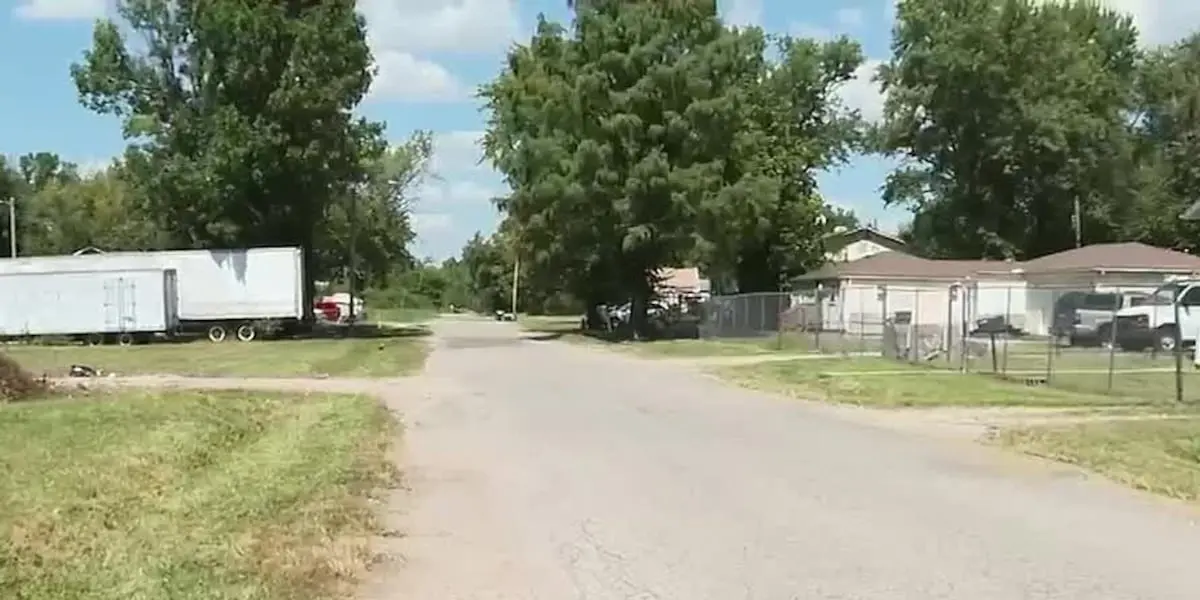
Without warning, the pack ambushed the worker. The sheer physics of the assault was overwhelming: the dogs targeted his limbs, knocking him off balance, before dragging his body across the asphalt street and deep into a roadside drainage ditch.
A Neighbor’s Harrowing Account
Mike Tomlin, a resident of the Washington Park neighborhood, was nearby when the violence erupted. The sheer brutality of the attack was audible from his home.
"I heard the man screaming, and then I could hear dogs," Tomlin recalled, his voice shaken by the memory. "I mean, he was screaming for his life. I realized he was getting mauled by some dogs."
Tomlin and other neighbors rushed to see what was happening, but the speed and ferocity of the pack made immediate physical intervention highly dangerous without firearms or heavy defense tools.
Police Intervention and Confrontation
When Washington Park police officers arrived at the active scene, they found the dogs actively attacking the victim in the ditch. As officers approached, the pack did not scatter; instead, emboldened by their numbers, several of the dogs turned their aggression toward the armed officers.
Sensing an immediate threat to their own lives and attempting to save the victim, officers discharged their duty weapons, striking and injuring several members of the pack. The gunfire broke the pack’s cohesion, sending the wounded and surviving dogs fleeing into a nearby dense, wooded tract of land.
Paramedics rushed to the ditch, but the victim’s injuries were catastrophic. The man was pronounced dead at the scene, having suffered extensive, deep-tissue bite wounds across his face, torso, arms, and legs.
Supporting Context & Metrics: The Crisis of Feral Canine Packs
To understand how a tragedy of this magnitude occurs, it is necessary to examine the broader ecological and socio-economic factors governing stray animal populations in post-industrial and economically challenged municipalities.
The Dynamics of Feral Pack Behavior
Domesticated dogs (Canis lupus familiaris) that are abandoned or born into the wild quickly revert to ancestral pack behaviors to survive. While a single stray dog rarely poses a lethal threat to an adult human, a pack of five or more operates under a collective psychology:
- Pack Mentality: Individual fear of humans is suppressed by the collective confidence of the group.
- Territorial Aggression: Packs claim specific hunting grounds, often utilizing abandoned homes, vacant lots, and wooded buffers as dens.
- Predatory Sequence: The presence of a stationary or slow-moving human (such as a person on a break) can trigger a predatory chase instinct, particularly if the animal is starving or diseased.
Municipal Challenges in the Metro East Region
Washington Park, a village in St. Clair County, Illinois, has struggled for decades with population decline, economic disinvestment, and an abundance of vacant properties.
| Metric / Indicator | Impact on Animal Control |
|---|---|
| High Vacancy Rates | Abandoned homes and overgrown lots provide ideal shelter and breeding grounds for feral dog populations. |
| Underfunded Municipal Budgets | Small villages lack the tax base to maintain dedicated, 24/7 municipal animal control departments. |
| Reliance on County Services | Local police forces are forced to rely heavily on county-level agencies for specialized animal capture and containment. |
According to national statistics compiled by organizations such as the Centers for Disease Control and Prevention (CDC) and the Humane Society:
- Approximately 4.5 million people are bitten by dogs each year in the United States.
- Fatal attacks remain statistically rare (averaging 30 to 50 per year nationwide), but a disproportionate number of these fatal encounters occur in rural or economically marginalized urban areas where stray populations are poorly controlled.
- Feral packs, as opposed to owned, loose pets, account for a small but highly lethal percentage of these fatal incidents.
Official Statements and Institutional Friction
A central focus of the ongoing investigation is the stark contradiction between the accounts provided by the Washington Park Police Department and St. Clair County Animal Services. This discrepancy highlights a potentially systemic failure in emergency communications.
┌────────────────────────────────────────┐     ┌────────────────────────────────────────┐
│   Washington Park Police Department    │     │    St. Clair County Animal Services    │
├────────────────────────────────────────┤     ├────────────────────────────────────────┤
│ • Contacted County during BOTH 911     │     │ • Claimed no knowledge of either       │
│   calls (the bite & the fatal attack). │     │   incident until Friday afternoon.     │
│ • Requested immediate assistance       │     │ • Noted a significant delay in direct  │
│   due to the high threat level.        │  ──►│   notification and dispatch logs.      │
└────────────────────────────────────────┘     └────────────────────────────────────────┘
The Police Department’s Position
Washington Park Police Chief and department spokespersons have been resolute in their timeline. According to departmental statements, dispatchers recognized the danger immediately during the first non-fatal attack. They assert that formal requests for mutual aid and specialized animal control assistance were routed to St. Clair County Animal Services during both the first call (the bite incident) and the subsequent fatal attack.
Police argue that had county animal control units responded to the first call two hours prior, the feral pack might have been dispersed or captured before the fatal encounter could take place.
The County’s Rebuttal
In a contrasting statement provided to local news outlet First Alert 4, officials with St. Clair County Animal Services denied receiving timely notification.
County representatives stated they did not learn of either the initial biting of the woman or the subsequent fatal mauling of the contractor until Friday afternoon—nearly 18 hours after the fatal attack occurred.
The county has initiated an internal audit of their dispatch logs, radio communications, and digital intake systems to determine if a technical glitch, dispatch human error, or jurisdictional miscommunication caused this catastrophic delay.
Future Outlook & Community Safety
The immediate priority for Washington Park and St. Clair County authorities is the neutralization of the active threat. However, the long-term challenges of policy, infrastructure, and community healing present a complex path forward.
The Active Hunt for the Pack
A coordinated search effort is currently underway in the wooded areas surrounding Washington Park. Armed with specialized traps, tranquilizer rifles, and thermal imaging drones, county animal control officers and local police are combing the brush.
Because several of the dogs were shot and wounded by responding officers, investigators warn that the surviving animals may be highly defensive, unpredictable, and aggressive. Officials have urged the public to exercise extreme caution.
Neighbor Hood Vigilance and Fear
For the residents of Washington Park, the tragedy has shattered their sense of daily security.
"I’m being real careful," said Mike Tomlin, reflecting the sentiments of his neighbors. "I’m looking out. You can’t just walk around without looking over your shoulder now. We know those dogs are still out there in the woods."
Parents have been advised to keep children indoors, and pet owners have been warned not to leave domestic animals outside unattended until the entire pack has been accounted for.
Policy Implications and Necessary Reforms
To prevent a repeat of this tragedy, local leaders and public safety experts are calling for several immediate reforms:
- Unified Dispatch Protocols: Streamlining the communication pipeline between local municipal police departments and county-level specialized services (such as Animal Control) to ensure real-time emergency dispatching.
- Increased Funding for Animal Control: Allocating state or federal grant money to St. Clair County to increase the number of active animal control officers and vehicles, particularly during night shifts.
- Blight Mitigation: Addressing the systemic issue of abandoned properties in the Metro East region, which serve as the primary harbor for feral canine populations.
- Community Reporting Initiatives: Establishing a direct, rapid-response hotline for residents to report sightings of stray or aggressive dog packs before they can cause harm.
As Washington Park mourns the loss of a worker who was simply trying to earn a living, the pressure on local and county officials to resolve their communication failures and secure the neighborhood continues to mount. The investigation into both the timeline of the 911 calls and the whereabouts of the feral pack remains active.

0 Comments