

Executive Overview
TALLAHASSEE, Fla. — On paper, a 17-point victory to open the college football season is rarely cause for alarm. When a powerhouse program enters a matchup favored by more than 30 points, however, the narrative changes entirely. Such was the case this past Saturday afternoon at Doak Campbell Stadium, where the Florida State Seminoles secured a 34-17 win over the visiting New Mexico State Aggies to kick off their campaign at 1-0.
Yet, as the final whistle blew and the stadium lights cut through the humid North Florida air, the prevailing emotion inside the Seminoles’ locker room was not unbridled celebration, but rather a sobering realization of the work that lies ahead. Despite controlling the scoreboard for most of the contest, Florida State never truly imposed its will in the manner expected of an Atlantic Coast Conference contender. The performance was marred by self-inflicted wounds, structural lapses in the secondary, and an inability to consistently penetrate the line of scrimmage against an overmatched opponent.
In the wake of the victory, head coach Mike Norvell did not mince words during his post-game media session, immediately pointing the spotlight toward the areas of concern that must be ironed out before tougher tests arrive.
“It didn’t go exactly the way we wanted in certain aspects," Norvell admitted candidly. "There’s some miscommunications, some things that, in the first game, you want to eliminate as much as possible, or limit as much as possible. Obviously, it cost us in some inopportune moments. We had some penalties that put us in difficult situations. They had a touchdown called back, that was a four-point swing. We had a blown coverage that cost us, a couple of touchdowns that, unfortunately, you just can’t have. And then, throughout the course of the game, just a lot of areas where we’re going to be able to grow and continue to push to get better.”
To fully understand where Florida State stands as they prepare for a critical early-season matchup against the SMU Mustangs, one must look beyond the final score. A deep dive into the analytics reveals a game defined by distinct dichotomies: a dynamic, multi-phase breakout performance by junior running back Sam Singleton Jr. that highlighted the offensive upside, countered by alarming defensive vulnerabilities on third down and a troubling lack of disruption in the trenches.
Detailed Chronology: How the Opener Unfolded
The afternoon began with high expectations as the Seminoles took the field under a pristine Florida sky. Anticipation had built all offseason around a retooled offensive scheme and a defense expected to reload rather than rebuild. Early on, those expectations flickered to life.
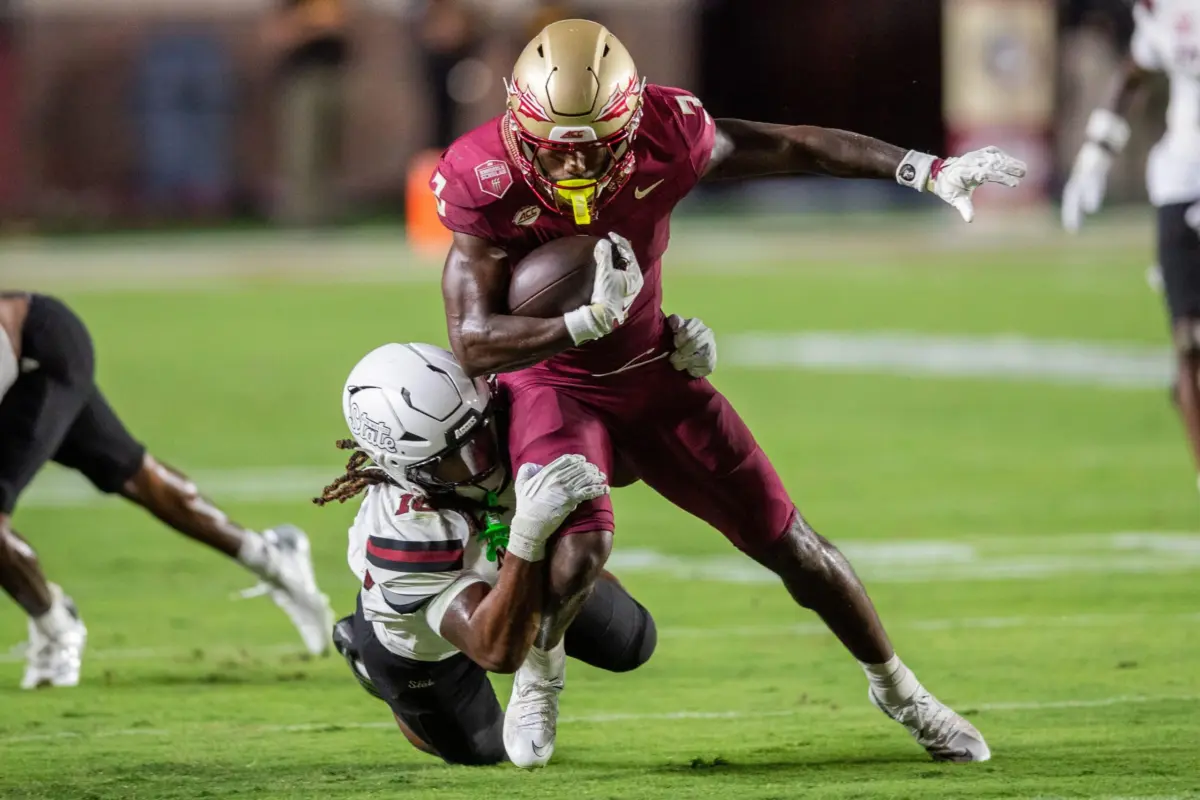
After a feeling-out process in the opening minutes, Florida State struck first, thanks largely to an explosive play manufactured by Singleton. Operating out of the backfield, Singleton reeled in a short pass from quarterback Ashton Daniels and turned it into a breathtaking 35-yard catch-and-run deep into Aggies territory. The play provided the spark the offense desperately needed, setting up the game’s opening touchdown and injecting energy into the home crowd.
However, the momentum proved fragile. Throughout the first half, New Mexico State quarterback Trey Hedden managed to keep the Aggies within striking distance by exploiting soft coverage and getting the ball out of his hands with surgical precision. While FSU held a comfortable advantage heading into the locker room, the halftime adjustments painted a picture of a team struggling to execute its fundamental assignments.
As the second half commenced, the Seminoles managed to stretch their lead through a balanced offensive attack, utilizing both Singleton’s versatility and efficient work from the remainder of the running back rotation, including Tre Wisner. Yet, every time Florida State appeared poised to break the game wide open and trigger a running-clock scenario, a yellow flag or a sudden defensive lapse would stall their progress.
A prime example arrived in the third quarter when a miscommunication in the FSU secondary resulted in a wide-open New Mexico State touchdown pass—one of several explosive plays surrendered by the Seminole defense. Though the Aggies had another touchdown nullified by a penalty (a crucial four-point swing that ultimately saved the defense from further embarrassment), the damage was done. The Aggies converted high-leverage situations with alarming regularity, converting 10 of their 17 third-down attempts.
The fourth quarter was largely a war of attrition. FSU leaned on its rushing attack to milk the clock and secure the 34-17 final margin, but the closing minutes lacked the authoritative stamp that fans and coaching staff alike had envisioned when the schedule was released. The victory was secured, but the mission statement for the week ahead was immediately clear: execution must improve exponentially.
Supporting Context & Metrics: One Step Forward, Two Steps Back
To evaluate the true nature of Florida State’s season-opening performance, analysts and coaching staffs rely on advanced metrics that strip away the noise of a final score. A breakdown of three critical data points from Saturday’s contest reveals a vivid snapshot of one major positive and two glaring concerns ahead of the showdown with SMU.
1. 164 Yards: Sam Singleton Jr.’s All-Purpose Masterclass
Amidst the offensive inconsistencies, the brightest spot for the Seminoles was undeniably the performance of junior running back Sam Singleton Jr. While significant offseason hype had centered around fellow back Ousmane Kromah, it was Singleton who seized the moment, earning the starting nod and delivering a career-defining performance.
Singleton accumulated 164 all-purpose yards, showcasing an elite blend of speed, vision, and pass-catching ability. He hauled in a career-high four receptions—matching his entire career total entering the season—for a team-leading 54 receiving yards and a touchdown. Furthermore, he added 42 yards and another score on the ground, supplemented by a dazzling 46-yard kickoff return that altered field position in a flash.
According to Pro Football Focus (PFF), Singleton earned an elite 80.8 receiving grade, the highest mark on the FSU offense. By acting as a reliable safety valve in the passing game, he alleviated immense pressure on quarterback Ashton Daniels, particularly when New Mexico State loaded the box to stop the deeper routes. Even with Tre Wisner performing efficiently on minimal touches (averaging 8.5 yards per carry), Singleton cemented his status as a foundational pillar of the Seminoles’ offensive architecture moving forward.
2. 77%: Trey Hedden’s Third-Down Efficiency
While the offense found dynamic solutions in the backfield, the defensive side of the ball wrestled with persistent structural failures—none more damaging than their inability to get off the field on third down.
New Mexico State quarterback Trey Hedden carved up the FSU secondary when it mattered most, completing 77% of his third-down passes. Specifically, Hedden went 10-for-13 for 158 yards and two touchdowns on third down alone. Both scoring tosses were deep shots exceeding 30 yards that capitalized on soft coverage schemes and a lack of interior pass rush.
The Aggies executed their game plan flawlessly, maintaining a blistering average time-to-throw of just 2.3 seconds, per PFF. This quick-release strategy neutralized FSU’s pass rush while exploiting blown coverages and poor leverage in the defensive backfield. Time and again, the Seminoles won the early downs, only to surrender drive-extending conversions in high-leverage moments.
3. 5%: The Troubling Defensive Run Stuff Rate
Beyond the aerial struggles, a deeper look into the trenches raises legitimate questions about the physical dominance of the Florida State front seven. While the box score showed that FSU limited New Mexico State to a respectable three yards per carry (when adjusting for sacks), analytics from GameOnPaper revealed a concerning metric: a defensive run stuff rate of just 5%.
The Seminoles managed to stuff only one designed run behind the line of scrimmage all afternoon—recording a single tackle for loss that was not a sack. While this deficiency did not ultimately cost them the game against an overmatched opponent (the Aggies logged a modest minus-0.08 EPA per rush), it serves as a red flag. Against an Atlantic Coast Conference opponent with a superior offensive line and a bruising rushing attack, an inability to win—let alone dominate—the line of scrimmage could prove catastrophic.
Official Statements: Inside the Post-Game Locker Room
The mood in the post-game press conference room at Doak Campbell Stadium was measured and analytical. Head coach Mike Norvell projected neither panic nor complacency, choosing instead to address the locker room’s shortcomings with direct accountability.
When pressed about the defensive breakdowns on third down, Norvell pointed squarely to communication and execution errors that fall directly on coaching and player preparation.
“There’s some of the anticipation throws, I think right off three of the third and long were things that we were in control of and did not execute, whether it’s communication, leverage, the overall assignment, those are things that we’ve got to own and improve upon,” Norvell stated.
He continued, emphasizing the need to eliminate self-inflicted wounds that grant opponents extended life: “What we can’t have is where it’s self-inflicted where we’re not putting ourselves in the best position to be able to get off the field. That happened too many times tonight, but, we’re going to get that corrected.”
Turning to the offensive side of the ball, Norvell was glowing in his praise of Sam Singleton Jr., validating the hard work the junior put in throughout grueling fall camp sessions.
“Sam’s a guy that’s a really talented football player,” Norvell said. “He’s growing, just in all areas. I was proud of him to see his impact in all three phases of it. The return game had a big kickoff return. Obviously, you had some good runs, but then you’re also catching the ball out of the backfield was great to see and to see his confidence growing in what we do.”
Norvell noted that Singleton’s multi-dimensional skill set matched the coaching staff’s preseason projections: “I envisioned him and the explosiveness he has in the different areas that he could impact, and I think he saw the same thing. It was a great start for him to this season, and we’re expecting big things as we continue to move forward.”
Future Outlook: The Road Ahead and the SMU Test
As the calendar turns toward Week 2, the Florida State coaching staff faces a race against time. The margin for error in college football narrows dramatically with each passing week, and the competition is about to scale upward significantly.
The upcoming matchup against the SMU Mustangs presents an entirely different tier of athletic and tactical challenge. SMU features an explosive offensive system capable of punishing the exact kinds of defensive lapses, blown coverages, and soft third-down zones that New Mexico State successfully exploited. If FSU’s secondary allows opposing quarterbacks to operate with a 2.3-second release time and convert at a 77% clip on money downs, the scoreboard operator in Tallahassee will be working overtime.
Furthermore, the defensive line must find ways to generate backfield penetration. A 5% run-stuff rate will simply not suffice when facing conference opponents who feature physical, downhill rushing schemes. Defensive coordinator and position coaches will undoubtedly spend long hours in the film room this week working on leverage, hand placement, and gap integrity to ensure the front seven establishes a more authoritative physical presence.
On the offensive side, the blueprint is much clearer. The emergence of Sam Singleton Jr. as a premier, all-purpose weapon gives offensive coordinators a dynamic chess piece to deploy alongside a deep running back room and a steady passing attack. If Daniels can build upon his chemistry with Singleton and the wider receiving corps while cleaning up procedural penalties, the Seminoles’ offense has all the makings of an elite unit.
Ultimately, Week 1 served its primary purpose: it yielded a victory and entered a "W" into the left-hand column. But for a program with championship aspirations, the 34-17 triumph over New Mexico State was ultimately a diagnostic exercise. It laid bare the flaws that must be eradicated, the stars who are ready to shine, and the urgent developmental tasks required to transform a talented roster into a polished, championship-caliber contender. The real test begins now.

0 Comments