

Executive Overview
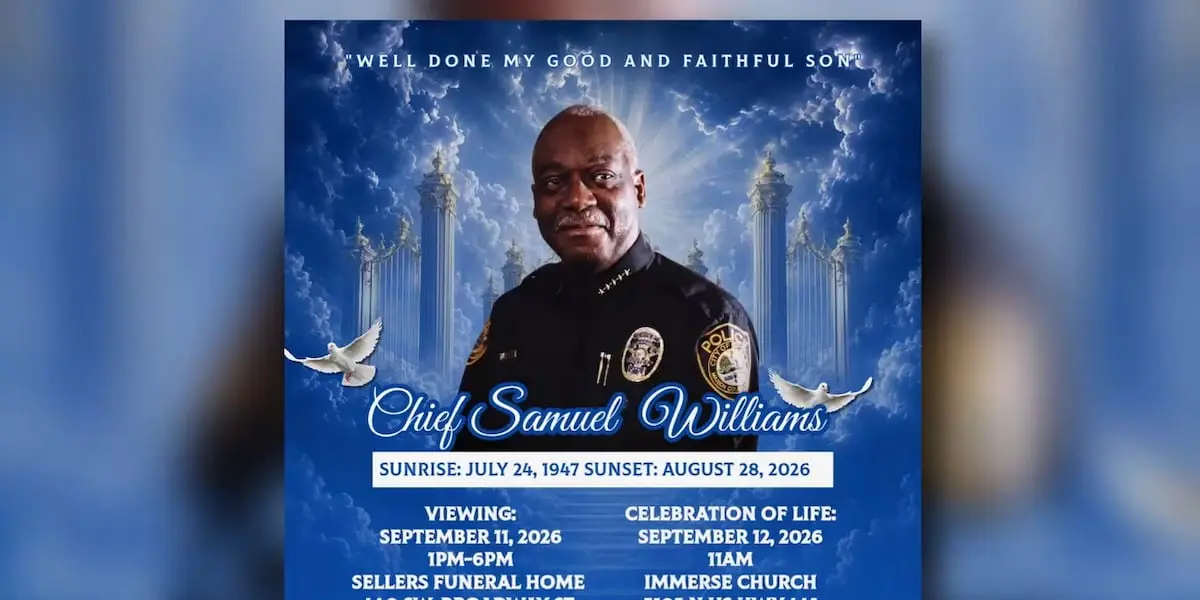
The City of Ocala and the broader North Central Florida law enforcement community are preparing to pay their final respects to one of their most influential modern leaders. Former Ocala Police Chief Samuel Williams passed away on Friday, August 28, 2026, at the age of 79. Chief Williams, who steered the Ocala Police Department (OPD) through a transformative era of growth, technological modernization, and economic volatility from 2003 to 2011, leaves behind a legacy defined by community-oriented policing, administrative resilience, and a deep-seated commitment to civil rights and public trust.
To honor his decades of service, municipal leaders, regional law enforcement agencies, and community members have organized a two-day memorial event. A public viewing is scheduled for Friday, September 11, 2026, at Sellers Funeral Home in Ocala. The following day, Saturday, September 12, 2026, a formal celebration of life will be held at Immerse Church, where active-duty officers, retired veterans, and civic leaders will gather to commemorate his life and career.
Chief Williams’ death marks the end of an era for Marion County law enforcement. Serving as chief during a period of rapid demographic expansion and the fiscal challenges of the Great Recession, Williams is remembered not only for his tactical and administrative acumen but also for his pioneering efforts to bridge the historical divide between law enforcement and Ocala’s diverse communities.
Detailed Chronology: The Life and Career of Samuel Williams
+-----------------------------------------------------------------------------+
|                           SAMUEL WILLIAMS (1947 - 2026)                      |
+-----------------------------------------------------------------------------+
|  1970s - 1990s:  Rises through the ranks of Ocala Police Department         |
|  2003:           Appointed Chief of Police                                  |
|  2003 - 2011:    Serves as Chief; implements Community Policing initiatives |
|  2008 - 2010:    Navigates OPD through Great Recession budget shortfalls    |
|  2011:           Retires from active duty; transitions to advisory roles    |
|  August 2026:    Passes away at age 79                                      |
|  Sept 2026:      Public memorials and final honors in Ocala, FL             |
+-----------------------------------------------------------------------------+
Rise Through the Ranks
Samuel Williams began his journey in law enforcement during a time of significant social and institutional change in the American South. Entering public service in the latter half of the 20th century, Williams worked his way up through the ranks of the Ocala Police Department. At every level—from patrol officer to detective, sergeant, lieutenant, and captain—he earned a reputation as a methodical, fair-minded officer who prioritized de-escalation and direct community engagement long before those concepts became standard industry terminology.
The Chiefdom: 2003–2011
In 2003, Williams was appointed Chief of Police, inheriting an agency tasked with protecting a rapidly growing city. Marion County was undergoing an unprecedented real estate and population boom, bringing new infrastructure, economic diversity, and policing challenges.
During his eight-year tenure as chief, Williams focused on three primary pillars:
- Community-Oriented Policing (COPS): He established decentralized neighborhood policing initiatives, placing officers on foot and bicycle patrols in historically underserved areas to foster direct relationships with residents.
- Professionalization and Accreditation: Chief Williams pushed for rigorous training standards, ensuring the department maintained its standing with state and national accreditation bodies. He championed continuing education and mental health support for officers.
- Diversity and Inclusion: Understanding the changing demographics of Ocala, Williams actively recruited minority and bilingual officers, striving to ensure the police department mirrored the community it swore to protect.
Navigating the Great Recession
The latter half of Williams’ tenure was defined by the global financial crisis of 2008. Florida was among the states hardest hit by the housing market collapse, leading to severe municipal budget shortfalls.
Faced with declining tax revenues, Chief Williams was forced to make difficult administrative decisions. Rather than executing mass layoffs that would compromise public safety, Williams restructured administrative divisions, deferred non-essential equipment upgrades, and renegotiated vendor contracts. His fiscal discipline during this period preserved frontline patrol strength and kept crime rates stable during a time of profound economic anxiety.
Retirement and Elder Statesmanship
Chief Williams retired in 2011, passing the baton to his successor, Greg Graham. In retirement, Williams remained an active and revered figure in Marion County. He served on various non-profit boards, mentored young men and women seeking careers in criminal justice, and acted as an informal advisor to subsequent police chiefs and city managers.
Supporting Context & Metrics: The Evolution of Ocala Policing
To understand the magnitude of Chief Williams’ impact, it is essential to analyze the structural evolution of Ocala and its police department during and immediately following his tenure.
Demographic and Municipal Expansion
When Williams took office in 2003, Ocala was transitioning from a rural, agriculture-and-horse-centric hub into a major logistical and residential center in Central Florida.
| Metric | 2003 (Start of Tenure) | 2011 (End of Tenure) | Percentage Change |
|---|---|---|---|
| Ocala Municipal Population | ~48,500 | ~56,300 | +16.1% |
| OPD Sworn Officers | ~145 | ~175 | +20.7% |
| Annual Call Volume | ~62,000 | ~78,000 | +25.8% |
| Violent Crime Rate (per 1,000) | 7.8 | 5.2 | -33.3% |
Source: FDLE Uniform Crime Reports & City of Ocala Historical Archives
Under Williams’ leadership, despite a 25.8% increase in calls for service driven by population growth, the violent crime rate in Ocala decreased by approximately 33.3%. This reduction is widely attributed to his department’s focus on targeted, intelligence-led policing and neighborhood-level crime prevention programs.
The Shift from Human-Centric to Tech-Driven Policing
The passing of Chief Williams coincides with a broader debate currently taking place in North Central Florida regarding the future of public safety. While Williams’ era was characterized by "boots on the ground" community policing, modern law enforcement has increasingly relied on automated, algorithmic surveillance.
       CHIEF SAMUEL WILLIAMS ERA (2003-2011)
       +------------------------------------+
       |  - Foot & Bicycle Patrols          |
       |  - Direct Community Liaison        |
       |  - Decentralized Substations       |
       |  - Relationship-Based Policing     |
       +------------------------------------+
                         │
                         ▼ Evolution of Industry
                         │
       MODERN SURVEILLANCE ERA (2026)
       +------------------------------------+
       |  - Automated License Plate Readers |
       |  - Predictive Crime Analytics      |
       |  - Digital/Virtual Patrols         |
       |  - Data-Driven Interventions       |
       +------------------------------------+
A prime example of this technological shift is the ongoing controversy surrounding Flock-style license plate reader (LPR) cameras. Recently, North Central Florida sheriffs have had to respond to state directives ordering the removal of certain Flock cameras from state-maintained right-of-ways due to regulatory and privacy concerns.
This tension highlights the contrast between the policing philosophy of Chief Williams—which prioritized human interaction and trust-building—and the contemporary reliance on automated surveillance networks. Observers note that while technology offers unprecedented investigative efficiency, the foundational trust built during the Williams era remains the most critical asset in resolving community crises.
Official Statements and Tributes
The announcement of Chief Williams’ passing has prompted a wave of tributes from civic leaders, law enforcement officials, and community organizations across Florida.
Ocala Police Department Statement
In an official release, the Ocala Police Department expressed deep sorrow over the loss of their former leader:
"Chief Samuel Williams was a leader of unparalleled integrity, a mentor to generations of officers, and a true servant of the Ocala community. His vision for community policing laid the foundation for the modern, professional agency we are today. He led us through times of prosperity and times of economic hardship with the same steady hand and unwavering moral compass. Our thoughts and prayers are with his family, and we stand ready to honor his memory with the dignity and respect he earned over a lifetime of service."
Municipal and Civic Leaders
City officials highlighted Williams’ role as a bridge-builder. A joint statement from local community leaders emphasized his impact on civil rights:
"Chief Williams understood that public safety cannot exist without public trust. During a period when relations between law enforcement and minority communities were strained nationwide, Chief Williams walked our neighborhoods, listened to our concerns, and made sure his officers did the same. He was not just the police chief; he was a neighbor, a friend, and a champion of equity."
Future Outlook: Preserving the Legacy of Community Policing
As the Ocala Police Department navigates the complexities of 21st-century law enforcement, the principles championed by Chief Samuel Williams remain highly relevant.
Balances of Technology and Community Trust
Modern law enforcement agencies face a delicate balancing act. The integration of advanced technologies, such as artificial intelligence, body-worn camera analytics, and automated license plate readers, promises to streamline operations. However, as demonstrated by the recent regional pushback against Flock-style cameras, technological encroachment without robust regulatory oversight can erode the very public trust that Williams spent his career building.
Future leadership at the OPD and surrounding agencies will likely continue to grapple with this dynamic. Industry experts suggest that the most successful agencies will be those that use technology not as a replacement for community interaction, but as a supportive tool for relationship-based policing.
The Next Generation of Leadership
The memorial services on September 11 and 12 will serve as a gathering point for current and future law enforcement leaders. For young officers entering the force in an era of heightened scrutiny and technological change, the career of Chief Samuel Williams offers a timeless blueprint: that effective policing is rooted in empathy, accountability, and an unwavering commitment to the community one serves.
Chief Williams’ legacy will endure not only in the department’s archives or the physical infrastructure of the city he protected, but in the ongoing daily efforts of Ocala’s officers to maintain the trust, safety, and unity of their city.

0 Comments