
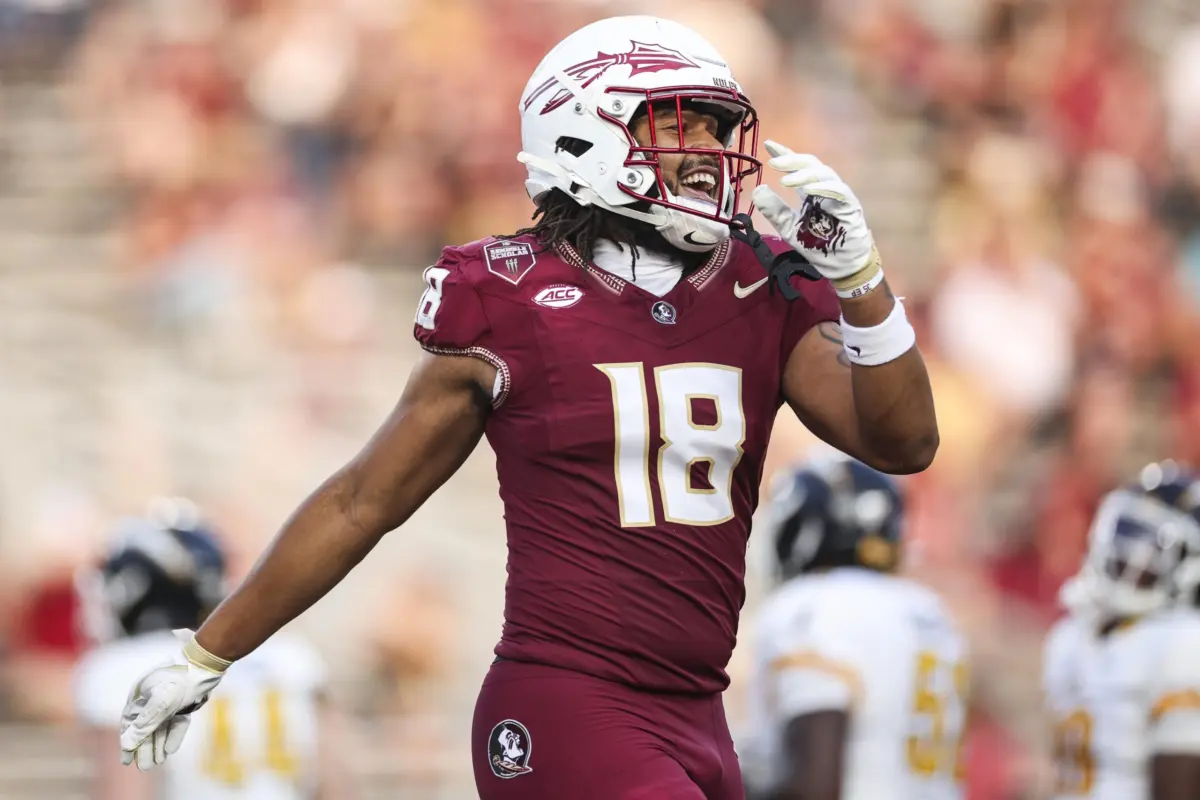

Executive Overview
The Florida State Seminoles find themselves at a fascinating and perilous juncture of the early college football season. Following an uninspiring, unpolished 34-17 victory over New Mexico State—a game that left fans and analysts alike questioning the true ceiling of this roster—head coach Mike Norvell’s squad faces a grueling nine-day preparation window. The objective? Readying themselves for a titanic, high-stakes Atlantic Coast Conference (ACC) opener on Labor Day against the 19th-ranked SMU Mustangs.
Oddsmakers and national pundits have wasted little time casting doubt on the Seminoles. Despite playing within the hallowed confines of Doak Campbell Stadium, FSU opens this prime-time clash as an underdog, conceding more than a field goal to a Mustangs program carrying immense momentum, championship aspirations, and the lingering sting of being just a few plays away from the conference title game a season ago.
For Florida State, the margin for error is razor-thin. Last year’s Labor Day national television disaster—a stunning, tone-setting collapse against Boston College and quarterback Tommy Castellanos that plunged the program into an early 0-2 hole and sparked an existential crisis in Tallahassee—still looms large in the collective memory of the fanbase. To avoid a repeat of that nightmarish scenario and make a definitive statement on the national stage, the Seminoles cannot simply rely on raw talent. They must execute with clinical precision.
As Norvell and defensive coordinator Tony White prepare their schemes to counter SMU head coach Rhett Lashlee’s high-octane offensive machinery, the spotlight shifts inexorably to the gridiron. If Florida State is to weather the storm, establish its authority in the ACC, and justify its preseason hype, three specific players must step out of the shadows and deliver signature performances: defensive tackle Daniel Lyons, safety Ashlynd Barker, and tight end Landen Thomas.
Detailed Chronology: From the Aggies to the Mustangs
The narrative arc of Florida State’s early season has been defined by a stark contrast between expectation and execution. The journey began under the glaring lights of Week Zero, where the Seminoles hosted New Mexico State. On paper, a 17-point victory should have provided a comfortable cushion of optimism. However, the game failed the foundational "eyeball test" for a program striving to reclaim national elite status.
FSU struggled to establish consistent dominance in the trenches, experienced communication breakdowns in the defensive secondary, and labored to find an offensive rhythm that felt dynamic rather than methodical. While the final score read 34-17 in favor of the garnet and gold, the film session told a far more sobering story. Missed assignments, sluggish interior pressure, and a lack of killer instinct left the coaching staff with a massive laundry list of corrections.
Recognizing the gravity of the situation, the athletic department and coaching staff immediately pivoted toward damage control and intensive preparation. With a rare nine-day gap leading up to their Monday night battle, Norvell utilized the time to conduct deep-dive self-scouting sessions. The message to the local media on Tuesday was direct, urgent, and devoid of coach-speak clichés: SMU is watching, and they smell blood in the water.
"SMU is gonna see some of the issues that were there, and Rhett does a great job of trying to exploit your issues that he sees on film," Norvell candidly admitted to reporters. "We got to make sure that we’re 11 playing as one and just go out there and trust our technique, make sure we’re clean in our communication and alignment, and then go play the game."
Norvell’s concerns are rooted in reality. SMU enters this matchup not as a wide-eyed newcomer adjusting to the ACC, but as a battle-tested predator. Under Lashlee, the Mustangs have cultivated an aggressive, opportunistic identity. They possess an offense capable of striking from anywhere on the field, balanced by a defensive philosophy designed to attack and compound opponent errors.
"We know what’s in front of us this week… a team that was a couple of plays away from being in the championship game last year," Norvell added, emphasizing the caliber of the opponent. "This is one of the top teams in the ACC conference. This is a team that has big expectations for all that’s in front of them. They were in the playoffs a couple of years ago, [and they are] all focused to this week. I mean, it’s gonna take a great effort on our part. That’s what I fully expect out of this team."
Now, the calendar turns to Labor Day. The stage is set for a national television audience, and the narrative threads of FSU’s redemption arc converge on 60 minutes of high-intensity football.
Supporting Context & Metrics: The Anatomy of the Matchup
To truly understand why the upcoming contest against SMU presents such a daunting challenge—and why specific players have been thrust into the epicenter of the game plan—we must examine the underlying tactical data and historical context governing both programs.
The Defensive Dilemma: Containing Kevin Jennings and the SMU Attack
SMU’s offense, orchestrated by Rhett Lashlee, thrives on pace, space, and stress-testing opposing defenses with multi-dimensional threats. The focal point of this offensive engine is dual-threat quarterback Kevin Jennings. Jennings possesses the rare ability to punish defenses with accurate intermediate throws while breaking contain and converting crucial third downs with his legs.
For Florida State defensive coordinator Tony White, the primary mathematical and tactical equation involves rush-lane integrity. If FSU’s edge rushers—such as Jalen Anderson and Rylan Kennedy—fly upfield with reckless abandon, Jennings will simply step up through the B-gaps and gash the defense on designed runs or scrambles. However, instructing edge defenders to play a disciplined, containment-oriented style inherently limits their pass-rush explosiveness.
This tactical constraint shifts the entire burden of pressure onto the interior defensive line. The Noles must collapse the pocket from the inside out, forcing Jennings to throw under duress from a muddy, condensed environment.
PFF Grades and the Reality of Week Zero
The advanced analytics from Pro Football Focus (PFF) paint a revealing picture of FSU’s roster depth and current operational ceiling. In the opener against New Mexico State, the Seminoles’ defensive line rotations exposed a stark divide between elite potential and week-to-week consistency.
With younger pieces like Kevin Wynn and Jordan Sanders being brought along slowly by the coaching staff, the defensive front was heavily reliant on veteran anchors. Yet, the productivity metrics did not match the snap counts. This statistical reality brings us directly to the first linchpin of Monday night’s strategy.
Official Statements & Key Player Breakdowns
If Florida State is to overcome the betting odds and silence the skeptics on national television, three distinct players must elevate their performance from functional to phenomenal.
No. 1: Defensive Tackle Daniel Lyons
In high-stakes college football, elite programs require their veteran captains to author defining moments when the lights shine brightest. For fifth-year senior defensive tackle Daniel Lyons, Monday night represents a referendum on his collegiate legacy.
Lyons was billed heading into the season as the definitive interior presence for FSU’s defensive front—a reliable anchor capable of swallowing double teams and disrupting the backfield. Yet, his performance against New Mexico State left much to be desired. Despite logging a heavy workload of 41 snaps out of 66 total defensive plays, Lyons walked off the field without registering a single official stat.
More concerning than the stat sheet was his film evaluation. PFF handed Lyons an uninspiring 53.2 pass-rush grade. For a player carrying the mantle of leadership and anchoring the 1-technique and nose positions, that grade is simply insufficient.
Given White’s defensive scheme and the necessity of keeping rush-lane integrity against SMU’s Kevin Jennings, Lyons will once again shoulder the lion’s share of the interior snaps. With Kevin Wynn and Jordan Sanders still developing, Lyons cannot afford another quiet night. He must consistently push the pocket, demand double teams that free up the linebackers, and collapse the interior so that Jennings has nowhere to step up. Norvell and White have repeatedly expressed immense confidence in Lyons’ capabilities; now is the time for that confidence to manifest in a breakout performance.
No. 2: Safety Ashlynd Barker
Statistically speaking, safety Ashlynd Barker had a productive outing in Week Zero. He led the Seminoles with eight total tackles and tied for the team lead in defensive snaps played (53). Exhibiting a visibly stronger frame after another rigorous offseason in the strength and conditioning program, the fifth-year senior captain looked the part of a secondary leader.
Yet, a closer examination reveals untapped potential and areas of critical vulnerability. Barker occupies the "Rover" position—arguably the most mentally demanding role in Tony White’s defensive scheme. Operating as a hybrid chess piece, Barker is asked to line up everywhere from the box near the line of scrimmage to a deep center-field safety alignment.
This versatility makes him the de facto on-field communicator for a secondary that noticeably struggled with alignment and pre-snap recognition against New Mexico State. While neither of the touchdowns allowed in the opener fell directly on Barker’s ledger, his presence on the field during those breakdowns highlighted communication fractures. Most notably, television broadcasts caught Barker still relaying instructions and signaling alignments as the ball was snapped on the opening touchdown.
Against SMU, those mental lapses will be punished ruthlessly. Rhett Lashlee’s offense is engineered to stretch secondaries to their absolute limits, coupling a punishing power-running game—bolstered by NC State transfer running back Kendrick Raphael—with explosive deep-threat receivers like Yamir Knight and Yannick Smith.
Barker will be tasked with simultaneously helping plug the run game against Raphael and tracking burners streaking across the deep secondary. As a veteran leader with a year of experience in White’s scheme under his belt, Barker must function as an extension of the coaching staff, ensuring that newer additions are properly aligned before the whistle blows. To limit SMU’s offensive pyrotechnics, Barker must transcend being a mere tackler and become the undisputed general of FSU’s back seven.
No. 3: Tight End Landen Thomas
While the defensive side of the ball faces monumental challenges, the Florida State offense must find ways to diversify and exploit favorable matchups. One of the bright spots of Week Zero was the emergence of homegrown junior tight end Landen Thomas.
Surpassing ECU transfer Desirrio Riles in the rotation by earning a 39-36 snap advantage, Thomas proved his mettle by hauling in the tight end group’s only reception of the game while earning solid, balanced grades across the board from PFF. On Monday night, the Seminoles will need Thomas to take a massive leap forward.
SMU’s defensive game plan is projected to heavily feature strategies designed to neutralize FSU’s explosive wide receiver Duce Robinson, potentially rolling coverages or assigning extra bodies to bracket him in the passing game. If the Mustangs dedicate extra resources to removing Robinson from the equation, Landen Thomas will become the primary beneficiary, stepping into prime 1-on-1 matchups over the middle of the field.
This scenario plays directly into Thomas’s natural skill set. Arriving in Tallahassee with a reputation as a pass-catching weapon first and a blocker second, Thomas possesses the fluid route-running and soft hands needed to exploit the seams of a defense. Furthermore, he will be attacking a vulnerable area of the SMU roster.
The Mustangs operate primarily out of a 4-2-5 defensive base, which dictates that either a nickel back or a safety must cover the tight end. With SMU breaking in transfer additions at both defensive back positions and adjusting to a new defensive play-caller, Thomas holds a definitive experience and chemistry edge. If quarterback Tommy Castellanos—or whoever commands the FSU offense—needs a reliable safety valve in high-leverage moments, Thomas must answer the call.
Future Outlook: Defining the Trajectory of the Season
As the clock ticks down toward Monday night’s kickoff, the stakes for the Florida State Seminoles extend far beyond a single conference game. This prime-time showcase is a referendum on the program’s resilience, cultural foundation, and competitive readiness.
A victory over the 19th-ranked team in the country, secured in hostile home-primetime conditions, would instantly erase the lingering doubts generated by the New Mexico State opener. It would validate the coaching staff’s developmental timeline, inject massive momentum into the ACC championship race, and banish the ghost of last year’s Labor Day disaster against Boston College. It would signal to the college football world that Florida State is not merely rebuilding, but reloading.
Conversely, another sluggish performance, defensive communication breakdown, or failure to execute in the trenches would trigger immediate alarm bells in Tallahassee. The narrative of a fragile program unable to meet national expectations would resurface with a vengeance, placing intense pressure on Norvell and his staff as the remainder of a brutal conference schedule looms on the horizon.
Ultimately, the blueprint is clear, and the responsibilities have been assigned. For Daniel Lyons, Ashlynd Barker, and Landen Thomas, Monday night is not just another game on the schedule—it is their moment to seize the narrative, elevate their teammates, and write a triumphant new chapter in Florida State football history. When the lights ignite at Doak Campbell Stadium, the Seminoles will either rise to meet their massive expectations or leave their supporters searching for answers once more.

0 Comments