

Executive Overview
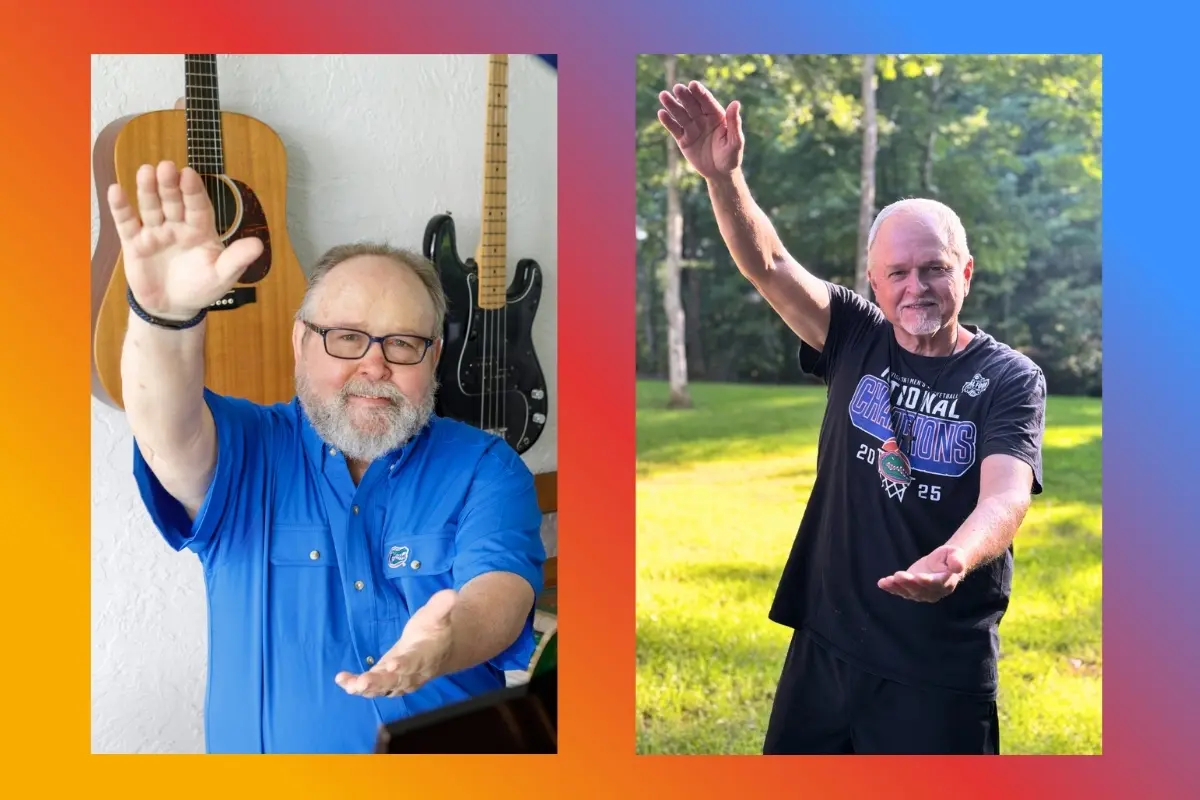
Few rituals in American sports are as instantly recognizable as the "Gator Chomp." Executed by extending both arms forward and snapping them together in a rhythmic imitation of an alligator’s jaws, the gesture is a unifying rally cry for the University of Florida (UF) athletic program. Performed in unison by over 90,000 fans inside Ben Hill Griffin Stadium—famously known as "The Swamp"—the chant creates a daunting environment for visiting teams and serves as an indelible signature for Gator Nation across the globe.
Yet, despite its ubiquitous presence in modern collegiate athletics, pop culture, and international sporting events, the Gator Chomp did not originate from a high-priced marketing agency or an athletic department initiative. Instead, it was born out of frustration, boredom, and opportunistic creative spark during a disastrous road loss in Jackson, Mississippi, on September 26, 1981.
Two members of UF’s "Pride of the Sunshine" Marching Band—graduate student Rob Hyatt and senior music education major Monty Musgrave—observed the opposing band’s tuba section playing a famous cinematic theme during a lopsided defeat. Recognizing the untapped potential of the music, Hyatt and Musgrave adapted the concept, penned a full band arrangement, pitched it to university directors, and ignited what would become one of the most iconic traditions in modern sports history.
This comprehensive report details the complete origin story, chronological development, legal evolution, and broader cultural significance of the Gator Chomp, tracing its transformation from a minor band distraction into an international athletic phenomenon.
Detailed Chronology
========================================================================================================
TIMELINE: THE ORIGIN AND ASCENT OF THE GATOR CHOMP
========================================================================================================
Sept 26, 1981 : UF loses to Mississippi State in Jackson, MS; Hyatt & Musgrave conceptualize the gesture.
Sept 27, 1981 : Musgrave composes the full brass arrangement in his Gainesville apartment.
Sept 28, 1981 : Hyatt pitches the idea to UF band directors; proposal is officially approved.
Oct 03, 1981  : The motif debuts live at Tiger Stadium in Baton Rouge, LA during a UF victory over LSU.
Oct 10, 1981  : The cheer debuts at home in Florida Field vs. Maryland; cheerleaders join the band.
Late 1981     : The song is integrated into UF pregame performances, notably against Florida State.
Mid-1980s     : Name transitions from "Jaws" to "Gator Chomp" to address copyright and trademark concerns.
2014          : SEC Network broadcasts a national documentary feature documenting Hyatt and Musgrave's story.
Present       : Mainstay gesture used across global athletic programs, professional sports, and media.
========================================================================================================
The Spark in Jackson (September 26, 1981)
The autumn of 1981 saw the Florida Gators travel to Mississippi Veterans Memorial Stadium in Jackson, Mississippi, to face the Mississippi State Bulldogs. The outing was miserable both on and off the field for the small contingent of the UF pep band, which had been dispatched in a single bus. Accommodated at the unglamorous Sun and Sand Motel in downtown Jackson, the student musicians endured a painful display as Florida plummeted toward a 28-7 defeat.
During the second half, with the outcome virtually decided, the Mississippi State tuba section began playing the iconic two-note suspense motif composed by John Williams for Steven Spielberg’s 1975 blockbuster film, Jaws. While the Bulldogs’ cheerleaders executed basic gestures to the music, the crowd reaction in Mississippi was minimal.
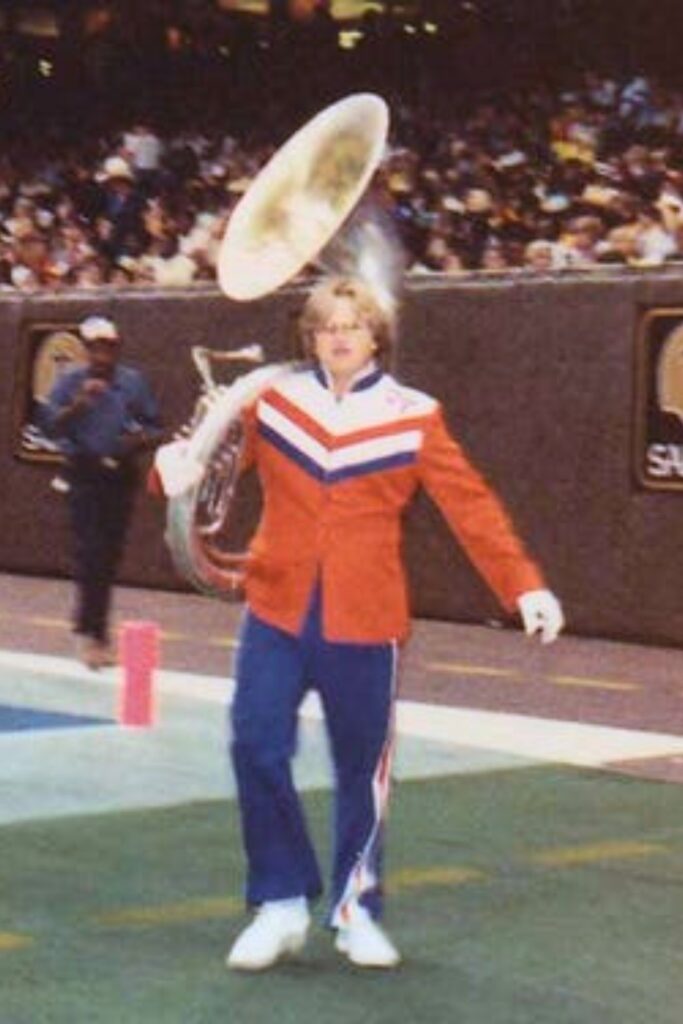
Rob Hyatt, a Gainesville native and graduate student traveling with the pep band, found solace in the musical cue amid the depressing game. Recognizing the natural thematic connection between an aquatic apex predator and the Florida Alligator, Hyatt turned to senior sousaphone player Monty Musgrave and suggested that Florida adopt the theme as an offensive and defensive rallying cry.
Composition and Approval (September 27–28, 1981)
Upon returning to Gainesville following the defeat, Musgrave immediately set to work in his apartment. Although the original film motif relied primarily on an alternating minor second interval (E to F), Musgrave sought to create a fuller, richer sonic experience suitable for a major collegiate marching band. He composed harmonized counter-melodies and intricate brass lines, transforming a simple two-note refrain into a full-scale stadium arrangement.
On Monday, September 28, 1981, Hyatt brought the concept and Musgrave’s musical score to the weekly staff meeting with UF’s three band directors. Recognizing the potential to energize a home crowd, the directors gave immediate approval to incorporate the musical arrangement into the band’s repertoire.
Field Debut and Home Adoption (October 1981)
The newly minted arrangement—initially dubbed "Jaws"—made its operational debut on October 3, 1981, when Florida traveled to Baton Rouge to face Louisiana State University (LSU). Played from the visitor stands at Tiger Stadium, the music correlated with a 24-10 Florida victory, immediately cementing its status as a good-luck charm among band members.
Prior to the next home game, band directors notified the UF spirit squad and cheerleaders, coordinating the music with synchronized, full-arm clapping motions. On October 10, 1981, the song debuted inside Florida Field during a victory against the Maryland Terrapins.
The student section adopted the arm gesture almost instantly. By the final game of the 1981 regular season against arch-rival Florida State University, the band had fully incorporated the gesture and song into its official pregame stadium performance.

+--------------------------------------------------------------------------------------------------+
|                             EVOLUTION OF THE GATOR CHOMP ARRANGEMENT                             |
+--------------------------------------------------------------------------------------------------+
|  1981: Raw "Jaws" Theme  -->  1981: Full Brass Score   -->  1980s: Rebrand   -->  Present: Global |
|  Played by Mississippi      Composed by Musgrave;          Renamed "Gator       Stadium Staple &  |
|  State Tuba Section         Adopted by UF Pep Band          Chomp" for Legal     Pop Culture      |
|                                                             Protection           Phenomenon       |
+--------------------------------------------------------------------------------------------------+
The Legal Rebrand and Mass Adoption
As the arrangement gained popularity throughout the early 1980s, university legal counsel raised concerns regarding intellectual property rights. The name "Jaws" was heavily protected by Universal Pictures and composer John Williams.
To mitigate legal exposure while preserving the tradition, the athletic department and band administration formally rebranded the tune and accompanying gesture as the "Gator Chomp." Over the subsequent decade, as television broadcasts of Southeastern Conference (SEC) football expanded, the Gator Chomp became synonymous with Florida athletics, spreading from the stadium stands into mainstream American culture.
Supporting Context & Metrics
The Ecosystem of Florida Football Traditions
The Gator Chomp does not exist in isolation; it operates as an integral component of a dense tapestry of game-day traditions at the University of Florida. To understand its structural role in game momentum, it is essential to contextualize it among UF’s other celebrated rituals:
- "Mr. Two Bits": A tradition started in 1949 by George Edmondson Jr., who paced the stands wearing a yellow shirt, striped tie, and seersucker trousers to lead the crowd in a famous cheer ("Two bits, four bits, six bits, a dollar…"). The ritual is now carried on by honorary guest leaders prior to kickoff.
- "We Are the Boys from Old Florida": Originating in the early 1900s, this song evolved during the 1970s into an end-of-the-third-quarter ritual where fans lock arms, sway side-to-side, and sing in unison.
- "I Won’t Back Down": Introduced in October 2017 following the passing of Gainesville native Tom Petty, this rock anthem is sung immediately after "We Are the Boys" between the third and fourth quarters, creating an emotional bridge into the final minutes of play.
- The Gator Chomp: Unlike scheduled quarter-break songs, the Chomp serves as a dynamic, reactive stadium chant. It is deployed during key third-down defense plays, following big offensive gains, and as a victory celebration.
+-----------------------------------------------------------------------------------+
|                        UF GAMEDAY TRADITION ARCHITECTURE                          |
+-----------------------------------------------------------------------------------+
| TRADITION                | ORIGIN ERA | FREQUENCY / TIMING                        |
+--------------------------+------------+-------------------------------------------+
| Mr. Two Bits Cheer       | 1949       | Pre-Game Kickoff                          |
| We Are the Boys          | 1970s      | End of 3rd Quarter                        |
| Tom Petty Tribute        | 2017       | Between 3rd & 4th Quarter                 |
| The Gator Chomp          | 1981       | Reactive / High-Leverage Game Situations  |
+--------------------------+------------+-------------------------------------------+
Quantitative and Cultural Impact
The expansion of the Gator Chomp spans decades, establishing measurable footprints in sports broadcasting, merchandising, and elite international competition:
- Stadium Capacity Amplification: Ben Hill Griffin Stadium holds an official capacity of 88,548, though attendance frequently exceeds 90,000. When executed in unison, the visual impact of over 180,000 extended arms snapping together creates a psychological intimidation factor documented by visiting coaches and sports journalists alike.
- Broadcast Frequency: During nationally televised home broadcasts, the Gator Chomp motif is played by the band and highlighted by television networks dozens of times per game, making it one of the most televised organic fan movements in college sports.
- Global Sporting Reaching: Former Florida Gators competing on international stages—including Olympic gold medalists Ryan Lochte, Caeleb Dressel, and Grant Holloway—have routinely performed the Gator Chomp on medal podiums and during broadcast introductions, projecting the regional college tradition to worldwide audiences.
+-----------------------------------------------------------------------------------+
|                     COMPARATIVE MATRIX: FAMOUS COLLEGE CHANTS                     |
+-----------------------------------------------------------------------------------+
| PROGRAM              | TRADITION NAME        | ORIGIN ERA | PRIMARY TRIGGER       |
+----------------------+-----------------------+------------+-----------------------+
| University of Florida| The Gator Chomp       | 1981       | Band Cue / Defensive  |
| Florida State Univ.  | The Tomahawk Chop     | 1984       | War Chant / Pep Band  |
| Univ. of Wisconsin   | Jump Around           | 1998       | End of 3rd Quarter    |
| Virginia Tech        | Enter Sandman         | 2000       | Team Entrance         |
+----------------------+-----------------------+------------+-----------------------+
Official Statements & Primary Accounts
The historical accuracy of the Gator Chomp’s creation was cemented in 2014 when the SEC Network aired a dedicated feature investigating its origin. The founders have consistently documented the blend of chance, boredom, and musical passion that sparked the tradition.
Rob Hyatt, Co-Creator and Former Alachua County School Board Chair
Reflecting on the setting of the 1981 Mississippi State game, Rob Hyatt emphasized how dire circumstances fueled creative thinking:
"That was one of the biggest movies ever up to that point, and so I think part of it may have been that it was such a god-awful game. You had to think about something because you couldn’t be thinking about the game. It was too depressing.
I think the Mississippi State cheerleaders were probably joining in with some motions, but there was actually zero reaction. It was nothing to anybody from Mississippi State, and so I turned to the person next to me and said, ‘The Gators should do this,’ and I think anybody who heard me agreed with me.
We can give an unwitting assist to the Mississippi State tuba section because they had no idea what they were releasing."
On the humble accommodations that framed the historical moment, Hyatt added:
"We were housed at the Sun and Sand Motel in downtown Jackson, and if you can somehow associate Jackson, Mississippi, with sun and sand, you know that’s a stretch."
+-----------------------------------------------------------------------------------+
|                                 KEY PLAYER PROFILES                               |
+-----------------------------------------------------------------------------------+
| ROB HYATT                                                                         |
| - Role in 1981: UF Graduate Student & Gator Pep Band Member                       |
| - Contribution: Identified the "Jaws" motif and pitched the concept to directors  |
| - Subsequent Career: Educator; Former Chair of the Alachua County School Board    |
|                                                                                   |
| MONTY MUSGRAVE                                                                    |
| - Role in 1981: UF Senior Music Education Major & Sousaphone Player               |
| - Contribution: Arranged the full brass band score for the UF Marching Band       |
| - Subsequent Career: Music Educator and Professional Musician                      |
+-----------------------------------------------------------------------------------+
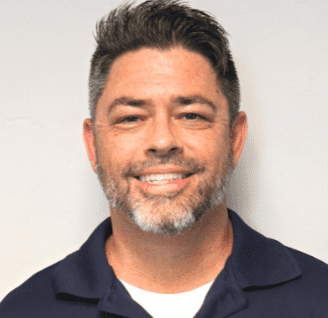
Monty Musgrave, Co-Creator and Music Educator
Monty Musgrave recalled the technical process of translating an idea into a formal band arrangement overnight:
"I was a trumpet major, but my senior year I switched over and started playing sousaphone for a couple of unimportant reasons. I just started playing sousaphone, had a great time, and was intrigued by what the Mississippi State Band was doing.
When we got back from the shellacking, I went to my apartment and I wrote out all the parts. It was a little bit more than E and F—I mean, there were some other parts that other instruments played, so I made it a whole band arrangement, and I brought it to the band staff.
When we first did it, we just started doing it, and then it kind of grew and grew and grew. I mean, I really didn’t think that much of it at the time. It’s really been so interesting to see how this has evolved, and it’s become the most iconic cheer in all sports. Who knew back in 1981, two guys sitting around, and this happened, and anywhere you go in the world, everybody recognizes that."
Future Outlook
As collegiate athletics enters an era dominated by Name, Image, and Likeness (NIL) deals, multi-billion-dollar media rights, and stadium modernization, the preservation of organic, student-led traditions faces new challenges and opportunities.
+-----------------------------------------------------------------------------------+
|                        FUTURE OUTLOOK: TRADITION IN THE DIGITAL AGE                |
+-----------------------------------------------------------------------------------+
| CHALLENGES                                | OPPORTUNITIES                         |
+-------------------------------------------+---------------------------------------+
| • Over-commercialization of game breaks   | • Global brand amplification via NIL   |
| • Intrusive stadium audio/video technology| • Digital avatar/gaming integration   |
| • Changing student section demographics   | • International alumni engagement     |
+-------------------------------------------+---------------------------------------+
Preservation in the Modern Entertainment Era
Modern stadium experiences increasingly rely on pre-recorded audio tracks, light shows, and commercial sponsorships. However, sports culturalists note that live, band-driven traditions like the Gator Chomp offer an authenticity that digital media cannot replicate. The physical engagement of the entire stadium creates a shared community experience that remains central to the University of Florida’s athletic identity.
Global Digital Amplification
In the age of short-form social media platforms like TikTok, Instagram, and YouTube, short, visually striking gestures are uniquely optimized for digital virality. The Gator Chomp’s simple arm movement makes it effortlessly shareable for fans, recruits, and international athletes.
Furthermore, as college sports video games return to the market with high-fidelity stadium recreations, the Gator Chomp continues to be meticulously rendered as a core feature of the virtual game-day experience.
Legacy of Organic Student Innovation
The story of Rob Hyatt and Monty Musgrave serves as a lasting testament to the role of student culture in defining collegiate sports. What began as a brief conversation between two friends seeking relief from a depressing football game in Jackson, Mississippi, evolved into a timeless, multi-generational emblem of pride for millions of Florida fans worldwide.
As long as the "Pride of the Sunshine" takes the field, the legacy of that fateful trip in September 1981 will continue to echo through the bleachers of The Swamp for generations to come.

0 Comments