A volatile security environment in the Middle East has once again reached a critical flashpoint. On Saturday, September 5, 2026, Iranian state media accused the United States military of launching a targeted missile strike against an Iranian oil tanker operating in the northern Persian Gulf, near the highly strategic Kharg Island energy hub. The incident, which reportedly involved four sea-skimming or air-launched missiles, marks a sharp and dangerous escalation in a long-running shadow conflict that has periodically threatened to choke off global energy supplies.
While the Islamic Republic of Iran Broadcasting (IRIB) reported that the vessel’s crew was successfully evacuated without casualties, the geopolitical shockwaves of the alleged attack were felt immediately across global markets and diplomatic corridors. The strike occurred just six miles (ten kilometers) off Kharg Island, the nerve center of Iran’s crude oil export infrastructure. This development follows a tense, month-long operational pause by U.S. forces in the region, during which diplomatic backchannels had reportedly attempted to cool hostilities.
The silence from Washington in the immediate aftermath of the incident has fueled intense speculation. If confirmed, this direct kinetic action by the United States against commercial or state-owned Iranian energy assets represents a fundamental shift in engagement rules. Security analysts warn that this strike could trigger a retaliatory cycle, putting international commercial shipping, regional U.S. military installations, and the critical transit lanes of the Strait of Hormuz in immediate jeopardy.
Detailed Chronology of the Incident
The sequence of events unfolded rapidly in the early hours of Saturday, September 5, 2026, against a backdrop of heightened naval readiness in the Persian Gulf.
[Friday, Sept 4]
   │
   ├── Commercial shipping congestion observed off Bandar Abbas / Strait of Hormuz.
   └── U.S. and allied naval assets report elevated Iranian patrol activity.
   │
[Saturday, Sept 5 - Early Morning]
   │
   ├── Iranian tanker transits approximately 6 miles (10 km) off Kharg Island.
   ├── Four missile impacts reported by Iranian state media (IRIB).
   ├── Vessel sustains damage; emergency distress calls are broadcast.
   └── Rapid response units evacuate all crew members; zero casualties reported.
   │
[Saturday, Sept 5 - Mid-Day]
   │
   ├── Iranian state television broadcasts preliminary reports blaming the U.S.
   └── U.S. Central Command (CENTCOM) maintains official silence.
The Attack off Kharg Island
According to reports broadcast by the IRIB, the Iranian tanker was transiting the warm waters of the Persian Gulf, approximately ten kilometers off the coast of Kharg Island, when it was targeted. Witnesses and maritime tracking data indicated a sudden disruption in the vessel’s transponder signals shortly before the state media announcement.
Iranian authorities assert that four distinct missiles struck the vessel. The precision of the strikes suggests the use of advanced guidance systems, characteristic of state-actor military technology. Despite the multiple impacts and subsequent structural damage to the tanker, shipboard safety protocols and rapid-response tugboats managed to prevent a catastrophic explosion or immediate sinking. The entire crew was evacuated safely, with no injuries or fatalities reported—a detail that some maritime experts suggest indicates a targeted effort to disable the vessel rather than destroy it entirely.
Precursor Tensions in the Strait of Hormuz
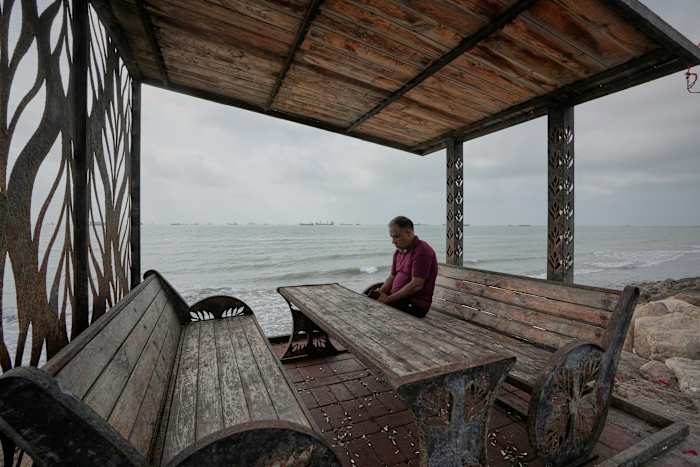
The incident did not occur in a vacuum. Just twenty-four hours prior, on Friday, September 4, 2026, international observers and photojournalists captured images of commercial vessels lying heavily anchored in the Strait of Hormuz off the coast of Bandar Abbas, Iran. Local residents on the beaches of Kuhestak and the waterfronts of Bandar Abbas went about their daily lives under the quiet shadow of a massive maritime traffic jam.
This congestion was the direct result of escalating insurance premiums and security warnings issued to merchant vessels transiting the chokepoint. The month-long pause in direct U.S. military strikes on Iranian assets had done little to ease the underlying friction, as the Islamic Revolutionary Guard Corps Navy (IRGCN) had steadily increased its patrol and surveillance activities throughout the week, culminating in the weekend’s explosive confrontation.
Supporting Context & Metrics
To understand the gravity of the alleged attack, one must examine the immense strategic value of the geography and the sheer volume of global trade that hinges on the stability of this maritime corridor.
Kharg Island: The Lifeblood of Iran’s Economy
Kharg Island is not merely a piece of coastal territory; it is the economic heart of the Islamic Republic. Located in the northeastern corner of the Persian Gulf, the island handles approximately 90% of Iran’s total crude oil exports.
Infrastructure: The island features deep-water loading berths capable of accommodating Supertankers (VLCCs and ULCCs), extensive storage tank farms, and a complex network of undersea pipelines connecting it to the mainland oilfields of Gachsaran and Bibi Hakimeh.
Vulnerability: Because of its concentration of infrastructure, any disruption to Kharg Island immediately cripples Iran’s ability to generate foreign currency. During the Iran-Iraq War of the 1980s, the island was targeted hundreds of times, a historical precedent that makes the current Iranian leadership highly sensitive to any military activity in its vicinity. This area was also targeted during U.S. military strikes in March 2026, establishing a pattern of high-stakes targeting.
Metric / Feature
Strategic Value & Details
Kharg Island Export Share
~90% of all Iranian crude oil exports
Daily Transit Volume (Strait of Hormuz)
~20.5 million barrels of oil per day (bpd)
Global Petroleum Share
Approximately 20% of global liquid petroleum consumption
Key Regional Chokepoints
Strait of Hormuz, Bab-el-Mandeb, Suez Canal
Primary Export Destinations
East Asian markets (primarily China), domestic regional partners
The Global Shipping Implications
The Strait of Hormuz is widely considered the world’s most critical energy chokepoint. With a width of only 21 miles at its narrowest point, the shipping lanes inside the strait consist of two-mile-wide channels for inbound and outbound traffic, separated by a two-mile-wide buffer zone.
The potential for a wider conflict has sent shockwaves through the global shipping industry. Maritime underwriters in London and Singapore are reportedly reviewing war risk premiums for vessels operating in the Persian Gulf. A sustained conflict could raise shipping insurance costs by up to 400%, a burden that would ultimately be passed down to global consumers in the form of higher fuel and retail prices.
Official Statements and Diplomatic Posturing
The diplomatic handling of the crisis highlights the deep divide between the regional adversaries and the calculated ambiguity often employed in modern naval warfare.
Tehran’s Narrative
The initial response from Tehran was characterized by swift public denunciation coupled with a notable lack of formal, high-level diplomatic documentation. The IRIB took the lead in framing the incident as an act of unprovoked aggression:
"The criminal attack by terrorist U.S. forces on an innocent commercial vessel near our sovereign oil terminals is a flagrant violation of international maritime law and an act of economic piracy. The Islamic Republic reserves the right to respond at a time and place of its choosing."
— Excerpt from IRIB Saturday Morning Broadcast
Despite the aggressive rhetoric, Western analysts noted that top-tier Iranian officials—including the Foreign Minister and the Supreme National Security Council—did not immediately issue formal diplomatic protests to the United Nations. This delayed official reaction may indicate that Tehran is assessing its retaliatory options before committing to a specific diplomatic or military path.
Washington’s Strategic Ambiguity
As of Saturday afternoon, the United States Government had maintained a strict policy of non-commentary. U.S. Central Command (CENTCOM), which oversees military operations in the Middle East, declined multiple requests to confirm or deny involvement in the missile strikes.
Historically, the U.S. Navy has operated under strict rules of engagement designed to protect international shipping and deter Iranian aggression. Some defense analysts suggest that if the U.S. did conduct the strike, it may have been a preemptive measure targeting a vessel suspected of transporting illicit weaponry or violating international sanctions, rather than a direct assault on Iran’s domestic oil trade. Others suggest the silence is a deliberate effort to keep Tehran guessing about the extent of U.S. intelligence capabilities and operational intentions.
Future Outlook: Scenarios of Escalation and De-escalation
The situation in the Persian Gulf remains highly fluid. The coming days will determine whether this incident is a isolated flare-up or the opening salvo of a broader regional conflict. Analysts point to three primary paths the conflict could take:
Rather than engaging the U.S. Navy in a direct, conventional confrontation, Iran is likely to employ its well-established network of regional proxies and asymmetric naval tactics. This could involve:
Houthi drone strikes targeting commercial shipping in the Red Sea and the Bab-el-Mandeb strait, effectively creating a dual-front maritime crisis.
Sabotage operations using limpet mines or fast-attack craft against Western-flagged tankers transiting the Strait of Hormuz, mirroring the tactics observed during the high-tension periods of 2019.
Cyberattacks targeting the port infrastructure and maritime logistics networks of U.S. allies in the Gulf, such as Saudi Arabia and the United Arab Emirates.
Scenario B: Direct Naval Skirmishes (Moderate Risk)
If Iran feels its domestic economic survival is directly threatened by continued strikes near Kharg Island, the IRGCN may attempt to enforce a partial blockade of the Strait of Hormuz. This would inevitably bring Iranian forces into direct conflict with the U.S. Fifth Fleet, stationed in Bahrain. Such a scenario would likely involve swarm attacks by armed speedboats, anti-ship cruise missile launches from coastal batteries, and the deployment of naval mines.
Scenario C: Backchannel De-escalation (Low to Moderate Probability)
Despite the hostile public rhetoric, the potential for catastrophic economic fallout may force both sides to the negotiating table through neutral intermediaries. Oman, Switzerland, and Qatar have historically served as vital diplomatic conduits during U.S.-Iran crises. A negotiated "quiet period," wherein the U.S. suspends active targeting in exchange for Iranian guarantees regarding the safety of commercial transit lanes, remains the only viable diplomatic off-ramp. However, given the intensity of the latest strike, the path to such an agreement appears fraught with political and military obstacles.





0 Comments