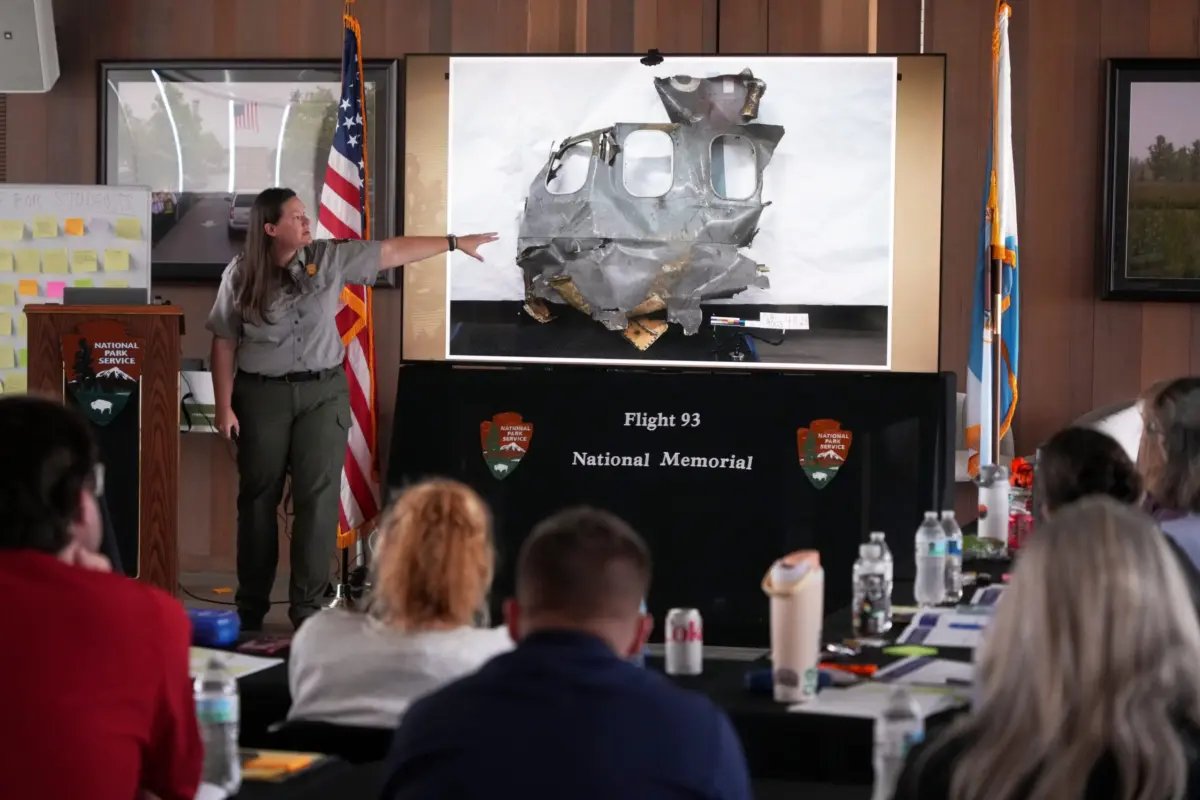
SHANKSVILLE, Pa. — For three somber days this summer, a cohort of educators converged upon the windswept plains of remote western Pennsylvania, gathering at the Flight 93 National Memorial to confront a profound pedagogical dilemma: How does one teach a historical tragedy to a generation born entirely in its wake?
As the 25th anniversary of the September 11 terrorist attacks approaches, approximately one-third of all living Americans have no personal memory of the day al-Qaida hijackers commandeered commercial airliners, turning them into weapons of mass destruction that claimed nearly 3,000 lives in New York City, the Pentagon, and a reclaimed strip mine in Shanksville.
This stark demographic reality has forced a national reckoning within America’s educational systems. Across the country, teachers, curriculum designers, and lawmakers are wrestling with a fundamental question: What specific details are appropriate for young minds, how should the geopolitical aftermath be framed, and what do the victims’ families want the next generation to understand about the lives lost?
"Even worse than getting started wrong or using inappropriate language is the total omission of telling the story," said Gordon Felt, whose brother, Edward Felt, perished aboard United Airlines Flight 93. Speaking directly to the assembled teachers during a poignant seminar session, Felt captured the anxiety haunting families of the fallen. "That’s our biggest fear."
Executive Overview
A comprehensive review of state education policies reveals that at least 40 states now mandate, expect, or suggest that public schools address 9/11 in their curricula. Yet, despite this widespread inclusion, the scope, specificity, and philosophical framing of these lessons vary wildly from state to state.
While some states have instituted rigorous, multi-year frameworks that examine everything from aviation security to civil liberties and international warfare, others offer vague suggestions or rely solely on mandated moments of silence. This patchwork of educational standards leaves millions of students vulnerable to gaps in their historical understanding of an event that fundamentally reshaped modern geopolitics, domestic surveillance, and the American national psyche.
Compounding this legislative inconsistency is a shifting classroom dynamic. Educators who once navigated the raw, immediate trauma of the early 2000s now face classrooms where 9/11 is viewed as ancient history—treated with the same detached curiosity as the attack on Pearl Harbor or the assassination of John F. Kennedy. To bridge this generational divide, cultural institutions like the National Sept. 11 Memorial & Museum in New York and the Flight 93 National Memorial in Pennsylvania are aggressively expanding teacher-training initiatives, attempting to transform a raw national wound into an enduring lesson on civic responsibility and human resilience.
Detailed Chronology: From Immediate Shock to Historical Curriculum
To understand how 9/11 education evolved, it is necessary to trace the trajectory of how American institutions processed the trauma over the past quarter-century.
Phase 1: The Era of Immediacy (2001–2011)
In the immediate aftermath of the attacks, formal curricula were largely secondary to immediate emotional processing. Schools across the nation functioned as stabilization centers. Teachers comforted weeping children, dealt with sudden waves of Islamophobia, and tried to make sense of a radically altered security landscape.
During the first decade following the attacks, formal academic standards lagged behind the event. A decade after 2001, roughly 60% of U.S. states did not explicitly mention 9/11 in their educational standards. The event was viewed as too raw, too politically charged, and too close to contemporary policy debates to be codified into standard textbook history.
Phase 2: Codification and the "Settled Event" (2011–2020)
As the decade mark passed, academic attitudes shifted. According to University of Wisconsin education professor Jeremy Stoddard—who, alongside retired dean Diana Hess, has researched 9/11 education for decades—the attacks began to be perceived as a "settled event" rather than a bleeding current affair.
"For those states that include it, it seems to be going in much more depth than it was in the past," Stoddard notes. State legislatures began introducing specific bills requiring instructional hours, memorial observances, and dedicated curriculum units, though the ideological motivations behind these mandates began to diverge.
Phase 3: The Post-Memory Generation (2020–Present)
Today, educators face the "post-memory" era. The children sitting in classrooms today were born long after the towers fell. They know the world only through the lens of TSA checkpoints, perpetual counter-terrorism policies, and digital archives. Consequently, educational strategies have shifted away from emotional shock value toward contextual analysis—explaining how the events of a single Tuesday morning constructed the geopolitical reality of the 21st century.
Supporting Context & Metrics: A Patchwork of State Standards
Data gathered by The Associated Press through state public records requests, curriculum reviews, and interviews reveals profound disparities in how states approach the subject:
Mandated Instruction: Exactly 25 states currently have laws or established education standards that actively require or expect public schools to provide instruction specifically targeting the Sept. 11 attacks.
Optional Frameworks: Another 13 states include optional or suggested mentions of 9/11 within their social studies guidelines.
Observance Mandates: Several additional states maintain laws requiring or strongly recommending school-wide observances, bringing the total number of states with some form of active policy to at least 40.
The Generational Divide: A recent Pew Research Center poll, which surveyed adults born after 2000, indicated that approximately 60% of young Americans first learned about the attacks through formal schooling.
Ideological Diversity in State Classrooms
State curriculum mandates rarely map neatly onto traditional political alignments, resulting in a fascinating mosaic of historical interpretations:
Alabama: Integrates the attacks into fifth-grade curricula as a study of "the United States’ military involvement in international conflicts since 1980," focusing on the military ripple effects.
Texas: Historically approaches 9/11 and its surrounding geopolitical events through the framework of "radical Islamic terrorism," placing it as a central pillar of modern global history.
Colorado: Encourages high school students to analyze the complex domestic and international aftermath of the attacks, explicitly including discussions regarding "Middle Eastern discrimination" and civil rights violations.
New Mexico: Encourages expansive discussions that stretch beyond battlefield tactics to include controversial post-9/11 federal policies, such as the U.S. detention of suspected enemy combatants at the Guantanamo Bay naval base in Cuba and the systemic abuses uncovered at the Abu Ghraib prison.
California, Florida, New Jersey, and North Dakota: Despite vast political differences, these states universally require or expect students to critically evaluate the delicate balance between national security imperatives and civil liberties in a post-9/11 society.
Recent conservative overhauls of social studies frameworks have frequently prioritized 9/11 education. Notably, a 2023 Florida law mandated that specific middle and high school courses dedicate a strict 45-minute block exclusively to the history of 9/11. Similarly, Louisiana’s "Freedom Framework"—crafted in 2022 following extensive community debate over race and history—introduces foundational concepts of 9/11 to students as early as second grade.
Official Statements and Institutional Perspectives
Educational leaders, lawmakers, and museum directors emphasize that teaching 9/11 requires striking a delicate balance between historical accuracy and psychological safety.
"We coalesced around our belief that Sept. 11 needed to be included in a very real way. Threats to our freedom are real, but as Americans, I think, we are quite powerful when we stand together and we face that adversity."
— Cade Brumley, Louisiana Education Superintendent
Lawmakers are likewise active on the legislative front. State Senator John Kavanagh, a Republican who sponsored Arizona’s initial sweeping 2022 law requiring age-appropriate 9/11 education across all grade levels—and who subsequently supported a 2023 revision narrowing the mandate to seventh through 12th grades—explained the rationale behind the adjustment:
"We have to protect young children from the true horror of 9/11 and ensure older children never forget it."
— John Kavanagh, Arizona State Senator
At the national level, institutions are mobilizing massive financial and logistical resources. Megan Jones, education chief at the National Sept. 11 Memorial & Museum in New York, noted that when she assumed her role in 2014, teachers voiced profound anxiety about triggering traumatic memories. Today, the challenge is entirely different: educators must supply foundational historical facts to students who view the date as ancient history, while reconciling their own pained recollections.
To combat this knowledge deficit, the New York memorial successfully raised over $25 million this year alone to supercharge student field trips, digital learning modules, and comprehensive teacher-training programs.
Meanwhile, federal lawmakers are pushing for nationwide standardization. U.S. Representative Andrew Garbarino (R-N.Y.) has introduced a formal congressional resolution encouraging all U.S. states to incorporate comprehensive instruction on the attacks into their standard school calendars.
On the Ground: Teachers and Students Face the History
The friction between dry legislative mandates and lived human emotion is most evident inside the classroom.
At the Shanksville seminar, educators like Martha "Marty" Runzer—a fifth-grade teacher and former United Airlines flight attendant—brought deeply personal stakes to the coursework. Every September 11, Runzer wears her vintage wings pin to her West Chester, Pa., classroom, recounting stories of colleagues who perished and emphasizing how ordinary people became "everyday superheroes," pointing directly to the passengers and crew members of Flight 93 who revolted against their hijackers.
Conversely, younger educators like John Boston Bradley, a 28-year-old social studies teacher at Bishop McCort High School in Johnstown, Pa., have no personal recollection of the events. While Bradley has taught his Catholic high school students about the attacks, he admitted that attending the memorial symposium fundamentally shifted his approach toward the "human, emotional aspect" of the tragedy.
"It will help our students understand that these difficult stories need to be told," Bradley reflected while pausing quietly before the Wall of Names at the Shanksville memorial.
This pedagogical evolution is mirrored by the questions children themselves are asking. Standing beneath the soaring edifices of the New York memorial plaza, nine-year-old Desmond Killian gazed up at his parents, asking a question emblematic of a new generation: "Why did they want to crash into us? Which country?"
His father, Eric Killian, gently navigated the complex reality. "It wasn’t so much a country," he replied, illustrating the difficult task facing parents and teachers alike: explaining non-state actors, religious extremism, and global terror to children whose historical worldview is still forming.
For older students, the grasp of history is often sharper, shaped by familial storytelling. Seventeen-year-old Ameya Williams, a high school senior from New Jersey, has studied the mechanics of the attacks, the intelligence failures that preceded them, and the arduous process of urban rebuilding. Hearing vivid accounts from her grandfather—who was actively commuting to his job at the World Trade Center when the planes struck—gave her an intimate connection to the era.
"I feel like understanding it is understanding what they went through," Williams said.
Future Outlook: Preserving Memory in a Digital Age
As the 25th anniversary approaches, the challenge of teaching 9/11 will only intensify. The transition from living memory to textbook history is nearly complete. The generation that experienced the towers falling in real-time, smelled the acrid smoke drifting across the East Coast, and watched the ground tear open in Shanksville is steadily passing the torch to educators who were in kindergarten or unborn in 2001.
Experts warn that without deliberate, well-funded, and nuanced educational frameworks, the historical gravity of 9/11 risks fading into a generalized abstraction—a mere bullet point in an overcrowded standardized test.
Yet, initiatives like the teachers’ seminar in Shanksville, multi-million-dollar educational investments in New York, and cross-state curriculum adjustments suggest a resilient national commitment. By moving past the initial paralyzing shock and embracing rigorous, empathetic instruction, American schools are striving to ensure that the sacrifices of September 11 remain not merely a date on a calendar, but a defining, cautionary, and unifying lesson in the cost of freedom for generations yet unborn.




0 Comments