In a significant cultural coup for North Central Florida’s academic and artistic landscape, the Santa Fe College Fine Arts Department has announced a two-day residency and exhibition featuring the internationally recognized visual and performing artist Craig Smith. Scheduled for September 17–18 on the college’s Northwest Campus in Gainesville, Florida, the multi-part engagement will introduce audiences to Smith’s interdisciplinary practice, which bridges sound, photography, video, and relational performance art.
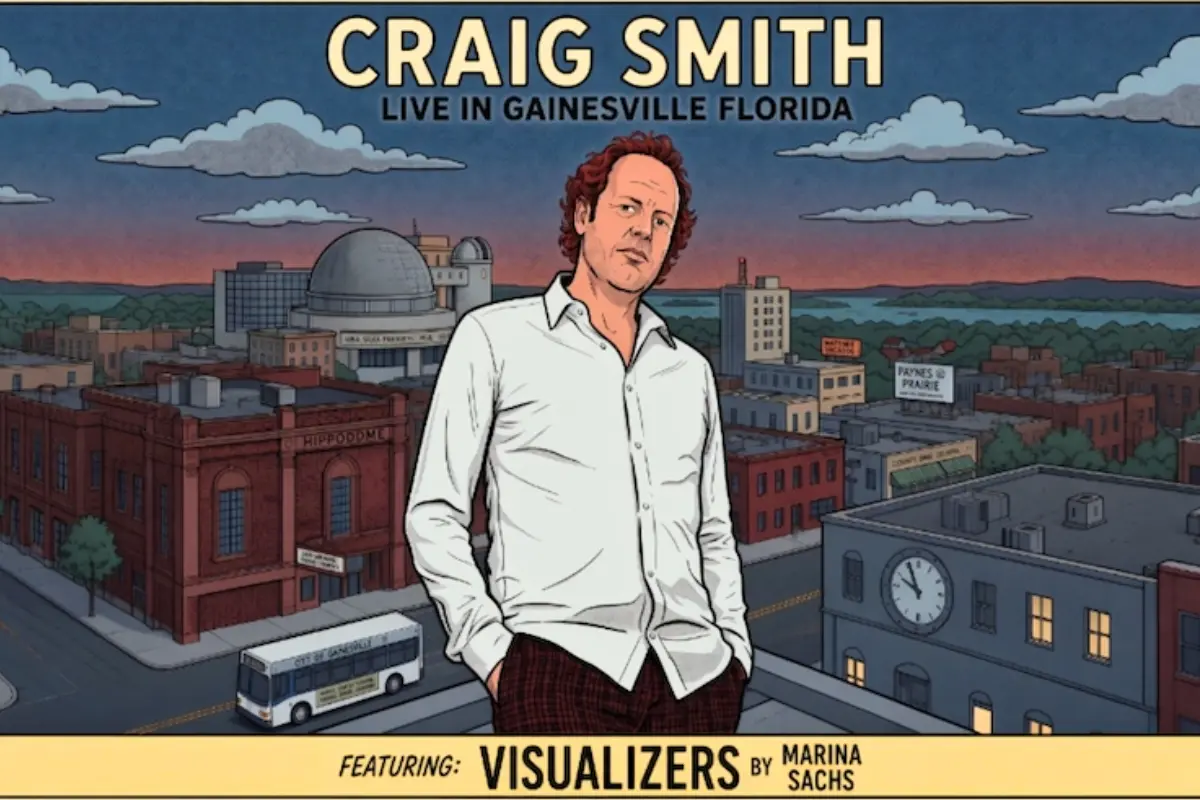
The event series begins on the evening of Thursday, September 17, with Smith’s debut live musical performance in Gainesville. Hosted inside the Kika Silva Pla Planetarium, the event will combine selections from Smith’s recent urban art-rock album, Emerald Cut, with custom-engineered fulldome visual projections created by artist Marina "Shade" Sachs. The residency continues the following evening, Friday, September 18, with the formal opening reception for Smith’s historical retrospective exhibition, Social Practices (2001–2006), at the SF Art Gallery.
By hosting an artist whose career spans solo exhibitions and site-specific interventions across 13 countries, Santa Fe College reinforces its commitment to bringing high-caliber, contemporary global arts programming directly to its student body and the broader Alachua County community. The initiative highlights a growing trend among higher education institutions to leverage non-traditional venues—such as planetariums—to foster interdisciplinary innovation at the intersection of visual art, performance, and sound design.
The scheduled two-day residency has been structured to present two distinct modalities of Craig Smith’s artistic output: his auditory performance practice and his foundational research in social practice art.
       SEPTEMBER 17                                SEPTEMBER 18                     OCTOBER 23
+-----------------------+              +---------------------------------+      +-----------------+
|  Planetarium Concert  |              |    Gallery Opening Reception    |      | Exhibition Ends |
|  7:00 PM - 8:15 PM    | ------------>|       7:00 PM - 9:00 PM         | ---> | SF Art Gallery  |
| Kika Silva Pla Dome   |              | SF Art Gallery (Room M-147)     |      |   Room M-147    |
+-----------------------+              +---------------------------------+      +-----------------+
Day One: Thursday, September 17 – Immersive Planetarium Concert
Format: Live urban art-rock musical performance paired with custom fulldome visualizers.
Ticketing: Advance digital ticketing available via Showpass.
The residency commences inside the 35-foot dome of the Kika Silva Pla Planetarium. Smith will perform live selections drawn from his latest musical release, Emerald Cut, alongside earlier urban art-rock compositions. This concert marks the artist’s first live musical appearance in the Gainesville region.
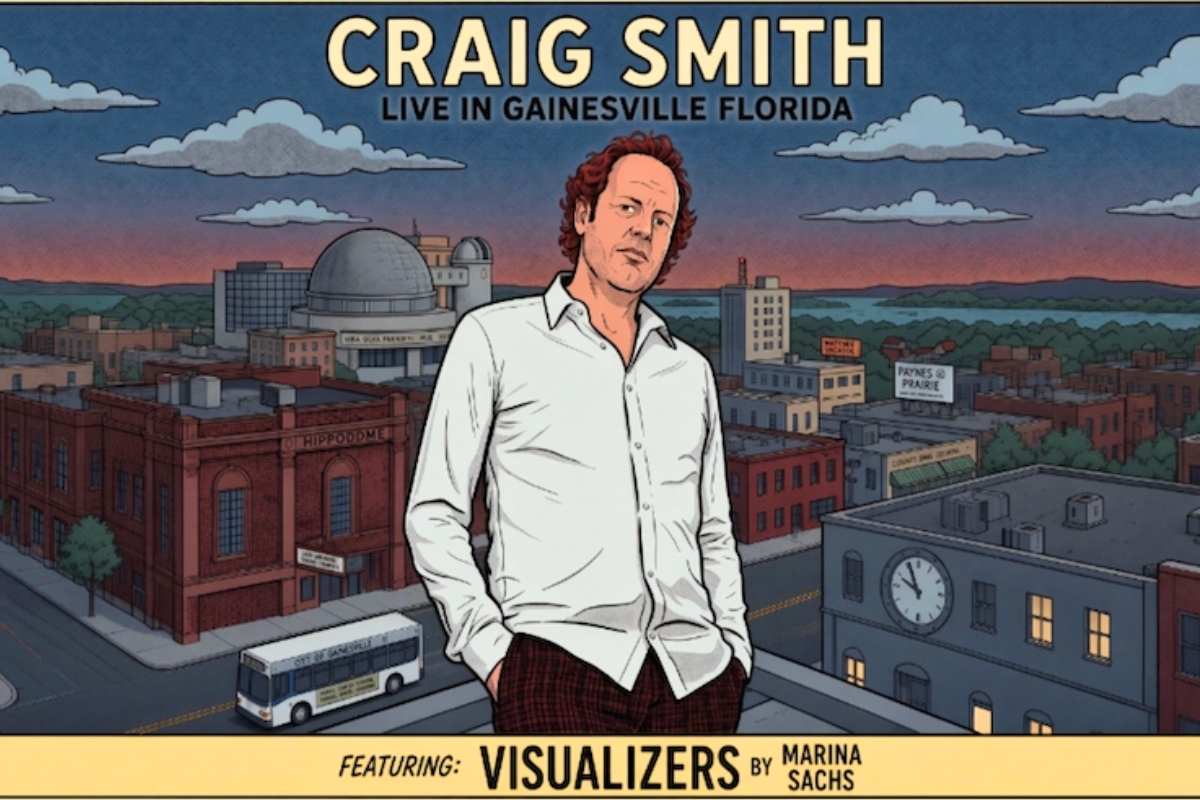
To construct an immersive environment, Smith has partnered with visual artist Marina "Shade" Sachs. Sachs has developed custom visualizers tailored specifically for the planetarium’s hemispherical projection system. As Smith performs, Sachs’ visual compositions will map onto the overhead dome, creating an envelope of light and sound that transforms the scientific facility into an avant-garde performance hall.
Day Two: Friday, September 18 – Exhibition Opening Reception
Time: 7:00 p.m. – 9:00 p.m.
Location: SF Art Gallery, Building M, Room 147, Northwest Campus
Exhibition Social Practices (2001–2006)
Exhibition Duration: September 18 through October 23
The second phase of the residency shifts focus to Smith’s visual and archival work. The SF Art Gallery will host an opening reception for Social Practices (2001–2006), a survey examining a critical five-year period in Smith’s career. The exhibition aggregates photographic documentation, video works, and structural artifacts that illustrate Smith’s early investigations into human interactions within regulated physical spaces.
Following the September 18 opening, the exhibition will remain open to the public, students, and scholars through Friday, October 23, providing a multi-week platform for academic study and curatorial guided tours.
Supporting Context & Metrics
Deconstructing Craig Smith’s Practice and "Social Practices"
Craig Smith’s practice operates at the intersection of conceptual art, media studies, and relational aesthetics. His research considers human social relations not merely as a thematic subject, but as the primary medium of cultural production.
During the featured period of 2001 to 2006, contemporary art underwent a pronounced pivot toward relational aesthetics—a movement popularized by curator Nicolas Bourriaud, which framed human interactions and their social contexts as valid artistic substrates. Smith’s work from this era pushed those boundaries by embedding artistic interventions into operational, everyday systems. Rather than restricting his work to traditional white-cube galleries, Smith carried out projects inside diverse institutional environments:
Healthcare Facilities & Clinics: Investigating institutional care, diagnostic rituals, and physical vulnerability.
Financial Institutions: Examining transaction dynamics, security protocols, and spatial representations of capital.
Athletic Arenas: Analyzing spectator behavior, physical conditioning, and performance metrics.
Public Transit & Urban Nodes: Documenting transient social configurations in metropolitan settings.
By recontextualizing these everyday environments, Smith highlights how spatial architecture and institutional rules shape human behavior and social connection.
International Reach & Venue Diversity
Smith’s work has attained global reach, with solo exhibitions, collaborative performances, and site-specific installations executed across 13 countries.
The choice of the Kika Silva Pla Planetarium for the September 17 performance reflects a broader movement within contemporary art: repurposing scientific visualization infrastructure for artistic expression.
Opened on Santa Fe College’s Northwest Campus in 2006, the Kika Silva Pla Planetarium features a digital projection system that presents complex astronomical data. By utilizing this infrastructure for art-rock performances and generative visual projections, Santa Fe College demonstrates how scientific facilities can support interdisciplinary STEAM (Science, Technology, Engineering, Arts, and Mathematics) initiatives.
Official Statements
Excerpts from key organizers, curatorial statements, and event documentation highlight the broader significance of the two-day event:
"Bringing Craig Smith to Santa Fe College represents a crucial effort to blur the boundaries between distinct creative disciplines. By presenting an immersive art-rock concert inside our planetarium and a historical exhibition of social practice art in our gallery, we offer our students and community an opportunity to see how visual art, performance, and social theory intersect in modern creative practice."
— Santa Fe College Fine Arts Department Statement
"My work has long focused on how physical environments and social structures dictate the ways we communicate, connect, and build culture. Presenting ‘Emerald Cut’ inside a planetarium with visualizers developed by Marina Sachs allows us to test those spatial relationships in real time, converting a space designed for astronomical observation into an intimate, shared auditory experience."
— Craig Smith, Visual and Performing Artist
"The visualizers constructed for the September 17 performance are designed to interact dynamically with the spatial architecture of the planetarium’s dome. Rather than serving as passive backdrops, these projections function as an active visual counterpoint to Smith’s sonic narrative, wrapping the audience in a unified aesthetic environment."
— Marina "Shade" Sachs, Collaborating Visual Artist
Future Outlook
The hosting of Craig Smith’s residency underscores Santa Fe College’s role as a vital cultural engine in North Central Florida. By integrating international artistic perspectives into its local community programming, the institution establishes a valuable framework for future creative initiatives.
+-----------------------------------------------------------------------------------+
|                       INSTITUTIONAL & REGIONAL IMPACT ROADMAP                     |
+-----------------------------------------------------------------------------------+
| 1. PEDAGOGICAL EXPANSION                                                          |
|    • Provides SF College fine arts students direct access to international artist |
|    • Demonstrates real-world application of relational aesthetics and media art   |
+-----------------------------------------------------------------------------------+
| 2. INFRASTRUCTURE DIVERSIFICATION                                                 |
|    • Sets a precedent for hosting acoustic/visual art inside scientific spaces    |
|    • Establishes Kika Silva Pla Planetarium as a venue for multi-disciplinary art |
+-----------------------------------------------------------------------------------+
| 3. REGIONAL CULTURAL ELEVATION                                                    |
|    • Expands Alachua County's access to free and low-cost contemporary art        |
|    • Strengthens ties between higher education facilities and local art audiences |
+-----------------------------------------------------------------------------------+
Pedagogical and Institutional Value
For students enrolled in Santa Fe College’s Fine Arts, Visual Arts, and Digital Media programs, Smith’s two-day residency offers a first-hand look at professional practice in conceptual art and performance. By presenting both a live performance and a archival retrospective, the college demonstrates how an artist can navigate multiple mediums—moving fluidly from studio recording to spatial projection and gallery installation.
Long-Term Gallery Programming
Following the opening reception on September 18, the exhibition Social Practices (2001–2006) will serve as a core educational resource for the SF Art Gallery through October 23. The gallery plans to facilitate student tours, academic discussions, and community visits centered on the exhibition. These sessions will explore institutional critique, the evolution of social practice art over the last two decades, and the changing roles of artists in contemporary public space.
Through this comprehensive program, Santa Fe College reaffirms its commitment to accessible contemporary art, offering audiences new opportunities to reflect on how sound, image, and social structures intersect.



0 Comments