

Executive Overview
College football is a sport built on pageantry, sensory overload, and precision technology. On a dramatic Monday night in Tallahassee, however, the Florida State Seminoles and the 19th-ranked SMU Mustangs were forced to strip the game down to its rawest, most fundamental elements. A sudden and disruptive stadium-wide power outage pushed the kickoff back to a staggering 9:15 p.m., plunging parts of the venue into eerie darkness and eliminating the vital technological infrastructure modern athletics relies upon.
When the lights flickered back on just enough to play, the game unfolded under surreal conditions: no public address announcements echoed through the stands, no in-game video replays assisted the officials or entertained the crowd, coach-to-player audio systems were completely dead, and the massive stadium video boards sat dark and useless.
Yet, beneath the unusual shroud of silence and technical limitations, a fiercely competitive Atlantic Coast Conference (ACC) battle emerged. Florida State, battling through glaring offensive struggles and relying heavily on defensive opportunism, pushed the ranked Mustangs to the absolute brink. FSU forced four crucial turnovers, clawed back from multiple deficits, and tied the game late in the fourth quarter.
Ultimately, however, depth, explosive offensive yardage, and execution down the stretch proved to be the deciding factors. No. 19 SMU escaped Doak Campbell Stadium with a hard-fought 27-24 victory, capitalizing on a late fourth-quarter field goal and a desperate, clock-expiring final stand with just 21 seconds remaining. While SMU outgained the Seminoles significantly—racking up 585 total yards to FSU’s 324—the game will long be remembered as an administrative and logistical nightmare that transformed a prime-time conference showdown into a throwback gridiron survival test.
Detailed Chronology
First Quarter: Darkness, Fumbles, and Early Scrambles
The evening’s chaotic trajectory was established well before the opening whistle. Following a coin toss won by SMU—who promptly elected to receive—a sudden power outage inside the stadium forced officials to delay the kickoff until 9:15 p.m. When play finally commenced under the strange, quiet ambiance of a powerless arena, the Mustangs wasted no time inviting trouble.
On SMU’s very first possession of the night, a mishandled exchange resulted in a fumble. Florida State defender Quindarrius Jones was Johnny-on-the-spot, recovering the loose ball to grant the Seminoles an immediate, golden opportunity to draw first blood. Unfortunately for the home crowd, FSU’s offense was unable to capitalize on the gift, stalling out and turning the ball over on downs without troubling the scoreboard.
As the quarter progressed, the Seminoles began to discover flickers of offensive rhythm. Running back Ousmane Kromah churned out a tough first down, quickly followed by a successful conversion from wide receiver Duce Robinson. Refusing to play conservatively, FSU dialed up a fourth-down conversion attempt, with wideout Jayvan Boggs hauling in a crucial reception to keep the chains moving.
A subsequent face mask penalty whistled against the SMU defense advanced the ball deep into Mustang territory at the eight-yard line. Taking matters into his own hands, quarterback Ashton Daniels executed a decisive quarterback keeper, barreling across the goal line for the game’s opening touchdown. The successful extra point knotted the score at 7-7 with just 1:55 remaining in the opening frame.
SMU threatened on their ensuing drive, pushing deep enough to prompt a field goal attempt after linebacker Caleb LaVallee delivered a textbook third-down deflection to stall the Mustangs’ momentum. Fortunately for FSU, the kick sailed wide, keeping the score deadlocked as the quarter expired.
Second Quarter: Momentum Swings and Mustang Resurgence
The second quarter opened with high drama. Daniels nearly threw an interception on the very first play of FSU’s drive, narrowly escaping disaster before recovering to connect with Boggs for another vital first down. Once again finding themselves facing a critical fourth-and-one, the Seminoles opted to be aggressive. This time, however, the SMU front wall held firm, stopping the run short and turning the ball over on downs at the 9:30 mark.
The Mustangs instantly capitalized on the short field. Methodically slicing through the FSU defense, SMU marched into the red zone. Even a five-yard penalty for having too many players on the field could not derail their march, as the Mustangs punched it into the end zone to capture a 14-7 advantage.
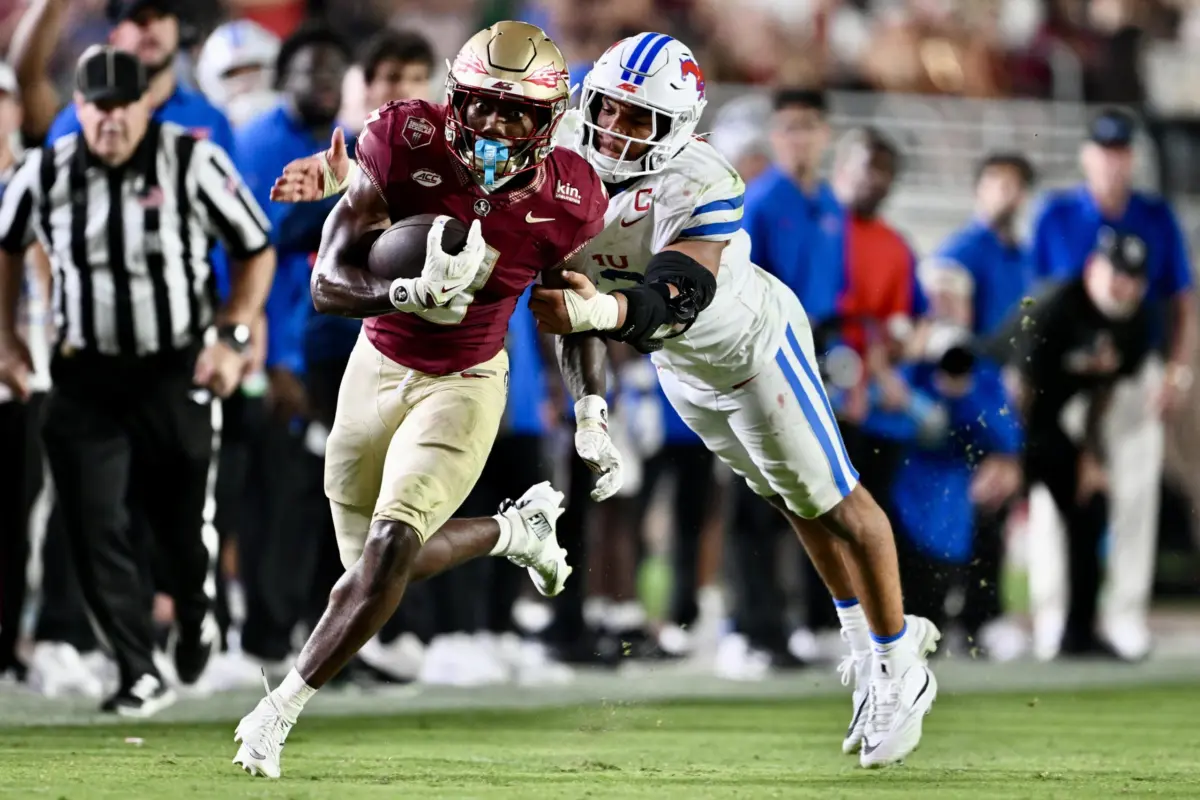
The Seminoles needed a rapid response, and Kromah provided one in electrifying fashion. Taking a handoff, the explosive running back tore through a seam in the defense for a mesmerizing 65-yard sprint that instantly flipped field position and deposited FSU deep inside SMU territory. While the Mustang defense stiffened and prevented a touchdown, FSU settled for a field goal to trim the deficit to 14-10.
SMU’s response was swift and devastating. Striking through the air, the Mustangs completed a massive 64-yard bomb to wide receiver Jalen Hale, instantly setting up first-and-goal. The resilient Florida State defense managed to bow its back and keep the visitors out of the end zone, forcing SMU to settle for a field goal that extended their lead to 17-10 heading toward the locker rooms. A modest 29-yard kickoff return by Samuel Singleton Jr. offered FSU a fleeting chance to manufacture points before the break, but the clock ran out before the offense could strike.
Third Quarter: Defensive Grind and the Equalizer
Receiving the second-half kickoff, Florida State flashed life through a quick completion to Robinson, but the drive quickly stalled, resulting in a punt.
True to form, the Seminoles’ defense provided a lifeline. With SMU threatening at the six-yard line and facing a third-and-goal, defensive back Nehemiah Chandler stepped in front of a pass for a brilliant interception, erasing a near-certain Mustang touchdown.
Regrettably, the FSU offense failed to convert the turnover into points, punting the ball away once more. Yet, special teams chaos struck again. The SMU returner fumbled the punt under heavy coverage, and FSU’s Gemari Sands pounced on the loose ball to gift the offense yet another golden starting position.
Initially, the Seminoles trotted out the field goal unit. A timely offsides penalty against SMU, however, erased the kick and awarded FSU a fresh set of downs. Facing a fourth-and-two from the nine-yard line, the coaching staff trusted their ground game. Kromah took the handoff and danced into the end zone for a crucial touchdown. The ensuing extra point tied the game at 17-17, breathing new life into the partisan home crowd.
Both defenses dug in thereafter. FSU forced an SMU punt, though the Seminoles were subsequently forced to punt on their own possession as the game ground into a tense, fourth-quarter tactical stalemate.
Fourth Quarter: A Dramatic Finish
As the final period unfolded, the intensity reached a fever pitch. Daniels jump-started the FSU offense with his legs, picking up a hard-earned first down before unleashing a brilliant 21-yard strike to wide receiver Micahi Danzy.
The momentum culminated when Daniels targeted Singleton for a spectacular 39-yard catch-and-run touchdown. The extra point split the uprights, miraculously pulling Florida State even once more at 24-24.
With the game hanging in the balance, the FSU defense delivered another clutch play. Ashlynd Barker intercepted an SMU pass, giving the ball back to the offense with a chance to take a late lead. Once again, however, the sputtering FSU offense failed to capitalize on the turnover, ultimately punting the ball back to the Mustangs with the clock winding down.
SMU seized their final opportunity with cold efficiency. Driving methodically down the field, the Mustangs reached the FSU 12-yard line with a mere two minutes remaining on the game clock. Facing a fourth-and-one situation near the goal line, SMU opted for pragmatism over risk, booting a short field goal to seize a 27-24 lead.
That sequence left Florida State with a daunting reality: 21 seconds and no timeouts to orchestrate a game-winning drive or move into field goal range. The final desperate sequence yielded no magic, and the clock expired on a heartbreaking 27-24 defeat.
Supporting Context & Metrics
While the final scoreline of 27-24 suggests a razor-thin, back-and-forth defensive struggle, the underlying statistical sheet paints a considerably more complex picture of dominance and resilience.
| Statistical Category | SMU Mustangs | Florida State Seminoles |
|---|---|---|
| Total Offensive Yards | 585 | 324 |
| Passing Yards | 430 | 125 |
| Third-Down Conversions | 8 / 14 (57.1%) | 2 / 15 (13.3%) |
| Turnovers Forced | 0 | 4 |
| Time of Possession | Advantage SMU | Deficit |
The most glaring disparity of the contest lay in offensive efficiency and third-down execution. SMU masterminded a staggering 585 total yards of offense, heavily anchored by a prolific aerial attack that shredded the FSU secondary for 430 passing yards. Conversely, the Seminoles struggled mightily to sustain drives, finishing the night an abysmal 2-for-15 on third-down conversions.
Despite being outgained by more than 260 yards and managing just 125 yards through the air, Florida State stayed within striking distance entirely due to defensive opportunism. FSU forced four critical turnovers—recovering two fumbles and intercepting two passes—which repeatedly bailed out an anemic offense and kept the scoreboard close. Ultimately, however, the statistical weight proved insurmountable; SMU’s 8-for-14 success rate on third down allowed the Mustangs to control the tempo, drain the clock, and manufacture the game-winning points when it mattered most.
Official Statements
The surreal nature of the evening dominated post-game press conferences, with players and coaching staff addressing both the logistical chaos and the fierce on-field battle.
Reflecting on the bizarre atmosphere caused by the pre-game power outage, team leadership emphasized the need for mental toughness. While declining to use the blackout as an excuse for the offensive struggles, program representatives acknowledged the profound impact of playing a high-level ACC game in near-silence without video replay assistance or coach-to-player communication channels.
"You prepare all week for a specific environment, and then you step into something entirely unprecedented," a team spokesperson noted regarding the blackout conditions. "There were no scoreboard prompts, no crowd noise cues, and zero communication tech. But at the end of the day, both teams played under the same lights—or lack thereof. We had opportunities to seize control of this football game, especially defensively, but we simply didn’t execute well enough on third down to close it out."
Defensively, players expressed pride in the four-turnover performance while lamenting the inability of the offense to turn those defensive takeaways into decisive points.
"We knew coming in that SMU was a high-powered offense with a lot of weapons," noted linebacker Caleb LaVallee. "Our mindset was to fly around, create chaos, and give our offense short fields. We did that for stretches, but against an offense that puts up nearly 600 yards, you eventually have to get off the field on third down. We left everything out there, and it hurts to come up three points short."
Future Outlook
As the dust settles on a truly unforgettable Monday night in Tallahassee, both programs face critical trajectories as the ACC conference slate intensifies.
For No. 19 SMU, the gritty road victory validates their ranking and underscores their offensive firepower. Surpassing 580 yards of total offense on the road—even amidst bizarre operational conditions—demonstrates a high ceiling for the Mustangs. However, defensive lapses and ball-security issues that allowed FSU to stay within striking distance via four turnovers will undoubtedly be points of emphasis for the coaching staff as they prepare for higher-tier conference opponents. If SMU can tighten its turnover margin while maintaining its explosive offensive rhythm, the Mustangs project as legitimate contenders down the stretch.
For Florida State, the 27-24 loss is a mixture of encouraging resilience and glaring structural concerns. The Seminoles proved they possess the defensive playmaking and grit to hang with ranked opponents, fighting back from multiple deficits and neutralizing a potent attack for stretches through sheer opportunistic pressure.
Yet, the offensive metrics demand immediate recalibration. Finishing 2-for-15 on third down and mustering a meager 125 passing yards is unsustainable against elite competition. Addressing the offensive line’s consistency, third-down play-calling, and aerial efficiency will be paramount for the coaching staff during the upcoming bye and practice weeks. If FSU can marry its opportunistic, hard-nosed defense with a functional, multi-dimensional offense, the Seminoles possess the foundational toughness to rebound and salvage their ACC campaign.

0 Comments