

Executive Overview
TALLAHASSEE, Fla. — In the high-stakes ecosystem of major collegiate athletics, few environments prove as unforgiving as a Monday night defeat followed immediately by a microscope of public scrutiny. For the Florida State Seminoles, the fallout from a bitterly disappointing 27-24 loss to the No. 19 SMU Mustangs has set off a rigorous period of internal reflection. Sitting at an uncharacteristic 1-1 overall record and an early 0-1 mark in Atlantic Coast Conference (ACC) play, the program finds itself at a vital crossroads.
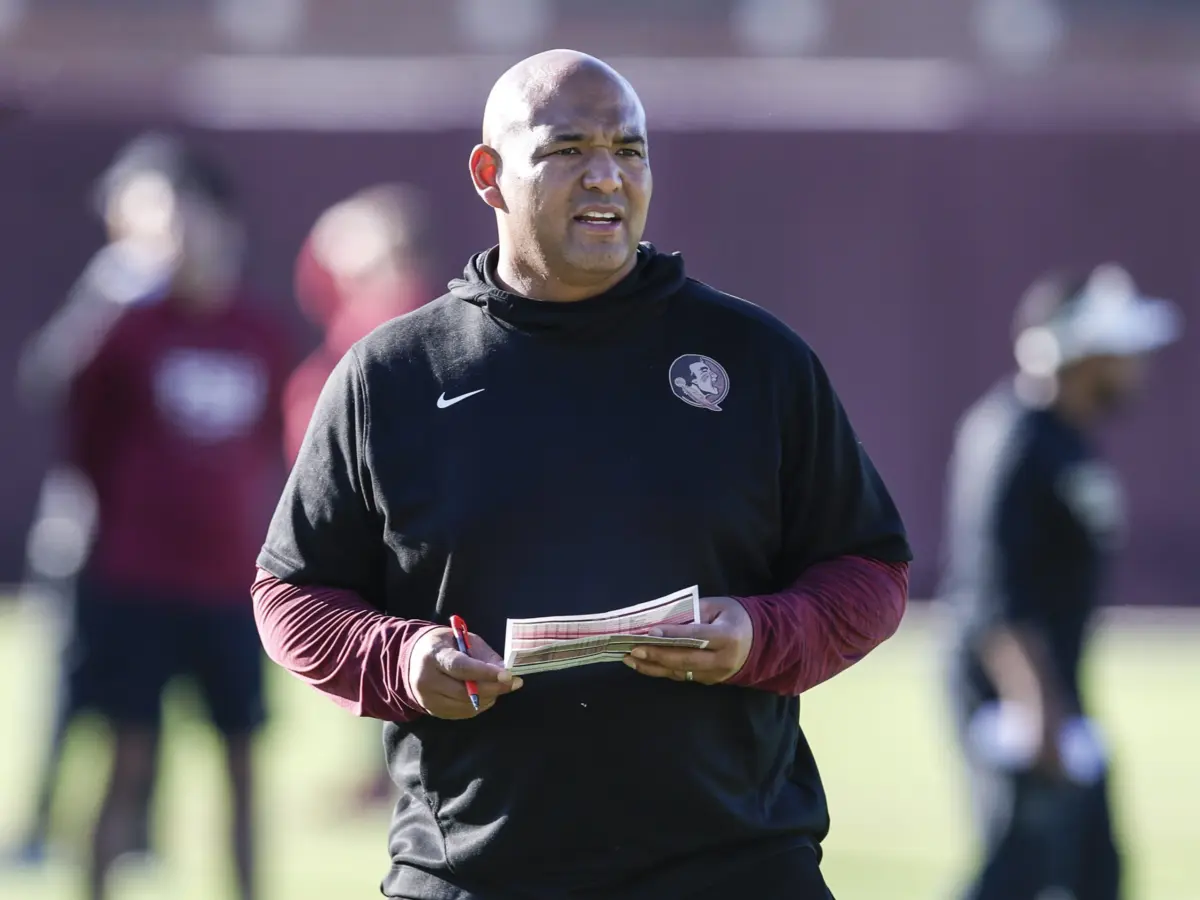
On Wednesday, Florida State offensive coordinator Tim Harris Jr. and defensive coordinator Tony White stepped to the podium to face the local media. Their task was twofold: dissect the glaring deficiencies that led to Monday’s setback and chart a corrective course during a timely bye week. With a daunting two-week build-up culminating in their first road trip of the season—a high-profile date with the No. 12 Alabama Crimson Tide on September 19—the Seminoles cannot afford lingering structural flaws.
The stark metrics from the SMU matchup underline the urgency of the coaching staff’s mission. Offensively, Florida State sputtered into historical inefficiency, converting an abysmal 2-of-15 attempts on third down. Defensively, the unit surrendered a staggering 585 total yards while allowing the Mustangs to dictate the tempo by converting over 57% of their third-down opportunities.
Yet, beneath the statistical wreckage and raw frustration, both coordinators offered a transparent assessment of accountability, pointing toward execution errors, mental lapses, and the fine margins that separate victory from defeat in contemporary college football. As the Seminoles dive into their bye week preparations, the collective focus has shifted from dwelling on past failures to instilling a culture of absolute precision.
Detailed Chronology: The Anatomy of Monday’s Collapse
To understand the gravity of Wednesday’s press conferences, one must revisit the fading light of Monday night at Doak Campbell Stadium (or the venue of the contest), where the Seminoles watched a hard-fought battle slip through their fingers in the closing moments. The 27-24 final score does not fully capture the statistical disparity that unfolded over four quarters, as SMU outgained Florida State by a commanding 585 to 324 total yards.
The game’s narrative was defined by missed opportunities, particularly in high-leverage situations. Offensively, the Seminoles looked disjointed when the chains needed to move. A conversion rate of 13.3% on third down (2-of-15) effectively starved the FSU defense of rest and rhythm, allowing SMU to control the time of possession and run 69-plus plays of sustained offensive pressure.
Defensively, Tony White’s unit showed flashes of high-level disruption, rendering stretches of the game where the Mustangs were stymied. However, the defense was repeatedly undone by explosive plays and catastrophic breakdowns in situational awareness. The turning points of the contest crystallized in the fourth quarter: a pivotal third-and-10 sequence where a defensive misstep allowed an improbable escape and throw; a costly third-and-7 conversion yielded through a defensive play-call miscue; and, most damagingly, Yannick Smith’s devastating 79-yard touchdown run—a back-breaking sprint born of miscommunication and poor leverage.
When the final whistle blew, sealing the 27-24 defeat, the realization set in: Florida State had not merely been outplayed; they had out-executed themselves. The ensuing 48 hours have been marked by intensive film study, arduous evaluations, and hard conversations within the facilities in Tallahassee.
Supporting Context & Metrics: Decoding the Numbers
The statistical autopsy of the SMU game reveals deep-seated operational challenges that Tim Harris Jr. and Tony White must solve if the Seminoles hope to compete against elite national competition like Alabama.
The Third-Down Abyss (Offense)
Finishing 2-of-15 on third down is a statistical anomaly that points directly to systemic preparation and on-field chemistry. In modern football, sustaining drives is the lifeblood of offensive success. When an offense operates at a 13.3% clip on money downs, it places an insurmountable burden on the special teams and defense.
Tim Harris Jr. did not mince words when addressing the root causes. According to the offensive coordinator, the breakdowns were multifaceted, tracing back to spatial awareness, route depth precision, and quarterback-receiver synchronization.
"The quarterback knowing where people are gonna be, guys knowing exactly their depth on routes, we’ve just got to do a better job of that overall," Harris remarked.
Crucially, Harris defended the structural integrity of the play-calling itself, noting that the analytical framework and game plans provided answers against SMU’s defensive looks. The failure, in his estimation, lay squarely in the transition from the whiteboards to the gridiron. "You look at our game the other night, the planning and how we gameplan things — things were there, and we just have to execute better," Harris added. "It goes with about everything. It’s an everybody thing."
Short-Yardage Inefficiencies and Personnel Utilization
Compounding the third-down woes were struggles in short-yardage running situations. Florida State repeatedly failed to punch through when inches mattered most. Harris pointed to subtle defensive adjustments—such as successfully executed twists by the defensive line—coupled with occasional misreads in zone-read schemes.
Furthermore, the utilization of explosive perimeter weapons like Duce Robinson became a focal point of discussion. Harris emphasized that the coaching staff must do a better job scheming movements to place dynamic playmakers in advantageous positions. In tight, contested-catch scenarios, those are "the balls that need to be won," a standard the Seminoles failed to meet consistently on Monday.
Defensive Fatigue and Explosive Plays
On the other side of the ball, Tony White’s defense was caught in a tug-of-war between high-effort execution and catastrophic lapses. SMU converted an astounding 8-of-14 third downs (over 57%), keeping the Seminole defense on the field for an exhausting number of snaps.
Yet, White refused to hide behind fatigue. Reviewing the film of roughly 69 defensive plays, White offered a stark appraisal: "You’re pissed off like hell… But when you look at the football, and I think there was 69 plays in there or something, the men went out there and they played their tails off. For about 60 plays in there they balled, and there’s nine plays that you want back."
Those nine plays, however, proved fatal.
Official Statements: Inside the Coordinators’ Press Conferences
The media availability sessions provided a fascinating window into the psychological state of Florida State’s coaching staff. Both coordinators exhibited a blend of ownership, urgency, and unwavering belief in their rosters.
Tim Harris Jr.: Emphasizing Ownership and Execution
Harris projected a calm, analytical demeanor, treating the offensive performance not as a structural failure of philosophy, but as an execution crisis that can be corrected through repetition.
- On Collective Responsibility: "It goes with about everything. It’s an everybody thing. And we’ll get better. Our guys, they understand that. We understand that as a stat, and that’s our focus."
- On Short-Yardage Struggles: "We need to do a good job of making sure that our players are applying the things that we’re coaching and that we’re preaching every day… You get beat on a twist, you make a bad read on a zone read, that stuff, it happens from time to time. So we’ve got to continue to evaluate what we’re asking our guys to do, and then just be able to do the things that they’re best at."
- On Perimeter Passing and Duce Robinson: "We have very good players on the wings, and we have to do a good job of moving them and putting them in positions. We had an opportunity […] that couldn’t be seized, but these are the balls that need to be won."
Tony White: Raw Accountability and Defensive Nuance
Tony White brought his trademark intensity to the podium, offering unfiltered commentary on the emotional and technical realities of defensive football. White shouldered significant blame for a crucial third-and-7 conversion allowed by the defense, admitting his focus drifted from the game situation to the play itself.
- On the Defensive Effort vs. Critical Lapses: "You’re pissed off like hell. But when you look at the football, and I think there was 69 plays in there or something, the men went out there and they played their tails off. For about 60 plays in there they balled, and there’s nine plays that you want back."
- On SMU’s High Third-Down Conversion Rate: Dismissive of broad statistical panic, White refocused on the micro-level realities of competition: "Play ball, man. That’s football, right? I don’t care about that."
- On the Near-Miss on Third-and-10: Describing the chaotic sequence preceding SMU’s game-winning field goal, White detailed how linebacker Mikai Gbayor tripped in traffic while FSU was flushing the quarterback. "We flushed the quarterback, we’ve got two guys running to go get him against his throwing arm, and he throws it sideways, jumping like this in the air, and if we don’t trip, we’re gonna be body on body, and then who knows what happens."
- On Coaching Accountability: Addressing the third-and-7 conversion, White was direct: "I told the guys, that’s me. I was locked into the play, not the situation. Hey, that’s me, guys. We’re all subject to it. But we’ve gotta eliminate those times, both coaches and players, and let them go out there and play."
- On Yannick Smith’s 79-Yard TD and Situational Awareness: White diagnosed the breakdown that led to the back-breaking long run with sharp precision: "There’s people’s jobs that are supposed to say where the sticks are. Where the down and distances are. And we’re a little too deep, and we don’t use our technique, and we don’t get the ball on the ground […] We’re not locked into the moment. We’re not locked into the down and distance. We’re not into those assignments, and then good players are gonna beat you. Toes on the sticks."
Future Outlook: The Bye Week and the Alabama Horizon
As the dust settles on the SMU defeat, Florida State’s calendar shifts from immediate crisis management to long-term recalibration. The timing of the bye week could not be more fortuitous. With a 1-1 record and a wounded 0-1 conference standing, the Seminoles possess a valuable window to heal physical bruises, correct mental errors, and install structural refinements without the immediate pressure of a Saturday game.
However, the margin for error is razor-thin. Looming on the horizon is a colossal test on September 19: a high-stakes, hostile road trip to face the No. 12 Alabama Crimson Tide. In years past, matchups against national titans like Alabama have served as foundational litmus tests for programs seeking elite status. For this iteration of the Seminoles, the trip to Tuscaloosa represents an existential challenge.
To stand a chance against the Crimson Tide, the offensive transformation under Tim Harris Jr. must be immediate. Route depths must be synchronized, quarterback-receiver chemistry must crystallize, and short-yardage play-calling must find reliable answers. Simultaneously, Tony White’s defense must eliminate the mental lapses that surrender explosive plays. The nine plays White referenced from the SMU film—the missed tackles, the depth miscalculations, the situational disconnections—cannot be replicated against elite SEC competition.
The next two weeks in Tallahassee will not be defined by comfort, but by accountability. As both coordinators made clear to the media, the blueprints for success are already drawn; the burden now rests entirely on the players and coaches to bridge the gap between preparation and execution. If Florida State can harness this bye week to master the fundamental details—to keep their "toes on the sticks"—the Seminoles may yet salvage their season and redefine their trajectory on the national stage.

0 Comments