

Executive Overview
In one of the most expansive and logistically complex wildlife public health interventions in modern history, the United States Department of Agriculture (USDA) is preparing to launch its annual autumn offensive against raccoon rabies. Beginning in October, a coordinated fleet of low-flying aircraft and ground distribution teams will disperse millions of oral rabies vaccine (ORV) baits across the southeastern United States. The operation, overseen by the USDA’s Animal and Plant Health Inspection Service (APHIS) Wildlife Services, represents a critical wall of defense designed to halt the westward expansion of a lethal zoonotic pathogen.
Rabies, a viral disease affecting the central nervous system of mammals, carries a near-100% fatality rate once clinical symptoms manifest. While domestic pet vaccination mandates have successfully neutralized canine rabies variants in the United States, wildlife reservoirs—most notably raccoons (Procyon lotor), striped skunks, coyotes, and foxes—remain persistent vectors of the disease.
The upcoming October campaign is not merely a localized control measure; it is a vital component of a contiguous biological barrier stretching from the Canadian border to the Gulf of Mexico. By immunizing wild populations en masse through the distribution of specialized fishmeal-coated vaccine sachets, federal and state agencies aim to systematically squeeze the virus toward the Atlantic coast, with the ultimate goal of complete regional eradication.
Detailed Chronology: Executing the Autumn Drop
The execution of the ORV campaign is a masterpiece of seasonal timing and aerospace logistics. The selection of October for the southeastern drop is highly deliberate, calculated to coincide with the behavioral patterns of the target vector. During the autumn months, raccoon populations experience high foraging activity as they prepare for the colder winter season, making them exceptionally receptive to the scent of the bait. Furthermore, cooler autumn temperatures prevent the structural degradation of the heat-sensitive vaccine baits.
+-------------------------------------------------------------------+
|               TYPICAL ORV ANNUAL TIMELINE (SOUTHEAST)             |
+-------------------------------------------------------------------+
|  Late Summer:        Targeted aerial drops in Northeastern states |
|  September:          Logistical staging and bait manufacturing    |
|  October (Phase 1):  Fixed-wing aerial drops in rural Southeast    |
|  October (Phase 2):  Rotary-wing drops in suburban margins        |
|  October (Phase 3):  Ground baiting in urban/high-density zones    |
|  November-Dec:       Post-drop trapping and serological monitoring|
+-------------------------------------------------------------------+
1. Aerial Dispersal Operations
The backbone of the campaign relies on fixed-wing aircraft, predominantly Twin Otters, operating at low altitudes (approximately 500 feet above ground level). These aircraft fly highly precise, GPS-guided parallel grid patterns over rural forests, agricultural fields, and wildlands. Inside the cabin, automated conveyor systems drop the baits at pre-determined intervals to achieve a target density of roughly 75 to 150 baits per square kilometer, depending on the estimated local raccoon population density.
In suburban and fragmented landscapes where fixed-wing aircraft cannot safely maneuver, helicopters are deployed. These rotary-wing aircraft allow for more targeted placement of baits in woodlots, ravines, and riparian corridors adjacent to residential neighborhoods.
2. Urban and Ground-Based Distribution
Because raccoons are highly adaptable synanthropes—animals that benefit from living in close proximity to human habitats—urban areas present a unique challenge. Aerial drops are impossible over densely populated city centers. To address this, ground crews consisting of wildlife biologists and trained technicians distribute baits by hand.
Equipped with vehicles and specialized mobile mapping software, these teams target micro-habitats favored by raccoons:
- Storm drains and culverts
- The perimeters of trash receptacles and dumpsters
- Suburban greenways and public parks
- Wooded edges bordering residential properties
Supporting Context & Metrics: The Science of Oral Vaccination
The success of the ORV program relies on a sophisticated fusion of veterinary immunology, materials science, and wildlife ecology.
The Anatomy of the Bait
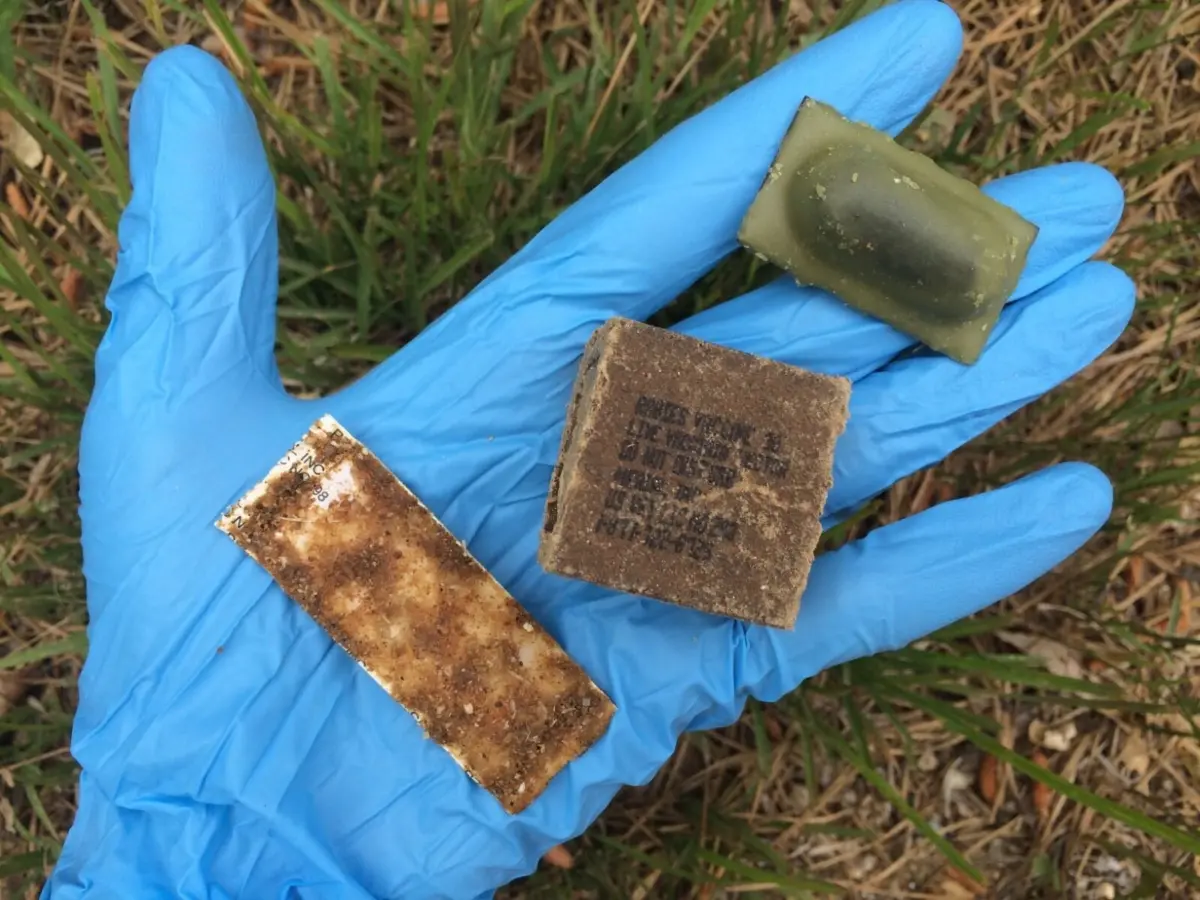
The baits are engineered to be highly attractive to wild carnivores while protecting the delicate biological payload inside. There are three primary bait configurations utilized by the USDA:
- Fishmeal-Coated Sachets: A small plastic packet containing the liquid vaccine, encased in a hard shell made of compressed fishmeal and wax.
- Fishmeal-Coated Cubes: Similar to the sachet, but shaped into a uniform block that can easily pass through automated aircraft distribution chutes.
- Blister Packs: Compact, durable polymer packets containing the vaccine, often coated with a highly enticing sweet or fishy attractant.
+-----------------------------------------------------------------+
|                    ANATOMY OF AN ORV BAIT                       |
+-----------------------------------------------------------------+
|                                                                 |
|         [=============================================]         |
|        /  [ Hard outer shell: Fishmeal & polymer wax ]         |
|       |                                                 |       |
|       |    +---------------------------------------+    |       |
|       |    | [ Inner Sachet: Liquid Rabies Vaccine] |    |       |
|       |    +---------------------------------------+    |       |
|       |                                                 |       |
|        ===============================================/        |
|                                                                 |
|  * Mechanism: Animal bites bait -> Punctures inner sachet ->    |
|    Vaccine coats oral cavity & tonsils -> Triggers immunity.    |
+-----------------------------------------------------------------+
When a raccoon encounters the bait, it bites into the outer shell, puncturing the inner sachet. The liquid vaccine is released directly into the animal’s oral cavity. Unlike traditional vaccines that must be injected or digested, the ORV vaccine is absorbed through the oral mucosa and tonsils, stimulating the production of neutralizing antibodies.
Public Health and Safety Parameters
A primary concern for the public is the safety of these baits regarding domestic pets and humans. The USDA has established strict safety profiles for the vaccines used:
- Domestic Animals: The baits are non-toxic to domestic dogs and cats. If a domestic dog consumes a single bait, there is no cause for alarm. However, the USDA notes that if a dog consumes multiple baits, it may experience temporary, mild gastrointestinal upset (vomiting or diarrhea) due to the rich fishmeal and wax formulation.
- Human Contact: While the vaccine is safe, humans are strongly advised to leave the baits undisturbed. If a bait must be moved, individuals should wear gloves or use a plastic bag to avoid direct contact with the liquid vaccine, as the scent of human skin can also deter wild animals from consuming the bait. If skin contact with the liquid vaccine does occur, immediate washing with soap and water is recommended.
Economic and Epidemiological Metrics
The financial rationale for the ORV program is compelling. The cost of managing rabies reactively is astronomically higher than the proactive cost of the baiting program.
| Metric / Parameter | Reactive Management (No ORV) | Proactive Management (With ORV) |
|---|---|---|
| Human Post-Exposure Prophylaxis (PEP) | $3,000 to $10,000+ per person exposed | Negligible; localized exposure rates drop |
| Livestock/Pet Loss | High veterinary/replacement costs | Minimized through herd immunity barriers |
| State/Local Health Budgets | Consumed by laboratory testing & quarantine monitoring | Allocated to scheduled, predictable prevention |
| Efficacy Monitoring | Reactive investigation of animal attacks | Active surveillance (serological testing of trapped animals) |
Official Statements: The Strategy of the "Containment Line"
A recurring question raised by local communities and public health advocates is why certain regions with active rabies cases are excluded from the annual autumn drop. Specifically, in the Southeast, South Carolina reports dozens of raccoon rabies cases annually, yet remains outside the active October drop zone.
To clarify this strategic decision, a spokesperson for the USDA’s Animal and Plant Health Inspection Service (APHIS) provided an in-depth policy statement:
"Oral rabies vaccine zones are positioned in areas of states representing the westernmost extent of where raccoon rabies is present geographically. In the southeast, those boundaries are present in southeast VA, western NC, east TN, northern GA and AL.
The goal is to prevent westward spread of raccoon rabies by creating a continuous vaccine barrier that stays in front of rabies occurrence on the landscape that eventually will be moved further to the east as rabies is locally and regionally eliminated.
The program is very close to establishing an ORV area in South Carolina counties bordering North Carolina and Georgia in the next few years. However, raccoon rabies is present throughout the state of SC and other nearby states and the program does not ‘spot treat’ local areas of outbreak that are not part of the continuous barrier."
Analyzing the "Spot Treating" Prohibition
The USDA’s refusal to "spot treat" isolated outbreaks is grounded in established epidemiological principles. Rabies is a highly dynamic disease; without a continuous, contiguous barrier, vaccinating a localized pocket within an endemic zone yields only temporary results. The virus will inevitably re-invade from surrounding untreated areas once the localized immunity wanes.
By focusing resources on a strict, unbroken frontline—anchored against geographical barriers and stretching thousands of miles—the USDA ensures that the virus cannot breach the western frontier. Once this barrier is permanently stabilized, the agency can systematically advance the line eastward, reclaiming territory and permanently squeezing the virus out of the eastern seaboard.
Future Outlook: Technology and the Path to Eradication
The battle against raccoon rabies is entering a new era characterized by technological refinement and ecological precision. As the USDA looks toward the next decade of the National Rabies Management Program, several key advancements are poised to reshape the landscape of wildlife disease control.
1. Next-Generation Vaccines
Currently, researchers are deploying and testing next-generation vaccines, such as ONRAB, a recombinant human adenovirus-vectored vaccine. ONRAB has shown exceptional efficacy in trials, particularly in achieving high seroconversion rates (the development of detectable antibodies) in both raccoons and striped skunks. Skunks have historically been a difficult vector to immunize with older vaccine formulations, making this development a major milestone for comprehensive wildlife rabies control.
2. Precision Drone Delivery
While fixed-wing aircraft and helicopters remain the workhorses of the program, the integration of Unmanned Aerial Vehicles (UAVs), or drones, is on the horizon. Drones offer an unparalleled combination of precision, safety, and cost-efficiency. They can be programmed to navigate highly complex suburban terrains, dropping baits with pinpoint accuracy into known wildlife corridors, riverbanks, and suburban greenbelts without the noise and expense of manned helicopters.
3. Predictive Modeling and GIS Integration
Modern epidemiologists are utilizing Geographic Information Systems (GIS) paired with machine learning algorithms to predict wildlife movement patterns. By analyzing variables such as canopy cover, water sources, urban sprawl, and climate data, these models can predict "hotspots" of raccoon density. This allows the USDA to dynamically adjust bait deployment densities in real-time, ensuring maximum immunization coverage with minimal bait waste.
The Long-Term Vision
The ultimate goal of the USDA and its state partners is the total eradication of terrestrial raccoon rabies from the North American continent. While the challenges are formidable—including managing vast wilderness areas, navigating urban sprawl, and securing consistent federal funding—the systematic march of the ORV barrier offers a proven, scientifically sound blueprint. Until total eradication is achieved, the autumn sky over the American Southeast will continue to deliver a quiet, life-saving rain of prevention.

0 Comments