

Executive Overview
For nearly a quarter of a century, American men’s tennis has chased a ghost. Not since Andy Roddick hoisted the silver trophy in the late summer of 2003 has an American man stood atop the podium at Flushing Meadows—or any other Grand Slam venue. On Sunday afternoon, that multi-decade drought will face its most formidable challenger yet.
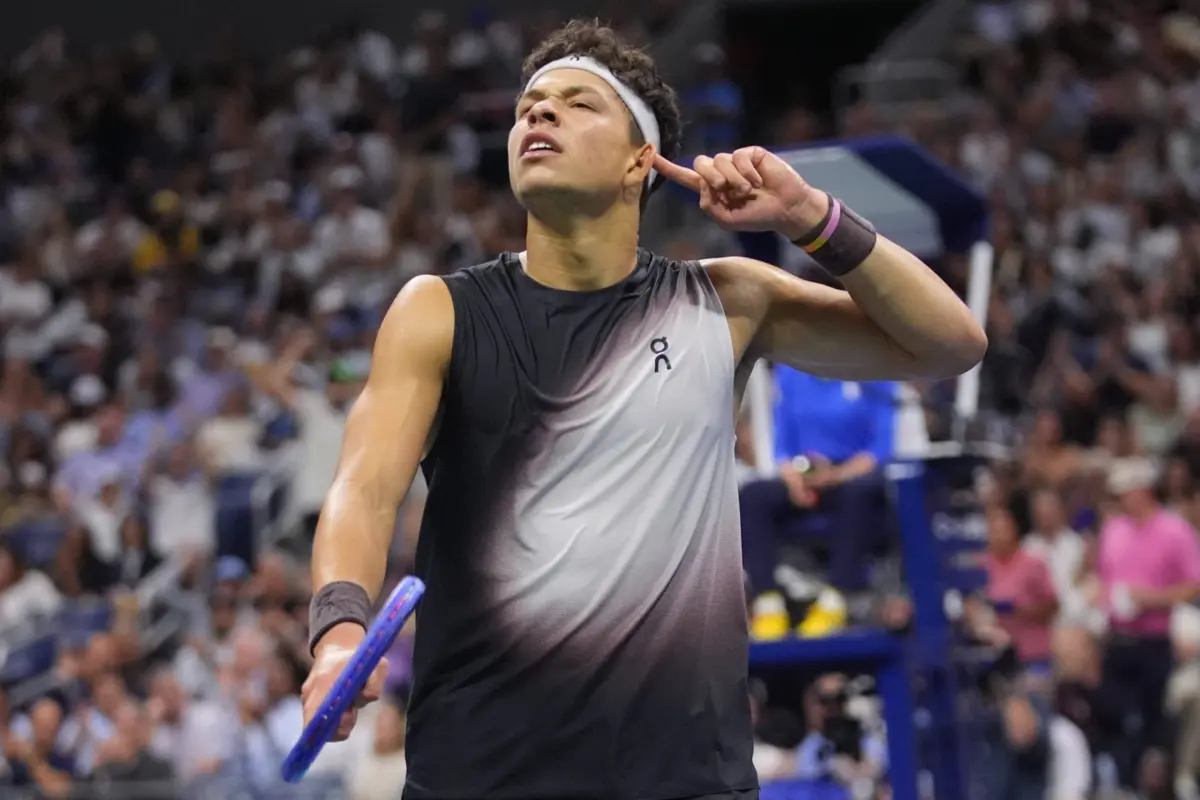
Ben Shelton, the charismatic 23-year-old former University of Florida standout and Gainesville native, is precisely one match away from rewriting tennis history. On Friday, the eighth-seeded Shelton put on a masterclass of resilience, overcoming a first-set deficit to secure a grueling 4-6, 6-3, 6-3, 7-5 victory in the semifinals. The win books his ticket to the grandest stage in American sports: a Sunday afternoon showdown at Arthur Ashe Stadium against the tournament’s top seed, Alexander Zverev of Germany.
Shelton’s rise has been nothing short of meteoric, but his roots remain deeply anchored in the collegiate tennis system. Coached by his father, Bryan Shelton—a former ATP professional and the architect behind the University of Florida’s 2021 NCAA National Championship—the younger Shelton represents a new archetype of American tennis player: physically imposing, tactically versatile, and possessing a left-handed serve that has been clocked as one of the fastest in the history of the sport. As the sporting world prepares for the 2:00 p.m. ET broadcast on ABC, the pressure on Shelton is immense, but those who have followed his journey from Buchholz High School to the professional circuit believe he is uniquely built for this moment.
Detailed Chronology: The Road to the Final
The Semifinal Crucible: Overcoming the Opening Set Backdrop
Shelton’s semifinal victory was a testament to mental fortitude and tactical evolution. Facing an opponent who came out firing with high-percentage first serves and deep, penetrating groundstrokes, Shelton dropped the opening set 4-6. Throughout the first set, Shelton struggled to find his rhythm on his second serve, winning just 41% of those points and allowing his opponent to dictate play from the baseline.
Semifinal Match Scoreboard:
Set 1: 4-6 (Opponent)
Set 2: 6-3 (Shelton)
Set 3: 6-3 (Shelton)
Set 4: 7-5 (Shelton)
The Tactical Pivot in Sets Two and Three
Recognizing the need to disrupt his opponent’s rhythm, Shelton and his coaching box—led by his father, Bryan—initiated a tactical shift at the start of the second set. Shelton began utilizing a wider, slicing serve from the Ad-court, pulling his opponent off the doubles alley and opening up the court for his devastating inside-out forehand.
This adjustment paid immediate dividends:
- Set 2 (6-3): Shelton broke serve in the fourth game, consolidating with a love-hold powered by three consecutive aces. He won 88% of his first-serve points in this set.
- Set 3 (6-3): Shelton continued to apply relentless pressure, utilizing drop shots and frequent approaches to the net to keep his opponent off-balance. A double-break secured the set in just 38 minutes.
The Fourth-Set Drama
The fourth set was a high-octane battle of nerves. Serving at 5-5, Shelton faced two break points—moments that could have easily sent the match into a deciding fifth set. Relying on his signature weapon, he fired a 141 mph ace out wide, followed by a fierce body serve to escape the jam. In the subsequent game, Shelton pounced on a series of second serves, securing the match-winning break to close out the set 7-5, collapsing to the blue hardcourt of Arthur Ashe Stadium in triumph.
Supporting Context & Metrics
To fully understand the gravity of Shelton’s run to the final, one must examine both the historical weight of American tennis and the mathematical parameters of Sunday’s matchup against Alexander Zverev.
The Weight of History: The Post-Roddick Era
Since Andy Roddick’s triumph in 2003, American men’s tennis has endured a prolonged era of near-misses and transition. The era of the "Big Three" (Roger Federer, Rafael Nadal, and Novak Djokovic) locked down the sport’s major titles for two decades, leaving American contenders like James Blake, Mardy Fish, John Isner, and Taylor Fritz on the periphery of Grand Slam glory.
| Year | Last American Male Champion | Opponent | Score |
|---|---|---|---|
| 2003 | Andy Roddick | Juan Carlos Ferrero | 6-3, 7-6(2), 6-3 |
| 2026 | Ben Shelton (Finalist) | Alexander Zverev | To Be Played |
Shelton’s appearance in the final is not merely a personal milestone; it is the culmination of a concerted effort by U.S. Tennis Player Development to revitalize the men’s game through diverse playing styles and athletic development.
The Gator Connection: A Collegiate Blueprint
Unlike many of his contemporaries who bypassed the collegiate system to turn professional as teenagers, Shelton’s development was carefully managed. He played for the University of Florida Gators from 2020 to 2022.
Under the guidance of his father, Bryan, Ben Shelton achieved the following milestones at the collegiate level:
- 2021 NCAA Team Championship: Led the Gators to their first-ever men’s national tennis title, playing at the No. 5 singles position as a freshman.
- 2022 NCAA Singles Championship: Captured the individual national title, cementing his status as the premier player in collegiate tennis.
- Transition to the Pros: Turned professional in the summer of 2022, retaining his father as his full-time touring coach—a partnership that remains intact on the ATP Tour today.
Key Matchup Metrics: Shelton vs. Zverev
Sunday’s final presents a classic clash of styles. Zverev, the tournament’s top seed, is renowned for his defensive coverage, world-class backhand, and extensive experience in late-stage Grand Slam matches. Shelton, the eighth seed, counters with explosive power, left-handed angles, and the crowd-backed energy of a home favorite.
Statistical Comparison (Tournament Averages):
===========================================================
Metric                  Ben Shelton        Alexander Zverev
-----------------------------------------------------------
First Serve Speed (Avg) 128 mph            121 mph
Aces Per Match          18.4               12.2
Break Points Saved      71.4%              64.8%
Unforced Errors (Avg)   32                 22
Net Points Won          74%                61%
===========================================================
Official Statements and Expert Perspectives
The tennis community has reacted with immense anticipation to Shelton’s historic run, highlighting both his tactical maturity and the emotional resonance of his father-son coaching dynamic.
Following his semifinal victory, Ben Shelton reflected on the journey and the significance of having his father in his corner:
"If you told me five years ago when I was playing high school tennis in Gainesville that I’d be playing for a US Open title on Arthur Ashe Stadium, I would have laughed. But having my dad by my side through every single step of this—from the clay courts at UF to the biggest stadium in the world—makes it incredibly special. We have one more match to focus on, and we’re going to give it everything we have."
Bryan Shelton, Ben’s father and coach, offered a tactical perspective on the upcoming challenge against Zverev:
"Ben has shown incredible growth this fortnight in his ability to problem-solve on the court. Against a player of Zverev’s caliber, you cannot rely solely on power. You have to be willing to play the long points, transition to the net when the opportunity arises, and manage your emotions. We’ve prepared for this our entire lives."
ESPN tennis analyst and former world No. 1 John McEnroe commented on the cultural impact of Shelton’s run:
"The energy Ben brings to Arthur Ashe Stadium is infectious. He has that rare quality of feeding off the crowd without letting the pressure consume him. American tennis has been waiting for a personality and a game like this to break through on the men’s side. Zverev is the favorite on paper, but with 23,000 screaming fans behind Shelton, anything is possible."
Future Outlook: The Tactical Chess Match on Sunday
As the sports world turns its attention to Queens on Sunday afternoon, the tactical battle lines are clearly drawn. For Shelton to hoist the trophy and end the 23-year drought, several critical elements must align.
1. Neutralizing Zverev’s Backhand
Zverev possesses one of the most lethal two-handed backhands in modern tennis, capable of hit-to-hit consistency and cross-court angles that can stretch opponents out of position. Shelton must avoid feeding Zverev’s backhand with mid-court forehands. Instead, Shelton will likely utilize heavy, topspin forehands to Zverev’s forehand wing, attempting to extract errors from what is widely considered the German’s more vulnerable side.
2. First-Serve Percentage vs. Second-Serve Protection
While Shelton’s peak serve speed generates headlines, his first-serve percentage will be the true barometer of his success on Sunday. If Shelton’s first-serve percentage dips below 60%, Zverev’s elite return game will look to punish his second serve. Shelton must find a balance between high-velocity flat serves and high-margin kick serves to keep Zverev guessing.
3. Embracing the Moment
Playing in a Grand Slam final is as much a psychological test as a physical one. Zverev has experienced the heartbreak of losing a US Open final from two sets up (in 2020 against Dominic Thiem) and will be highly motivated to secure his legacy. For Shelton, the key will be managing the adrenaline of the home crowd, pacing his energy through what promises to be a physical, multi-hour affair.
Regardless of Sunday’s outcome, Ben Shelton’s run to the US Open final marks a watershed moment for American tennis. By bridging the gap between collegiate development and international stardom, the Gainesville native has proved that the future of American men’s tennis is not just promising—it has arrived.

0 Comments