
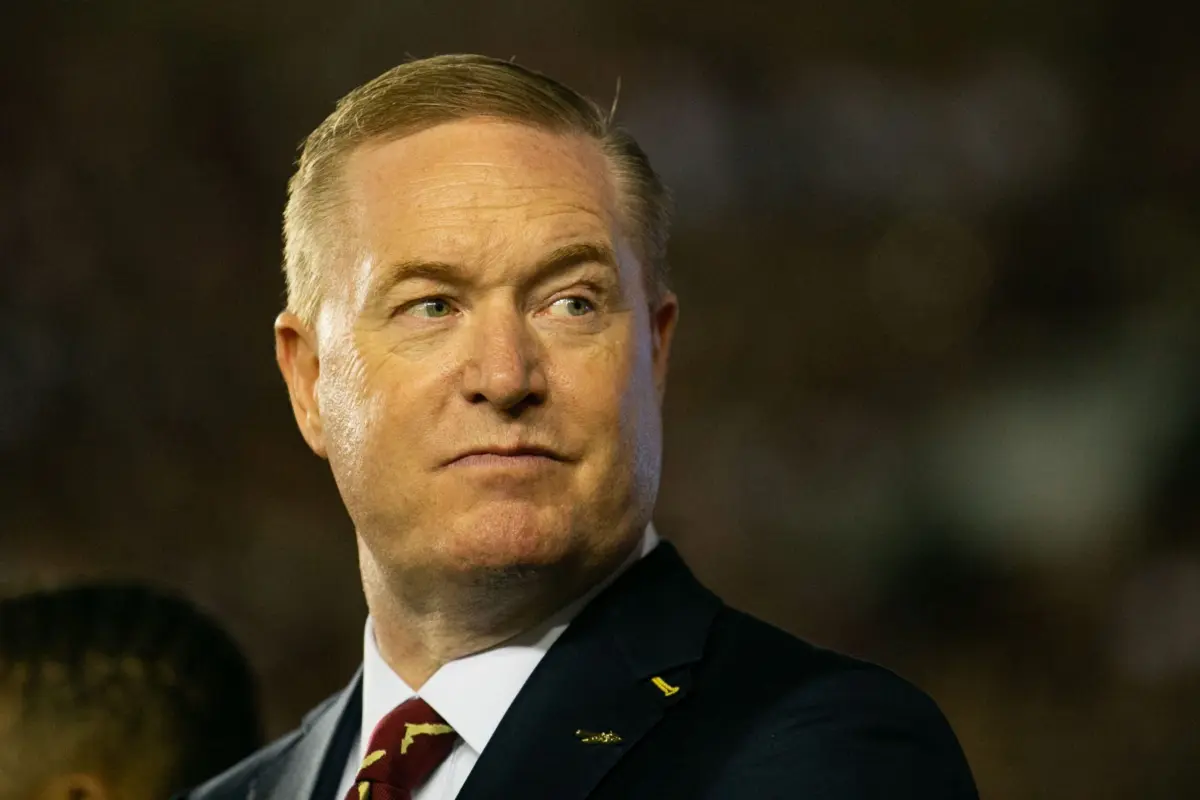

TALLAHASSEE, Fla. — In a sweeping leadership shakeup that underscores the relentless pressures of the modern collegiate athletics landscape, Florida State University has officially parted ways with Vice President and Director of Intercollegiate Athletics, Michael Alford. The decision, finalized and announced on September 14, 2026, brings an abrupt halt to a tenure that began with immense promise and championship aspirations, only to unravel amid mounting financial commitments, stadium renovation controversies, strategic missteps in Name, Image, and Likeness (NIL) adaptation, and a steep on-field regression of the flagship football program.
The news, initially broken by ESPN’s senior college sports reporter Andrea Adelson following direct confirmation from FSU President Richard McCullough, signals a critical inflection point for the Seminoles. As power conferences navigate the turbulent waters of revenue sharing, legal settlements, and an increasingly professionalized athletic ecosystem, Florida State’s leadership determined that a fundamental overhaul at the top was non-negotiable.
To bridge the gap during this tumultuous period, President McCullough has elevated Senior Associate Athletics Director Bruce Warwick to the role of Interim Director of Athletics, effective immediately. Warwick, who arrived in Tallahassee in 2020 after an extensive and successful administrative career with the National Football League’s Los Angeles Rams, will oversee day-to-day operations while the university initiates a comprehensive national search for a permanent successor.
While university leadership expressed customary gratitude for Alford’s years of service—acknowledging his foundational work as the former president and CEO of Seminole Boosters—the underlying subtext of the announcement was unmistakably clear. In an era where institutional competitiveness is measured in millions of dollars, playoff berths, and agile adaptation to regulatory shifts, FSU’s administration concluded that the athletic department required a radically different strategic vision to reclaim its elite standing on the national stage.
Detailed Chronology: From the Pinnacle of the ACC to Institutional Crisis
The Honeymoon Phase: December 2021 to January 2024
When Michael Alford assumed the mantle of Florida State’s athletic director in December 2021, succeeding David Coburn, he stepped into a department searching for stability and direction. Having previously served as the president and CEO of Seminole Boosters, Inc., Alford was already intimately familiar with the university’s donor base, corporate partnerships, and political power structures. His early tenure was defined by aggressive positioning and a synchronized alignment with head football coach Mike Norvell.
That partnership bore spectacular fruit during the 2023 college football season. Under Norvell’s guidance, the Seminoles put together a flawless, undefeated 2023 regular season campaign, capturing the Atlantic Coast Conference (ACC) Championship and cementing their status among college football’s elite. For Alford, the triumphant season served as the validation of his leadership, showcasing a revitalized athletic department ready to challenge the status quo of the sport.
The Turning Point: The 2023 CFP Exclusion and the Costly Extension
However, the euphoria of the 2023 championship was abruptly punctured on Selection Sunday when the College Football Playoff Selection Committee controversially excluded the undefeated Seminoles from the four-team field, citing an injury to star quarterback Jordan Travis. The snub ignited institutional outrage across the state of Florida, unifying the university administration, state politicians, and the fan base in a shared sense of grievance against the sport’s power brokers.
In the wake of this disappointment, Alford made what would ultimately become the defining decision of his career: orchestrating a massive, lucrative contract extension for Mike Norvell. Designed to ward off aggressive poachers from other major programs and signal unwavering institutional confidence, the new deal tied Florida State to its head coach through a deeply expensive, long-term commitment.
At the time, the extension was widely praised as a necessary aggressive maneuver. In hindsight, however, it locked the university into a financial straitjacket. As the subsequent seasons unspooled, the football program suffered an astonishing, catastrophic collapse, plunging from national championship contenders to the bottom tier of major college football. Because of the contract’s prohibitive buyout terms, Alford and the university administration found their hands tied, unable to make decisive changes without incurring staggering financial penalties—a reality that rapidly eroded Alford’s political capital on campus.
Infrastructure Ambitions and the Doak Campbell Stadium Controversy
Simultaneously, Alford spearheaded one of the most ambitious and disruptive infrastructure projects in the university’s history: a massive, multi-million-dollar renovation of the iconic Doak Campbell Stadium.
The project aimed to modernize the historic venue, replacing aging bleacher seating with state-of-the-art premium club spaces, modern suites, and enhanced fan amenities. Yet, as the blueprint moved into execution, the project ran into compounding difficulties. Construction costs soared well past initial projections, driven by broader macroeconomic inflationary pressures on labor and raw materials. To fund the enterprise, Florida State absorbed hundreds of millions of dollars in athletics-related debt.
Compounding the financial strain was the tangible impact on capacity. The removal of traditional seating to make way for premium revenue-generating areas substantially reduced the overall seating capacity of the stadium. While modern athletic departments increasingly prioritize high-margin luxury seating over raw attendance figures, the combination of soaring construction debt, reduced ticket inventory, and a collapsing on-field product turned the stadium renovation from a symbol of progress into a persistent flashpoint for disgruntled season ticket holders and donors.
The NIL Quagmire and Shifting Economic Realities
As the financial pressures mounted, college athletics underwent a seismic, irreversible evolution regarding Name, Image, and Likeness (NIL) compensation, judicial challenges to amateurism, and the impending implementation of direct revenue sharing with student-athletes.
Throughout this transition, Alford’s public statements regarding NIL strategy, the function of outside athletic collectives, and the financial mechanics of revenue sharing frequently drew sharp rebukes from the FSU community. In an era where institutional success is heavily dictated by the agility and capital reserves of a school’s NIL ecosystem, a persistent perception took root among major boosters and fans that Florida State was lagging behind its primary national competitors.
While athletic departments across the country scrambled to professionalize their fundraising and player-compensation models, FSU’s administration was routinely viewed as overly cautious or structurally unequipped to navigate the hyper-capitalistic modern marketplace. By the fall of 2026, the cumulative weight of these missteps—stalled football performance, crippling debt obligations, strained donor relations, and strategic hesitation in the NIL era—rendered Alford’s position untenable.
Supporting Context & Metrics: The Financial and Strategic Landscape
To fully understand the impetus behind Florida State’s decision to remove Michael Alford, one must examine the shifting economic realities of major collegiate athletics in 2026. The job of a Power Four athletic director is no longer simply managing game-day operations and coaching searches; it requires the financial acumen of a corporate CEO, the political diplomacy of a diplomat, and the fundraising prowess of an investment banker.
- The Buyout Burden: The lucrative contract extension granted to Mike Norvell following the 2023 season included guaranteed compensation structures that made any future coaching change financially prohibitive. In modern college football, a struggling program requires agility; FSU’s financial commitments stripped the athletic department of its strategic flexibility, leaving leadership trapped between high-cost retention and catastrophic buyout figures.
- Capital Debt and Infrastructure: The Doak Campbell Stadium renovations involved capital expenditures running well into the hundreds of millions of dollars. In an economic environment characterized by rising interest rates and fluctuating ticket sales, servicing this debt load required aggressive revenue generation—revenue that was severely compromised by the football team’s on-field decline and the reduction of general seating capacity.
- The NIL Arms Race: Competitors in the Southeastern Conference (SEC) and Big Ten established highly synchronized, institutionalized NIL operations capable of deploying millions of dollars annually to secure elite roster talent. FSU’s public friction regarding collective structures and compensation models created friction with the Seminole Boosters and private donors, illustrating a widening chasm between athletic department leadership and the financial vanguard of the fan base.
Official Statements: Leadership Addresses the Transition
The university’s official announcements and statements released on September 14 shed light on the unanimous resolve of FSU’s executive leadership and Board of Trustees to pivot toward a more aggressive, modernized administrative model.
FSU President Richard McCullough emphasized the university’s unyielding commitment to championship-level standards:
"Michael Alford has served the University and our student-athletes with dedication, and we thank him for his contributions to our athletics programs. As we begin this transition, our focus remains on the success of our teams and continuing to provide every competitive advantage we can to our student-athletes, coaches, and staff. Florida State is committed to maintaining the highest standards for our student-athletes and staff. We want all of them to be able to play for championships. This leadership change reflects that commitment."
FSU Board of Trustees Chairman Peter Collins framed the dismissal as an indispensable step in structural restructuring:
"Changes like this are never easy, but sometimes necessary. We have made significant investments and structural changes in our athletics program and Seminole Boosters over the past few years, but more are needed. This step begins the next phase of restructuring that the University must commit to in order to compete in this era of college sports. The President and the Board are in lockstep on the mission and what the results must be."
Interim Athletic Director Bruce Warwick struck a note of operational stability, focusing his immediate attention on the welfare of student-athletes and coaching staffs:
"It is important that we remain dedicated to providing continuity and support to our student-athletes, coaches and staff, who remain our top priority. Our team is fully prepared to oversee day-to-day operations and ensure that our programs experience zero disruption during this transitional phase."
Warwick brings a wealth of institutional memory and high-level professional sports administration to the role. Prior to joining Florida State in 2020, Warwick spent a distinguished career with the Los Angeles Rams, navigating the complex operational logistics of an elite professional franchise—experience that university leadership hopes will inject corporate precision into FSU’s athletic administration.
Future Outlook: The Search for a New Vision
As Bruce Warwick assumes temporary control of the department, Florida State University stands at a critical crossroads. The forthcoming national search for a permanent Athletic Director will test the vision, ambition, and financial resourcefulness of the university’s leadership.
The next individual to sit in the athletic director’s chair in Tallahassee will inherit a complex, high-stakes portfolio:
- Navigating Revenue Sharing: Preparing the department for the imminent, mandated implementation of direct revenue sharing with student-athletes, which is projected to cost athletic departments tens of millions of dollars annually.
- Rebuilding the Football Infrastructure: Untangling the long-term financial commitments of the football program while charting a sustainable path forward for a team that remains the undisputed economic engine of the university.
- Optimizing Donor Relations: Repairing and revitalizing relationships with major benefactors and the Seminole Boosters network to ensure competitive parity in the NIL and collective marketplace.
- Managing Capital Debt: Overseeing the completion and financial stabilization of the Doak Campbell Stadium renovation project while maximizing revenue from newly constructed premium seating assets.
For Florida State University, the dismissal of Michael Alford is more than a routine personnel change—it is a bold acknowledgment that the old paradigms of collegiate athletics administration are obsolete. As the national search officially gets underway, the Seminoles are signaling to their fans, donors, and conference rivals that mediocrity is unacceptable, and that the institution will spare no effort in realigning its leadership to chase championships once again.

0 Comments