

Executive Overview
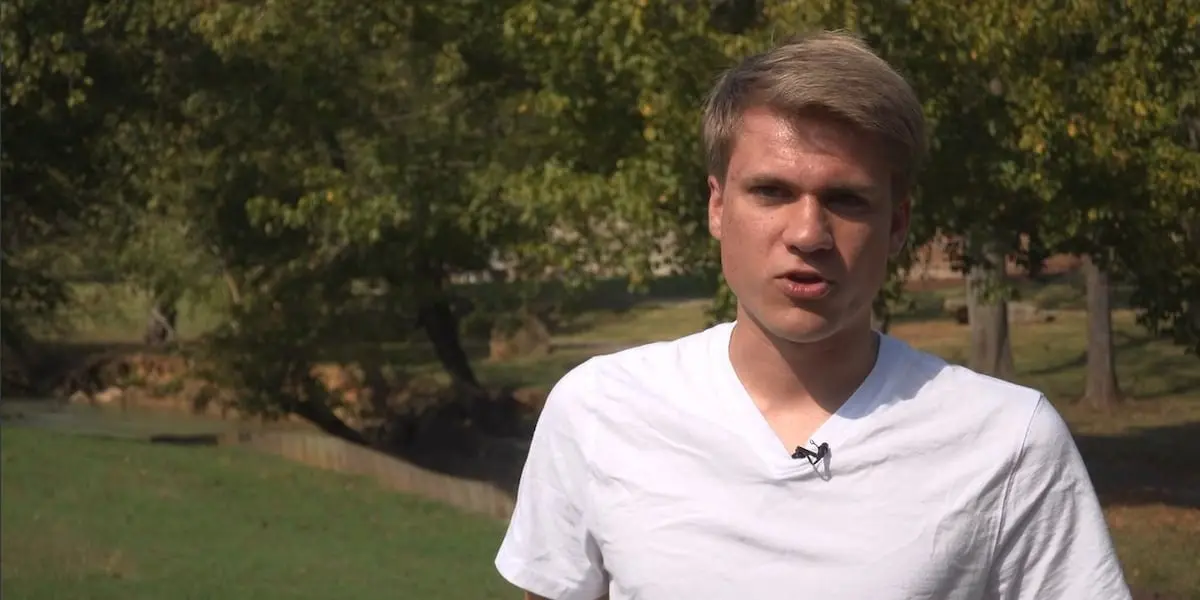
In an extraordinary display of situational awareness, raw courage, and decisive action, a Carson-Newman University student averted a potential tragedy in Jefferson City, Tennessee. Noah Mathews, a junior at the private Christian liberal arts university, pulled a 3-year-old autistic child from a swift, swollen creek after the toddler wandered away from his nearby home and became trapped in a hazardous, fast-moving current.
The incident unfolded on a Monday afternoon at approximately 3:30 p.m. along a water body running adjacent to the university campus. Mathews, walking near the waterway, noticed unusual movement in the current. Upon closer inspection, he discovered the young boy desperately clinging to a submerged tree branch, fighting to keep his head above water. Without hesitation, Mathews descended into the rushing rapids, secured the child, and successfully pulled him to safety.
Local law enforcement officials later confirmed that the toddler, who is diagnosed with autism, had slipped away from his residence unnoticed. Police stated that the swift actions of the college junior unquestionably prevented a catastrophic outcome. Following the rescue, Mathews kept the frightened child calm by showing him cartoons on a mobile device while waiting for campus security and the Jefferson City Police Department to arrive. The boy was evaluated by first responders and promptly reunited with his mother.
This comprehensive report examines the sequence of events, the physical and psychological dynamics of swift-water rescues, the specific vulnerabilities associated with wandering behavior in children with autism, and the broader community response to Mathews’ heroic deed.
Detailed Chronology: The Rescue at the Creek
The Routine Walk That Turned Extraordinary
The afternoon of the incident began like any other for Noah Mathews. As a junior at Carson-Newman University in Jefferson City, Tennessee, Mathews was navigating his usual routine, walking along a familiar path near a creek that borders portions of the campus. The time was approximately 3:30 p.m. Weather conditions and recent regional precipitation had elevated water levels, creating a swift and potentially dangerous current within the channel.
Nothing initially suggested that the routine walk would intersect with a life-or-death emergency. However, heightened environmental awareness proved critical. As Mathews glanced toward the left side of the pathway, a subtle visual anomaly captured his attention.
Spotting the Child
The focal point of the discovery was a partially submerged tree positioned directly in the path of the rushing water. The tree, warped by the current into a crescent-like shape, served as a hazardous trap in the waterway.
Mathews adjusted his trajectory, stepping closer to the muddy embankment to inspect the obstruction more thoroughly. That is when he saw him: a small child, estimated to be approximately three years of age, locked in a desperate struggle for survival. The toddler was clinging tightly to a low-hanging tree branch, his fingers wrapped around the wood as the rapid current churned around his small frame.
"My immediate thought was just to get him out of that area, so he didn’t fall in and get swept downstream or drown possibly," Mathews recounted in interviews following the incident.
The Physical Rescue
Time was of the essence. In swift-water scenarios, hypothermia, exhaustion, and the sheer force of the water present mortal dangers even to adults. For a 3-year-old child, the window to prevent being swept away is measured in seconds.
Recognizing that waiting for emergency services was not an option, Mathews formulated a rescue plan on the spot. He navigated down the steep, slick embankment to the water’s edge, carefully positioning his own body to maintain traction against the pull of the current.
"I kind of lower myself and prop myself up, so I can pull him up and pull him out of that area safely," Mathews explained, detailing the biomechanics of the rescue. Leaning into the water, he braced his footing, reached out, and secured a firm grip on the child. With a coordinated heave, Mathews hoisted the toddler out of the punishing rapids and onto dry ground, removing him from immediate peril.
Post-Rescue Care and Law Enforcement Response
Once the child was safely ashore, Mathews immediately shifted focus to trauma mitigation and securing professional help. Wet, shivering, and understandably terrified, the young boy needed stabilization while authorities were notified.
Mathews placed an urgent call to Carson-Newman campus security. While waiting for responders to arrive, he sat with the child on a nearby park bench. Recognizing that the toddler was experiencing acute distress, Mathews utilized modern distraction techniques, turning on mobile cartoons to calm the boy down and create a sense of safety until uniformed officers arrived.
The Jefferson City Police Department arrived shortly thereafter, taking over the scene. Officers immediately initiated a welfare check and began canvassing the immediate neighborhood to locate the child’s guardians. Within a short period, law enforcement successfully connected the toddler with his mother, confirming that he had wandered away from home prior to the incident.
Supporting Context & Metrics
The Mechanics and Dangers of Swift Water
To truly understand the gravity of Noah Mathews’ actions, one must examine the deceptive power of moving water. According to water safety organizations and swift-water rescue professionals, moving water possesses exponential force capabilities that the average person drastically underestimates.
- The 6-Inch Rule: Just six inches of fast-moving water can knock an adult off their feet. For a 3-year-old child—whose center of gravity is low but whose body mass is minimal—even two to three inches of swift current can easily sweep them away.
- Force Multipliers: Water weighs approximately 62.4 pounds per cubic foot. When water is in motion, it exerts lateral pressure against any object in its path. A current moving at just a few miles per hour can exert enough force to pin a human against submerged obstacles, such as the tree branch encountered by the toddler in Jefferson City.
- Thermal Shock and Hypothermia: Even during warmer months, immersion in rushing creeks fed by runoff can induce rapid thermal loss. Children lose body heat up to four times faster than adults, putting them at immediate risk of cold-water incapacitation.
By extracting the child from the water before exhaustion or hypothermia set in, Mathews short-circuited a timeline that could easily have resulted in tragedy.
Autism and the Phenomenon of Wandering (Elopement)
Subsequent investigation by the Jefferson City Police Department revealed a critical detail: the 3-year-old boy has autism and had wandered away from his home, an event commonly referred to in the medical and developmental community as "elopement."
Elopement is a well-documented and profoundly challenging behavior associated with Autism Spectrum Disorder (ASD). Understanding this context sheds light on how the incident occurred and highlights the unique dangers faced by neurodivergent children.
- Statistical Prevalence: According to studies by the Interactive Autism Network and the American Journal of Public Health, roughly 49% of children with autism attempt to wander or bolt from safe environments. This behavior typically peaks during early childhood (ages 4 to 7, though occurrences at age 3 are frequent).
- Lack of Safety Awareness: Children with ASD frequently possess an impaired sense of danger. Unlike neurotypical children who may hesitate near hazards like busy roadways or bodies of water, children who elope are often drawn to sensory stimuli, such as the sound of running water, without recognizing the lethal risks involved.
- The "Silent Danger": Wandering often occurs silently and swiftly, catching caregivers off guard in fractions of a second. Studies indicate that accidental drowning is a leading cause of mortality among children with autism who elope, accounting for a disproportionate percentage of total fatalities in this demographic.
The intersection of autism-related elopement and an accessible, fast-moving creek created a high-risk scenario in Jefferson City. The rapid intervention by a civilian bystander disrupted what statistics show is a frequently fatal trajectory for wandering children.
Official Statements and Community Impact
Law Enforcement Assessment
Local authorities did not mince words when evaluating the outcome of the incident. Representatives from the Jefferson City Police Department praised Noah Mathews for his uncommon bravery, noting that his split-second decision-making directly altered the course of the day.
In formal statements released following the investigation, police officials emphasized that without Mathews’ intervention, the situation would likely have ended in a fatal drowning. The combination of swift currents, the submerged tree hazard, and the child’s tender age created a worst-case scenario from which self-rescue was completely impossible.
Personal Reflections from the Rescuer
Despite widespread praise from local media, campus administrators, and community members, Mathews maintained a remarkably humble demeanor when speaking about the event. Rather than basking in the label of "hero," he framed his actions through a lens of personal philosophy and faith.
"I did something to better someone’s life, I guess," Mathews reflected during an interview with regional affiliate WVLT.
Expanding on his worldview, the Carson-Newman student offered a poignant message directed toward the young boy he saved, expressing a desire that the child’s life journey be marked by resilience and divine protection:
"I would want him to know that God is looking out for him, and I hope that he can walk through life knowing that."
Carson-Newman University Culture
The campus community at Carson-Newman University, a private Baptist-affiliated institution in East Tennessee, has rallied around Mathews, pointing to his actions as an embodiment of the university’s core values of service, character, and community engagement. Faculty and student bodies alike have lauded the junior for his calm under pressure, citing his campus training and personal integrity as instrumental factors in the successful rescue.
Future Outlook & Recommendations
Enhancing Water Safety and Elopement Awareness
While this specific incident concluded with a joyful reunion between mother and child, the event serves as a stark reminder of the infrastructure and community safety measures needed to protect vulnerable populations.
- Increased Public Awareness on Elopement: Community health advocates emphasize the need for greater education regarding autism-related wandering. Local first responder agencies across East Tennessee are increasingly adopting tracking technologies, such as Project Lifesaver or specialized GPS wearables, to assist families of children with ASD.
- Environmental Safety Measures Near Campuses and Creeks: Municipalities and universities sharing borders with natural waterways are continually evaluating environmental hazards. While natural creeks cannot be entirely fenced off without disrupting ecosystems, targeted signage, vegetation management around dangerous snags, and improved pedestrian barriers along high-traffic walking paths can mitigate risks.
- Bystander Intervention Training: Incidents like the Jefferson City creek rescue underscore the invaluable role of everyday citizens in public safety. Expanding access to basic swift-water awareness and first-aid training within university curricula empowers students to act effectively when emergencies arise.
Conclusion
The near-tragedy along the Carson-Newman University creek stands as a powerful testament to vigilance, bravery, and community interconnectedness. Through a combination of sharp observation and fearless physical action, Noah Mathews ensured that a 3-year-old boy was given a second chance at life. As local police closed the case and returned the toddler safely to his mother, the community was left reflecting on the fragility of life—and the extraordinary difference one individual can make when called upon to serve.

0 Comments