

Executive Overview
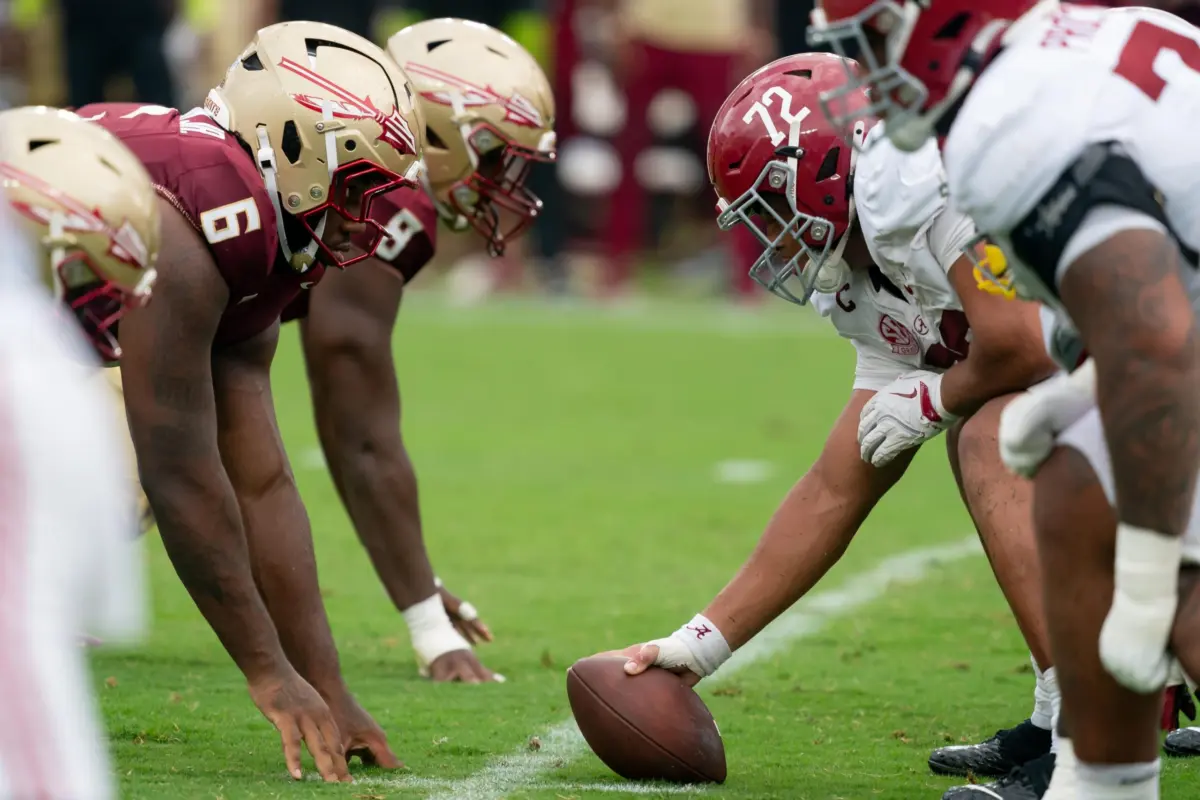
The stage is set at a sold-out Saban Field at Bryant-Denny Stadium, where 100,000 roaring fans will bear witness to a high-stakes collision of college football bluebloods. On Saturday afternoon, the Florida State Seminoles (1–1, 0–1 ACC) march into hostile territory in Tuscaloosa to face the No. 10-ranked Alabama Crimson Tide (2–0, 1–0 SEC). This clash marks the second installment of a heavily anticipated, consecutive home-and-home series that has captured the attention of the entire college football landscape.
For the Seminoles, this game arrives at a precarious crossroads. Mike Norvell’s squad is stumbling out of the blocks, reeling from a devastating 27–24 last-second defeat to the No. 19 SMU Mustangs. Questions surrounding play-calling, third-down execution, and overall roster construction have cast a heavy shadow over Tallahassee.
Conversely, Kalen DeBoer’s Crimson Tide enter this contest with a singular, unyielding focus: revenge. Last season, Florida State shocked the collegiate world by snapping Alabama’s legendary 23-game season-opening win streak with a gritty 31–17 upset in Doak Campbell Stadium. That loss left an indelible scar in Tuscaloosa—one that the Crimson Tide have waited 365 days to wash away. With historical trends heavily favoring Alabama in revenge scenarios and the Crimson Tide boasting a nation-leading third-down defense, the odds appear astronomical. Yet, in a sport where desperation meets elite talent, the psychological weight of this rematch guarantees a fierce battle, regardless of the daunting point spreads.
Detailed Chronology: The Road from Tallahassee Triumph to Tuscaloosa Tension
The Ghost of September Past
To understand the vitriol and intensity surrounding Saturday’s 3:30 p.m. ET kickoff—broadcast nationally on ABC—one must look back at the dramatic opening weekend of the previous season. The Seminoles put on a masterclass of physical football, rumbling for 230 rushing yards and four touchdowns while completely neutralizing an eighth-ranked Alabama attack, holding the Tide to a mere 87 yards on the ground and zero rushing scores en route to a 31–17 stunner.
That loss proved to be a crucible for Alabama. Rather than letting the setback derail their campaign, the Crimson Tide rattled off eight consecutive victories, captured an SEC Championship berth, and punched their ticket to the quarterfinals of the College Football Playoff. However, the sting of that defeat remained pinned to the bulletin boards inside the Mal M. Moore Athletic Facility all year long.
The Current Trajectory: FSU’s Early-Season Struggles
While Alabama used last year’s loss as fuel for an elite trajectory, Florida State’s current campaign has been fraught with structural fractures. The Seminoles enter Week 3 searching for an offensive identity, a quest made exponentially more difficult by their performance against SMU.
Despite forcing four turnovers against the Mustangs, FSU managed to convert those defensive takeaways into a meager seven points. The offense stalled repeatedly, converting a dismal 2-of-15 third-down opportunities (13.3%). SMU, by contrast, carved up the Seminoles’ secondary and linebackers, finishing 8-of-14 on third downs and outgaining FSU by a staggering 585 to 324 in total yards. A late, game-winning field goal by the Mustangs cemented a bitter 27–24 loss, plunging the Seminoles’ fanbase into a state of acute anxiety.
Supporting Context & Metrics: Tale of the Tape
The statistical indicators heading into this matchup paint a stark picture of contrasting fortunes. Alabama operates with surgical precision, while Florida State swims upstream against a tide of self-inflicted inefficiency.
The Third-Down Chasm
The most glaring statistical disparity in this matchup lies in third-down efficiency.
- Florida State’s Offense: The Seminoles rank a dismal 97th nationally in third-down conversions, moving the chains on just 35.7% of their attempts (10-of-28).
- Alabama’s Defense: The Crimson Tide boast the nation’s top-ranked third-down defense. Through their first two games, Alabama has suffocated opposing offenses, allowing them to convert a mind-boggling 1 out of 23 third-down attempts (4.3%).
Defensive Realities
FSU’s defense has struggled mightily to establish resistance, ranking near the bottom of the FBS across nearly every major metric:
- Total Defense: 452 yards allowed per game (116th)
- Passing Defense: 351 yards allowed per game (127th)
- First-Down Defense: 41 first downs surrendered (135th)
- Yards Per Play: 6.8 yards allowed (118th)
- Red Zone Defense: 80% conversion rate allowed (135th)
The loss of interior anchor Darrell Jackson has deeply impacted FSU’s defensive front, while second-year defensive coordinator Tony White’s aggressive scheme has largely failed to generate the necessary pressure or secondary communication to stop high-powered attacks.
Conversely, Alabama’s innovative 4-2-5 defensive structure—featuring a versatile nickel safety, or "husky," rather than a traditional third linebacker—has wreaked havoc. The Tide have already racked up seven sacks, limited opponents to a paltry 65 total rushing yards, and scored defensive touchdowns in back-to-back weeks, anchored by linebacker Caleb Woodson’s team-leading 13 tackles.
Offensive Personnel
Offensively, Alabama is piloted by first-year starting quarterback Keelon Russell, who has completed 64.2% of his passes. He is flanked by explosive running back Daniel Hill (averaging 5.6 yards per carry with three touchdowns) and big-play wide receiver Ryan Coleman-Williams, who is chewing up turf at 19.2 yards per reception.
FSU will look to lean on running back Kromah and playmakers like Duce to break the game open, but doing so against an elite Alabama front seven will require flawless execution—something the Seminoles have lacked thus far.
Official Statements and Institutional Perspectives
The institutional temperature in Tallahassee is palpable. With leadership transitions and mounting pressure on head coach Mike Norvell, every decision, snap, and press conference is heavily scrutinized.
Norvell, who holds a 1-0 career record against Kalen DeBoer and boasts five regular-season non-conference wins over SEC programs since 2020 (the most in the nation), has historically thrived in early-season statement games. However, the margin for error has evaporated.
"This will finally be the game when everything comes together for the Noles," noted optimistic analysts within the program’s inner circle. "The players and coaches all know what is on the line. Everyone is playing for their futures at FSU."
Yet, the prevailing sentiment among national observers and fan communities alike—such as insights drawn from Tomahawk Nation member discourse—leans toward grim realism. Historical data does not favor the Seminoles. Since 2007, Alabama has suffered just 37 total losses. In the 30 subsequent games where the Tide had an opportunity for immediate revenge against the team that beat them, Alabama holds an astonishing 26-4 (.867) record. Furthermore, the Crimson Tide have won 89 consecutive home games against unranked opponents, with their last such loss dating back to November 17, 2007, against ULM.
As long-time program observers aptly summarized: "Last year Bama got jumped in Tallahassee. This year they’re waiting at the door with a frying pack and a packed Bryant-Denny. Tuscaloosa isn’t handing out participation trophies."
Future Outlook: Legacy, Coaching Stances, and Saturday’s Horizon
As the sun rises over Tuscaloosa on Saturday, the implications of this game stretch far beyond a standard September out-of-conference matchup.
For Alabama, a victory cements their status as relentless juggernauts capable of executing absolute institutional memory. It validates DeBoer’s leadership and proves that the slip-up in Tallahassee was nothing more than an anomalous blip on an otherwise pristine radar.
For Florida State, the afternoon carries existential weight. A competitive showing—or, miraculously, a repeat upset—would instantly revitalize a floundering season, breathe life back into a beleaguered fanbase, and validate Norvell’s long-term vision. However, another lopsided defensive collapse combined with an impotent third-down offense risks turning the remainder of the autumn into a prolonged exercise in damage control.
The metrics suggest a blowout; history warns of a furious Alabama onslaught; but the unpredictable, chaotic nature of college football remains the ultimate equalizer. When the whistle blows at 3:30 p.m. ET, the stats, the odds, and the fiery echoes of last year’s upset will dissolve into the roar of 100,000 screaming fans. Only the execution on the gridiron will write the next chapter of this fierce rivalry.

0 Comments