
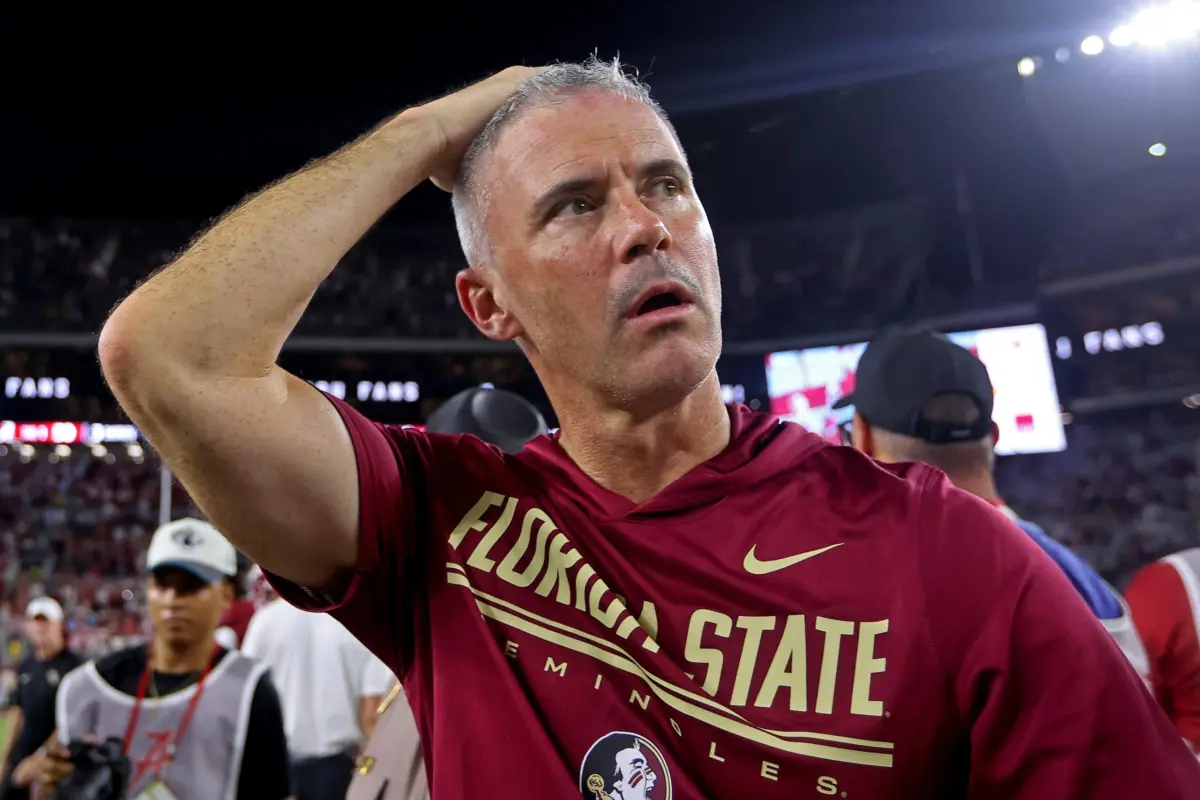

TUSCALOOSA, Ala. — For a fleeting, electric 25 minutes inside Bryant-Denny Stadium on Saturday night, the Florida State Seminoles looked every bit the part of a national powerhouse. They punched the vaunted No. 10 Alabama Crimson Tide in the mouth, racing out to a commanding 21-6 lead and stunning a restless, capacity-filled SEC crowd.
Then, the weather siren sounded. Mother Nature intervened with a weather delay late in the first half, and when the clouds parted and play resumed, the narrative flipped with terrifying speed.
What followed was an unraveling of historic proportions. Alabama engineered a staggering sequence of nine consecutive scoring possessions, exposing deep defensive fissures and fatal offensive lapses that ultimately condemned Florida State to a 50-36 defeat. The loss drops the Seminoles to a dismal 1-2 on the young season and stretches their agonizing road losing streak to 10 consecutive games.
For head coach Mike Norvell, whose postgame demeanor was a cocktail of raw frustration, accountability, and lingering defiance, the result was a bitter pill to swallow. Addressing the media alongside quarterback Ashton Daniels and linebacker Chris Jones, Norvell minced no words regarding where his program stands.
"I’m pissed off that we didn’t win the game," Norvell said bluntly, setting the tone for a sobering postgame evaluation. "We’ve been close, but the results have not been good enough."
Executive Overview: A Tale of Two Halves in Tuscaloosa
The final scoreline of 50-36 suggests an offensive shootout, a back-and-forth heavyweight prize fight in the heart of SEC country. In reality, Saturday night’s contest was a game of stark, contrasting halves that underscored the thin margin of error facing Florida State as they attempt to reclaim elite status in college football.
To understand the scope of the Seminoles’ collapse, one must examine the opening frames. Florida State played with a swagger and precision that caught Kalen DeBoer’s Crimson Tide flat-footed. The offensive game plan was sharp, utilizing tempo and varied route combinations, while the defense forced early stops, capitalizing on mistakes to build a 15-point cushion.
Yet, championship programs are built on resilience and the ability to weather momentum swings. When a weather delay forced a pause in the action late in the second quarter, the momentum abruptly shifted crimson. Alabama seized control with 20 unanswered points before halftime—a sequence Norvell flatly labeled "awful"—and never looked back.
The defensive dam broke entirely after the break. Alabama’s high-powered offense exploited every matchup advantage, racking up staggering yardage and leaving a tired, overmatched Florida State defense scrambling in vain. Coupled with critical offensive mistakes that stalled FSU’s own second-half push, the Seminoles were left to pick up the pieces of another blown opportunity on foreign turf.
Detailed Chronology: How the Momentum Shifted in Crimson
The Fast Start: Silence in the Crimson Tide Cathedral
From the opening whistle, Florida State executed with a level of crispness that silenced the normally deafening Bryant-Denny Stadium crowd. Quarterback Ashton Daniels was dialed in, distributing the ball efficiently and utilizing his legs to extend plays against an aggressive Alabama pass rush.
The Seminoles’ offensive line established a physical baseline, opening lanes in the running game and keeping Daniels upright. Defensively, FSU played with disciplined aggression. They clogged interior running lanes and forced Alabama into early third-and-long situations, converting stops into offensive opportunities.
When Florida State punched in their third touchdown of the half, taking a stunning 21-6 lead, the sideline was galvanized. The upset watch was officially on, and the Seminoles appeared completely unfazed by the hostile environment and the storied reputation of their opponent.
The Turning Point: The Weather Delay and the 20-Point Swing
With the clock winding down in the second quarter and Florida State firmly in the driver’s seat at 21-13, a weather delay halted the momentum. Teams retreated to the locker rooms as lightning crackled over Tuscaloosa, pausing the action and granting both coaching staffs crucial time to adjust.
When play resumed, the complexion of the game had fundamentally altered.
"The delays and all the things that happened, I thought our guys handled it well early… not as well coming out of the halftime break," Norvell reflected.
What transpired over the remainder of the first half was a nightmare scenario for the Seminoles. Alabama capitalized on structural breakdowns in the FSU secondary and found a rhythmic running game that exploited tired defenders. The Crimson Tide ripped off 20 unanswered points in a dizzying display of efficiency before the halftime buzzer, turning a 15-point deficit into a comfortable lead.
Norvell did not sugarcoat the disastrous sequence, describing it as "an awful sequence of that game" that completely altered the competitive landscape of the evening.
The Second-Half Barrage: Alabama’s Nine-Possession Clinic
Any hopes of a Florida State halftime recalibration were quickly dashed as the third quarter commenced. Alabama’s offense emerged from the locker room operating at a surgical level.
The Crimson Tide scored on nine consecutive possessions spanning from the late first-half surge well into the fourth quarter. It was an exhibition in modern offensive football—stretching the field vertically, punishing missed assignments in zone coverage, and utilizing play-action to keep FSU’s linebackers constantly on their heels.
Despite trailing heavily, Florida State refused to completely fold. Daniels and the offense engineered scoring drives to keep the scoreboard ticking, refusing to let the game spiral entirely out of hand. However, every time the Seminoles managed to find the end zone, the defense proved incapable of returning the favor with a stop.
As the clock ticked toward zeroes, the sheer physical and mental toll of chasing Alabama’s receivers across the turf became glaringly apparent. The final whistle brought relief to a battered FSU squad, locking in the 50-36 final score.
Supporting Context & Metrics: Defensive Vulnerabilities Exposed
While the offense put up 36 points and showed periods of high-octane production, the defensive side of the ball is currently facing an existential crisis. The metrics emerging from Florida State’s last two outings paint a grim picture of a unit struggling to find its footing against elite competition.
In their previous matchup against SMU, followed immediately by Saturday night’s onslaught in Tuscaloosa, the Seminoles surrendered more than 550 yards of total offense in back-to-back games. For a program historically renowned for defensive stoppers, lockdown cornerbacks, and fierce pass rushes, yielding over 1,100 yards across a two-game stretch is an untenable statistic.
Norvell was unsparing in his assessment of his defense during his postgame remarks.
"That side of the ball is not good enough right now," Norvell stated plainly. While acknowledging that both SMU and Alabama field exceptionally talented, explosive offenses, he refused to use personnel quality as an excuse for the systemic breakdowns on the field.
The primary issues plaguing the defense center around tackling in space, communication in the secondary during extended plays, and an inability to generate consistent pressure with a four-man front. When forced to blitz to compensate for a lack of pass rush, the secondary was routinely exposed in one-on-one coverage downfield.
Furthermore, the 10-game road losing streak has transformed from a statistical anomaly into a psychological hurdle. Winning away from home in major college football requires immense mental toughness, elite depth, and defensive consistency—three elements that have eluded the Seminoles consistently when crossing state lines.
Official Statements and Postgame Insights
The postgame media session offered a window into the psyche of a coaching staff and player leadership grappling with the gap between their internal expectations and the reality of their on-field execution.
Mike Norvell: Accountability and Urgency
Head coach Mike Norvell cut a figure of intense determination at the podium. Eschewing platitudes, he emphasized the urgent need for internal growth while maintaining belief in the ultimate trajectory of the program.
"I’m pissed off that we didn’t win the game," Norvell repeated, emphasizing the emotional weight of the loss. He highlighted the dichotomy between how his team started the game and how they finished it. "We came out early and played really well. The guys battled. But you can’t make crucial mistakes on offense and fail to get stops against a team like that and expect to win."
When pressed on the defensive woes, Norvell doubled down on accountability. "We have to coach better, and we have to execute better. Giving up those numbers in consecutive weeks is simply not the standard here."
Ashton Daniels and Chris Jones: The Player Perspective
Quarterback Ashton Daniels, who showed grit under heavy pressure and directed the offense through periods of sustained success, emphasized the offensive side’s need to capitalize when the defense is struggling to find answers.
"We left plays out there," Daniels noted, pointing to critical execution errors that stalled drives in the second half when FSU needed to match Alabama score-for-score. "When you’re playing a team of that caliber on the road, you can’t afford to shoot yourselves in the foot."
Linebacker Chris Jones echoed his head coach’s sentiments regarding the defensive collapse. "We showed what we could do early on, but we didn’t maintain our discipline," Jones said. "Communication breakdowns hurt us, and we have to get back to the drawing board to fix those fundamentals."
Future Outlook: Rebuilding the Foundation
With a 1-2 record and the Atlantic Coast Conference slate looming larger by the week, Florida State stands at a critical crossroads. The early-season optimism generated during training camp has been thoroughly tested by the unforgiving realities of elite competition.
The immediate task for Norvell and his coaching staff is triage. The defense must find functional solutions to its inability to stop the run and cover in space before conference opponents exploit the exact same vulnerabilities. Scheme adjustments, personnel rotations, and simplified play-calling may be necessary to build confidence within a unit that has absorbed heavy body blows over the last fortnight.
Offensively, the blueprint exists. The first 25 minutes against Alabama proved that when Daniels is in rhythm and the playbook is executed with precision, the Seminoles can trade punches with anyone in the country. The challenge now lies in consistency—eliminating the mental lapses and procedural errors that turn productive quarters into stagnant stretches.
Moreover, the psychological barrier of the 10-game road losing streak must be systematically dismantled. Overcoming that monkey on their back will require leadership from veterans like Jones and Daniels, as well as a renewed mental toughness from the entire roster.
"At the end of the day, this team is growing," Norvell concluded, casting his gaze toward the remainder of the season. "The results are not where they need to be, but the response to this adversity will define who we are."
As Florida State boards the flight back to Tallahassee, the margin for error has evaporated. The Seminoles have the talent to compete, but until they learn to sustain their brilliance across a full sixty minutes—particularly away from home—program milestones will remain agonizingly out of reach.

0 Comments