

Executive Overview
For roughly 26 minutes of game clock, the Florida State Seminoles looked every bit the powerhouse their coaching staff had envisioned during a grueling offseason of retooling, recruiting, and repositioning. Armed with an extra week of preparation and tactical rest, FSU played with a crispness, speed, and precision that caught a visiting Alabama squad completely flat-footed.
Ashton Daniels commanded the offense with poise, orchestrating drives downfield at will. Defensively, coordinated masterminds under Tony White forced the Crimson Tide into consecutive three-and-outs, establishing a commanding 21-6 advantage deep into the first half.
Then, the script flipped with catastrophic severity.
Over the final 34 minutes of game action, the Seminoles unraveled in historic fashion. Alabama mounted a staggering 37-7 run, exposing deep-seated roster vulnerabilities, questionable coaching adjustments, and a glaring lack of depth that has plagued the program over successive seasons. When the dust settled, Florida State had surrendered more than 550 yards of total offense, allowing points on nine consecutive drives.
What began as a promising statement game ultimately morphed into a familiar, painful referendum on the state of the Florida State program: flashy scripts can win quarters, but depth, execution, and elite roster construction win football games.
Detailed Chronology: The Anatomy of a Collapse
The Illusion of Control: FSU’s Scripted Ascent
The opening frame couldn’t have gone better for head coach Mike Norvell and his staff. Benefiting from a bye week that allowed them to meticulously game-plan while Alabama was coming off a brutal, physical SEC road matchup, the Seminoles struck early and often.
Ashton Daniels settled into an immediate rhythm, exploiting soft spots in the Crimson Tide secondary. FSU found the end zone on three of its first four offensive possessions, showcasing explosive play-calling that kept Kalen DeBoer’s defense on its heels.
Simultaneously, the Florida State defense played above expectations. Tony White dialed up a brilliant early-game pressure package that completely neutralized Alabama’s rushing attack, limiting the Crimson Tide to a meager 13 yards on 10 carries in the opening quarter. When FSU forced another stop with four minutes remaining in the second half, holding a 21-6 lead and facing Alabama with a daunting third-and-17, a blowout victory seemed within reach.
The Turning Point: Momentum Slips Before the Half
Every championship-pedigree program knows the danger of giving an opponent a lifeline before intermission. Up by 15 points, the Seminoles needed only to execute cleanly for four minutes to take a commanding cushion into the locker room.
Instead, a combination of poor game management, undisciplined penalties, and defensive breakdowns handed Alabama a life-saving touchdown drive. That late-half surge bridged the gap, shifting the psychological momentum of the game entirely. The Crimson Tide went into the locker room not feeling defeated, but emboldened.
The Second-Half Bleed
If the late first-half score was the catalyst, the second half was an unmitigated disaster of adjustments—or lack thereof.
As Alabama dialed up its offensive tempo and shifted tactical strategies, the Florida State coaching staff failed to counter. The FSU defense that looked impenetrable in the first quarter completely dissolved. The Crimson Tide strung together scoring drives on nine consecutive possessions, utilizing a punishing ground game that systematically broke the Seminoles’ spirit and body.
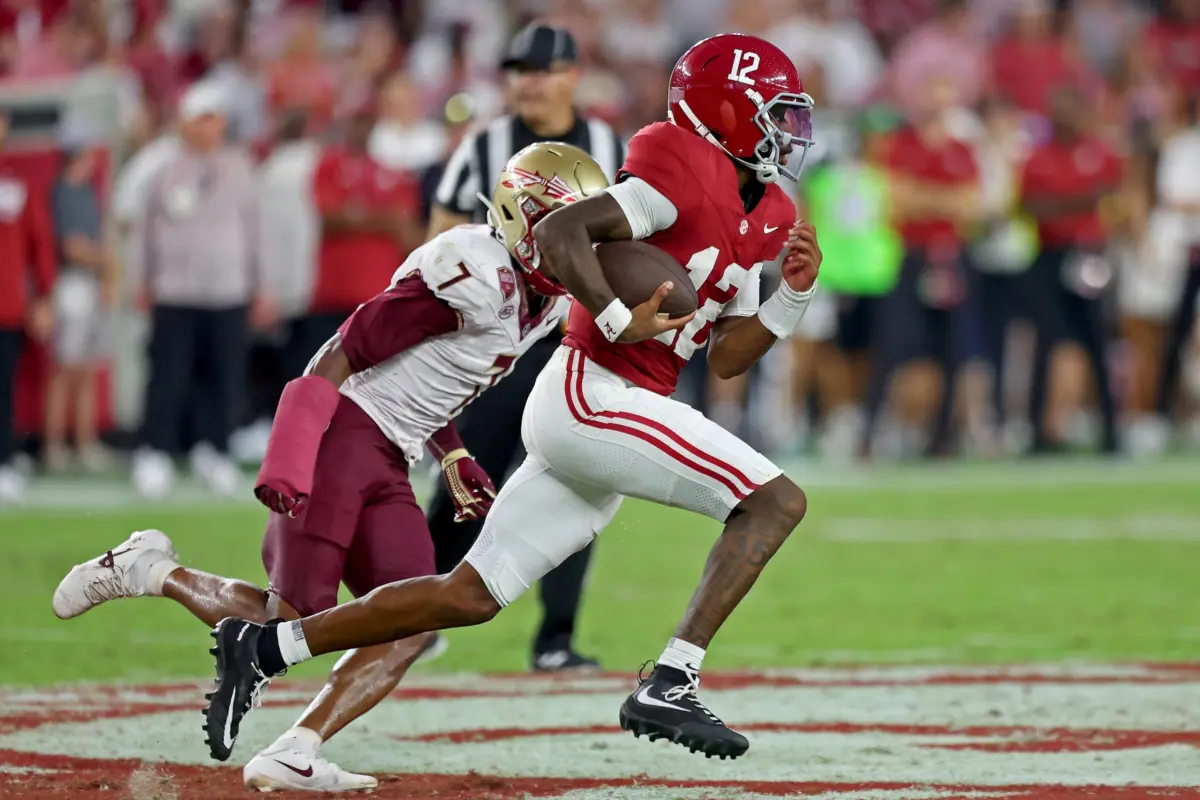
Offensively, the explosive plays that defined FSU’s early success dried up. Sacks, negative plays, and poor pocket protection derailed drive after drive, leaving the defense stranded on the field for punishing stretches. By the time Keelon Russell broke loose for a devastating 57-yard touchdown run in the third quarter, the death blow had been struck, transforming a 15-point lead into a comfortable two-touchdown victory for the visitors.
Supporting Context & Metrics: The Anatomy of a Roster Deficit
To understand how a 21-6 lead evaporates into a 43-28 defeat, one cannot look at the game in a vacuum. This collapse was years in the making, born from structural roster construction issues, underwhelming transfer portal returns, and thin depth charts.
The Trench Warfare Disconnect
Football games are ultimately decided in the trenches, and yesterday’s contest proved that Florida State simply lacks the heavyweight depth required to slug it out for 60 minutes against elite SEC competition.
The statistical regression along the defensive front illustrates the story of a unit gasping for air:
- First Quarter: Alabama managed just 13 yards on 10 rushing attempts.
- Fourth Quarter: Alabama exploded for 124 yards on 14 carries.
No single sequence highlighted FSU’s personnel limitations better than Alabama’s final, game-sealing touchdown drive. Having clawed back within seven points, the Seminoles momentarily backed the Crimson Tide up to their own 10-yard line via a holding penalty. Any championship defense dreams of a 1st-and-20 situation.
Instead, Kalen DeBoer’s offense simply leaned on a ground-and-pound identity, running the ball on eight of the next nine plays—culminating in a demoralizing 20-yard rushing touchdown to seal the game. Florida State’s front seven finished the contest with zero sacks and a meager three tackles for loss, completely worn down by a relentless Alabama offensive line.
The Failure of Big-Money Additions
Adding to the frustration is the underwhelming return on investment from high-profile offseason acquisitions. The program invested heavily to bring in coach Nick Williams to manage the edges and relieve pressure on defensive line coach Terrance Knighton. Yet, the pass rush has stagnated.
The Desir twins, whom FSU fought hard to keep out of the transfer portal, are being forced into heavy snap counts due to an alarming lack of rotational depth. They finished the afternoon with a combined 0.5 tackles for loss and zero sacks. Up the middle, Daniel Lyons has failed to take over games the way the coaching staff envisioned, while backups Kevin Wynn and Jordan Sanders have offered little relief.
Offensive Line and Execution Flaws
The depth issues were not isolated to the defensive side of the ball. FSU’s offensive line—featuring Paul Bowling at right guard and Nate Pabst at right tackle—struggled mightily to protect Ashton Daniels as the game wore on.
While Daniels posted respectable raw passing statistics (377 yards), a closer inspection reveals unsustainable volatility: 344 of those yards came on just 10 explosive plays. With sack yardage factored in, the Seminoles rushed for a paltry 3.6 yards per carry. Without a consistent ground game or the elite roster depth to sustain multiple offensive philosophies, the offense stalled precisely when it needed to grind the clock.
Official Statements: Postgame Reflections
The postgame press conference captured a sobering reality within the Florida State locker room. Gone was the offseason bravado; in its place was a heavy acknowledgment of systemic deficiencies.
Head coach Mike Norvell cut a dejected figure as he addressed the media, pointing directly to the team’s inability to sustain physical intensity.
"We have to be able to get off the field, and we showed the capability early in the game," a somber Norvell told reporters. "We allowed too many explosive plays tonight… As their run game got going later in the game, it did wear on us. Not good enough when you give up over 550 yards of offense."
Norvell acknowledged the self-inflicted mistakes that mounted as fatigue set in during the second half:
"There was an element late where we definitely got worn down and being on the field. There were a few times when we had a self-inflicted miss in alignment. There are big plays when no edge shows up. I thought we defended the run really well early, and it was unfortunate to see where it went to."
Linebacker Chris Jones echoed his coach’s sentiments, emphasizing that the collapse was rooted in tactical execution rather than a lack of competitive spirit:
"It really has nothing to do with effort or want-to," Jones explained. "It has to do with execution. They came out with different things, and we did not execute the right way… They came out with more of a gap scheme at the beginning of the game. Then, they started running more stretch and outside zone. We were in bad spots in a lot of those plays."
Future Outlook: A Critical Juncture for the Program
Just a little over a year ago, Florida State walked off the field having decisively defeated Alabama, fueling optimism that the program had permanently elevated into college football’s elite tier. That victory now feels increasingly like an outlier—a historical blip masking deeper, systemic vulnerabilities.
To spot a powerhouse 15 points and still walk away with a two-touchdown victory tells you everything you need to know about where the Crimson Tide program sits compared to the Seminoles. The trajectory of Florida State’s decline is no longer a matter of debate; it is plainly visible on autumn Saturdays when fatigue sets in and the bodies on the sideline begin to thin out.
Moving forward, the coaching staff and athletic department face profound questions. Flashy game scripts and high-dollar transfer portal splashes can win quarters, but sustainable success requires meticulous talent evaluation, elite developmental infrastructure, and true two-deep roster depth. Until Florida State solves its structural deficiencies in the trenches and addresses its recurring execution lapses, performances like the second half against Alabama will remain the painful standard of a program searching for its identity.

0 Comments