

Executive Overview
HIGH SPRINGS, Fla. — In an era where local municipal governments across the United States increasingly grapple with the complex realities of inflationary pressures, surging infrastructure costs, and tightening revenue streams, the historic North Florida city of High Springs has found itself at the epicenter of a passionate local debate. Recent discussions regarding how best to stabilize the municipality’s finances brought to light a radical, highly controversial cost-saving suggestion: the complete elimination of the city’s dedicated police and fire departments.
While the proposal to disband these core emergency services was never formally placed on the official meeting agenda, the mere prospect of such a drastic measure sent shockwaves through the community. It galvanized local residents, business owners, and civic advocates alike. The unfolding drama culminated in a tense city commission meeting dominated by public outcry, ultimately resulting in the passage of a new municipal budget that preserves public safety funding—though not without introducing additional financial burdens for local property owners.
This comprehensive report examines the sequence of events that led to the contentious budget session, analyzes the broader financial metrics and structural challenges facing High Springs, captures the voices of the citizens who stood up to defend their emergency services, and looks ahead at what this fiscal balancing act means for the long-term viability of the community. Through a professional journalistic lens, we unpack the delicate tension between fiscal responsibility and the foundational expectations of municipal governance.
Detailed Chronology: From Whispers of Cuts to the Budget Vote
The path to the recent city commission showdown in High Springs was paved with mounting economic anxiety and behind-the-scenes discussions regarding structural deficits. For months, municipal leaders have quietly reviewed various operational expenditures in an effort to align city spending with sustainable revenue projections. As in many small-to-midsize Florida municipalities, High Springs relies heavily on property tax revenues, utility fees, and state-shared revenues to fund its daily operations. When preliminary budgetary forecasts indicated a widening gap between projected revenues and rising operational costs, administrators and planners began brainstorming contingency measures.
Among the various strategies floated during preliminary administrative reviews was the concept of extreme outsourcing or regional consolidation of emergency services—specifically, dissolving the municipal police and fire departments to contract out law enforcement and fire protection to Alachua County or private entities. While floated primarily as an extreme thought experiment in fiscal austerity, word of the concept quickly leaked into the public sphere, creating immediate alarm among residents who viewed the suggestion as an existential threat to community safety and local autonomy.
The Commission Meeting: A Community Mobilizes
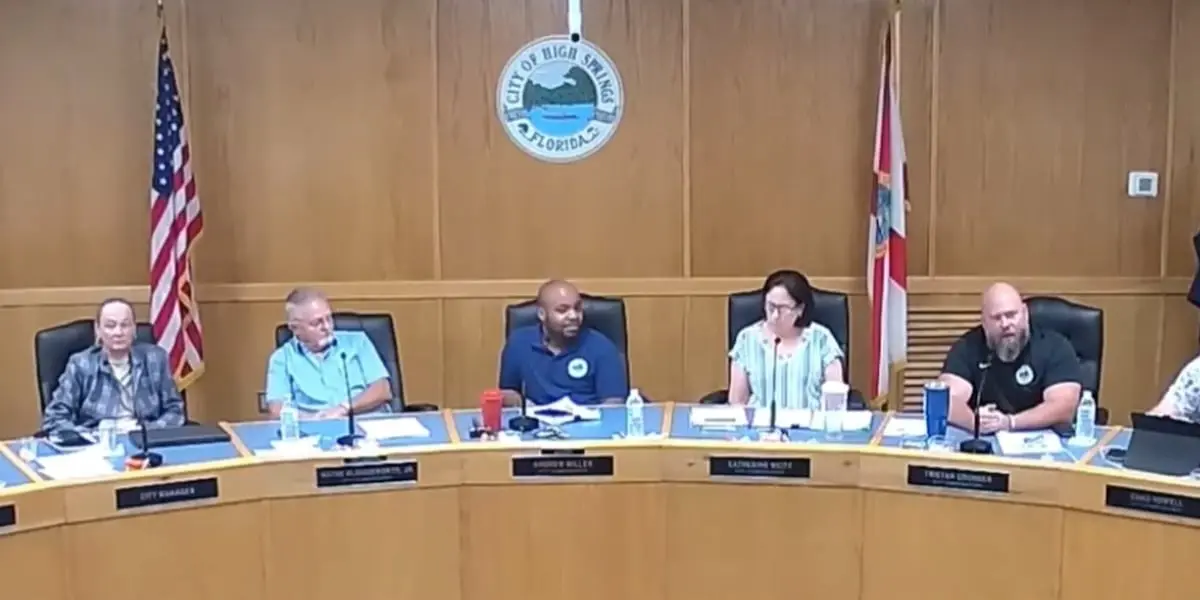
The tension culminated during a regularly scheduled City Commission meeting in High Springs. Although the formal agenda made no mention of dissolving the police or fire departments—focusing instead on standard budgetary readings and fiscal planning—the public comment session served as an immediate referendum on the rumor.
Dozens of residents packed the chambers, many standing along the walls, waiting for their opportunity to address the elected officials directly. The atmosphere was charged with a mixture of disbelief and fierce determination. Speaker after speaker stepped up to the podium to voice their unequivocal opposition to any notion of gutting public safety.
The public comment period underscored a profound philosophical divide between abstract spreadsheet-driven austerity and the tangible, human expectations of municipal governance. Residents argued that while balancing a budget is mathematically necessary, it cannot be achieved by stripping away the fundamental social contract between a local government and its populace: the guarantee of immediate police protection and rapid fire response.
Following hours of intense public testimony and commissioner deliberation, the governing body ultimately voted to pass the new fiscal year budget. Crucially, the approved spending plan rejects the notion of dismantling emergency services, ensuring that both the High Springs Police Department and the High Springs Fire Department remain fully funded and operational.
However, the relief of preserving these departments came with a financial caveat: balancing the ledger required accepting revenue adjustments that will directly impact local taxpayers.
Supporting Context & Metrics: The Anatomy of a Municipal Budget
To fully understand why the mere discussion of eliminating police and fire services could surface in High Springs, one must examine the broader economic and structural landscape facing the city. Municipal finance is a complex ecosystem governed by strict statutory requirements, unpredictable economic shifts, and localized cost drivers.
Property Valuations and the 9% Tax Impact
The newly adopted budget addresses funding shortfalls through a combination of internal cost containment and reliance on rising property assessments. According to data provided by the Alachua County Property Appraiser’s Office, property values within the High Springs municipal boundaries have experienced notable appreciation over the past year.
While a rising tax base is typically viewed as a sign of economic health, it directly translates to higher tax bills for property owners unless millage rates are aggressively rolled back. Under the newly passed budget, local property owners are projected to pay approximately 9% more in city-related property taxes. This increase is driven primarily by the higher assessed values of residential and commercial real estate rather than an intentional, punitive tax rate hike by the commission.
For many fixed-income seniors, working-class families, and small business owners in High Springs, a 9% year-over-year increase in property tax liability is a significant strain, particularly when viewed alongside broader inflationary pressures affecting groceries, insurance, and utilities. This economic squeeze forms the backdrop against which radical cost-cutting ideas like disbanding departments were even whispered in administrative circles.
The Cost of Public Safety
In almost every municipal budget, public safety—police and fire-rescue—represents the single largest expenditure category. Maintaining a 24/7 police force and fully staffed fire stations requires massive investments in personnel salaries, healthcare benefits, specialized training, vehicle fleets, maintenance, and cutting-edge communication technology.
In a smaller municipality like High Springs, these fixed costs consume a disproportionate share of the general fund. When revenues lag or administrative costs rise, local leaders are often forced into difficult triage. However, as the recent meeting demonstrated, the community views public safety not as a flexible line item that can be trimmed or outsourced at will, but as the non-negotiable core of municipal existence.
Official Statements and Community Voices
The emotional core of the High Springs budget debate lies in the impassoned testimony delivered by ordinary citizens and community leaders who refused to let public safety be used as a bargaining chip in fiscal negotiations.
During the public comment period, resident Karl Spain captured the prevailing sentiment of the assembly with a powerful, declarative statement that drew audible applause from the audience:
"It’s the will of the people to fund this department repeatedly and continuously fund this department as the number one priority of the city government of High Springs."
Spain’s remarks resonated deeply because they articulated a fundamental civic truth: regardless of bureaucratic spreadsheets or economic models, the legitimacy of a local government rests upon its responsiveness to the foundational values of its citizens. For the people of High Springs, a city without its own police officers and firefighters is a city in name only, stripped of its identity, security, and institutional self-reliance.
Other residents echoed these concerns, pointing out that contracting emergency services out to larger regional entities often leads to slower response times, a dilution of local accountability, and a loss of community-oriented policing where officers actually know the neighborhoods and families they protect.
While city commissioners and administrative officials defended their duty to explore all potential fiscal scenarios—arguing that responsible governance requires looking at every possible avenue when balancing a tight budget—they ultimately yielded to the overwhelming consensus of the populace. The commissioners’ vote to pass the budget with public safety intact served as an acknowledgment that while fiscal discipline is vital, it cannot override the collective will and safety of the community.
Future Outlook: Navigating Long-Term Fiscal Sustainability
While the immediate crisis has been averted and the High Springs Police and Fire departments secured for the current fiscal cycle, the underlying structural challenges that provoked these drastic discussions have not vanished. As High Springs looks toward the future, municipal leaders, city planners, and residents alike must confront several critical questions regarding long-term fiscal health and sustainable growth.
1. Diversifying Revenue Streams
Relying heavily on property taxes to fund essential services leaves High Springs vulnerable to real estate market fluctuations and places a disproportionate burden on local property owners. Moving forward, the city must explore aggressive economic development strategies to expand its commercial tax base. Attracting new businesses, encouraging sustainable light industry, and boosting tourism can generate alternative revenue streams that alleviate the tax pressure on residential homeowners.
2. Regional Collaboration vs. Municipal Autonomy
The floating of the idea to eliminate local departments highlights an ongoing national debate regarding the efficiency of small municipal agencies versus regional consolidation. While consolidation can sometimes yield administrative cost savings, it often sacrifices local responsiveness and community trust. High Springs must proactively evaluate interlocal agreements, shared dispatch services, and grant opportunities to capture operational efficiencies without compromising the autonomy and presence of its local first responders.
3. Enhancing Budgetary Transparency and Public Trust
The anxiety caused by the rumors of police and fire department cuts underscores the vital importance of open, transparent communication between city hall and the citizenry. Building long-term trust requires early public engagement, where financial challenges are shared transparently with residents long before drastic ideas enter the public lexicon. By fostering a collaborative dialogue on fiscal matters, High Springs can prevent future panic and work hand-in-hand with its constituents to build balanced, resilient budgets.
Conclusion
The recent fiscal debate in High Springs, Florida, serves as a compelling case study in the modern challenges of local governance. It demonstrates the fierce loyalty communities feel toward their frontline protectors and illustrates the delicate balancing act required of elected officials tasked with keeping municipal balance sheets in the black.
By listening to the resounding voice of its residents, the High Springs City Commission reaffirmed that public safety remains the bedrock of the community. As the city navigates the complexities of future fiscal years, the lessons learned from this contentious budget cycle will undoubtedly guide its path toward a more resilient, transparent, and secure tomorrow.

0 Comments