
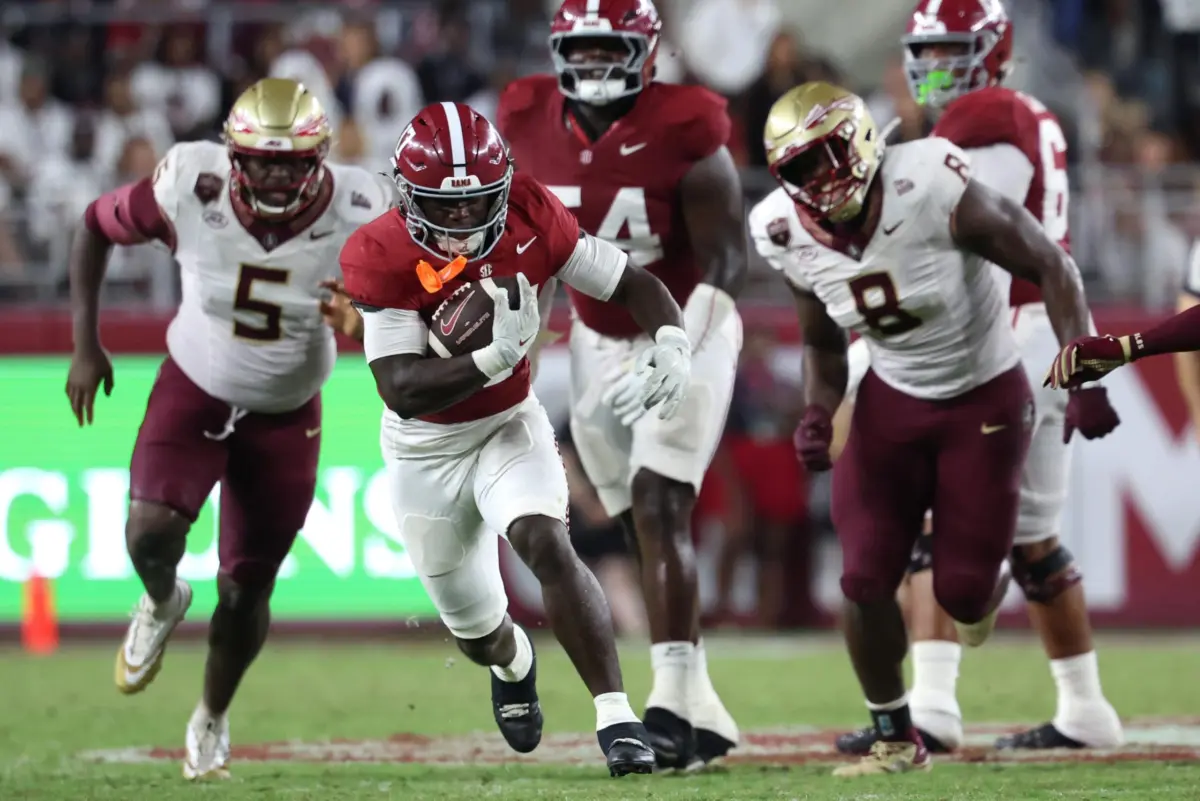

TALLAHASSEE, Fla. — In the cold, unyielding arithmetic of college football, moral victories are little more than consolation prizes muttered by the vanquished. There are no asterisks in the win-loss column for keeping a powerhouse on the ropes, nor are there style points awarded for a brilliant first half that dissolves into a second-half defensive catastrophe.
For the Florida State Seminoles (1–2, 0–1), the sobering reality of the 2025 season crystallized beneath the lights on Saturday. Despite roaring out of the gate, commanding a multi-touchdown lead well into the second quarter, and orchestrating a thrilling offensive display that repeatedly pierced one of the nation’s premier secondaries, FSU walked away with a bitter defeat. A staggering defensive unraveling and recurring offensive inconsistencies—trends rapidly calcifying into a systemic identity—dug a chasm the Seminoles simply could not climb out of.
Now sitting at sub-.500 through the first third of the campaign, Florida State retreats to the friendly confines of Doak Campbell Stadium for a much-needed, albeit superficial, breather against Central Arkansas. It is a brief respite before the bottom drops out of their schedule: an unforgiving, three-week gauntlet featuring tilts against Virginia, Louisville, and Miami.
To understand how a game of such immense promise slipped through their fingers, one must look beyond the final scoreboard. The raw metrics, the tactical breakdowns, and the unyielding mathematics of the gridiron expose the precise fault lines that ruptured under the crimson tide.
Executive Overview: A Tale of Two Halves
For roughly twenty-two minutes of game time, Florida State looked every bit the part of a championship-caliber contender. Head coach Mike Norvell’s squad executed a brilliant game plan, stunning a partisan crowd and catching the Crimson Tide flat-footed. Quarterback Ashton Daniels uncorked a series of breathtaking deep balls, unlocking an explosive vertical passing game that terrorized Alabama’s back end, while defensive coordinator Tony White’s unit initially stymied Keelon Russell and the high-powered Tide offense.
Then came the flashpoint. In a stunning 132-second sequence just before halftime, a comfortable 21–6 Seminole advantage evaporated like morning mist, mutating into a harrowing 26–21 halftime deficit. It was a localized disaster that bled seamlessly into a broader structural collapse.
Alabama rattled off nine consecutive scoring drives, converting every single possession after their initial two punts. The Seminole defense, burdened by a glaring lack of depth and exposed by fatigue, was ground into dust by an Alabama rushing attack that churned out chunks of yardage at will. By the time the fourth quarter rolled around, Florida State’s frontline had nothing left to give, surrendering 124 yards on the ground in the final stanza alone.
While the offense manufactured 10 explosive plays—highlighted by stellar vertical tracking from wide receiver Duce Robinson and versatile speedster Michai Danzy—their inability to maintain down-to-down consistency ultimately exposed Daniels to dangerous situations, culminating in costly turnovers.
When the dust settled, Florida State was left to pick up the pieces of what could have been a program-defining upset, forced instead to confront the uncomfortable truths of a roster stretched to its absolute breaking point.
Detailed Chronology: How the Momentum Shifted
To comprehend the magnitude of FSU’s collapse, one must examine the micro-narrative of the game—how an afternoon of soaring optimism descended step-by-step into a tactical rout.
The Promising Genesis
The opening act belonged entirely to the Seminoles. White dialed up a brilliant defensive scheme that kept Keelon Russell off balance, forcing consecutive three-and-outs on Alabama’s first two possessions. It was disciplined, aggressive, and suffocating football.
Offensively, Norvell and his staff sensed vulnerability. Instead of playing it conservative, FSU dialed up aggressive shots downfield. Daniels, overcoming his historical accuracy limitations, began connecting with his targets in stride. By the midway point of the second quarter, Florida State held a commanding 21–6 lead. The offense was humming, the defense was flying around the ball, and an upset was brewing.
The 132-Second Nightmare
Every great college football upset features a turning point—a singular, violent momentum swing from which the underdog never recovers. For Florida State, that turning point occurred in the waning moments of the first half.
Leading by 15 points, the Seminoles needed merely to stanch the bleeding and reach the locker room with their double-digit cushion intact. Instead, the defensive unit buckled catastrophically. FSU allowed three touchdowns in a mind-boggling span of 132 seconds.
The sequence laid bare fundamental breakdowns in coverage and execution. On the first scoring drive, the Seminoles had multiple golden opportunities to get off the field on third down, only to commit costly procedural and tackling errors. The subsequent two scores were fueled by glaring explosive plays where missed assignments left Alabama receivers galloping into open space. In the blink of an eye, a statement 21–6 lead transformed into a deflating 26–21 halftime deficit.
The Second-Half Avalanche
If the locker room offered a chance for a psychological reset, it failed to manifest on the field. Alabama received the ball to start the second half and immediately marched down the field for a touchdown. They followed it with another methodical scoring drive, cementing a terrifying statistical reality: the Tide had unlocked an unbroken chain of offensive execution.
Even as Daniels and the FSU offense tried valiantly to trade punches, the defense could not buy a stop. The pass rush vanished, the secondary grew hesitant, and the Crimson Tide dictated the terms of engagement. By the time Alabama capped off a punishing 90-yard, clock-eating touchdown drive in the fourth quarter to push their lead to 50–36, the game—and any lingering hopes of a miraculous comeback—was out of reach.
Supporting Context & Metrics: The Numbers That Tell the Tale
Football may be played by humans prone to emotion, fatigue, and error, but the numbers rarely lie. Three defining statistical pillars illuminate precisely why Florida State’s valiant effort ultimately fell short.
+-----------------------------------+---------------------------------------+
| Metric Category                   | Statistical Reality                   |
+-----------------------------------+---------------------------------------+
| Alabama Consecutive Scoring Drives| 9 Straight Drives                     |
| Alabama Yards Per Rush (Q4)       | 7.4 Yards / 124 Yards on 14 Carries   |
| FSU Offensive Explosive Plays     | 10 Plays (344 of 377 Passing Yards)   |
+-----------------------------------+---------------------------------------+
1. Nine Straight Scoring Drives
After FSU forced those initial two punts in the opening quarter, Alabama scored on every single possession for the remainder of the game. Nine consecutive scoring drives.
It is a statistical anomaly that feels almost typographical, yet it serves as the ultimate indictment of FSU’s defensive ceiling on Saturday. If White’s unit could have managed just two defensive stops during that stretch—forcing a single punt or manufacturing a lone turnover—the entire complexion of the game changes, potentially allowing the Seminoles to travel back to Tallahassee with a famous victory.
Instead, the defense failed to force a punt past the first quarter. They failed to create a single takeaway. Thirty-six points on the road against a powerhouse like Alabama should, under almost any historical circumstance, be enough to secure a victory. The offense held up their end of the bargain; the defense completely abdicated its responsibility.
2. 7.4 Yards Per Rush for Alabama
The engine driving Alabama’s historic scoring streak was a relentless, ground-and-pound rushing attack that systematically wore down Florida State’s front seven.
Initially, FSU’s defensive front appeared up to the assignment, conceding a meager 13 rushing yards on 10 carries in the first quarter. But football is a game of attrition. The body blows accumulated. By the fourth quarter, the gas tank was empty.
Alabama exploded for 124 yards on 14 carries in the final stanza alone. The crowning blow of the afternoon was a brutal 90-yard touchdown drive heavily reliant on the run game, culminating in an average of 7.4 yards per rush over the stretch and stretching the Tide’s lead to an insurmountable 14 points.
This collapse exposes the Achilles’ heel flagged by analysts during the offseason: roster depth.
The snap counts tell a damning story of an overworked front line. Four FSU defensive linemen logged 40 snaps or more—drastically eclipsing the 50% participation cap Norvell has publicly stated he desires to maintain optimal freshness. Conversely, four other defensive linemen played 22 snaps or fewer, as the coaching staff struggles to cultivate the trust necessary to rotate bodies effectively.
Whether this stems from developmental stagnation, conservative coaching, or simply a thin recruiting pipeline, the defensive depth was fundamentally unprepared for the physical demands of an elite SEC opponent. Florida State paid the ultimate price for that imbalance.
3. 10 Explosive Plays from the Seminoles
It was not all doom and gloom for the Garnet and Gold; Norvell’s offensive scheme proved it could stress an elite defense through sheer vertical explosiveness.
Ashton Daniels accumulated 377 passing yards, and an astonishing 344 of those yards came via just 10 explosive plays. The game plan successfully took the top off the Alabama defense, catching the secondary flat-footed with deep shots downfield.
Wide receiver Duce Robinson was exceptional, carving up coverage for 135 yards on 6 catches, including a sparkling 40-yard reception. Speedster Michai Danzy added a dynamic element, utilizing his elite acceleration to haul in 3 catches for 89 yards, featuring a massive 56-yard explosive gain.
However, these breathtaking highlights masked a troubling underlying metric: down-to-down inconsistency.
According to advanced analytics via gameonpaper.com, Florida State posted an elite explosive-play rate of 17% (placing them in the 99th percentile nationally). Yet, their overall success rate plummeted to 45% (ranking in the 53rd percentile).
Daniels labored to a sub-60% completion percentage for the second consecutive week, struggling with decisiveness in the intermediate passing game. When an offense relies so heavily on high-risk, high-reward explosive plays to manufacture yardage, the margin for error shrinks to zero. Eventually, the reliance on the deep ball forced Daniels into regrettable throwing decisions, leading to drive-killing interceptions.
Official Statements: Assessing the Wreckage
Addressing the local Tallahassee media during his Monday press conference, head coach Mike Norvell cut a figure of weary resolve. He did not mince words regarding his team’s execution, particularly on the defensive side of the ball.
"There’s obviously a handful of plays that we’d love to have back, because I still felt like we left points out there on the field where we got to be better. Unfortunately, defensively, did not play to the standard after those first four drives," Norvell admitted.
The second-year head coach directly addressed the unprecedented defensive collapse that saw Alabama march down the field unchecked for the better part of three quarters:
"We look at how much are we asking guys to do, the confidence, the speed, the reactions of what shows up on film because it’s not good enough. They scored on nine straight drives in the game… And so, that was definitely something that was disappointing to see. I mean, we did get a little worn down there towards the back part of the game. They did a good job throughout it and our depth has been tested."
On the offensive side, Norvell acknowledged the dichotomy between the big-play heroics and the grinding, day-to-day efficiency issues that continue to plague his signal-caller:
"There might be some games that you throw a few times, right, because of what things look like. Then there’s gonna be times that you got to be able to push the ball down the field. I thought they did a good job in their preparation and executing when we get those opportunities for those throws and plays."
Norvell also addressed the growing pains associated with a defensive rotation stretched thin by youth and inexperience:
"We’re playing a lot of guys that are kind of getting thrust into action a little bit, and that’s an opportunity, but you gotta take advantage of it when you get in the game. And that’s part of your continued growth. Some positions are a little thinner than others, when it comes to that."
Future Outlook: The Road Ahead
As the page turns from the heartbreak in Tuscaloosa to the immediate horizon, Florida State stands at a critical juncture in the 2025 campaign.
At 1–2 overall and 0–1 in conference play, the margin for error has evaporated. Saturday’s matchup against Central Arkansas offers a mandatory calibration game—an opportunity to fix technique, build confidence among the younger defensive reserves, and allow Daniels to refine his intermediate timing without the existential threat of an elite pass rush.
Yet, the coaching staff cannot afford to view the cupcake contest through rose-colored glasses. The structural issues exposed by Alabama—a fatigued front seven, an over-reliance on a high-variance explosive passing game, and an inability to maintain defensive discipline over four quarters—will not vanish simply because the opponent changes its uniform color.
Immediately following this weekend’s tune-up, the Seminoles will step into the meat grinder. A three-game gauntlet against Virginia, Louisville, and Miami looms large. If White’s defense cannot find a way to manufacture stops when opponents lean on the run game, and if Norvell cannot develop reliable rotational depth along the defensive line, those conference foes will ruthlessly exploit the blueprints laid bare by the Crimson Tide.
In college football, moral victories do not exist. But moral honesty is mandatory. Florida State proved they can throw punches with the heavyweights of the sport; now, they must prove they possess the stamina, depth, and discipline to survive the full fifteen rounds.

0 Comments