
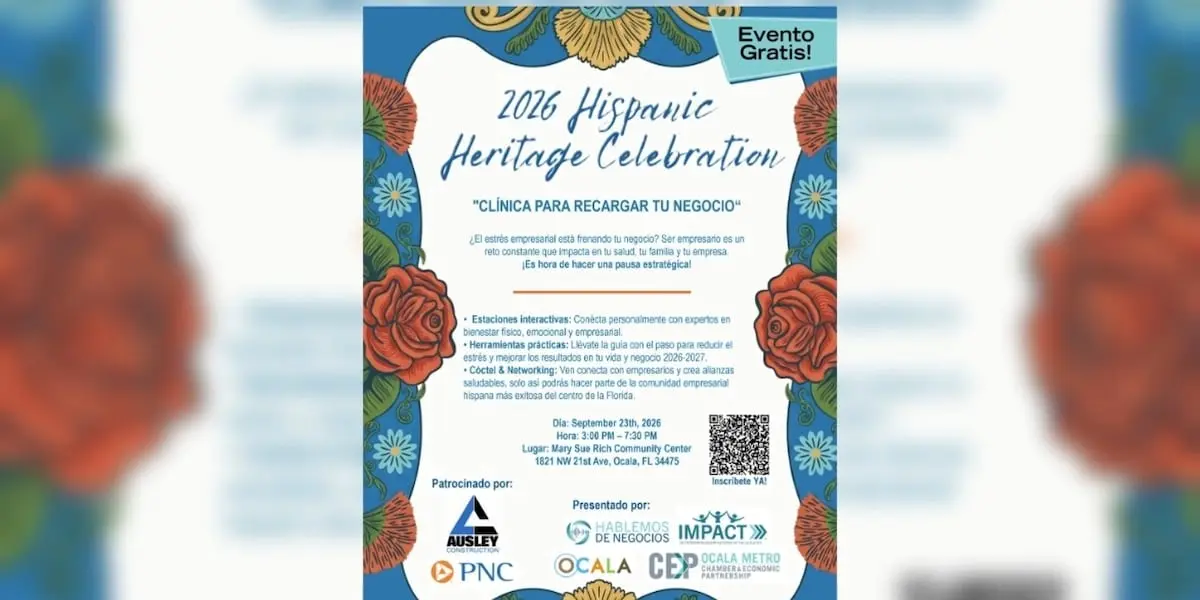

OCALA, Fla. — As communities across the United States ring in National Hispanic Heritage Month this September, local leaders and economic development advocates in Marion County are shifting the focus from cultural celebration alone to targeted, tangible economic empowerment. On Wednesday afternoon, the Mary Sue Rich Community Center at Reed Place in Ocala will host a specialized business fair and professional development clinic explicitly tailored for Hispanic small business owners.
Dubbed the "Recharge Your Business" clinic, the event is designed to serve as an immersive, high-impact incubator for entrepreneurs navigating the complex post-pandemic economic landscape. Far from a traditional networking mixer, this curated experience offers an intensive curriculum focused on bolstering operational resilience, optimizing financial health, securing legal scaffolding, and—crucially—addressing the often-overlooked mental and emotional well-being of the business owner.
In a region where Hispanic-owned enterprises represent one of the fastest-growing segments of the local economy, initiatives like the "Recharge Your Business" clinic arrive at a pivotal moment. This comprehensive report explores the structural importance of the event, details its programmatic schedule, contextualizes the booming landscape of Hispanic entrepreneurship in Central Florida, and evaluates the long-term outlook for minority-led business development in Marion County.
Executive Overview
The landscape of American entrepreneurship has undergone a profound demographic shift over the past decade, with Hispanic-owned businesses emerging as a vital economic engine. In Central Florida, this trend is acutely visible. From retail storefronts and construction firms to professional consultancies and tech startups, Hispanic entrepreneurs are driving local job creation, tax revenues, and neighborhood revitalization.
However, business ownership is rarely a linear path of uninterrupted growth. Macroeconomic headwinds—including persistent inflationary pressures, fluctuating interest rates, supply chain volatility, and workforce retention challenges—pose disproportionate threats to micro-enterprises and small businesses. Furthermore, research consistently highlights that minority business owners frequently face systemic hurdles when attempting to access traditional capital, legal guidance, and comprehensive support systems.
Recognizing these vulnerabilities, the organizers behind the "Recharge Your Business" clinic have structured the event to address the whole entrepreneur. By fusing hard business acumen—such as financial planning and legal compliance—with holistic elements like mental and emotional wellness, the clinic breaks away from conventional corporate seminars. It acknowledges a fundamental truth of modern entrepreneurship: a business cannot sustainably outgrow the well-being of its founder.
Scheduled to kick off at 3:00 p.m. on Wednesday, the program at the Mary Sue Rich Community Center represents a collaborative effort among civic leaders, mental health advocates, financial advisors, and legal experts. It underscores Marion County’s commitment to fostering an inclusive, resilient business ecosystem where Hispanic entrepreneurs are not merely surviving, but scaling toward generational success.
Detailed Chronology: Anatomy of the "Recharge Your Business" Clinic
To understand the value proposition of Wednesday’s event, it is necessary to examine how the clinic is structured to maximize participant engagement and knowledge retention. Designed as a dynamic, interactive afternoon rather than a passive lecture series, the schedule reflects a meticulous blueprint aimed at delivering immediate, actionable takeaways.
Phase 1: Registration and Networking Immersion (2:30 PM – 3:00 PM)
The afternoon commences with early arrival registration at the state-of-the-art Mary Sue Rich Community Center. Organizers have intentionally carved out a half-hour window before the official programming begins to allow attendees to connect with peers, exchange contact information, and establish a collaborative atmosphere. In micro-enterprise development, peer networks often serve as the first line of defense against operational isolation. This pre-event networking serves to break down silos among local Hispanic business owners operating across disparate industries.
Phase 2: Opening Remarks and the Holistic Business Paradigm (3:00 PM – 3:30 PM)
The formal sessions open with a framing address that introduces the "Recharge Your Business" philosophy. Unlike standard business clinics that focus exclusively on bottom-line metrics, opening facilitators will address the psychological toll of entrepreneurship. Small business owners routinely grapple with burnout, decision fatigue, and the chronic stress of financial volatility. By destigmatizing these challenges early in the program, the event establishes a supportive environment conducive to genuine professional development.
Phase 3: Interactive Multidisciplinary Presentations (3:30 PM – 5:00 PM)
The core of the afternoon consists of a series of rotating, interactive presentations led by subject-matter specialists. The curriculum is partitioned into four critical pillars:
- Financial Health & Capital Access: Certified financial planners and commercial banking specialists break down the mechanics of cash flow management, debt restructuring, and strategies for preparing a business to secure low-interest capital. Attendees receive templates for forecasting liquidity and evaluating profitability margins.
- Legal Safeguards & Compliance: Legal practitioners specializing in corporate law guide participants through entity structuring (LLCs, S-Corps, Sole Proprietorships), intellectual property protection, contract review, and labor law compliance. This session aims to insulate business owners from costly litigation and regulatory pitfalls.
- Emotional and Mental Well-being: Licensed mental health professionals lead workshops on stress management, resilience-building, and maintaining work-life integration. Participants are provided with tangible mindfulness tools and frameworks for setting psychological boundaries to prevent burnout.
- Strategic Growth & Operational Scaling: Business strategists demonstrate how to leverage digital marketing, streamline internal workflows, and identify new market segments within Marion County and the broader Central Florida region.
Phase 4: Expert Q&A Panel and Open Consultation (5:00 PM – 6:00 PM)
The structured presentations culminate in an exhaustive, interactive Question and Answer panel. Rather than a brief five-minute wrap-up, this extended session allows business owners to present specific operational roadblocks they are currently facing to the panel of specialists. Following the panel, attendees are given the opportunity to schedule one-on-one follow-up consultations with participating experts, ensuring that the insights gained can be directly translated into individualized action plans for their respective enterprises.
Supporting Context & Metrics: The Rise of Hispanic Entrepreneurship
To fully appreciate the significance of the "Recharge Your Business" clinic, one must evaluate the macroeconomic data governing Hispanic small business ownership both nationally and locally within the state of Florida.
The National and Statewide Landscape
According to data compiled by the Stanford Latino Entrepreneurship Initiative (SLEI) in partnership with the Latino Business Action Network (LBAN), Hispanic-owned businesses have been growing at a rate significantly faster than their non-Hispanic counterparts over the past decade. Nationally, there are estimated to be over 5 million Hispanic-owned businesses contributing more than $800 billion to the U.S. economy annually.
In Florida—home to one of the largest and most vibrant Hispanic populations in the country—this entrepreneurial dynamism is even more pronounced. Florida consistently ranks among the top states for new business formations, with Hispanic women, in particular, representing one of the fastest-growing demographics of startup founders.
However, growth metrics alone do not tell the entire story. Structural disparities persist:
- The Capital Gap: Data from the Federal Reserve Bank indicates that Hispanic business owners are less likely to receive full approval for commercial loans compared to non-Hispanic white business owners, frequently relying instead on personal savings, credit cards, or high-interest microloans to fund operations.
- Information Asymmetry: Many minority entrepreneurs launch businesses without formal business education, relying on intuition and hustle. While these traits are invaluable in early phases, navigating municipal permitting, tax codes, and commercial leasing requires specialized navigation tools that are often gatekept by networks of privilege.
- The Burnout Epidemic: A 2023 Small Business Administration (SBA) survey revealed that over 65% of micro-enterprise founders experience chronic stress levels that negatively impact their physical health and personal relationships.
Marion County’s Micro-Economic Ecosystem
Ocala and the broader Marion County region present a unique economic backdrop. Traditionally known for its equine industry, manufacturing, logistics, and agriculture, Marion County has experienced steady population growth, drawing newcomers seeking a lower cost of living compared to South Florida or major metropolitan hubs like Orlando and Tampa.
This population influx has created a surging demand for localized services, retail establishments, professional firms, and hospitality venues—sectors where Hispanic entrepreneurs have established a formidable footprint. Yet, small businesses in Marion County often operate with lean staffs, meaning the owner wears multiple hats: chief executive, human resources director, accountant, and marketing lead. When an owner faces a crisis in any one of these domains, the entire enterprise is destabilized.
Events like the "Recharge Your Business" clinic serve as a vital institutional counterweight to these vulnerabilities. By democratizing access to high-level legal, financial, and psychological expertise, the clinic acts as an equalizer, providing local entrepreneurs with the institutional scaffolding necessary to weather economic storms and scale operations effectively.
Official Statements and Stakeholder Perspectives
The launch of the Hispanic Heritage Month business fair has garnered support from municipal leaders, community organizers, and participating specialists, all of whom emphasize the necessity of proactive, holistic support systems for small business owners.
While local chambers of commerce and economic development councils frequently host networking events, organizers of the Wednesday clinic stress that this initiative was intentionally designed to bridge the gap between inspiration and practical execution.
"When we talk about celebrating Hispanic Heritage Month, we must move beyond symbolic recognition and invest tangibly in the economic vitality of our community," noted an economic development advocate closely tied to the planning of the Ocala event. "Hispanic small business owners are the backbone of our local commercial corridors. By providing them with actionable tools—not just in finance and law, but in mental health and personal resilience—we are investing in the long-term stability of Marion County as a whole."
Mental health professionals participating in the clinic have likewise underscored the urgency of integrating wellness into professional development. For years, the corporate world maintained a strict firewall between business performance and emotional well-being. Modern organizational psychology, however, has proven that founders operating under chronic, unmanaged stress make suboptimal strategic decisions, suffer from higher rates of enterprise failure, and struggle with team leadership.
“You cannot separate the entrepreneur from the enterprise,” shared a consulting psychologist slated to lead the well-being seminar. “When a small business owner is overwhelmed by financial anxiety or legal uncertainty, their cognitive bandwidth shrinks. They stop innovating and start merely reacting. Our goal on Wednesday is to help these owners step back, decompress, reset their nervous systems, and reclaim their strategic vision.”
Financial and legal specialists echoing these sentiments point out that preventative counseling is exponentially more cost-effective than reactive crisis management. A single poorly drafted contract or an unoptimized tax structure can cost a micro-enterprise thousands of dollars—capital that could otherwise be reinvested into inventory, marketing, or employee compensation. By bringing legal and financial experts directly to the entrepreneurs in an accessible, community-centered environment, the clinic breaks down the intimidation factor often associated with professional advisory services.
Future Outlook: Building a Sustainable Economic Infrastructure
As the "Recharge Your Business" clinic concludes its inaugural sessions at the Mary Sue Rich Community Center, municipal leaders and business advocates are already looking toward the horizon. The critical question facing Marion County is not whether Hispanic entrepreneurship will continue to expand—the demographic and economic indicators confirm that it will—but rather how institutional support structures can evolve to sustain that growth over the next decade.
1. Institutionalizing Continuous Education
Industry experts emphasize that a single afternoon clinic, while immensely valuable, must serve as a catalyst rather than a standalone intervention. Moving forward, the success of Wednesday’s event will likely be measured by its ability to spawn ongoing mentorship programs, peer-led mastermind groups, and continuous educational pipelines. Local stakeholders are already exploring the feasibility of establishing quarterly follow-up workshops, digital resource libraries, and bilingual business incubators in Ocala.
2. Expanding Access to Alternative Capital
Addressing the persistent capital gap remains a paramount objective for Central Florida’s economic development agencies. Future initiatives are expected to focus heavily on connecting Hispanic business owners with Community Development Financial Institutions (CDFIs), micro-lending networks, and angel investor syndicates that understand the specific credit profiles and growth trajectories of minority-led micro-enterprises.
3. Fostering Cross-Sector Collaboration
The intersection of mental health advocacy and business development showcased at the Mary Sue Rich Community Center points toward a more holistic future for small business support. As the modern workplace continues to evolve, programs that prioritize holistic wellness, emotional intelligence, and sustainable work practices are expected to become the gold standard of economic development programming.
Conclusion
National Hispanic Heritage Month offers a designated annual window to honor the rich cultural contributions of Hispanic Americans to the fabric of United States society. In Marion County, Florida, the "Recharge Your Business" clinic elevates this commemoration from passive reflection to active economic fortification. By arming Hispanic entrepreneurs with the legal tools to protect their assets, the financial acumen to secure capital, and the mental health strategies to sustain their personal well-being, the community is laying the groundwork for a robust, equitable, and resilient economic future.
As the doors of the Mary Sue Rich Community Center open at 3:00 p.m. on Wednesday, local business owners will step into an environment designed not just to help them manage their enterprises, but to help them reclaim their passion, reignite their growth, and secure their legacies for generations to come.

0 Comments