

Executive Overview
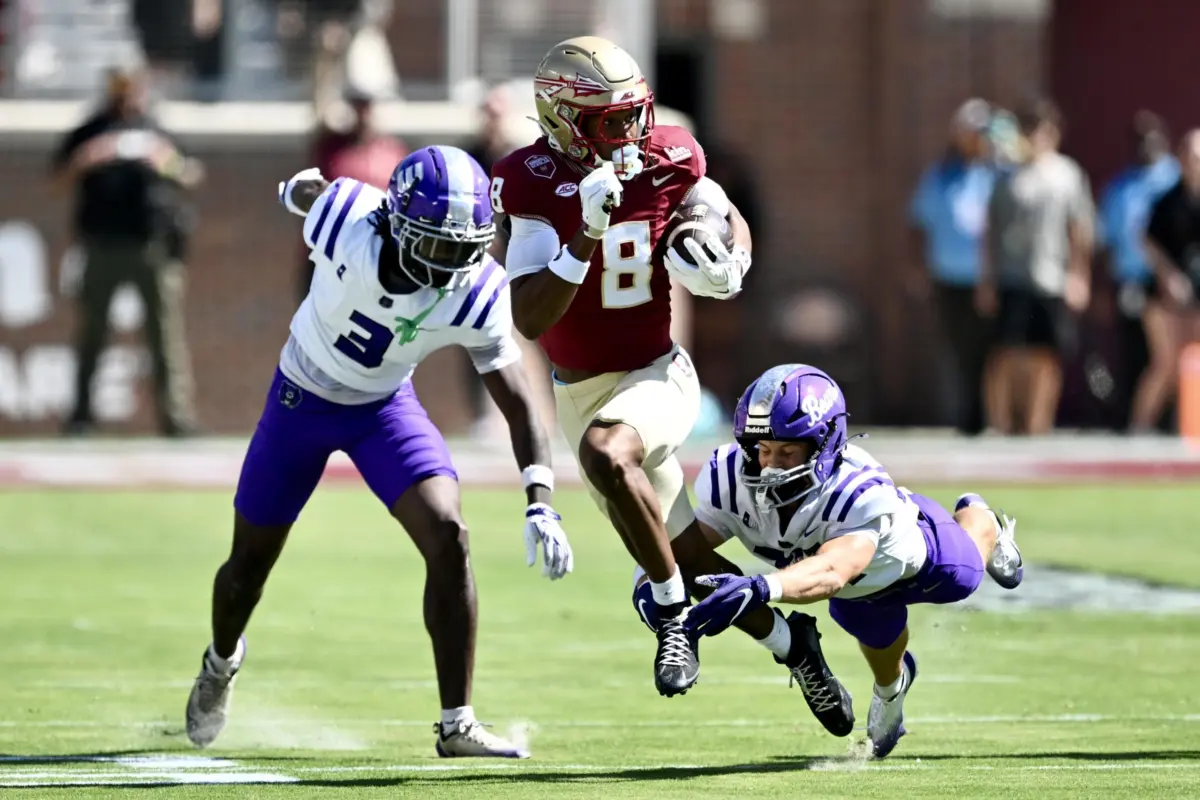
For the Florida State Seminoles, a 34-7 victory over an FCS opponent in Central Arkansas should have been a straightforward affair—a routine tune-up marked by early dominance, coast-to-coast substitutions, and a fourth quarter dedicated to handing the reins over to the next generation of the program. Yet, as the final whistle echoed through the stadium, the atmosphere among the garnet and gold faithful was notably subdued.
The scoreline indicates a comfortable 27-point win, but the underlying reality of the contest paints a far more complicated picture. Rather than the stress-free developmental showcase typical of matchups against lower-division opponents, Florida State found itself relying on its front-line starters well into the second half on both sides of the ball. This unexpected necessity kept the playbook conservative, forced starters to log high-intensity snaps they could have otherwise spent recovering, and severely restricted the developmental runway for the program’s younger prospects.
Nevertheless, beneath the surface of a game that proved surprisingly competitive for longer than anticipated, a silver lining emerged. The matchup served as the baptism of fire for 15 Seminoles who made their official season debuts for 2026, including a cohort of five true freshmen tasting collegiate action for the first time. As Florida State closes the book on its non-Power Four slate for the year, this contest acts as a critical inflection point. This exhaustive retrospective examines the snap counts, evaluates the strategic implications of extended starter deployment, highlights the rookies who took their initial steps under the bright lights, and forecasts what this means as the Seminoles brace for the unforgiving gauntlet of conference play.
Detailed Chronology: How a Routine Matchup Turned Into an Extended Test
When the schedule was initially mapped out, the visit from Central Arkansas was circled as an optimal opportunity for load management. Against programs from the Football Championship Subdivision (FCS), elite Power Four programs generally aim to secure a multi-score lead by halftime, clear the bench by the third quarter, and let deep-rotation players and redshirts soak up valuable live-game repetitions.
However, football is rarely played strictly on paper. From the opening kickoff, Central Arkansas demonstrated a level of resilience and tactical discipline that disrupted Florida State’s rhythm. While the Seminoles’ ultimate athleticism and talent superiority inevitably won out—resulting in a comfortable 34-7 final advantage—the path to that margin was riddled with stalled drives, defensive lapses, and an inability to break the game open early.
The First Half Battle
In the opening two quarters, the expected rout failed to materialize. Central Arkansas’s defensive front executed their gap assignments effectively, frustrating the Seminoles’ rushing attack and forcing key third-down conversions. On the other side of the ball, the Bears managed sustained drives that kept Florida State’s defense on the field longer than coaching staffs prefer against lower-tier competition.
The Seminoles managed to construct a workable lead heading into the locker room, but the lack of an overwhelming offensive explosion meant that head coach Mike Norvell and his staff could not afford to empty the bench. Leaving starters on the sideline to watch the second half unfold from safety gear was out of the question; the game remained close enough that a sudden momentum shift could have put the outcome in jeopardy.
The Second-Half Grind
As the teams emerged for the third quarter, hopes that the game would quickly tilt in favor of mass substitutions were dashed. FSU’s starters trotted back onto the field, tasked with putting the game out of reach once and for all.
This extended deployment proved to be a double-edged sword. On one hand, it allowed the unit to correct mistakes, fine-tune timing, and eventually secure the 34-7 cushion. On the other hand, it exacted a physical toll. Starters absorbed unnecessary hits and logged high-impact minutes deep into the contest, compressing the recovery window ahead of a grueling stretch of the schedule. More detrimentally, it choked off the pipeline of live-game experience for the underclassmen—experiences that are vital for building depth, maintaining locker room morale, and preparing the roster for inevitable injuries down the road.

Despite these developmental limitations, the coaching staff managed to carve out narrow windows of opportunity in the latter stages of the game. When the door finally cracked open, 15 players managed to break through, earning their first game action of the 2026 campaign.
Supporting Context & Metrics: The Breakdown of Snap Counts and Debuts
To truly understand what transpired on Saturday, one must look past the final score and analyze the precise distribution of playing time. The snap counts reveal a calculated, albeit constrained, effort by the coaching staff to inject fresh legs and raw talent into the game only after the primary objective—securing the victory—was safely within reach.
In total, 15 Seminoles made their season debuts, including five true freshmen whose entries mark the official beginning of their collegiate journeys. Below is the comprehensive positional breakdown of these debutants and the exact snap counts they accumulated during the contest.
Defensive Snap Count Analysis
The defensive front and secondary saw a targeted injection of fresh faces, particularly as the coaching staff sought to manage workloads in the trenches and test youth in the defensive backfield.
- Franklin Whitley (Defensive Right Tackle – DRT): 25 Snaps
- Whitley led all debutants in sheer volume, logging a robust 25 snaps at defensive tackle. His heavy utilization indicates that the coaching staff trusts his physical readiness to absorb meaningful contact in rotation, providing vital relief to the interior line starters.
- Jaemin Pinckney (Defensive Left End – DLE): 13 Snaps
- Pinckney contributed 13 solid snaps on the edge. While limited in duration, his deployment offered a glimpse into the team’s developmental pass-rushing depth.
- Wihtlley Cadeau (Defensive Left Tackle – DLT): 5 Snaps
- Cadeau chipped in with 5 snaps on the interior defensive line, a brief but valuable introduction to live collegiate game speed.
- AJ Cottrill (Weak-side Linebacker – WLB): 28 Snaps
- Cottrill recorded the highest snap count among all debutants, playing 28 snaps at the weak-side linebacker position. This significant workload underscores the coaching staff’s confidence in his assignment execution and range in the middle of the defense.
- Karon Maycock (Rover Inside Linebacker – RILB): 21 Snaps
- Operating in the interior linebacker corps, Maycock logged 21 productive snaps, showcasing his ability to diagnose plays and fit gaps in real-time game conditions.
- Tre Bell III (Strong Safety – SS): 17 Snaps
- In the secondary, Bell anchored the back end with 17 snaps at strong safety, providing reliable run support and coverage rotation.
- Jarvis Boatwright Jr. (Free Safety – FS): 15 Snaps
- Boatwright added 15 snaps at free safety, contributing to the backend coverage shell during the game’s later stages.
- Jamari Howard (Left Cornerback – LCB): 12 Snaps
- Howard locked down the outside for 12 snaps, gaining crucial perimeter coverage experience.
- Zae Thomas (Right Cornerback – RCB): 9 Snaps
- Rounding out the defensive debuts, Thomas saw 9 snaps at right cornerback, keeping the secondary fresh as the game wound down.
Offensive Snap Count Analysis
While the offensive starters were pressed into extended duty to steady a occasionally sputtering unit, the coaching staff managed to carve out a concise 7-snap window late in the game for select backup linemen and skill players to break the ice.
- Kevin Sperry (Quarterback): 7 Snaps
- Sperry’s insertion under center for 7 snaps provided the young signal-caller with his first taste of live game action in 2026, offering a brief foundational moment for his development.
- Chavez Thompson (Center – C): 7 Snaps
- Thompson stepped into the critical center role for 7 snaps, commanding line calls and managing the interior line communication under game conditions.
- Jayden Todd (Right Guard – RG): 7 Snaps
- Todd contributed 7 snaps at right guard, getting his feet wet in pass protection and run-blocking schemes.
- Jonathan Daniels (Right Tackle -RT): 7 Snaps
- Rounding out the offensive line debutants, Daniels logged 7 snaps at right tackle, experiencing collegiate edge rushers firsthand.
Official Statements and Coaching Perspectives
In the aftermath of the game, the tone from the Florida State coaching staff was a mixture of relief, pragmatism, and internal critique. While a win is a win in the ledger, the manner in which it was achieved left little room for complacency.
Addressing the media, head coach Mike Norvell did not shy away from evaluating the team’s performance with a critical eye. He emphasized that the primary goal—securing a victory—was accomplished, but immediately pivoted to the execution lapses that forced the coaching staff’s hand regarding personnel management.
"You always want to play clean football, and you want to be able to create opportunities for the young men in this locker room who work just as hard as the starters every single week," Norvell noted during his post-game press conference. "Tonight, we didn’t play clean enough early to make those substitutions as early as we would have liked. Credit to Central Arkansas; they came in with a great plan, they fought, and they made us earn every inch. Our starters had to answer the bell, and they did. But as a program, the standard is the standard. We have to execute at a higher level so that when these games present themselves, we can build depth and reward the guys who are developing behind the scenes."
Defensive coordinator and positional coaches echoed similar sentiments, highlighting the silver lining found in the performances of players like AJ Cottrill (28 snaps) and Franklin Whitley (25 snaps). According to staff reports, the young defenders who did break through made the most of their limited opportunities, displaying the kind of high-motor effort and technical discipline that coaches look for when evaluating future foundational pieces.

On the offensive side, the brief 7-snap appearance of young quarterback Kevin Sperry alongside trench contributors Chavez Thompson, Jayden Todd, and Jonathan Daniels was framed as an essential psychological and physical milestone. Even a handful of snaps in a live collegiate environment can serve as a massive confidence builder, validating months of grueling practice habits in the film room and on the scout team.
Future Outlook: Navigating the Non-Power Four Horizon
As the final notes of the stadium band faded and the analytical breakdown of the Central Arkansas matchup was filed away, a profound reality set in for the Florida State Seminoles: this was the final non-Power Four opponent on the 2026 schedule.
From this point forward, the margin for error shrinks to absolute zero. The safety nets provided by FCS matchups—games where systemic flaws can be masked by sheer talent disparities and where developmental rotations can absorb early-game mistakes—are officially gone. The remaining schedule presents a relentless gauntlet of Power Four competition, where every possession is heavily contested, physical attrition is accelerated, and depth is tested to its absolute breaking point.
The Challenge of Depth Realization
The inability to pull starters early against Central Arkansas leaves the coaching staff facing a unique psychological and physical challenge. On one hand, the front-line players are battle-tested and intimately familiar with high-pressure moments. On the other hand, they have accumulated extra mileage without the benefit of early rest.
Moving forward, managing player fatigue during game weeks will become paramount. The training and sports science staffs will need to carefully calibrate practice intensity to ensure that players who logged heavy minutes in September are fully recovered and explosive when Saturday arrives. Furthermore, the development of the 15 players who made their season debuts—and the dozens of others still waiting in the wings—must now occur in the white-hot crucible of conference play. Coaches will have to find micro-opportunities within tight games to spell starters, trusting that the baptism of fire experienced by younger players will pay dividends when injuries inevitably occur.
Strategic Adjustments for Conference Play
Offensively, the inconsistencies that allowed Central Arkansas to stay within striking distance for three quarters must be ironed out immediately. Against elite conference defenses, stalled drives and slow starts will not merely result in extended starter minutes; they will lead to deficits that cannot easily be overcome. The offensive line must establish an authoritative run game early, allowing the playbook to open up and protecting the quarterback from unnecessary punishment.
Defensively, the encouraging snaps logged by young contributors like Franklin Whitley and AJ Cottrill point toward a resilient future, but consistency remains the ultimate currency. Tackling angles, gap integrity, and explosive-play prevention will be stress-tested by high-powered conference offenses week in and week out.
Conclusion
Florida State’s 34-7 victory over Central Arkansas will ultimately occupy a modest footnote in the history of the 2026 college football season. Yet, for those paying close attention, it serves as a fascinating study in contrast. It exposed the vulnerabilities of a team still searching for complete consistency, highlighted the delicate balance between winning games and developing youth, and officially closed the door on the early-season tune-up phase.
As the Seminoles turn their full attention to the grueling demands of the Power Four schedule, the lessons learned under the lights against Central Arkansas—both positive and negative—will serve as their ultimate guide. The path ahead is steep, unforgiving, and entirely devoid of easy answers. For Mike Norvell and his squad, the time for experimentation has passed; the time to prove their mettle on the grandest stages has officially begun.

0 Comments