
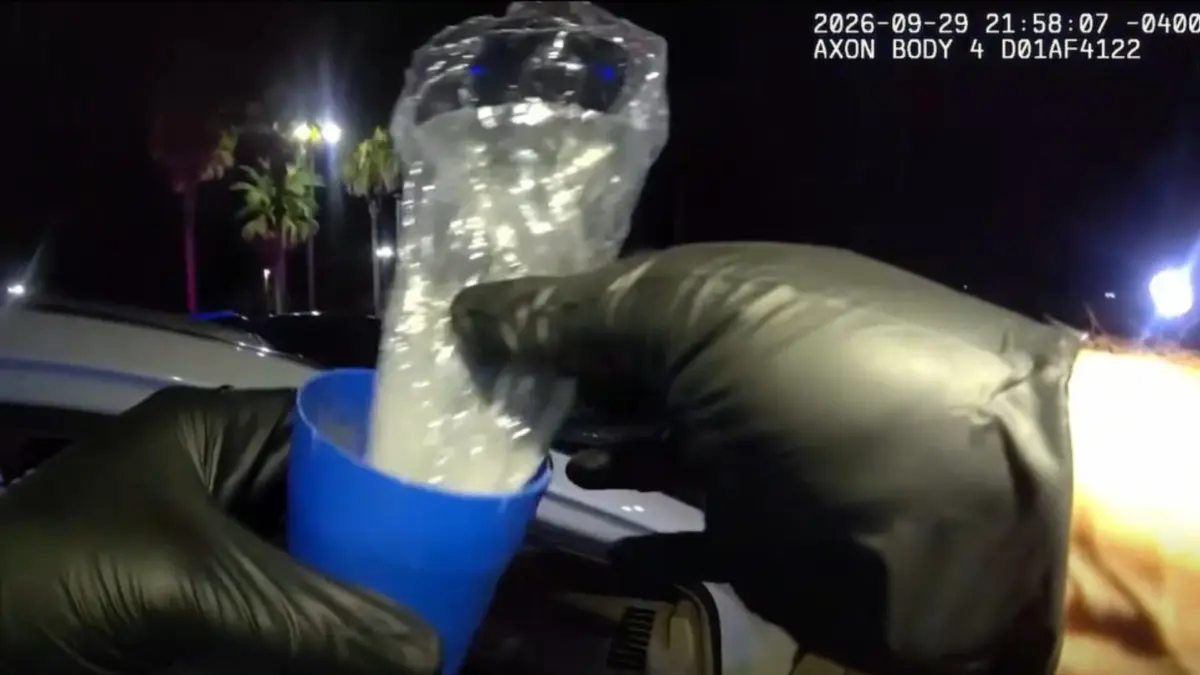

PALATKA, Fla. — An ordinary Tuesday night traffic stop in Putnam County escalated into a significant narcotics seizure this week, culminating in the arrest of four individuals and the recovery of a deadly triad of illicit substances: cocaine, methamphetamine, and fentanyl. According to the Putnam County Sheriff’s Office, deputies uncovered the dangerous contraband hidden in an unconventional hiding spot—dissolved or concealed within a fast-food milkshake held by one of the vehicle’s occupants.
The operation, executed on the evening of Tuesday, has once again underscored the lengths to which traffickers and users go to bypass law enforcement detection, as well as the pervasive nature of the opioid and stimulant crises in rural and semi-rural Florida counties. The four suspects—identified as Brandy Cain, Justin Palerino, Rocky Shuman, and Kierstyn Yarboro—now face a battery of felony drug possession charges.
The incident highlights not only the resourcefulness law enforcement officers must exercise during routine patrol stops, but also the compounding dangers deputies face when handling potent synthetic opioids like fentanyl, which can be lethal in microscopic quantities.
Executive Overview
On Tuesday night, patrol deputies with the Putnam County Sheriff’s Office initiated a standard traffic stop on a vehicle moving through the Palatka area. What began as a routine enforcement action quickly shifted tone as deputies observed suspicious behavior from the vehicle’s occupants, prompting a more thorough investigation that included a K-9 unit and a probable cause search of the interior.
Upon searching the vehicle, deputies made an alarming discovery. Alongside traditional methods of concealment, officers found that illicit narcotics had been placed inside a fast-food milkshake cup being held by a male passenger, alongside another individual in the car. The dairy beverage was utilized as a crude camouflage to mask the texture, smell, and visual presence of hard drugs.
A subsequent search of the vehicle and its occupants yielded a lethal cocktail of street drugs, including:
- Fentanyl: A synthetic opioid roughly 50 to 100 times more potent than morphine, driving the vast majority of overdose fatalities nationwide.
- Methamphetamine: A highly addictive central nervous system stimulant that has plagued communities across Florida for decades.
- Cocaine: A powerful crystalline tropane alkaloid stimulant.
All four individuals inside the vehicle—Brandy Cain, Justin Palerino, Rocky Shuman, and Kierstyn Yarboro—were taken into custody without incident and transported to the Putnam County Jail. While the initial charges focus on possession, the diversity and sheer volume of the substances recovered suggest potential distribution capabilities, prompting further scrutiny from local detectives. Among the arrested, Kierstyn Yarboro faces additional legal jeopardy; due to an active probation violation, she was denied bond during her initial court appearance, ensuring she remains behind bars as the case proceeds through the Seventh Judicial Circuit.
Detailed Chronology of the Operation
The Approach and Initial Observations
The sequence of events began late Tuesday evening when Putnam County Sheriff’s deputies signaled for a vehicle to pull over on a local roadway in Palatka. According to preliminary incident reports, the vehicle was flagged during standard patrol operations. Upon bringing the automobile to a halt, deputies approached the driver’s and passenger-side windows to conduct the customary interaction, requesting license, registration, and proof of insurance.
Almost immediately, deputies noted indicators of heightened anxiety and evasive behavior among the occupants. In law enforcement training, pre-stop and post-stop indicators—such as trembling hands, averted gazes, conflicting travel stories, and excessive fidgeting—often serve as the foundational cues that elevate a routine traffic stop to a criminal interdiction investigation.
Escalation and the Milkshake Discovery
Recognizing signs that suggested illegal activity might be afoot, deputies requested backup and deployed additional investigative protocols, which included questioning the occupants individually and inspecting the cabin of the vehicle.
During the search of the vehicle’s interior, deputies focused their attention on the center console and the passengers’ immediate seating areas. A male passenger was holding a fast-food milkshake cup. To the untrained eye, the cup appeared to be nothing more than a standard beverage purchased from a local drive-thru to accompany a late-night meal. However, upon closer inspection by deputies trained in narcotics concealment, the contents of the cup revealed a different reality.
Smuggling drugs inside fast-food containers, beverage cups, and fast-food wrappers is a known tactic in the playbook of modern drug couriers. Liquids, thick shakes, and slushes can obscure dense packages, wrap powder or crystalline substances in secondary moisture barriers, or temporarily mask chemical odors from interdiction K-9s. Deputies carefully secured the beverage container, confirming that it contained illicit substances hidden beneath or mixed into the consumable product.
The Search and Seizure
With probable cause firmly established by the discovery inside the beverage container, deputies expanded the scope of the search across the entirety of the vehicle’s cabin and trunk space. The secondary search uncovered a multi-drug inventory:
- Methamphetamine: Quantities of crystal meth, packaged for personal use or potential street-level distribution.
- Cocaine: Powdered cocaine recovered from personal belongings within the cabin.
- Fentanyl: Synthetic opioid doses that posed an immediate toxicity hazard to the deputies conducting the search, requiring specialized handling equipment and protective gear.
The suspects were systematically secured, read their constitutional rights, and placed into the rear compartments of patrol cruisers. The vehicle was towed from the scene to a secure law enforcement impound yard, where detectives planned to execute a comprehensive forensic search pursuant to a judge-signed search warrant.
Booking and Initial Judicial Proceedings
Following the roadside phase of the operation, Cain, Palerino, Shuman, and Yarboro were transported to the Putnam County Jail in Palatka. They were booked on multiple counts of controlled substance possession.
During the subsequent first-appearance hearings before a local magistrate, the severity of each suspect’s legal history came to light. While bond conditions were established for Cain, Palerino, and Shuman, Kierstyn Yarboro was dealt a severe setback. Because the new drug arrest constituted a direct violation of the terms of her ongoing probation from a prior conviction, the presiding judge ordered her held without bond. Yarboro will remain incarcerated pending a dedicated probation violation hearing, where a judge will determine whether to revoke her probation entirely and impose the remainder of a suspended prison sentence.
Supporting Context & Metrics: The Intersection of Traffic Stops and the Opioid Crisis
The Danger of Fentanyl in Routine Stops
The recovery of fentanyl during a standard traffic stop highlights a terrifying reality for modern law enforcement officers. Fentanyl, a synthetic prescription drug approved for managing severe pain—such as advanced cancer cases—has been illicitly mass-produced and smuggled into the United States via transnational cartels. It is frequently mixed into or sold as heroin, cocaine, and methamphetamine, or pressed into counterfeit prescription pills.
According to the Centers for Disease Control and Prevention (CDC) and the Drug Enforcement Administration (DEA), fentanyl is exceptionally potent:
- Lethal Dose: As little as two milligrams of fentanyl can be lethal depending on a person’s body size, tolerance, and past usage history.
- Absorption Risks: While casual skin contact with solid fentanyl is rarely fatal, accidental inhalation of airborne powder or mucous membrane contact poses severe, immediate health risks, requiring deputies to carry Narcan (naloxone) spray on their tactical vests during every shift.
Putnam County, like many rural and semi-rural counties across Florida, has not been immune to the broader fallout of the synthetic opioid epidemic. Local emergency medical services, hospital emergency departments, and law enforcement agencies are routinely forced to adapt their operational tactics to address the prevalence of these high-potency poisons on local roadways.
Traffic Stops as the Frontline of Drug Interdiction
Criminologists and law enforcement analysts frequently refer to traffic stops as the "frontline of criminal interdiction." While the primary purpose of traffic enforcement is road safety—ensuring vehicles are mechanically sound, drivers are licensed, and traffic laws are obeyed—highways and secondary roads are the primary logistical corridors utilized by drug trafficking organizations.
Major interstate corridors and state highways running through and adjacent to Putnam County connect urban hubs to more isolated rural zones. Traffickers often utilize secondary routes like State Road 19, U.S. Route 17, and local Palatka arteries to move cash, weapons, and narcotics while attempting to avoid the heavy federal and state highway patrol presence found on major arteries like Interstate 95 or Interstate 75.
The tactics utilized by the suspects in this case—such as hiding drugs in a fast-food milkshake—reflect a persistent cat-and-mouse game between law enforcement and those engaged in the illicit drug trade. Criminals continuously innovate concealment methods, utilizing everything from hollowed-out consumer electronics and food containers to complex aftermarket vehicle compartments (traps), in a bid to thwart visual inspections by patrol deputies.
Demographics and Legal Landscape of Putnam County Arrests
Putnam County, situated along the St. Johns River in northeast Florida, presents unique socioeconomic challenges that correlate with substance abuse trends. With an economy historically anchored in agriculture, timber, and manufacturing, the county has experienced economic shifts that leave certain segments of the population vulnerable to the cascading impacts of poverty and addiction.
When individuals like Brandy Cain, Justin Palerino, Rocky Shuman, and Kierstyn Yarboro are arrested on multi-substance possession charges, it reflects a broader behavioral pattern: poly-substance abuse. Modern users frequently do not limit themselves to a single drug; instead, stimulants like methamphetamine and cocaine are often used in tandem with or to counterbalance depressants and opioids like fentanyl, creating a volatile physiological cocktail that dramatically increases the risk of fatal overdose, erratic behavior, and criminal recidivism.
Official Statements and Law Enforcement Perspective
While formal, long-form press releases from the Putnam County Sheriff’s Office often follow the initial blotter entry, agency leadership has consistently emphasized zero-tolerance policies regarding the trafficking and possession of deadly synthetic narcotics within county lines.
Sheriff’s office representatives have repeatedly underscored that the presence of fentanyl on Putnam County streets represents an existential threat to the community. In previous public safety briefings, Putnam County officials have praised the vigilance of patrol deputies who maintain high levels of situational awareness during what might otherwise appear to be mundane traffic stops.
“Every traffic stop carries an inherent, unpredictable risk,” noted a local law enforcement trainer familiar with interdiction tactics. “A driver or passenger may appear entirely compliant until the moment a deputy spots something amiss—like a suspicious container, nervous sweating, or reaching toward a console. In this case, the deputies’ refusal to overlook minor anomalies allowed them to pull a lethal quantity of fentanyl and other hard drugs off the street before they could be distributed or consumed.”
Furthermore, prosecutors within the Seventh Judicial Circuit—encompassing Putnam, Flagler, St. Johns, and Volusia counties—have taken an aggressive stance on repeat offenders. The immediate denial of bond for Kierstyn Yarboro due to her probation violation signals that the local judicial system is aligned with law enforcement efforts to incapacitate individuals who repeatedly cycle through the criminal justice system while engaging in active narcotics offenses.
Future Outlook: Legal Proceedings and Community Impact
Immediate Judicial Timeline
As the case transitions from the initial arrest phase to the pretrial judicial process, several milestones lie ahead for Brandy Cain, Justin Palerino, Rocky Shuman, and Kierstyn Yarboro:
- Formal Arraignment: The State Attorney’s Office for the Seventh Judicial Circuit will formally review the investigative reports and probable cause affidavits filed by Putnam County Sheriff’s deputies to file official information (formal charges) in circuit court.
- Discovery and Evidence Testing: The seized substances—the powder presumed to be cocaine, the crystal suspected to be methamphetamine, and the dangerous synthetic opioid identified as fentanyl—will be submitted to an accredited crime laboratory for chemical analysis. Gas chromatography-mass spectrometry (GC-MS) testing will legally confirm the exact chemical composition and precise weights of the narcotics, which will dictate whether additional trafficking charges can be levied against the defendants.
- Probation Revocation Hearing for Yarboro: Prior to the resolution of the new drug charges, Yarboro will face a dedicated probation violation hearing. Because the standard of proof in probation hearings (preponderance of the evidence) is lower than that required in a criminal trial (beyond a reasonable doubt), prosecutors have a strong procedural avenue to secure a revocation and execute any back-up prison sentence hanging over her head.
- Plea Negotiations vs. Trial: Defense attorneys representing Cain, Palerino, and Shuman will review the body-worn camera footage, dashcam video, and K-9 deployment logs to evaluate potential Fourth Amendment suppression issues regarding the vehicle search and the discovery inside the milkshake cup. Absent a successful motion to suppress evidence, the case will likely move toward negotiated plea agreements or proceed toward a jury trial in Palatka.
Broader Community Implications for Palatka and Putnam County
The Palatka incident serves as a stark reminder of the continuous challenges local communities face in combating the illicit drug trade. Law enforcement agencies across northeast Florida are increasingly forced to invest in advanced training, personal protective equipment (PPE) for fentanyl exposure, and specialized K-9 units trained to detect multiple chemical odors simultaneously.
At the same time, community leaders, public health advocates, and local officials recognize that interdiction and incarceration alone cannot solve the root causes of the addiction crisis. Diversion programs, access to medically assisted treatment (MAT) within correctional facilities, and robust county-level mental health initiatives remain critical components of any comprehensive strategy aimed at breaking the cycle of recidivism exemplified by repeat offenders like Yarboro.
For the residents of Putnam County, Tuesday night’s traffic stop is both a testament to the proactive nature of their local sheriff’s deputies and a sobering validation that the war against synthetic opioids and hard drugs is being fought right in their own neighborhoods—sometimes hidden in plain sight inside a fast-food cup.
Copyright 2026 WCJB. All rights reserved. Additional reporting and editorial enrichment provided for comprehensive journalistic analysis.

0 Comments