

Executive Overview
In an era where school transportation safety is heavily scrutinized under the microscope of federal regulations and local logistics, a recent incident in central Pennsylvania has highlighted a critical, often overlooked variable in student safety: the emergency preparedness of the students themselves.
On a routine afternoon commute in the Hollidaysburg Area School District (HASD), located in Blair County, Pennsylvania, a potentially catastrophic event was averted through the rapid, decisive intervention of secondary school students. When their school bus driver suffered a sudden, debilitating medical emergency and lost consciousness while the vehicle was in motion, a group of quick-thinking students stepped into the vacuum of leadership.
Led by tenth-grader Alexis Smith, the students successfully neutralized a runaway multi-ton vehicle, established emergency communications with transport dispatchers, and administered vital life-support assessments to the stricken driver before first responders arrived.
The release of onboard surveillance footage by school district officials has sparked a national conversation among transportation safety experts, school administrators, and parent-teacher associations. The incident underscores not only the bravery of the youth involved but also the systemic vulnerabilities inherent in school pupil transportation—specifically, the reliance on a single adult operator to navigate complex suburban environments while managing dozens of young passengers.
Detailed Chronology of the Incident
The event transpired during the post-school drop-off route, a period characterized by high density both inside the bus and on the surrounding residential streets. The vehicle, a standard Type C school bus weighing approximately 20,000 pounds, was navigating a neighborhood route when it prepared to execute a routine passenger stop.
[Routine Stop Initiated]
       │
       ▼
[Driver Suffers Sudden Syncope/Medical Emergency]
       │
       ▼
[Foot Slips off Brake; Bus Begins Uncontrolled Roll]
       │
       ▼
[Students Mid-Disembarkation Face Immediate Crush Risk]
       │
       ▼
[Alexis Smith Lunges to Driver's Cockpit] ───► [Applies Emergency/Service Brake]
                                                      │
                                                      ▼
                                         [Engages Two-Way Radio Dispatch]
                                                      │
                                                      ▼
                                         [Conducts Triage (Pulse & Respiration)]
The Onset of the Emergency
As the bus came to a halt at a designated stop, the driver initiated the passenger disembarkation protocol, opening the pneumatic passenger doors. At this critical juncture, the driver experienced a sudden onset of medical distress, rapidly losing consciousness and slumping over the steering wheel.
Because the vehicle’s transmission remained in gear and the service brake was no longer depressed by the unconscious driver, the bus began to roll forward. This created an immediate, dual-threat hazard:
- Students currently exiting the vehicle were at risk of losing their footing and being pulled under the wheels.
- The unguided, heavy vehicle was moving toward potential obstacles, oncoming traffic, and residential properties.
The Intervention
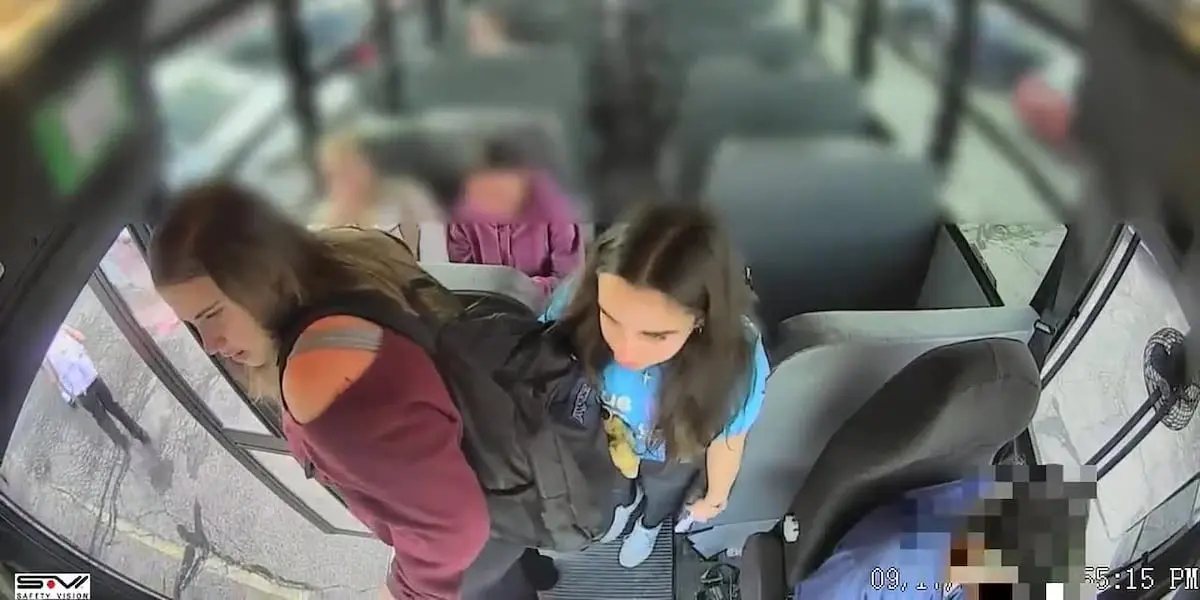
Onboard video captures the immediate transition from routine dismissal to high-stakes emergency. As the bus began its uncontrolled roll, students at the front of the vehicle immediately recognized the anomaly.
Alexis Smith, a 10th-grade student seated near the front, observed the driver’s physical collapse and the concurrent movement of the bus. Moving with remarkable speed and bypassing the barrier separating the passenger cabin from the driver’s cockpit, Smith reached the control console.
Smith performed three critical actions in rapid succession:
- Securing the Vehicle: She located and depressed the brake pedal, bringing the rolling vehicle to a complete and safe halt, thereby preventing collision with external structures or injury to the departing students.
- Initiating Emergency Comms: Understanding that localized physical control was only the first step, she located the bus’s two-way radio system. She keyed the microphone, contacted the school district’s transportation dispatch center, clearly reported the driver’s medical emergency, and requested immediate dispatch of emergency medical services (EMS).
- First-Aid Triage: While awaiting professional medical intervention, Smith monitored the driver’s condition. She checked for a radial pulse and assessed the driver’s respiration rate, maintaining a continuous feedback loop of information for when paramedics arrived on the scene.
Other students assisted by securing the interior of the bus, comforting younger passengers, and ensuring that the emergency exit pathways remained clear for arriving medical personnel.
Supporting Context & Metrics
To fully appreciate the gravity of the Hollidaysburg incident, it is necessary to examine the broader operational and statistical landscape of school pupil transportation in the United States.
The Scale of School Transportation
According to data from the National Highway Traffic Safety Administration (NHTSA) and the National Association of State Directors of Pupil Transportation Services (NASDPTS), school buses represent the largest mass transit system in the country.
| Metric | National Estimate (Annual) |
|---|---|
| Total Registered School Buses | ~480,000 |
| Students Transported Daily | ~26 Million |
| Total Annual Miles Driven | >4.3 Billion |
Despite their size and the lack of traditional safety restraints (like three-point seatbelts in older models), school buses remain statistically the safest mode of ground transportation for children, primarily due to their structural compartmentalization and high visibility. However, when an incident does occur due to driver incapacitation, the potential kinetic energy of a 10-to-15-ton vehicle poses extreme risks.
The Demographics and Health of the Driver Workforce
The Hollidaysburg incident highlights an escalating concern within the pupil transportation sector: the aging demographic of school bus drivers and the broader national driver shortage.
National School Bus Driver Shortage
       │
       ├─► Increased reliance on retired/older demographic cohorts
       ├─► Extended shift lengths and split-shift fatigue
       └─► Heightened pressure on medical examiners to clear drivers
Due to compensation structures and split-shift scheduling, school districts nationwide heavily rely on retired individuals or older demographics to fill driver vacancies. According to industry surveys:
- Over 60% of active school bus drivers in the United States are over the age of 55.
- Approximately 25% are over the age of 65.
While federal and state laws—specifically the Federal Motor Carrier Safety Administration (FMCSA) and state departments of transportation—require commercial driver’s license (CDL) holders to undergo regular medical examinations (typically every one to two years), acute medical events such as cardiac arrhythmias, strokes, or sudden diabetic anomalies can occur without warning, bypassing even stringent diagnostic screenings.
Official Statements
The response from the Hollidaysburg Area School District and the broader Blair County community was immediate, focusing on public commendation of the students and an internal review of safety protocols.
In a formal statement published via the district’s official communication channels, school administrators lauded the actions of Alexis Smith and her peers:
"The Hollidaysburg Area School District extends its deepest gratitude and admiration to the students who intervened during this frightening incident. Tenth-grader Alexis Smith demonstrated exemplary courage, presence of mind, and leadership under extreme pressure. By taking immediate action to secure the vehicle, coordinate with dispatch, and care for the driver, Alexis prevented what could have been a major tragedy. Our students’ actions embody the highest standards of citizenship and community care."
Local emergency medical personnel also praised the quality of the initial triage performed by the students. A representative from the responding emergency services department noted:
"In a medical emergency where seconds count, having accurate information prior to arrival is invaluable. The fact that a high school student had the composure to check vitals and communicate clearly via dispatch radio significantly streamlined our initial assessment and treatment protocol upon arrival."
The school district confirmed that the driver was transported to a regional medical facility for treatment. Out of respect for privacy and compliance with federal health information regulations (HIPAA), specific details regarding the driver’s medical diagnosis and recovery status have not been publicly disclosed.
Future Outlook and Policy Implications
The successful resolution of the Hollidaysburg incident provides a blueprint for emergency response, but it also raises critical questions regarding proactive safety measures in student transportation.
Future Safety Frameworks
       │
       ├─► Student Empowerment (Integration of basic bus safety in standard drills)
       ├─► Technological Redundancies (Driver monitoring, AEB, lane-keep assist)
       └─► Policy Reform (Stricter cardiovascular screenings for CDL holders)
1. Student Emergency Preparedness Integration
Historically, school bus evacuation drills have focused almost exclusively on exiting the vehicle through rear and side emergency doors in the event of a fire or collision. The Hollidaysburg event suggests that districts should consider expanding these curricula to include:
- Cockpit Familiarization: Teaching older students how to engage the emergency brake (parking brake) and safely cut the engine.
- Communications Training: Instructing students on how to operate standard two-way radio systems to contact central dispatch.
- Basic Triage: Encouraging age-appropriate first-aid and CPR training within secondary school physical education curriculums.
2. Technological Redundancies
As school districts update their fleets, the integration of Advanced Driver Assistance Systems (ADAS) is becoming a focal point of capital improvement budgets. Technologies under consideration include:
- Driver Monitoring Systems (DMS): Infrared camera systems mounted on the dashboard that monitor the driver’s eye gaze and facial positioning, sounding an alert and activating hazard lights if the driver falls asleep or loses consciousness.
- Automatic Emergency Braking (AEB): Sensor-driven braking systems that automatically bring the vehicle to a halt if an impending collision is detected and the driver fails to apply the brakes.
- Remote Fleet Stop: Telematics systems that allow dispatch centers to safely disable or slow down a vehicle remotely in the event of an uncommunicative operator.
3. Regulatory and Medical Oversight Reform
The incident may prompt legislative discussions regarding the frequency and depth of medical evaluations for school transport personnel. While the current system requires standard DOT physicals, some safety advocates argue for mandatory cardiovascular screenings, such as stress tests or electrocardiograms (ECGs), for drivers over a certain age who are tasked with transporting school-aged children.
Ultimately, the events in Hollidaysburg, Pennsylvania, serve as a powerful reminder of the resilience and capability of young citizens when confronted with sudden adversity. The decisive actions of Alexis Smith and her classmates have set a benchmark for civic responsibility, transforming a potential tragedy into an inspiring case study of community-driven emergency response.

0 Comments