
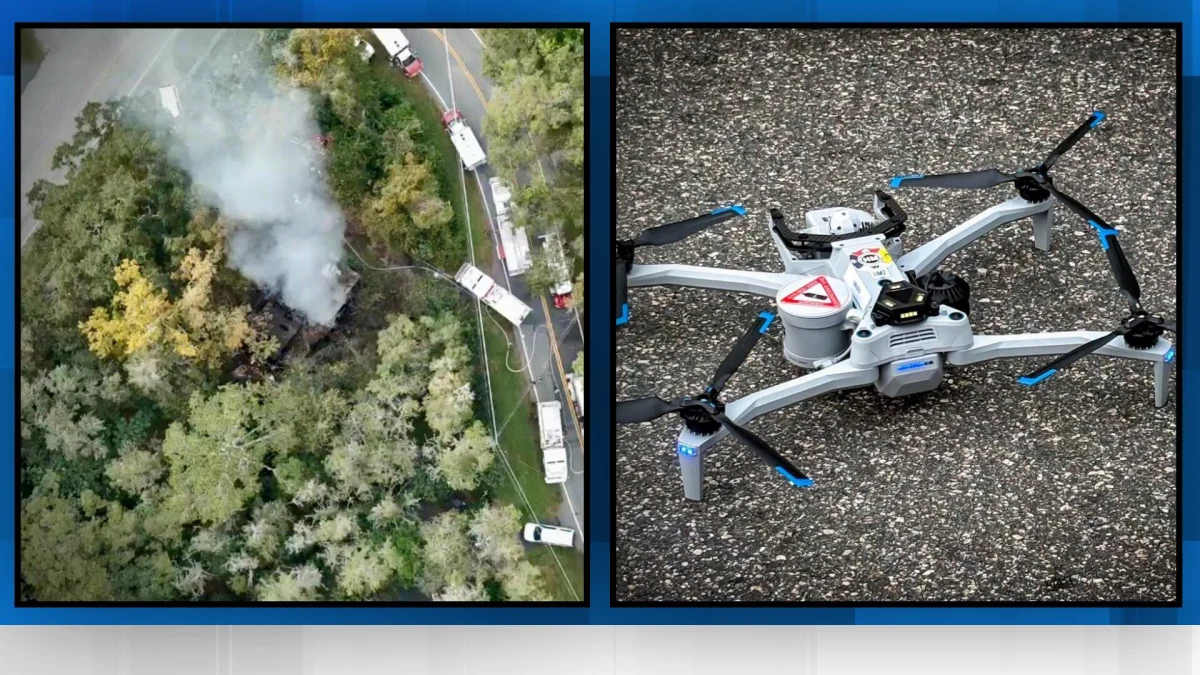

OCALA, Fla. — In an era where technological innovation continually reshapes public safety and emergency management, the integration of unmanned aerial systems (UAS)—commonly known as drones—has transitioned from a futuristic luxury to an indispensable tactical tool. On a Saturday afternoon in Marion County, this technological leap proved its worth during a high-stakes residential structure fire.
Swift intervention by Marion County Fire Rescue (MCFR), combined with the strategic deployment of thermal-imaging-equipped aerial drones, allowed first responders to quickly locate, contain, and neutralize a hazardous house fire on Southwest 27th Avenue. Despite significant challenges—including heavy smoke, structural compromise risks, and a complete absence of municipal water infrastructure—crews brought the incident under control in a remarkably compressed timeframe, with zero reported injuries.
Executive Overview
The incident unfolded on a typical Saturday afternoon in the quiet residential neighborhoods of southwest Ocala, testing the preparedness, tactical flexibility, and technological capabilities of local emergency services.
- Incident Type: Residential Structure Fire
- Location: Vicinity of Southwest 27th Avenue and Southwest 87th Place, Ocala, Florida
- Responding Agency: Marion County Fire Rescue (MCFR)
- Initial Dispatch / Arrival Time: First unit on scene at 3:30 p.m. EDT
- Fire Control Achieved: 3:46 p.m. EDT (Duration of active firefighting: approximately 16 minutes)
- Casualties: Zero (0 injuries to civilians or emergency personnel)
- Key Tactical Assets: Multiple engine hose lines, water tenders (tankers), and a tactical reconnaissance drone.
- Current Status: Cause of the fire remains under active investigation by local fire marshals.
What could have easily spiraling into a catastrophic total loss of property was instead mitigated by a textbook exercise in modern firefighting. This report provides a comprehensive examination of the event, breaking down the operational timeline, the logistical hurdles overcome by MCFR, the evolving role of drone technology in modern firefighting, and the broader implications for suburban fire safety in Marion County.
Detailed Chronology of Events
Understanding the rapid escalation and subsequent mitigation of the Southwest 27th Avenue fire requires a granular look at the timeline. Every second counts when a residential structure becomes engulfed in combustible gases and superheated smoke.
Pre-Arrival and Initial Dispatch (Pre-3:30 p.m.)
While exact dispatch call times vary in preliminary logs, MCFR communications hubs received reports of heavy smoke billowing from a residential property near the intersection of Southwest 27th Avenue and Southwest 87th Place. Multiple engines and rescue units were immediately dispatched to the scene, anticipating a working structure fire based on caller descriptions of dark, thick smoke emerging from the eaves and roofline of the home.
The Critical First Minutes: 3:30 p.m. – 3:35 p.m.
At precisely 3:30 p.m., the first primary MCFR unit arrived at the address. First-due company officers immediately established command and conducted a rapid 360-degree size-up of the property.
The conditions upon arrival were challenging:
- Visibility: Severely hampered by heavy, billowing black and gray smoke rolling from the structure’s primary living areas.
- Structural Integrity: Unstable roof trusses and hidden interior involvement suspected.
- Water Supply Deficit: A reconnaissance check revealed an immediate logistical obstacle—the residential neighborhood lacked municipal fire hydrants, forcing crews to rely entirely on mobile water carriage systems (tenders/tankers).
Recognizing the potential for rapid fire spread, command ordered the deployment of multiple hose lines for an aggressive interior attack while simultaneously setting up external supply lines.
Tactical Deployment and Aerial Reconnaissance: 3:35 p.m. – 3:45 p.m.
As interior crews advanced with hoselines, incident command authorized the deployment of a tactical drone. Operating an unmanned aerial vehicle (UAS) over a fireground offers an entirely different perspective than traditional ground observations.
While firefighters pushed through toxic smoke inside the structure, the drone operator flew the aircraft above the roofline to scan the structure for thermal anomalies. Using high-definition and infrared thermal-imaging cameras, the drone operator scanned the roof structure and exterior walls, pinpointing hidden hotspots where flames were actively eating away at structural cavities behind the drywall and siding.
This real-time intelligence was immediately radioed down to interior teams, allowing them to direct water streams precisely where they were most needed, bypassing the trial-and-error phase typical of traditional overhaul operations.
Resolution and Knockdown: 3:46 p.m.
Thanks to the coordinated efforts of ground crews and the aerial asset overhead, MCFR officials confirmed that the fire was officially under control by 3:46 p.m.—just 16 minutes after the first unit rolled onto the scene.
With the primary fire extinguished, crews transitioned from offensive attack to overhaul operations: pulling ceilings, checking attic spaces for extension, and verifying via thermal imaging that no embers remained hidden within the structural framework.
Supporting Context & Operational Metrics
Every firefighting operation operates within a matrix of environmental, infrastructural, and technological constraints. The Ocala incident highlights several key themes in modern suburban emergency response.
The Water Supply Dilemma in Suburban Pockets
One of the most critical challenges highlighted in MCFR’s initial report was the absence of nearby fire hydrants. In many rapidly developing suburban and semi-rural regions across Marion County, residential infrastructure does not always include high-capacity municipal water mains.
When hydrants are absent, firefighters must utilize alternative water supply (AWS) strategies:
- Water Tenders (Tankers): Heavy trucks carrying thousands of gallons of water directly to the scene.
- Portable Drop Tanks: Collapsible pools set up on roadways into which tenders dump their water, allowing primary engine companies to draft a continuous supply.
- Mutual Aid Tanker Shuttles: In larger incidents, neighboring districts dispatch additional tankers to ensure an unbroken chain of water supply.
In this instance, the rapid knockdown meant that heavy-duty tanker shuttle operations were bypassed or minimized, as initial onboard water reserves from the responding engines, combined with rapid interior containment, successfully drowned the seat of the fire before it could breach the home’s primary structural envelope.
The Evolution of Fireground Technology: Drones in Action
The deployment of drones by Marion County Fire Rescue underscores a nationwide shift in emergency services. Once restricted to police tactical units and search-and-rescue teams, drones are increasingly becoming standard equipment for progressive fire departments.
[Traditional Fireground]                 [Modern Fireground with UAS]
   - Ground-level visibility only           - 360-degree aerial perspective
   - Blind spots in attics/roofs            - Thermal imaging for hidden hotspots
   - High risk for roof collapse            - Early structural instability warnings
   - Reactive overhaul                      - Proactive, precision targeting
Key advantages demonstrated during the Ocala incident include:
- Thermal Hotspot Detection: Ordinary smoke obscures fire paths, but infrared sensors see through haze and smoke to detect intense heat signatures inside walls and roofing materials.
- Structural Safety: Rather than sending firefighters onto a potentially compromised roof to check for extension, an aerial drone can inspect roof integrity from above, minimizing firefighter exposure to collapse hazards.
- Incident Documentation and Command Overview: Incident commanders can view a live feed of the entire fireground on a tablet or command-vehicle monitor, optimizing resource allocation and preventing the duplication of efforts.
Official Statements and Inter-Agency Perspectives
While formal, long-form press releases are often concise, public information officers and department leadership have continually emphasized the importance of advanced training and modern tools in keeping Marion County safe.
In statements released following the emergency response, Marion County Fire Rescue representatives underscored the professionalism and agility of the personnel on duty.
"Our units responded with the utmost urgency, addressing not only the active fire conditions within the home but also navigating infrastructure challenges like the lack of nearby hydrants. The utilization of our aerial drone program allowed command staff to visualize the fire’s behavior in real-time, ensuring our crews worked smarter, safer, and faster to bring this incident to a successful conclusion."
— MCFR Public Information Operations
Fire safety advocates and technical analysts across Florida have also pointed to this specific incident as a model for suburban fire defense. Without a municipal water grid to lean on, the margin for error is razor-thin. A delay of even five to ten minutes could have allowed the fire to transition from a room-and-contents fire to a fully involved structural inferno, threatening adjacent properties in the neighborhood.
Future Outlook: The Road Ahead
As Ocala and greater Marion County continue to experience rapid population growth and residential expansion, emergency services face mounting pressures to maintain rapid response times and high-level service delivery across sprawling geographic footprints.
1. Expanding the Drone Program
Following the successful application of drone technology on Southwest 27th Avenue, expectations are high that MCFR will continue to scale up its unmanned aerial program. Future goals for such programs across fire services typically include:
- Equipping more front-line units with compact, deployable drones.
- Enhancing night-vision and thermal-imaging capabilities for nocturnal operations.
- Training a larger percentage of shift personnel as Federal Aviation Administration (FAA) Part 107 certified drone pilots.
2. Infrastructure and Water Supply Planning
While mobile water tenders remain a reliable stopgap, long-term urban planning in Marion County must grapple with the water supply deficit in outlying residential areas. As new subdivisions are approved, county commissioners and fire marshals will continue pushing for mandatory infrastructure investments—such as dedicated fire cisterns, commercial-grade water mains, and boosted hydrant coverage—to ensure that future residents enjoy the same level of fire protection found in urban cores.
3. Ongoing Investigation and Public Safety Reminders
As of this writing, the cause of the fire remains under active investigation by the Marion County Fire Rescue Bureau of Fire Prevention. Investigators are analyzing burn patterns, electrical systems, and potential appliance malfunctions to determine the exact origin of the blaze.
In the wake of this incident, local fire officials take the opportunity to remind all residents of basic home fire safety protocols:
- Smoke Alarms Save Lives: Ensure that smoke detectors are installed inside every sleeping room, outside sleeping areas, and on every level of the home, including the basement. Test them monthly.
- Create an Escape Plan: Every household should have a designated family meeting place outside and practice fire drills twice a year.
- Clear Defensible Space: Keep brush, dead leaves, and combustible materials cleared away from the exterior walls of residential structures to prevent exterior fires from jumping to the home.
Conclusion
The house fire on Southwest 27th Avenue in Ocala serves as a masterclass in modern emergency response. Confronted with thick smoke, potential structural collapse, and the distinct disadvantage of operating without a nearby water hydrant, Marion County Fire Rescue leveraged rigorous tactical training, rapid resource deployment, and cutting-edge drone technology to achieve the best possible outcome.
With zero injuries and the fire contained in under twenty minutes, this incident highlights the dedication of MCFR personnel and illustrates how technology can amplify human expertise in the relentless pursuit of public safety.

0 Comments