

Executive Overview
Through the opening month of the college football season, the narrative surrounding the Florida State Seminoles was defined by defensive fragility, blown assignments, and an alarming inability to control the line of scrimmage. Just two weeks prior, defensive coordinator Tony White found himself in an extraordinary position after a narrow victory over Central Arkansas: publicly apologizing to his own offense for a lethargic, porous front-seven performance that squandered time of possession and left the unit exhausted. Through four weeks, the Seminoles’ defensive front looked like the team’s glaring Achilles’ heel, unable to stop the run or generate consistent pressure.
Yet, college football is a sport capable of abrupt, violent shifts in momentum.
In what easily stands as the most thorough, dominant defensive masterclass of the Tony White era—spanning a 17-game window—Florida State completely dismantled the Virginia Cavaliers on Saturday afternoon. Holding UVA to a meager 7 points, 2.8 yards per play, and a dismal 3-of-19 conversion rate on money downs, the Seminoles authored a defensive blueprint for the rest of their campaign. Sparked by a massive structural adjustment in personnel, a historic 10-sack performance, and a renewed sense of fundamental discipline, FSU transformed from a defensive liability into an absolute unit.
While legitimate questions remain regarding the unit’s long-term depth and whether this performance can be replicated against higher-caliber offenses like Louisville, Saturday afternoon proved that the ceiling of this Florida State team is exponentially higher than previously imagined. This is the story of how the Seminoles rediscovered their defensive teeth, engineered a stunning tactical turnaround, and restored belief in Tallahassee.
Detailed Chronology: The Road from Tuscaloosa to Tallahassee
The Breaking Point: The Crimson Tide and Central Arkansas Struggles
To fully grasp the magnitude of Saturday’s defensive renaissance, one must examine the depths to which the unit had fallen just a fortnight prior.
Playing on the road against powerhouse Alabama, the Seminoles found themselves within striking distance midway through the fourth quarter, trailing 43-36. The Crimson Tide were backed up deep in their own territory on the 10-yard line. A single defensive stop would have given FSU’s offense a golden, improbable window to pull off an iconic upset. Instead, Alabama methodically chewed up the turf, executing a demoralizing 9-play, 90-yard touchdown drive where 80 yards came entirely on the ground. The resistance cracked under the physical weight of the SEC powerhouse, signaling that FSU’s front seven lacked the muscle to close out elite games.
If the Alabama collapse exposed structural limitations, the subsequent game against Central Arkansas exposed a troubling lack of intensity. Central Arkansas dominated the tempo, controlling the ball for an astonishing 40 minutes and running 75 plays against an exhausted FSU defense. Even though Florida State escaped with a victory, the defensive performance was so listless and uninspired that Tony White took the rare and humbling step of apologizing to the offensive coaching staff in the post-game media session. White lamented that his unit had failed to get off the field, thereby starving the FSU offense of vital opportunities.
By all metrics, the defensive trajectory was plummeting. Analysts and fans alike began writing off the front seven as the weakest link on an otherwise competitive roster.
Saturday’s Awakening: Mauled in Tallahassee
No one could have predicted the sheer violence of the turnaround that unfolded on Saturday. From the opening whistle, Florida State’s defense played with a relentless, suffocating fury that caught Virginia completely off guard.
After allowing a touchdown on their second possession, the Seminoles slammed the door shut, locking down the Cavaliers for the final 49 minutes of the contest. Virginia’s offense flatlined under the pressure. The Cavaliers stumbled through four separate drives that finished with negative yardage and sputtered out on five distinct three-and-outs.
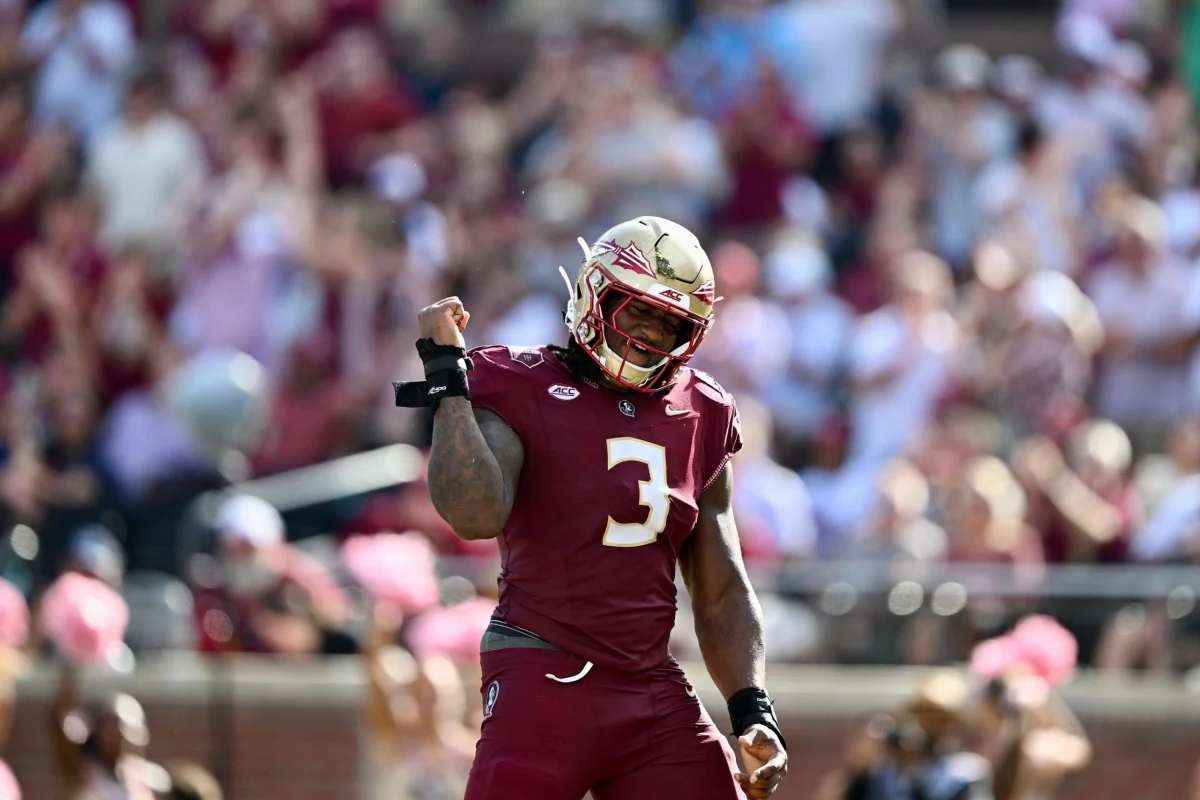
FSU’s defensive execution was anchored by an absolute annihilation of Virginia’s veteran offensive line. The Seminoles lived in the Cavalier backfield, harassing the quarterback into a staggering 10 sacks—the highest single-game sack output by a Florida State defense since 1989. Nine different players etched their names into the game book with at least one sack, led dynamically by edge rusher Rylan Kennedy, who accounted for two.
When the dust settled, the box score screamed absolute dominance: 12 tackles for loss. To put that in perspective, FSU entered the contest with just 24 tackles for loss total across their first four games of the season. Against a UVA offense that had not scored fewer than 27 points in any game prior to Saturday, the Seminoles pitched a masterpiece of modern defensive football.
Supporting Context & Metrics: Anatomy of a Defensive Masterclass
The Personnel Pivot: Embracing Size and Strength
The dramatic statistical leap was not merely a byproduct of emotional motivation; it was rooted in a critical schematic and personnel evolution orchestrated by Tony White and his defensive staff.
In the early weeks of the season, the Seminoles stubbornly attempted to deploy smaller, more athletic interior defensive linemen. The experiment failed miserably. FSU was repeatedly gashed between the tackles as opponents exploited their lack of anchor strength.
Recognizing this fatal flaw, White made the pivotal decision to hand a maiden career start to sophomore nose tackle Kevin Wynn. Tipping the scales at an imposing 317 pounds, Wynn provided the immovable mass FSU desperately needed in the interior. Replacing the lighter, 270-to-280-pound "tweener" linemen who had struggled to hold ground, Wynn completely altered the physics of the line of scrimmage.
Wynn made the most of his breakthrough opportunity, registering three tackles, one sack, and a tackle for loss while systematically blowing up Virginia’s interior blocking schemes. By swallowing up the opponent’s rushing lanes, Wynn freed up the rest of the front seven and second-level defenders to attack the backfield with impunity. Head coach Mike Norvell later praised White’s adaptability, noting how the defensive coordinator recognized the need to modify the game plan to fit the strengths of his personnel against a seasoned offensive line.
Tightening the Rotation and Snapping Pts
Beyond the defensive line, White streamlined his defensive philosophy by tightening his rotation and relying heavily on his most reliable playmakers. FSU opted to ride the "hot hand," leaning on core personnel who logged heavy snap counts to maintain continuity and rhythm on the field.
Linebackers Chris Jones and Mikai Gbayor each logged upwards of 40 snaps—driven partly by positional injuries, but cemented by their high-impact execution. The duo tied for the team lead with six tackles apiece while combining for 2.5 sacks and 2.5 tackles for loss.
In the secondary, safeties Quindarrius Jones and Ja’Bril Rawls anchored the back end, playing over 50 snaps each. Both defensive backs earned elite tackling grades above 75.0 from Pro Football Focus (PFF), demonstrating relentless physicality in run support while completely blanketing Virginia’s passing game. In total, nine FSU defenders played 40 or more snaps, and 14 crossed the 30-snap threshold.
While critics may point out that this heavy reliance on starters could introduce depth concerns later in the grueling ACC schedule, on this particular afternoon, White’s strategy was nothing short of brilliant. The unit operated with cohesive synchronization, displaying what Norvell described as a "four-seam unit"—where defensive linemen, linebackers, and safeties attacked in concert rather than isolation.
Official Statements: Inside the Locker Room
The post-game press conference in Tallahassee was marked by a palpable sense of relief, validation, and cautious optimism. Head coach Mike Norvell addressed the media with clear pride regarding how his team responded to adversity.
"I believe this can be a really good and dominant football team," Norvell stated firmly to the local media. "I thought our defense came out today with an attitude and a mentality. Tony (White) and his staff did a great job putting guys in position. The message of the week was go do your job. We went into today with 11 guys out there—offense, defense, special teams—everyone of us will do our job. Our staff, everybody focused on their responsibility. We thought some great things could occur, and they did that."
Norvell did not shy away from crediting his defensive coordinator’s tactical flexibility, acknowledging the difficult adjustments required after a rocky start to the campaign.
"I thought Tony did a really nice job of adapting the plan, as he’s continuing to be around this team and this defensive front," Norvell added. "I thought some guys definitely grew up. That was an experienced and good offensive line that they went against and definitely performed at an elite level."
The rhetoric from the coaching staff underscored a collective cultural reset. The messaging had shifted from damage control and apologies to mutual accountability and execution. For a defensive unit that had spent weeks absorbing heavy external criticism, Saturday’s performance provided the definitive proof of concept that White’s defensive scheme could work when executed with proper discipline and personnel alignment.
Future Outlook: Can FSU Sustain the Momentum?
As the dust settles on a historic defensive display, the Florida State coaching staff and fanbase must immediately confront two lingering, critical questions:
- Why did it take four weeks for this unit to unlock its potential?
- Can this elite level of play be sustained moving forward?
The answers remain shrouded in uncertainty. Florida State has notoriously struggled to build consistent week-to-week momentum over its last 29 games, often alternating brilliant tactical flashes with inexplicable regressions. Furthermore, the schedule offers no rest for the weary; the Seminoles must prepare to face a significantly more explosive and dynamic Louisville offense next week. Louisville will present entirely different stress points for FSU’s secondary and pass rush, testing whether Saturday’s pass-rush explosion was a permanent evolution or an outlier performance against a struggling UVA front.
Yet, for at least one weekend, Tony White and his defensive staff silenced their loudest critics. They constructed a simplified, aggressive game plan that minimized mental errors, allowed their athletes to play fast, and most importantly, trusted their heavy personnel to win the line of scrimmage.
If Kevin Wynn continues to anchor the interior, if Rylan Kennedy and the front-seven rotation can replicate even a fraction of Saturday’s disruptive pressure, and if the secondary maintains its sure-tackling discipline, Florida State’s season trajectory could look entirely different than it did after the Central Arkansas scare. The Seminoles proved they possess the raw talent and tactical capacity to dominate. Now, the true challenge begins: proving they can do it again.

0 Comments