

Executive Overview
In a legal move that could reshape the financial landscape of public higher education across the American South and Midwest, students and alumni of Lincoln University in Jefferson City, Missouri, have filed a landmark lawsuit against the state. The complaint alleges that Missouri has systematically underfunded the historically Black land-grant university (HBCU) for decades, directly violating federal mandates, devaluing the degrees of its graduates, and leaving the campus with millions of dollars in deferred maintenance and infrastructure decay.
The lawsuit, orchestrated by a newly formed advocacy group called the 1890 Project, marks the opening salvo in a coordinated legal campaign targeting more than a dozen states. The litigation is built on a foundation of federal data released in late 2023 by the Biden-Harris administration, which revealed that 16 states had collectively shortchanged their Black land-grant institutions by a staggering $12.6 billion over the last 30 years.
According to the lawsuit, Missouri is responsible for a $361 million funding deficit at Lincoln University between 1987 and 2020 alone. Plaintiffs argue that this systemic fiscal starvation has severely hampered the university’s competitive standing, leading to a sharp decline in enrollment, deteriorating campus facilities, and a persistent perception that its academic offerings are secondary to those of the state’s flagship institution, the University of Missouri in Columbia. As the first legal test of its kind under the 1890 Project’s specific land-grant strategy, the Missouri case represents a pivotal moment in the fight for educational equity, challenging states to reconcile their historical statutory obligations with their contemporary budget allocations.
Detailed Chronology
The Genesis of the Land-Grant System (1862)
To understand the legal mechanics of the lawsuit, one must look back to the mid-19th century. In 1862, amid the turmoil of the American Civil War, President Abraham Lincoln signed the First Morrill Act. Named after its sponsor, Senator Justin Smith Morrill of Vermont, the legislation granted federally controlled public lands to states. The states were to sell these lands and use the proceeds to fund and endow colleges focused on practical sciences, agriculture, and military tactics—a dramatic departure from the classical, theology-focused curricula of elite private universities of the era.
These new schools, which would become known as "1862 institutions," were designed to democratize higher education for the working class. However, in the post-Civil War era, particularly in former Confederate and border states, these institutions remained strictly segregated, closed to Black students who had been newly emancipated.
[1862 Morrill Act] ──> Public Lands Granted ──> Focus on Agriculture & Engineering (Segregated)
                                 │
                                 ▼
[1890 Morrill Act] ──> Dual System Mandated ──> States Must Integrate OR Fund Separate Black Land-Grants
                                 │
                                 ▼
                      [1890 Institutions (HBCUs)]
The 1890 Compromise and the Rise of Black Land-Grants
Recognizing that the 1862 Act had failed to benefit Black Americans, Senator Morrill introduced a second bill. Passed in 1890, the Second Morrill Act targeted the states that maintained segregated educational systems. The law issued an ultimatum: states must either open their existing land-grant universities to students of all races or establish separate, comparable land-grant institutions for Black students.
To comply with the law while maintaining racial segregation, 17 states—mostly in the South and along the border—established 18 separate land-grant institutions for Black students, today known collectively as the "1890 institutions." (Tuskegee University, a private institution, was later added to this group).
The Soldier-Founders of Lincoln University
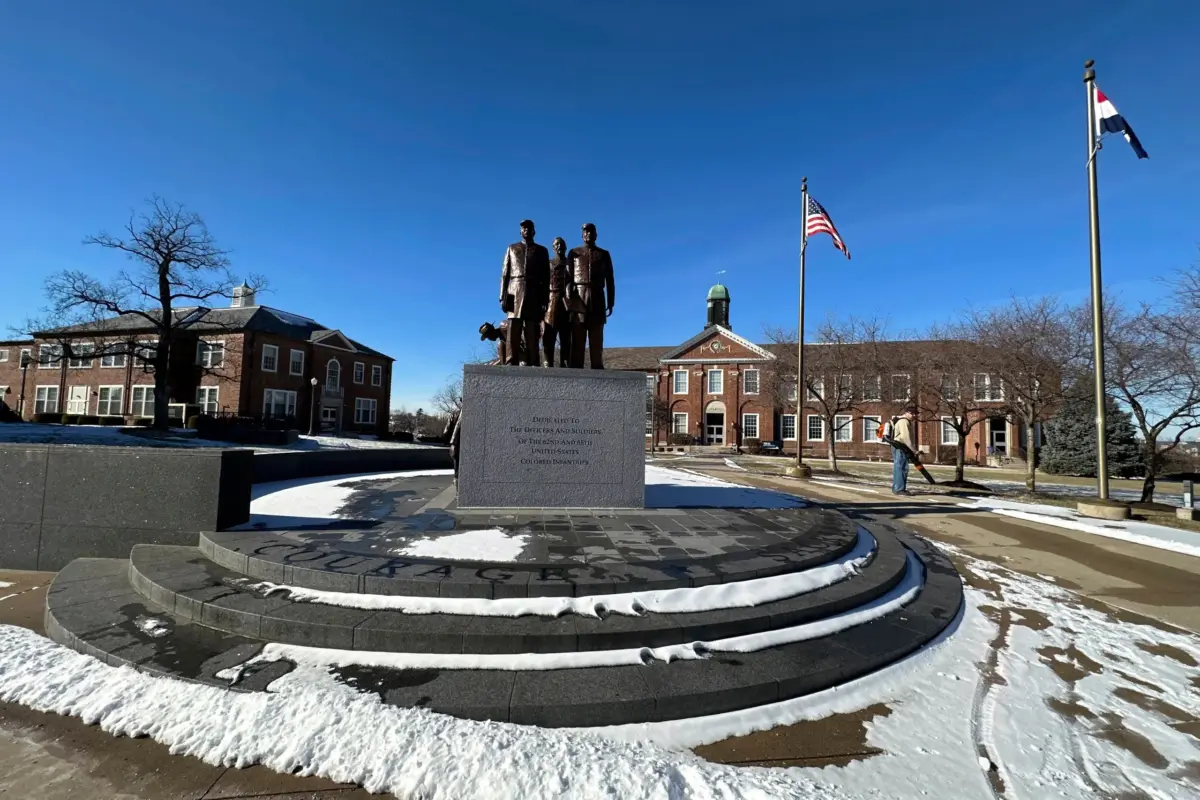
Missouri’s path to compliance was unique. Rather than building a brand-new institution from the ground up, the state looked to Lincoln Institute, which had been founded in 1866 by the veterans of the 62nd and 65th United States Colored Infantries. At the end of the Civil War, these Black Union soldiers, many of whom had learned to read and write while in service, pooled their modest military wages—totaling more than $6,000—to establish an educational institution in Missouri dedicated to the advancement of freed slaves.
In 1890, Missouri designated Lincoln Institute as its land-grant school for Black students, officially bringing it under the state’s public higher education umbrella. In 1921, the school was renamed Lincoln University.
A Legacy of Divergent Paths
Despite their shared land-grant designation, the University of Missouri in Columbia (the state’s 1862 flagship) and Lincoln University in Jefferson City embarked on vastly different trajectories. While the state poured resources into Mizzou, transforming it into a massive research hub with tens of thousands of students, Lincoln University was relegated to a separate-and-unequal tier.
For over a century, the state legislature consistently prioritized the flagship campus, creating a structural funding disparity that survived long after the legal end of Jim Crow and continues to impact the university today.
Supporting Context & Metrics
The Mathematics of Disparity
The core of the legal dispute lies in how land-grant universities are funded. Under federal law, the United States Department of Agriculture (USDA) distributes agricultural research and extension funds to both 1862 and 1890 land-grant universities. Crucially, federal regulations require states to provide a one-to-one financial match of these federal appropriations.
If a state fails to provide the matching funds for its land-grant institutions, it must request a waiver from the federal government. For decades, states routinely matched—and often exceeded—the federal allocations for their traditional 1862 universities, while simultaneously requesting matching waivers for their 1890 Black institutions. This legislative arbitrage allowed states to secure federal funds for HBCUs without spending their own state tax revenues, resulting in a compounding deficit for the Black schools.
| Metric | Lincoln University (1890 HBCU) | University of Missouri (1862 Flagship) |
|---|---|---|
| Current Enrollment | ~2,200 students | ~32,000 students |
| Peak Enrollment (Modern) | ~3,400 (2011) | ~35,000 (2015) |
| State Funding Shortfall (1987-2020) | $361 Million | $0 (Fully Funded / Exceeded Match) |
The $12.6 Billion National Deficit
The systemic nature of this underfunding was laid bare in September 2023, when U.S. Education Secretary Miguel Cardona and Agriculture Secretary Tom Vilsack sent formal letters to the governors of 16 states. Relying on three decades of data compiled by the National Center for Education Statistics, the federal secretaries detailed exactly how much money each state had failed to match for its 1890 institutions relative to its 1862 counterparts.
The analysis revealed that only two states with dual land-grant systems—Delaware and Ohio—had funded their traditional and HBCU land-grant institutions equitably. In the remaining 16 states, the cumulative shortfall reached $12.6 billion. Tennessee State University topped the list of underfunded schools, missing out on an estimated $2.1 billion. Missouri’s Lincoln University was identified as having been shortchanged by $361,591,290 between 1987 and 2020.
HBCU Land-Grant Funding Deficits (1987-2020) by State (Selected):
┌──────────────────────────────┬────────────────────────┐
│ Tennessee (Tennessee State)  │ $2.1 Billion           │
├──────────────────────────────┼────────────────────────┤
│ North Carolina (N.C. A&T)    │ $2.0 Billion           │
├──────────────────────────────┼────────────────────────┤
│ Florida (FAMU)               │ $1.9 Billion           │
├──────────────────────────────┼────────────────────────┤
│ Missouri (Lincoln Univ.)     │ $361 Million           │
└──────────────────────────────┴────────────────────────┘
The Local Toll: Lincoln University by the Numbers
The direct consequences of this $361 million deficit are visible across Lincoln’s Jefferson City campus. Deferred maintenance has left historic academic buildings and residential halls in states of disrepair.
The financial strain has directly impacted recruitment and retention. Lincoln’s student enrollment has fallen to approximately 2,200 students, down from 3,400 in 2011. In contrast, the University of Missouri’s flagship campus in Columbia boasts an enrollment of roughly 32,000 students. While Mizzou operates with state-of-the-art laboratory spaces, robust endowment portfolios, and sprawling student services, Lincoln has had to fight for basic operational survival.
Official Statements and Legal Arguments
The Voice of the Plaintiffs
The plaintiffs in the lawsuit represent different generations of Lincoln University graduates, but their grievances are remarkably consistent.
Jeanneth Johnson, a 54-year-old Lincoln graduate now living in the Detroit suburb of Sterling Heights, Michigan, expressed deep frustration over the persistent racial inequities that continue to govern state resource allocation:
"It is very unfortunate that we still live in a climate where, depending on the color of one’s skin, one gets precedence over the other."
Another plaintiff, Herbert Kitchen, a retired California community college administrator, shares a profound personal connection to the school. His great-great-grandfather, Caleb Lindsey, was one of the very soldiers of the 62nd United States Colored Infantry who pooled their wages to found Lincoln Institute in 1866.
Kitchen, who attended Lincoln in the 1980s, recalled a campus plagued by physical neglect, remembering dormitories that frequently lacked heat and hot water. During his time as a student, rumors of the university’s potential closure were common, and he noted that some employers viewed his degree as "second rate" compared to those from predominantly white institutions (PWIs).
"I am the hope and dream that my great-grandfather had when he was a slave," Kitchen said, emphasizing that his legal fight is a continuation of his family’s multi-generational struggle for dignity and education.
The Strategy of the 1890 Project
Don Calloway, a former Missouri state representative and the leader of the 1890 Project, explained that the group’s legal strategy is highly focused. Unlike previous desegregation lawsuits that targeted broad, systemic inequities across all state colleges, this litigation focuses strictly on the statutory matching requirements governing 1890 land-grant schools.
       [Historical Desegregation Lawsuits]
                       │
                       ▼
          Broad Equal Protection Claims
          (Often difficult to quantify)
                       │
                       ▼
              [The 1890 Project]
                       │
                       ▼
       Targeted Land-Grant Statutory Claims
       (Based on clear, federal matching data)
In an interview, Calloway clarified that the plaintiffs are not demanding identical funding to larger flagship institutions, but rather fiscal parity based on federal funding formulas:
"We’re not saying they should be funded equally, but they should be funded on parity. And the feds funded Lincoln with the proper parity. The problem is that the state made an intentional choice not to match the federal appropriation. And that’s where Lincoln really was cheated."
Calloway directly linked the university’s declining enrollment and deferred maintenance to this deliberate withholding of state matches.
State and Institutional Silence
In response to the filing of the lawsuit, the targets of the litigation have remained silent. The University of Missouri system, which oversees the state’s flagship campus and holds significant political sway in the state capital, declined to comment.
Similarly, the office of Missouri’s governor issued a brief written statement indicating that they are unable to comment on active, pending litigation.
Future Outlook
The Next Battlegrounds
The lawsuit against Missouri is not an isolated legal action; it is the opening salvo of a broader, national strategy. Don Calloway and the 1890 Project have confirmed that they are actively in discussions with attorneys general, legal teams, and potential plaintiffs in several other states that were identified in the 2023 federal report.
Among the primary targets for future litigation are:
- Virginia (Virginia State University)
- Arkansas (University of Arkansas at Pine Bluff)
- Maryland (University of Maryland Eastern Shore)
- North Carolina (North Carolina A&T State University)
- Alabama (Alabama A&M University)
- Georgia (Fort Valley State University)
By taking a state-by-state approach, the 1890 Project aims to build a body of legal precedents that will force state legislatures to the negotiating table.
State-by-State Legal Strategy:
[Missouri Case (First Target)] ──> Establish Precedent ──> Expand to VA, AR, MD, NC, AL, GA
Precedents and Projections
The 1890 Project’s legal strategy is informed by previous, hard-fought legal battles over HBCU underfunding. The most notable precedent occurred in Maryland, where a coalition of HBCU advocates waged a 15-year legal battle against the state. That lawsuit, which argued that Maryland had duplicated HBCU programs at PWIs and systematically underfunded its Black institutions, culminated in a historic $577 million settlement in 2021.
However, while the Maryland lawsuit relied on broad constitutional arguments regarding the remnants of de jure segregation, the 1890 Project’s focus on statutory land-grant matching presents a more direct, mathematically quantifiable path to victory. By utilizing the state’s own historical budget records and matching waiver requests, the plaintiffs can present a clear ledger of debt owed to these institutions.
Reclaiming the Promise of 1890
If successful, the lawsuit against Missouri and subsequent actions in other states could trigger a massive redistribution of state educational funds. For Lincoln University, securing even a portion of the $361 million shortfall could fund a renaissance: upgrading research facilities, modernizing student housing, expanding agricultural extension programs, and lowering tuition barriers for low-income students.
Beyond the financial implications, the litigation seeks a fundamental correction of a historical wrong. By forcing states to honor the promises of the Second Morrill Act of 1890, the descendants of the soldier-founders of Lincoln University hope to finally secure the equity, respect, and institutional stability that their ancestors fought and paid for over 150 years ago.

0 Comments