LADSON, S.C. — In a case that has horrified the South Carolina Lowcountry and drawn national scrutiny, local authorities have released chilling body camera footage capturing the final weeks inside a Ladson-area home where two young sisters were ultimately found starved to death. Emory Deacon, 2, and her 15-month-old sister, Harlow Deacon, were discovered deceased inside their Pinewood Drive residence on September 29, 2026, during a welfare check conducted by the Charleston County Sheriff’s Office.
Forensic investigations indicate that the toddlers had perished three to five days prior to being found. Their mother, Justine May, now sits behind bars, facing multiple felony charges, including two counts of homicide by child abuse.
The newly unsealed video records from the Charleston County Sheriff’s Office provide a haunting, unprecedented look at the interior of the home and the interactions between law enforcement, child welfare caseworkers, and May weeks before the tragedy unfolded. What emerges from the footage is a deeply unsettling juxtaposition: a seemingly orderly household masking mounting familial distress, escalating mental health concerns, and repeated missed opportunities by external agencies to intervene before the situation escalated to fatal neglect.
As investigators piece together the timeline, the community, family members, and advocacy groups are left grappling with profound questions regarding systemic failures, child protective oversight, and the warning signs that preceded the unimaginable loss of two innocent lives.
Detailed Chronology of Events
To understand the cascading failures that culminated in the deaths of Emory and Harlow Deacon, investigators have established a rigorous timeline tracking the family’s final months, the breakdown of relationships, and the mounting interventions by law enforcement and concerned relatives.
Early August 2026: The Family Fractures
The trajectory of the household shifted dramatically in early August 2026, when Justine May and Zachary Deacon—the children’s father—ended their eight-year relationship. The couple had been engaged for five years, building a life together in the Ladson community. Following the separation, the domestic dynamic rapidly deteriorated. According to subsequent statements from law enforcement and family members, Zachary Deacon grew increasingly alarmed by May’s erratic behavior, her social isolation, and what he perceived as a growing inability to adequately care for Emory and Harlow.
Prompted by these escalating fears, Deacon initiated multiple requests for welfare checks, urging local authorities to evaluate the safety and well-being of his young daughters inside the Pinewood Drive home.
August 30, 2026: The Initial Law Enforcement Visit
Nearly a month before the children were discovered dead, Charleston County deputies, accompanied by a child welfare caseworker, responded to the Pinewood Drive residence for a scheduled welfare check.
The resulting 22-minute body camera recording provides the most detailed visual record of the household prior to the tragedy. The footage begins with May answering the front door while holding 15-month-old Harlow, who is dressed only in a diaper. Inside, the home appears deceptively well-maintained: music plays softly from a kitchen speaker, and a family dog barks in the background.
As deputies converse with May, Harlow is placed on the floor, where she begins crawling, while two-year-old Emory sits quietly on a living room couch. The majority of the 22-minute conversation centers not on immediate physical abuse, but on the bitter fallout between May and Zachary Deacon. A caseworker is visible throughout the encounter, diligently taking notes while observing the children interact within the home environment. Ultimately, deputies left the premises without removing the children, determining that immediate emergency intervention criteria had not been met at that specific moment.
September 12, 2026: The Mobile Crisis Unit Response
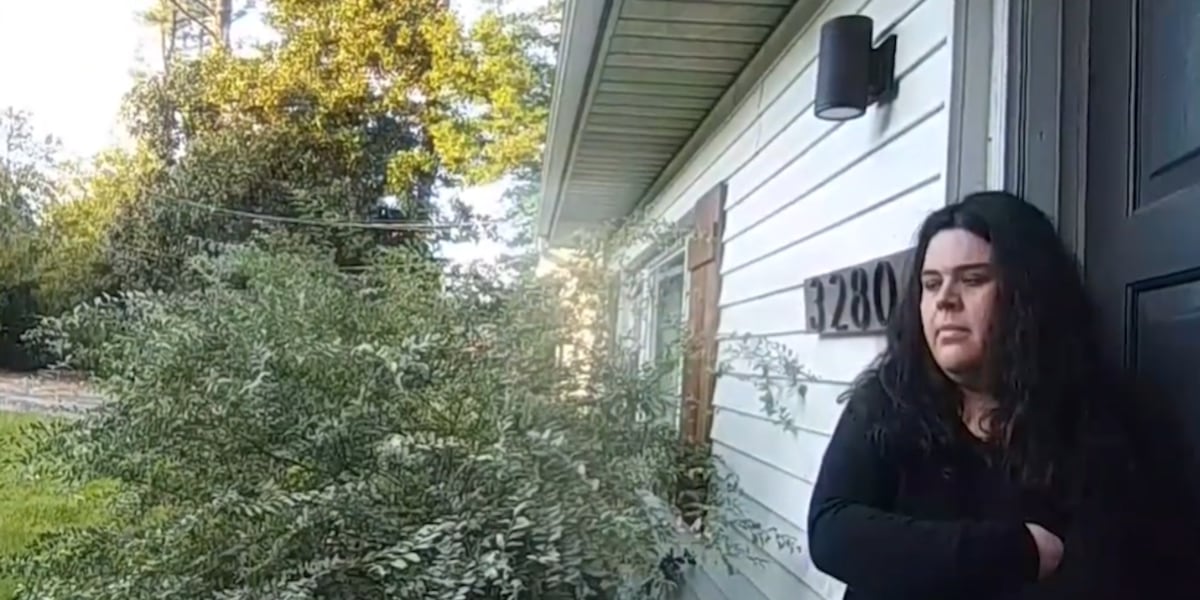
Just under two weeks later, on September 12, the situation deteriorated further. A mobile crisis unit, accompanied by law enforcement, returned to the Pinewood Drive home following fresh concerns raised by family members—specifically May’s parents, who had begun expressing acute panic over her mental stability and the welfare of the children.
In this bodycam footage, the interaction takes place almost entirely at the home’s front threshold. Dogs bark incessantly in the background, punctuated by faint sounds of children playing inside. When May answers the door, she immediately adopts a defensive posture, asking authorities, “How may I help you?” and firmly asserting that no one would be permitted to enter the residence.
When questioned about her mental state, May denies experiencing suicidal ideation, hallucinations, or visual disturbances, though she freely admits to profound frustration.
*"My family has been taunting the *** out of me," May tells authorities on the video, visibly agitated. She accuses Zachary Deacon of propagating "crazy lies" intended to paint her as having a mental breakdown. Furthermore, May explains that she has deliberately severed all contact with her own parents, characterizing their outreach as systematic "harassment." She references a particularly scathing email sent by her mother, describing it as "horrible."
Defending her psychological stability, May insists to the officers: "I’m clearly not crazy. And no, I’ve never had any mental health issues."
Despite her vehement denials, tensions outside the home continued to mount. In the days following this visit, May reportedly took to social media, publishing screenshots of text messages and emails from distressed family members who openly questioned her parenting abilities and mental health.
September 29, 2026: The Final Welfare Check
The tragic culmination of weeks of dread occurred on the afternoon of September 29. Authorities received a frantic 911 call requesting yet another emergency welfare check at the Pinewood Drive home. The caller—alarmed by a sudden, prolonged absence of the two young girls and deeply unsettled by May’s bizarre public demeanor—reported seeing the mother wandering aimlessly and alone through the neighborhood.
When Charleston County deputies arrived at the residence, they encountered a deeply distressed May exiting the front door, weeping uncontrollably and speaking incoherently.
Upon entering the home, deputies made the horrific discovery: two-year-old Emory and 15-month-old Harlow were found dead. Investigators later determined that the children had succumbed to severe starvation three to five days prior to that afternoon. Justine May was immediately taken into custody and subsequently charged with multiple felony counts, including two counts of homicide by child abuse.
Supporting Context & Metrics
The tragic deaths of Emory and Harlow Deacon have ignited an intense public examination of systemic child welfare protocols in South Carolina and nationwide. While comprehensive public health metrics regarding child fatalities from neglect often lag behind real-time events, the circumstances surrounding this case highlight several critical socio-environmental and institutional factors:
Frequency of Pre-Incident Contact: Records confirm that law enforcement and social services were dispatched to the Pinewood Drive residence on multiple occasions (at least twice officially documented via bodycam on August 30 and September 12) prior to the fatal September 29 discovery.
Vulnerability Metrics: Children under the age of three represent one of the demographic groups most vulnerable to fatal child abuse and severe neglect. According to national child welfare advocacy data, younger victims are disproportionately reliant on external reporters—such as estranged parents, extended family members, and neighbors—to initiate life-saving interventions.
The Intersect of Domestic Disputation and Neglect: Familial separations, particularly those marked by acrimony and disputed custody arrangements, frequently generate high-conflict calls to local law enforcement. Criminological studies emphasize the critical challenge faced by frontline responders: distinguishing between standard bitter custody disputes and genuine, escalating indicators of severe psychological distress and child endangerment.
Official Statements and Investigation Updates
In the wake of the arrests and the public release of the body camera archives, local officials have faced intense scrutiny regarding the adequacy of their initial responses.
The Charleston County Sheriff’s Office has maintained transparency by releasing the unedited bodycam footage to illustrate the precise nature of the interactions deputies had with May weeks before the tragedy. Spokespersons for the department have emphasized that every civil welfare call must navigate strict legal thresholds regarding home entry and the temporary protective custody of minors. In the August and September visits, law enforcement officials and caseworkers observed the children moving within the home and found insufficient immediate legal grounds to execute an emergency removal without a direct, observable threat to life or safety.
Legal analysts point out that the prosecution’s case will heavily rely on the forensic timelines established by medical examiners—specifically pinpointing the window of starvation—alongside digital evidence, text messages, and the newly released video footage demonstrating the progressive isolation of the children.
Justine May remains incarcerated as she awaits further court appearances. Her defense attorneys have not yet released comprehensive public statements regarding the specific legal strategies they intend to deploy against the homicide charges.
Future Outlook & Community Impact
As the legal proceedings against Justine May advance through the South Carolina judicial system, the Ladson community continues to mourn the senseless loss of Emory and Harlow. Improvised memorials, candlelight vigils, and expressions of profound grief have marked the neighborhood near Pinewood Drive.
Beyond the courtroom, the tragedy has catalyzed urgent policy discussions across the state:
Revisiting Inter-Agency Communication: Local leaders are calling for tighter protocols between municipal law enforcement agencies, mobile crisis mental health units, and the South Carolina Department of Social Services (DSS) to ensure that repeated red flags raised by estranged family members trigger multidisciplinary case reviews rather than isolated visits.
First Responder Training: Law enforcement training programs are increasingly emphasizing trauma-informed evaluations during domestic welfare checks, particularly when evaluating caregivers who exhibit signs of paranoia, severe stress, or social withdrawal.
Support Networks for High-Conflict Separations: Community advocates are pushing for dedicated diversion and intervention resources to support children caught in the crossfire of hostile parental breakups, ensuring that paternal or maternal warnings are subjected to rigorous, multi-agency follow-ups.
The deaths of Emory and Harlow Deacon serve as a grim, heartbreaking reminder of the fragility of young life and the heavy responsibility borne by communities to protect those who cannot speak for themselves. As the trial approaches, the pursuit of justice remains intertwined with the collective hope that systemic reforms will prevent similar tragedies from ever recurring in the Lowcountry.




0 Comments