
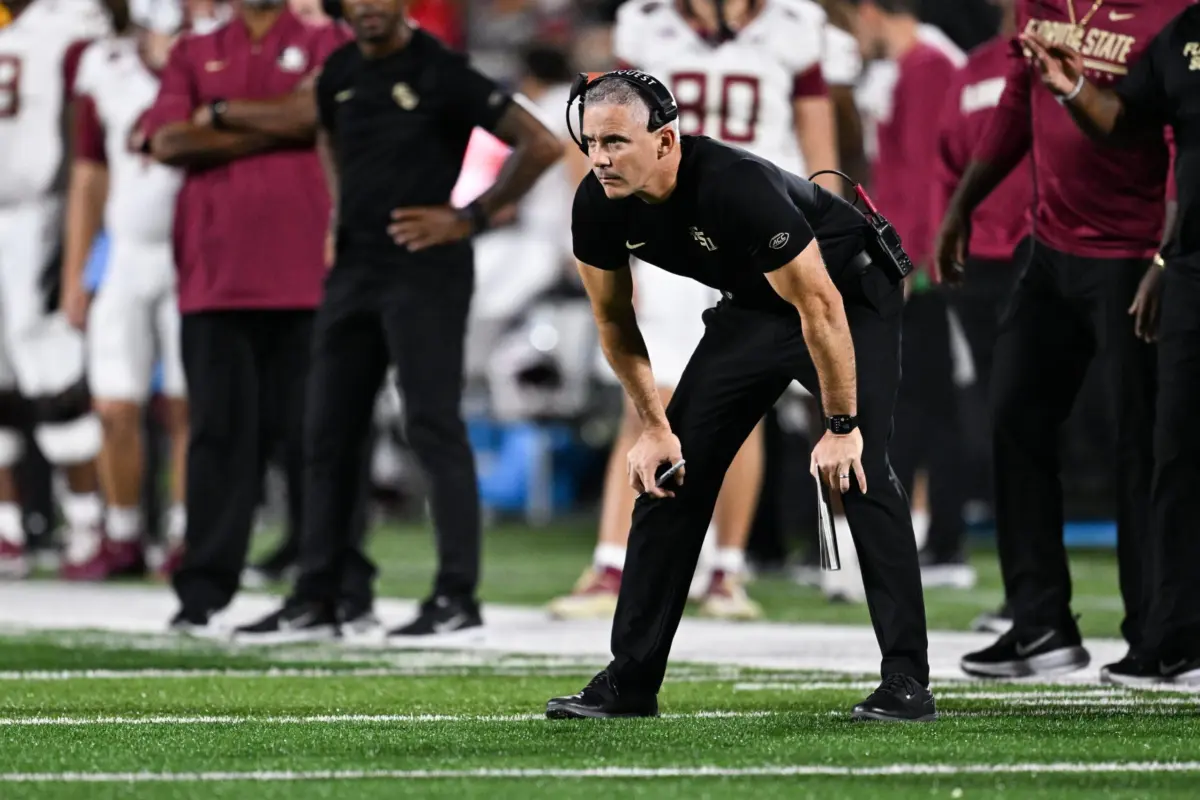

Executive Overview
For the first fifteen minutes of Friday night’s matchup against the Louisville Cardinals, Florida State football looked every bit like a program dictating its own destiny. Head coach Mike Norvell had scripted a tactical masterpiece, utilizing a heavy ground game and precise play-calling to march down the field at will. The Seminoles commanded a 14-0 lead, stifled Louisville’s early offensive momentum, and stood on the precipice of delivering a knockout blow on the road.
Then came the turning point—a sequence that has become all too familiar during the unraveling of Norvell’s tenure.
Instead of seizing total control with a 17-0 advantage on a crucial third-and-goal from the two-yard line, FSU’s play-calling grew overly ambitious. A slow-developing, play-action pass was easily diagnosed and snuffed out by the Cardinals’ defense. What followed was not merely a missed opportunity, but a catastrophic psychological and structural collapse.
Over the remaining forty minutes of game action, Louisville orchestrated a staggering 44-6 run, bulldozing FSU’s defense for 397 rushing yards and six touchdowns on the ground. The final 44-20 scoreboard did not just represent a blowout loss; it served as a brutal, unvarnished indictment of a program that has lost its psychological anchor.
As Florida State searches for answers during a deepening spiral, the overarching narrative is no longer about a single blown assignment or a missed tackle. It is about a recurring, systemic crisis of confidence. Across three seasons of mounting volatility, roster turnover, and administrative shifts, one chilling constant remains: when adversity strikes, the Seminoles fold. Under Mike Norvell, this fragility has shifted from an occasional flaw to the defining identity of Florida State football.
Detailed Chronology: From Masterclass to Total Meltdown
To understand the magnitude of Friday night’s collapse, one must examine the micro-level momentum shifts that turned a comfortable lead into an absolute rout.
The Scripted Triumph (First Quarter)
The game began precisely how Norvell and his coaching staff had drawn it up during a grueling week of preparation. The Seminoles’ opening drive was a textbook exercise in physical dominance: 14 plays, 11 of them runs, wearing down the Louisville front seven before punching it in for a touchdown.
When the FSU defense forced a turnover on downs on Louisville’s ensuing possession, the offense immediately capitalized. Facing a high-leverage fourth-down conversion, the Seminoles kept the chains moving and found the end zone a play later. Up 14-0 on the road, FSU was executing at peak efficiency.
When Louisville head coach Jeff Brohm blinked on the next drive—opting for a risky, missed 54-yard field goal instead of going for it on fourth-and-four—FSU was gifted pristine field position. Another fourth-down conversion pushed the Seminoles to the doorstep of a three-score lead, and the rout appeared to be on.
The Sliding Doors Moment (Second Quarter)
FSU faced a 3rd-and-goal from the Louisville two-yard line. A simple, decisive run plunge could have all but sealed the contest, forcing a demoralized Cardinals squad to chase ghosts for the rest of the evening.
Instead, Norvell dialed up a play-action pass—a high-risk, slow-developing execution play requiring optimal protection and receiver separation. Louisville’s defense refused to bite. The coverage locked down, the pass rush penetrated, and FSU was forced to come away with zero points.
The psychological pendulum swung violently in an instant. Energized by the goal-line stand, Louisville’s offense took the field and struck immediately: a 97-yard touchdown run that instantly slashed the deficit to 14-7.
The Avalanche
The speed of FSU’s descent was breathtaking. Following a poor kickoff return and an uninspired three-and-out by the Seminole offense, Louisville engineered a 13-play drive to knot the score at 14-14 before the half.
While the Seminoles briefly attempted to trade blows in the third quarter, individual cracks turned into structural fractures. FSU’s offense cratered, while Louisville’s ground game transformed into an unstoppable juggernaut. By the time the Seminoles found the end zone again, they were staring at an insurmountable 35-20 deficit with just 8:30 remaining in the fourth quarter.
When the final whistle blew, Louisville had outgained FSU by historic margins, turning a 14-0 advantage into a 24-point defeat and leaving the Seminole faithful to reckon with yet another historic low point of the modern era.
Supporting Context & Metrics: A Statistical Post-Mortem
The post-game box score reads like a horror story for a program with Florida State’s historic pedigree. While fans often point to emotional swings as intangible forces, the underlying metrics from Friday night expose deep tactical and execution failures.
The Rushing Discrepancy
The most glaring statistic of the evening was Louisville’s ground domination. The Cardinals rushed for a meager 15 yards in the first quarter—implying FSU’s defense had initially solved their blocking schemes. However, as the pressure mounted, the dam broke entirely.
Louisville finished the game with a staggering 397 rushing yards. This stands as the second-most rushing yards ever allowed by a Florida State defense in the history of the program. Furthermore, despite being shut out in the first quarter, the Cardinals punched in six rushing touchdowns, exposing a complete breakdown in gap integrity, tackling fundamentals, and defensive exhaustion.
Offensive Inconsistency and Cracking Under Pressure
Offensively, the Seminoles started strong but evaporated when the game tightened. FSU opened the game converting 4 of 5 attempts on third down. For the remainder of the contest, however, they went a dismal 3 for 12 on third down, finishing 7 of 17 overall.
Individual erosion mirrored the team-wide collapse. Wide receiver Micahi Danzy delivered a brilliant, highlight-reel one-handed touchdown catch in the first quarter to spark FSU’s early dominance. Yet, in the third quarter—with FSU trailing 21-14—Danzy suffered a catastrophic drop on an easily catchable pass that any Division I wide receiver should haul in. The drop killed a crucial drive, forcing a quick punt and sinking the team’s momentum further into the turf.
The Punting and Scoring Disconnect
Perhaps the most telling metric of the game’s second half was the stark inverse trajectory of both teams’ efficiency:
- After being stopped at the goal line in the second quarter, Florida State punted on five straight drives.
- Conversely, excluding the halftime break, Louisville scored a touchdown on four consecutive offensive possessions.
This sequence illustrates a team incapable of arresting momentum. When the opponent seized the upper hand, FSU had no mechanism to counter-punch, settling into a spiral of stagnant offensive series and porous defensive stands.
Official Statements: Norvell Owns the Collapse
Faced with mounting scrutiny over the trajectory of his program, Mike Norvell did not attempt to deflect blame during his post-game press conference with the Louisville media. Instead, he offered a sobering assessment of his team’s mental state.
"Too many times where we didn’t show the detail, the discipline, the mental toughness that’s necessary on the road," Norvell admitted candidly. "Starts with me… the guys were not prepared for those moments like they needed to be."
Norvell’s admission cuts to the core of the issue. Over his tenure, the head coach has consistently emphasized that above any individual play or schematic quirk, he evaluates his team primarily by its "response" to adversity. Yet, when pressed on the wild statistical swings between dominant quarters and historic collapses, Norvell pointed to execution breakdown rather than preparation lapse—though acknowledging that the two are inextricably linked.
"A week ago, we weren’t talking about the drawing board. We gave up 20 rushing yards a week ago. This week was 400 yards," Norvell noted, referencing the stark contrast from their previous performances. "It’s not because we forgot to coach this week. You’ve got to be able to execute in the moment."
Future Outlook: A Broken Cycle
As the post-mortem of Friday night gives way to the remainder of the 2025 season, the broader implications for Florida State football are severe.
The Road Woes Chronology
The loss to Louisville is not an isolated incident; it is the continuation of a toxic trend. Florida State has not won a true road game away from Doak Campbell Stadium in over 1,000 days. This inability to secure victories outside of Tallahassee points to a deep-seated psychological hurdle.
This road-game vulnerability follows an identical script to earlier high-profile failures. Just three weeks prior against Alabama, FSU surged to a 21-6 lead, surrendered a critical fourth-down stop late in the second quarter, and went into halftime trailing by a touchdown.
The pattern repeats itself domestically within the ACC as well. The Seminoles routinely feast on inferior competition at home—dominating opponents like Virginia Tech and Wake Forest by a combined 76-21 margin—only to deliver lifeless, flat performances on the road against conference rivals like Clemson, North Carolina State, and Florida.
The Coaching Constant
In college football, a program inevitably takes on the personality of its head coach. Over a turbulent three-year cycle, Florida State has pulled every structural lever available:
- They have replaced entire coordinator staffs on both sides of the ball.
- They have turned over the starting quarterback position every single season.
- They have transitioned leadership at the athletic director position.
Yet, despite all these changes, the results remain identical. Across the college football landscape—from Miami and Florida to national brands like USC, Oklahoma, and Clemson—programs reflect the emotional temperament of the man at the top.
If a head coach struggles to stabilize his emotions and maintain tactical composure amid mid-game momentum swings, his players will inevitably mirror those same deficiencies. For Florida State, this fragility has become an ingrained feature of the program rather than a temporary bug.
What Lies Ahead?
Will Florida State win more games down the stretch? Statistically, yes. The schedule following their upcoming bye week softens considerably, making a bowl-eligible campaign entirely realistic against less-heralded conference foes.
However, reaching a minor bowl game is a hollow consolation for a fanbase accustomed to competing for national championships. When the stakes are highest and the momentum turns against them, the Seminoles currently lack the leadership, mental toughness, and institutional poise required to step up and reclaim control.
Nights like Friday night shock the casual observer, but for anyone who has tracked the trajectory of Norvell’s program over the past three years, they are entirely predictable. Since navigating a series of narrow, double-digit comebacks back in 2023, this program has shown a total inability to absorb a punch and respond. Until the leadership dynamic at the top changes, the cycle of collapses, road failures, and psychological fragility will remain the defining legacy of Florida State football.

0 Comments