

Executive Overview
LAKELAND, Fla. — In the fiercely competitive landscape of American higher education, institutional momentum is frequently measured by its staying power. For the fourth consecutive year, Florida Polytechnic University (Florida Poly) has captured the coveted No. 1 public college in the Southeast designation in the U.S. News & World Report 2024–2025 Best Colleges rankings.
This sustained regional dominance is far from an isolated accolade. The specialized, science-and-technology-focused state university has simultaneously secured a spot among the Top 20 public engineering programs without a Ph.D. in the nation for the second consecutive year, while also capturing the No. 2 best value public college in the Southeast ranking.
These elite marks arrive at a pivotal juncture in Florida Poly’s institutional lifecycle. Far from resting on its laurels, the university is navigating an era of unprecedented campus transformation. Characterized by record-breaking student enrollment figures, aggressive infrastructural expansion, newly minted master’s degree programs, and rising national academic prestige, Florida Poly is aggressively carving out a distinct identity. It stands as Florida’s only public university dedicated exclusively to science, technology, engineering, and math (STEM), proving that targeted, agile educational models can rival—and occasionally outperform—traditional, multi-disciplinary behemoths.
Detailed Chronology: A Trajectory of Unprecedented Growth
To understand the weight of Florida Poly’s latest recognition, one must examine the rapid, carefully calculated chronology of expansion that has defined the university over the past academic cycle. The institution’s trajectory from a fledgling specialized campus to a regionally dominant, nationally recognized academic force is rooted in deliberate investments across student recruitment, program development, and physical infrastructure.
Fall 2024: Record-Breaking Enrollment and Program Expansion
The foundations of Florida Poly’s contemporary success were laid visibly at the onset of the 2024–2025 academic year. For the Fall 2024 semester, the university welcomed a historic, record-shattering student body exceeding 1,770 students. This represents a formidable 10% year-over-year growth rate—a striking metric at a time when many institutions of higher education nationwide are grappling with enrollment plateaus or outright declines driven by demographic shifts.
Simultaneously, the university recognized the growing demand for advanced, specialized technical competencies in the modern global economy. To address this, Florida Poly officially launched two new Master of Science degree programs:
- Master of Science in Electrical Engineering
- Master of Science in Mechanical Engineering
These graduate programs were meticulously designed to feed high-tech industries with top-tier talent equipped for immediate leadership in research, design, and development. By bridging the gap between undergraduate foundations and advanced specialized theory, Florida Poly continues to elevate its academic profile.
Physical Infrastructure and Campus Development
An expanding student body and growing academic catalog demand physical space, and Florida Poly has risen to meet this challenge through an aggressive capital improvement campaign.
- Residential Expansion: Just in time for the arrival of the Fall 2024 cohort, the university opened its third on-campus student residential building. This timely addition injected an extra 430 beds into the campus housing inventory, helping accommodate the surging population of residential students who form the core of the campus community.
- The Gary C. Wendt Engineering Building: Under construction and slated for completion by Spring 2025, this state-of-the-art facility represents a cornerstone of Florida Poly’s academic infrastructure. Spanning 40,000 square feet, the Wendt Engineering Building will provide cutting-edge laboratories, collaborative design spaces, and advanced research facilities intended to foster hands-on, project-based engineering education.
- The Student Achievement Center: Looking forward, the university has successfully initiated the first phase of development for the planned Student Achievement Center. Bolstered by crucial initial funding allocations from the Florida Legislature, this project will soon provide comprehensive support services, career development resources, and communal spaces designed to enhance holistic student success.
Supporting Context & Metrics: Decoding the Rankings
In higher education circles, the U.S. News & World Report rankings serve as a critical yardstick for institutional quality, peer perception, and student outcomes. Florida Poly’s persistent placement at the pinnacle of these lists validates its operational strategy.
The Anatomy of Excellence
- No. 1 Public College in the Southeast: Four consecutive years at the top of this category signals consistent institutional stability, high retention and graduation rates, strong faculty resources, and robust financial standing relative to peer institutions across the region.
- Top 20 National Public Engineering Program (No Ph.D.): This ranking is particularly telling. It highlights the institution’s razor-sharp focus on undergraduate engineering education. Without the distraction of massive doctoral pipelines, faculty resources are funneled directly into mentoring undergraduates, involving them in high-level applied research from day one.
- No. 2 Best Value Public College in the Southeast: Affordability paired with elite academic rigor is the holy grail of modern higher education. By keeping tuition accessible while delivering high-ROI STEM degrees, Florida Poly ensures its graduates enter the workforce without crippling debt—a vital metric for modern students and families.
The Economic Engine of the Sunshine State
Beyond rankings and retention figures, Florida Poly functions as a powerful economic catalyst for the State of Florida. Operating within the State University System of Florida and fully accredited by the Southern Association of Colleges and Schools Commission on Colleges (SACSCOC), the university is fundamentally intertwined with the regional economy.
Florida Poly’s operational philosophy rejects ivory-tower isolation. Instead, the institution actively blends rigorous applied research with strategic industry partnerships. Students do not merely study theory; they solve real-world problems presented by corporate partners, technology firms, and aerospace giants. This immersive, practical approach ensures that the local and national workforce receives engineering and technology graduates who are "day-one ready."
Architectural Iconography
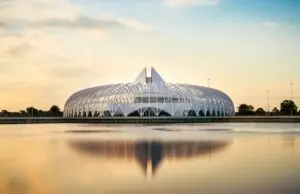
It is impossible to discuss Florida Poly without acknowledging its striking physical environment. The university’s campus is anchored by the iconic Innovation, Science, and Technology (IST) Building, designed by the world-renowned architect Dr. Santiago Calatrava.
Winning more than 20 global architectural awards, the futuristic, louvered structure has been named one of the 16 most breathtaking buildings in the world by Business Insider. This architectural masterpiece serves as a daily visual reminder to students, faculty, and visitors that Florida Poly is a place where futuristic vision, design ingenuity, and technical excellence intersect.
Official Statements
The resounding success of Florida Poly’s latest academic cycle prompted reflections from the institution’s top leadership regarding both past achievements and future ambitions.
Dr. Devin Stephenson, president of Florida Poly, emphasized the broader implications of the university’s sustained regional and national recognition:
"Maintaining such remarkable rankings at the regional and national levels demonstrates that students and academic leaders are recognizing Florida Poly as an excellent provider of high-quality STEM degrees," Dr. Stephenson stated. "This recognition is a clear sign that our innovative educational approach is making a significant impact, and our strategic plans for sustained growth will drive us toward even greater success."
Echoing these sentiments, Dr. Brad Thiessen, interim provost and vice president of academic affairs, underscored the core academic mission driving the institution forward:
"These rankings underscore the exceptional quality of our academic programs and reaffirm Florida Poly’s standing as a leading STEM institution," Dr. Thiessen noted. "As we continue to grow and fulfill our mission, we remain focused on expanding our high-demand academic degrees and fostering a vibrant learning environment for all our students."
Future Outlook: Sustaining Momentum in a High-Tech Era
As Florida Polytechnic University looks toward the horizon, the challenges and opportunities facing the institution are clear. The modern economy is undergoing a technological revolution driven by artificial intelligence, advanced manufacturing, renewable energy systems, and complex aerospace engineering. In this environment, the demand for specialized, highly trained STEM professionals has never been more acute.
Florida Poly is uniquely positioned to capitalize on these macroeconomic trends. By virtue of its singular focus on science and engineering, the university avoids the structural inefficiencies that often plague larger, more diffuse academic institutions. Its agility allows it to rapidly adapt its curriculum, forge targeted industry partnerships, and deploy capital infrastructure directly where it is most needed.
Over the coming years, the completion of the Gary C. Wendt Engineering Building in Spring 2025 will dramatically expand the university’s applied research capacity. Concurrently, the ongoing development of the Student Achievement Center will fortify the support systems necessary to shepherd an increasingly large and diverse student body through rigorous academic programs.
Ultimately, Florida Poly’s four-year reign as the Southeast’s top public college is not merely a title to be defended—it is a baseline for future achievement. By maintaining its uncompromising commitment to applied research, industry relevance, and academic rigor, Florida Polytechnic University is not only cementing its own legacy as a premier national STEM institution, but it is also actively shaping the technological and economic future of the State of Florida and the nation at large.

0 Comments