

LAKELAND, Fla. — In the fiercely competitive landscape of American higher education, institutional momentum is often measured in incremental gains. For Florida Polytechnic University, however, dominance has become a matter of sustained excellence. In the newly released U.S. News and World Report 2024–2025 Best Colleges rankings, Florida Poly has clinched the title of the No. 1 public college in the Southeast for the fourth consecutive year.
Beyond its regional dominance, the institution has solidified its national footprint. For the second consecutive year, Florida Poly earned a coveted placement among the Top 20 public engineering programs nationally in the "Without a Ph.D." category. Adding to its accolades, the university was also recognized as the No. 2 best value public college in the Southeast, proving that academic rigor and economic accessibility can successfully coexist in a specialized STEM-focused environment.
This latest wave of national and regional recognition arrives during a period of unprecedented transformation for the Lakeland-based campus. Characterized by surging enrollment metrics, aggressive infrastructural expansion, and curriculum enhancement, Florida Poly’s trajectory offers a compelling case study in the strategic scaling of a public university dedicated exclusively to science, technology, engineering, and mathematics (STEM).
Executive Overview: A Triumph of Focused STEM Education
Founded as a specialized institution within the State University System of Florida, Florida Poly occupies a unique niche. Unlike comprehensive state universities that cater to tens of thousands of undergraduate and graduate students across liberal arts, fine arts, and professional schools, Florida Poly maintains an exclusive focus on STEM disciplines.
This hyper-focus is proving to be a formidable competitive advantage. Dr. Devin Stephenson, president of the university, attributes the institution’s sustained acclaim to a deliberate, innovative educational model that aligns closely with workforce demands.
"Maintaining such remarkable rankings at the regional and national levels demonstrates that students and academic leaders are recognizing Florida Poly as an excellent provider of high-quality STEM degrees," Dr. Stephenson said. "This recognition is a clear sign that our innovative educational approach is making a significant impact, and our strategic plans for sustained growth will drive us toward even greater success."
The university’s performance in the U.S. News metrics reflects a maturation process. By maintaining small class sizes, offering hands-on applied research opportunities, and forging deep ties with high-tech industries across Florida and the United States, Florida Poly has cultivated an academic ecosystem that punches well above its weight class.
Detailed Chronology: Growth, Expansion, and Strategic Milestones
The current accolades from U.S. News and World Report do not exist in a vacuum; they are the cumulative result of a meticulously executed institutional timeline that has seen Florida Poly scale its physical footprint, academic offerings, and student body simultaneously over the past academic cycle.
Fall 2024: Record-Breaking Enrollment
The fall 2024 semester marked a watershed moment for campus demographics. Florida Poly welcomed an incoming student population exceeding 1,770 students—representing a robust 10% year-over-year increase. This growth reflects not only an expanded geographic draw but also a growing national awareness of the career outcomes awaiting STEM graduates. As regional industries hungered for specialized talent in computing, engineering, and applied sciences, prospective students increasingly turned to Florida Poly as a primary pipeline for high-paying technical careers.
Academic Innovation: Launching Advanced Degrees
To meet the escalating demands of the modern knowledge economy, undergraduate excellence must be underpinned by advanced graduate pathways. In lockstep with its enrollment milestones, Florida Poly successfully launched two critical new master’s degree programs for the 2024–2025 academic calendar:
- Master of Science in Electrical Engineering
- Master of Science in Mechanical Engineering
These programs were engineered to provide deep technical specialization and advanced research capabilities, catering to engineers looking to lead innovation in aerospace, defense, renewable energy, and advanced manufacturing sectors.
Infrastructural Scaling: Accommodating the Surge
An influx of nearly 1,800 students requires immediate and forward-thinking campus development. Florida Poly has met this challenge through a multi-pronged capital improvement strategy:
- Student Housing Expansion: Just in time for the fall 2024 move-in window, the university opened its third on-campus residential building. This addition injected 430 much-needed beds into the campus housing inventory, ensuring that student life remains vibrant and closely integrated with academic spaces.
- The Gary C. Wendt Engineering Building: Construction is charging ahead on this state-of-the-art, 40,000-square-foot facility. Designed to house cutting-edge laboratories, collaborative workspaces, and advanced research equipment, the Wendt Building is on schedule for completion by spring 2025, promising to dramatically expand the university’s research capacity.
- Student Achievement Center: Building on legislative funding allocations, the preliminary phase of the long-awaited Student Achievement Center has officially commenced. This facility is poised to become the epicenter of student support services, career counseling, and extracurricular engagement.
Supporting Context & Metrics: The Anatomy of a Top-Tier STEM Institution
Understanding Florida Poly’s sustained rise requires examining the underlying mechanics that drive U.S. News and World Report evaluations. The publication assesses institutions based on graduation and retention rates, faculty resources, expert opinion, financial resources, student excellence, and alumni giving.
The Value Equation
Ranked as the No. 2 best value public college in the Southeast, Florida Poly bridges the gap between elite private technological institutes and accessible public education. In an era where student loan debt is a national crisis, the university offers an ABET-accredited engineering and technology curriculum at a public tuition rate, yielding a high return on investment (ROI). Graduates frequently enter the workforce unburdened by crippling debt, equipped with skill sets that command immediate market premiums.
Accreditation and Industry Alignment
Florida Poly is fully accredited by the Southern Association of Colleges and Schools Commission on Colleges (SACSCOC), and its core programs hold prestigious ABET (Accreditation Board for Engineering and Technology) certification. This adherence to rigorous international standards ensures that coursework remains relevant, rigorous, and directly applicable to industrial needs.
Architectural Iconography as an Academic Catalyst
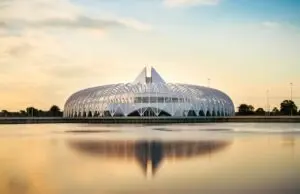
No discussion of Florida Poly is complete without examining its physical campus. The centerpiece of the university is the iconic Innovation, Science, and Technology (IST) Building, designed by world-renowned Valencian architect Dr. Santiago Calatrava.
Winning more than 20 global architectural awards and named by Business Insider as one of the 16 most breathtaking buildings in the world, the IST Building serves a dual purpose. Beyond its futuristic, white-ribbed aesthetic and operable sun louvers, it serves as a daily visual reminder to students and faculty that imagination and engineering are inextricably linked. The building itself acts as a living laboratory for architectural and structural engineering students.
Official Statements: Leadership Perspectives on the Future
The administrative leadership at Florida Poly views the 2024–2025 rankings not as a final destination, but as a validation of their long-term strategic vision.
Dr. Brad Thiessen, interim provost and vice president of academic affairs, emphasized the academic rigor underpinning the university’s success.
"These rankings underscore the exceptional quality of our academic programs and reaffirm Florida Poly’s standing as a leading STEM institution," Dr. Thiessen stated. "As we continue to grow and fulfill our mission, we remain focused on expanding our high-demand academic degrees and fostering a vibrant learning environment for all our students."
The leadership’s unified message points toward a deliberate balancing act: scaling up capacity without diluting quality. As new facilities like the Wendt Engineering Building come online and graduate programs expand, the faculty-to-student ratio and personalized mentorship models that define the Florida Poly experience remain fiercely protected.
Future Outlook: Sustaining Momentum in the New Economic Landscape
As Florida Poly looks toward the remainder of the decade, the macroeconomic environment favors its core mission. The State of Florida has emerged as a national economic juggernaut, attracting high-tech firms, aerospace corporations, semiconductor manufacturers, and defense contractors at an unprecedented pace.
In this environment, talent is the ultimate currency. Companies relocating to or expanding within the Sunshine State require a steady, localized stream of graduates who possess not just theoretical knowledge, but hands-on experience with modern technological tools. Florida Poly’s curriculum—which heavily integrates applied research and industry partnerships—positions its alumni perfectly for this shifting economic landscape.
The upcoming completion of the Gary C. Wendt Engineering Building in spring 2025 will serve as the next major catalyst for institutional growth. By providing advanced infrastructure for interdisciplinary research, the building will allow faculty and students to tackle increasingly complex challenges in automation, renewable energy systems, data analytics, and advanced robotics.
Furthermore, with enrollment metrics trending upward and regional dominance secured for four consecutive years, Florida Poly is transitioning from an ambitious regional upstart into an established national powerhouse in STEM education.
For prospective students, faculty, and industry partners, the message from Lakeland is clear: Florida Polytechnic University is not merely keeping pace with the future of technology—it is actively engineering it.

0 Comments