

LAKELAND, Fla. — In an era where higher education faces unprecedented scrutiny regarding return on investment, curriculum relevance, and institutional agility, Florida Polytechnic University continues to defy conventional academic trajectories. For the fourth consecutive year, the institution has claimed the coveted title of the No. 1 public college in the Southeast, according to the highly anticipated U.S. News & World Report 2024–2025 Best Colleges rankings.
This sustained regional dominance is accompanied by an equally impressive national milestone: Florida Poly has secured a spot among the Top 20 public engineering programs nationally without a Ph.D. for the second consecutive year. Furthermore, the university was named the No. 2 best value public college in the Southeast, an accolade that underscores its commitment to delivering world-class, accessible technical education.
As state universities across the United States grapple with fluctuating enrollment models and shifting economic demands, Florida Poly’s unique hyper-focused approach—being the only public university in Florida dedicated exclusively to science, technology, engineering, and math (STEM)—is proving not only viable, but wildly successful.
Executive Overview: A Blueprint for Modern STEM Education
The release of the latest U.S. News metrics serves as both a validation of Florida Poly’s strategic vision and a reflection of its rapid maturation. Founded just over a decade ago, the Lakeland-based institution has transformed from an ambitious regional project into a nationally recognized engine of innovation, applied research, and workforce development.
The university’s recent achievements extend far beyond league tables. Florida Poly is currently experiencing a historic period of expansion characterized by record-breaking student enrollment, cutting-edge infrastructural additions, and the strategic rollout of advanced graduate degree programs. By maintaining an intentionally rigorous curriculum backed by ABET accreditation and deep industry partnerships, the university has carved out a distinct niche in the American higher education landscape.
"Maintaining such remarkable rankings at the regional and national levels demonstrates that students and academic leaders are recognizing Florida Poly as an excellent provider of high-quality STEM degrees," said Dr. Devin Stephenson, president of the university. "This recognition is a clear sign that our innovative educational approach is making a significant impact, and our strategic plans for sustained growth will drive us toward even greater success."
This comprehensive report examines the multifaceted drivers behind Florida Poly’s continued rise, detailing its enrollment milestones, capital projects, academic expansions, and the broader economic implications of its success.
Detailed Chronology: Growth, Expansion, and Strategic Milestones
Florida Poly’s ascent to the top tier of American engineering and technology schools is not the result of happenstance, but rather of deliberate, synchronized execution across academic, infrastructural, and administrative fronts.
Fall 2024: Record-Breaking Enrollment Metrics
The momentum of the 2024–2025 academic year began with a historic influx of talent. For the Fall 2024 semester, Florida Poly welcomed an incoming student body exceeding 1,770 students—representing a robust 10% year-over-year increase. This growth reflects a surging national demand for specialized technical training, particularly as industries across aerospace, defense, software engineering, and advanced manufacturing experience acute talent shortages.
Unlike comprehensive universities that water down their offerings to appeal to a broad demographic, Florida Poly’s hyper-focus on STEM fields acts as a powerful recruitment beacon for high-achieving students seeking deep, practical competency rather than generalized liberal arts education.
Academic Diversification: New Master’s Programs
To meet the demands of an evolving tech-driven economy, academic expansion has kept pace with undergraduate growth. Florida Poly officially launched two new master’s degree programs: a Master of Science in Electrical Engineering and a Master of Science in Mechanical Engineering.
These programs are specifically designed to bridge the gap between theoretical academic research and immediate industrial application. By providing advanced specialization options, the university is actively supplying regional and national markets with high-level engineers capable of leading complex research and development initiatives.
Infrastructural Development: Paving the Way for Future Innovators
Physical expansion on the Lakeland campus has moved at a breakneck pace to accommodate the expanding student body and research apparatus:
- Residential Expansion: The university successfully opened its third student residential building right on schedule for the start of the academic year. The new facility adds 430 much-needed beds to campus housing, alleviating regional housing pressures and fostering an immersive, collaborative living-learning community.
- The Gary C. Wendt Engineering Building: Construction is currently in full swing on this state-of-the-art, 40,000-square-foot facility. Slated for completion in the spring of 2025, the Wendt Building will feature advanced laboratories and collaborative spaces designed to foster cross-disciplinary engineering projects.
- The Student Achievement Center: Momentum is also building for the Student Achievement Center, with the first phase of development officially underway following critical initial funding allocations from the Florida Legislature. This center is envisioned as a holistic hub for student success, career services, and leadership development.
Supporting Context & Metrics: Analyzing the U.S. News Methodology
Understanding the significance of Florida Poly’s top-tier rankings requires examining the rigorous criteria utilized by U.S. News & World Report. The publication evaluates institutions based on up to 17 indicators of academic quality, including peer assessment, graduation and retention rates, faculty resources, student selectivity, and financial resources per student.
Key Factors in Florida Poly’s Success:
- Peer Assessment: Academic leaders across the Southeast increasingly view Florida Poly as a regional benchmark for technical instruction and institutional effectiveness.
- Value Proposition: Ranking as the No. 2 best value public college in the region proves that high-caliber STEM education does not necessitate prohibitive student debt, a critical consideration for modern families and policymakers.
- Faculty-to-Student Dynamics: By maintaining a focused academic environment without the distraction of bloated non-STEM departments, faculty members engage directly with students on real-world engineering challenges.
"These rankings underscore the exceptional quality of our academic programs and reaffirm Florida Poly’s standing as a leading STEM institution," noted Dr. Brad Thiessen, interim provost and vice president of academic affairs. "As we continue to grow and fulfill our mission, we remain focused on expanding our high-demand academic degrees and fostering a vibrant learning environment for all our students."
Official Statements and Institutional Vision
Leadership at Florida Poly attributes the institution’s ongoing success to a steadfast commitment to its core founding principles: a singular dedication to STEM education, active collaboration with corporate partners, and an organizational culture that prizes ingenuity over bureaucracy.
President Devin Stephenson emphasizes that the university’s strategic roadmap relies on cultivating a symbiotic relationship with Florida’s burgeoning high-tech corridors. By aligning curriculum design directly with corporate workforce needs, Florida Poly ensures its graduates hit the ground running.
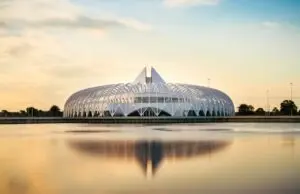
Furthermore, the iconic Innovation, Science, and Technology (IST) Building—designed by world-renowned architect Dr. Santiago Calatrava—serves as a physical manifestation of this forward-thinking philosophy. Winner of more than 20 global architectural awards and recognized by Business Insider as one of the 16 most breathtaking buildings in the world, the structure inspires the daily work of students and faculty alike, symbolizing the convergence of art, science, and engineering.
Future Outlook: Sustaining Momentum in a Competitive Landscape
As Florida Polytechnic University looks toward the remainder of the decade, the primary challenge will not be attracting attention, but rather managing controlled, sustainable growth while preserving the rigorous, hands-on educational model that put the institution on the map.
With the completion of the Gary C. Wendt Engineering Building in spring 2025, faculty and students will gain unprecedented laboratory resources to drive research in automation, robotics, aerospace components, and green energy systems. Simultaneously, the rollout of the Student Achievement Center will enhance the university’s support infrastructure, ensuring that retention and graduation rates continue to outperform national averages.
In an increasingly automated global economy, the demand for sophisticated problem-solvers who understand the practical applications of science and mathematics will only intensify. Florida Polytechnic University has positioned itself not merely as a participant in this educational evolution, but as a vanguard institution setting the standard for what a modern, specialized public university can achieve.

0 Comments