BERLIN — For nearly two decades, the United States women’s national basketball team has operated with an aura of absolute invincibility in World Cup competition. Opponents took the court not to win, but to minimize the margin of defeat.
On Sunday, September 6, 2026, inside Berlin’s premier basketball arena, that narrative was shattered.
In a low-scoring, physically punishing defensive battle, the United States escaped with a razor-thin 55-52 victory over a relentless Italian squad. The win preserved the Americans’ historic 32-game World Cup winning streak, but the manner of the victory sent shockwaves through the global basketball community. This was not the standard showcase of American athletic and tactical dominance; it was a desperate, back-to-the-wall survival act.
Led by Jackie Young’s team-high 10 points, the U.S. offense sputtered to its lowest scoring output in a World Cup victory in nearly sixty years. Only a clutch, game-defining defensive charge taken by veteran guard Chelsea Gray and a late-game scoring drought by Italy prevented one of the greatest upsets in international sports history.
Executive Overview
The United States entered the matchup as heavy favorites, carrying a 1-0 tournament record and a legacy of dominance that included eight consecutive Olympic gold medals. Their opponents, Italy, were making their first World Cup appearance since 1994 and had lost to this same American team by 34 points in a tournament qualifier just six months prior in March.
What transpired in Berlin, however, was a tactical masterclass by Italian head coach and his staff, who deployed a suffocating 2-3 zone defense that completely paralyzed the American offense. The United States shot an abysmal 29% from the field and converted a dismal 1-of-12 attempts from beyond the three-point arc.
Metric
United States
Italy
Final Score
55
52
Field Goal %
29.0%
36.8%
3-Point FG %
8.3% (1/12)
26.3% (5/19)
Turnovers
14
18
Top Scorer
Jackie Young (10 pts)
Cecilia Zandalasini (14 pts)
While the USA managed to improve to 2-0 in group play, the game proved that the gap between the U.S. and the rest of the world—which was highlighted by a nerve-wracking one-point gold medal victory over France at the 2024 Paris Olympics—has narrowed to a razor’s edge.
Detailed Chronology
[Q1: USA 23 - ITA 8]  --> Early American dominance, transition offense thrives.
[Q2: USA 30 - ITA 24] --> Italy switches to 2-3 zone; sparks a 16-7 run.
[Q3: USA 42 - ITA 39] --> Italy takes brief lead (35-32); USA responds late.
[Q4: USA 55 - ITA 52] --> Italy leads 50-48; Gray's charge & clutch jumper seal win.
First Quarter: The Illusion of Dominance
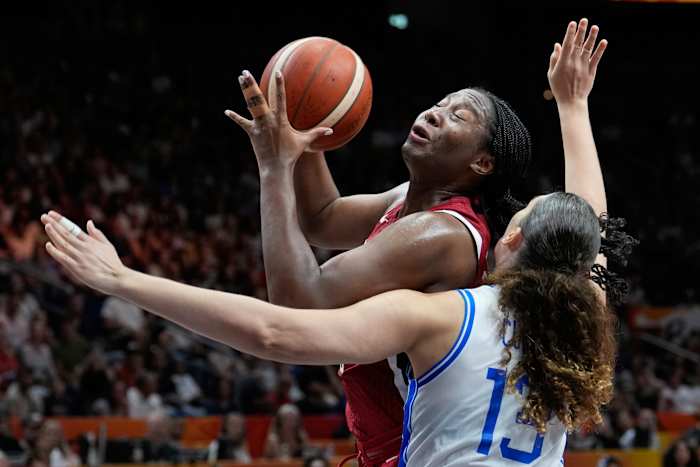
The game began in a fashion familiar to women’s international basketball. The United States utilized their size and speed to overwhelm Italy early. Behind active perimeter defense and quick transition baskets, the Americans raced out to a commanding 23-8 lead. Aliyah Boston found early success inside, scoring over Italy’s Lorela Cubaj, while Jackie Young disrupted Italian passing lanes. At the end of the first quarter, another American blowout seemed inevitable.
Second Quarter: The Zone Trap
Faced with a blowout, Italy adjusted. Abandoning their man-to-man schemes, they sank into a compact, highly disciplined 2-3 zone defense. The adjustment completely disrupted the rhythm of the game.
The U.S. guards struggled to penetrate the gaps, and without consistent ball movement, the offense stagnated. The Americans began settling for contested outside shots and missing high-percentage layups. Italy capitalised on the long rebounds, orchestrating a methodical 16-7 run to close the half. At halftime, the U.S. lead had shrunk to a fragile 30-24.
Third Quarter: Italy Takes the Lead
The third quarter saw Italy’s confidence swell. Cecilia Zandalasini began finding her mark from mid-range and beyond the arc, anchoring an 11-2 Italian run. For the first time in memory during group play, the United States looked rattled, falling behind 35-32 midway through the quarter.
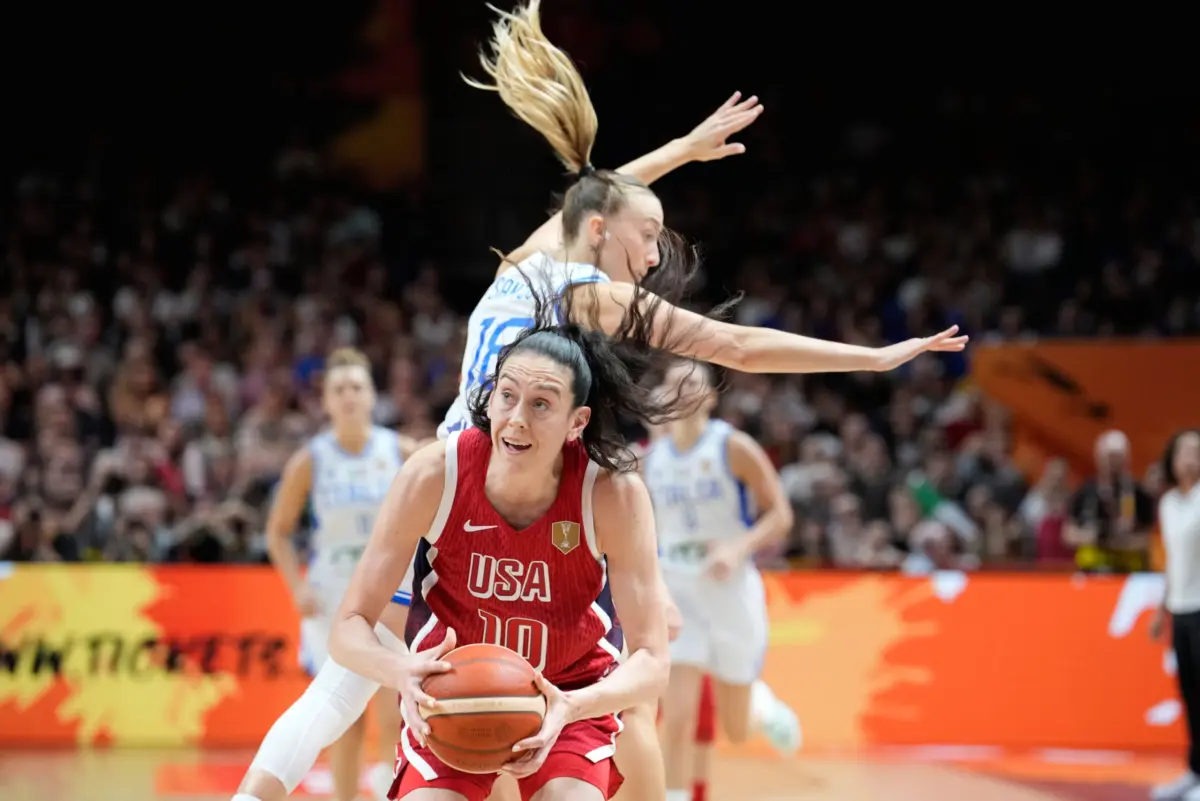
Breanna Stewart, typically the most reliable offensive weapon in the world, started the game 0-for-8 from the field, thoroughly frustrated by the physical fronting of Cubaj and Mariella Santucci. The U.S. managed to reclaim a slim 42-39 lead heading into the final period through sheer defensive effort and second-chance opportunities, but the momentum remained firmly with the Italians.
Fourth Quarter: The Clutch Execution
The final ten minutes were a grueling, possession-by-possession dogfight. With 4:29 remaining on the clock, Italy held a 50-48 lead, smelling blood in the water.
Under immense pressure, the championship DNA of the United States finally emerged. The Americans closed the game on a critical 7-0 run, sparked by their veteran leaders:
The Breakthrough: Breanna Stewart broke her scoring drought at the perfect moment, hitting a contested post-up bucket to put the U.S. back on top, 51-50.
The Turnaround Play: With 3:03 left and Italy threatening to score, Chelsea Gray sacrificed her body to draw a crucial offensive foul. The veteran point guard anticipated the drive, planted her feet, and took a hard hit to secure the turnover.
The Capitalization: On the succeeding possession, Jackie Young converted a tough layup off a quick baseline cut, extending the lead to 53-50.
The Dagger: With 1:07 remaining, Gray hit a signature step-back mid-range jumper, making it a two-possession game at 55-50.
Italy’s Matilde Villa quickly answered with a driving layup to cut the deficit to 55-52 with under a minute remaining. After the U.S. failed to convert on two consecutive possessions to seal the game, Italy secured the rebound with seconds remaining.
With the clock winding down, the ball found the hands of Zandalasini. She launched a contested, deep three-pointer at the buzzer. The shot fell short, clanging off the front rim as the horn sounded, allowing the Americans to escape with their streak intact.
Supporting Context & Metrics
Historical Context of the Scoring Slump
To understand how historic this offensive struggle was for USA Basketball, one must look back nearly six decades. The 55 points scored by the U.S. represents their lowest point total in a World Cup victory since October 23, 1967, when they defeated Australia 42-38 in Prague.
During their current 32-game World Cup winning streak, which began after a devastating semifinal loss to Russia in 2006, the Americans have won their games by an average margin of over 28 points. Prior to Sunday, only one opponent had managed to finish within single digits of the U.S. during this run: Australia, who lost by eight points (83-75) during the 2010 tournament in the Czech Republic.
U.S. World Cup Winning Streak Margin Trends (2006-2026):
======================================================
Average Winning Margin: +28.4 PTS
Single-Digit Games:
  - 2010 vs. Australia: +8 PTS (83-75)
  - 2026 vs. Italy:     +3 PTS (55-52)
======================================================
The Anatomy of a Shooting Collapse
The primary culprit behind the near-upset was an unprecedented perimeter shooting failure. The U.S. team, loaded with elite WNBA shooters, appeared completely out of sync against Italy’s defensive rotations.
Three-Point Shooting: The U.S. finished 1-of-12 (8.3%) from three-point range. This lack of spacing allowed Italian defenders to pack the paint, neutralizing the interior size advantage of Aliyah Boston and Brittney Griner.
Mid-Range and Paint Inefficiency: The Americans shot 29% overall from the field. This was compounded by an unusually high number of missed layups and put-backs—areas where the U.S. typically dominates due to their superior athleticism.
Official Statements
Following the game, the mood in the post-game press conferences was a mix of relief, respect, and stark self-assessment.
U.S. Head Coach Kara Lawson was candid about her team’s offensive shortcomings but praised their ability to grind out a victory when their primary weapons failed them:
"You have to be able to win different ways in this tournament because every team stylistically plays a little bit different. You do have to be able to win when you don’t have your fastball. We didn’t have a fastball tonight, but we figured it out late and we’ll grow from it. I thought that late charge Chelsea [Gray] took was a big momentum-changing play. It was an incredible winning play by Gray there."
Lawson also acknowledged the broader implications of the tight contest for the international game:
"We’ve seen that through the tournament that every game feels like a dogfight. It’s really hard. On any given night, if you’re not prepared to play, you’ll lose. That’s awesome for our sport."
Breanna Stewart expressed immense respect for the Italian game plan while highlighting the resilience of her teammates:
"Obviously, Italy really kind of mucked up the game for us a little bit. It made it difficult for us to score. They are a tough team. Tons of respect to what they’ve done. And, just proud of the resiliency of this group."
Chelsea Gray, whose defensive intelligence saved the game in the final minutes, pointed directly to execution errors:
"I think we missed some shots. We missed some layups, some shots that we have made in the past."
On the Italian side, the heartbreak of coming so close to an era-defining upset was visible. Italy’s star forward, Cecilia Zandalasini, who led all scorers with 14 points, showed visible emotion toward the officiating crew at the final buzzer regarding a potential uncalled foul on her final shot. She later offered a sincere apology during her press conference:
"I would like to apologize for how I reacted in the end. It was a lot of emotions today, but I should have kept them inside of me a little better."
Future Outlook
Implications for Team USA
While the United States moves to 2-0 and remains in a prime position to advance deep into the knockout stages, this game will serve as a blueprint for other opponents in the tournament. Teams like China, Australia, and Belgium possess the size and tactical discipline to replicate Italy’s zone defense.
Coach Kara Lawson and her coaching staff must address several critical areas before their next matchup:
Zone Offense Adjustments: The U.S. must improve their ball movement, high-post flashing, and baseline cutting to break down compact 2-3 zones.
Perimeter Shooting: The coaching staff needs to design quick-hitting plays to get their shooters open, rhythm looks early in possessions to prevent defenses from sagging into the paint.
Rotational Chemistry: Finding lineups that offer both elite defensive versatility and consistent floor spacing will be crucial as the tournament progresses.
The Rise of the Italian Program
For Italy, despite the loss, this game is a monumental victory for their national program. To push the reigning Olympic and World Cup champions to the final buzzer establishes Italy as a legitimate medal contender in Berlin. Their defensive discipline, anchored by Lorela Cubaj and Mariella Santucci, alongside the clutch scoring of Cecilia Zandalasini, proves that they can compete with any team in the world.
Tournament Landscape
Elsewhere in Sunday’s World Cup action, the global parity of the sport was on full display:
China edged the Czech Republic in a thrilling overtime battle, proving their status as a heavyweight contender.
Australia bounced back with a physical win over Turkey.
Belgium showcased their tactical depth with a convincing win over Puerto Rico.
The era of predictable, double-digit American blowouts is drawing to a close. As the 2026 FIBA World Cup continues in Berlin, the tournament is shaping up to be the most competitive and unpredictable iteration in the history of women’s international basketball.




0 Comments