

Executive Overview
As the 20th-century political landscape gives way to an increasingly polarized and dynamic electoral map, the internal ideological struggle within the Democratic Party continues to shape the future of American governance. In a strategic maneuver that underscores the enduring influence of the progressive wing, Senator Bernie Sanders (I-Vt.) is significantly expanding his financial footprint ahead of the midterms. Moving far beyond symbolic endorsements, Sanders’ political operation is deploying a substantial portion of its multi-million-dollar war chest to bankroll high-profile progressive candidates nationwide.
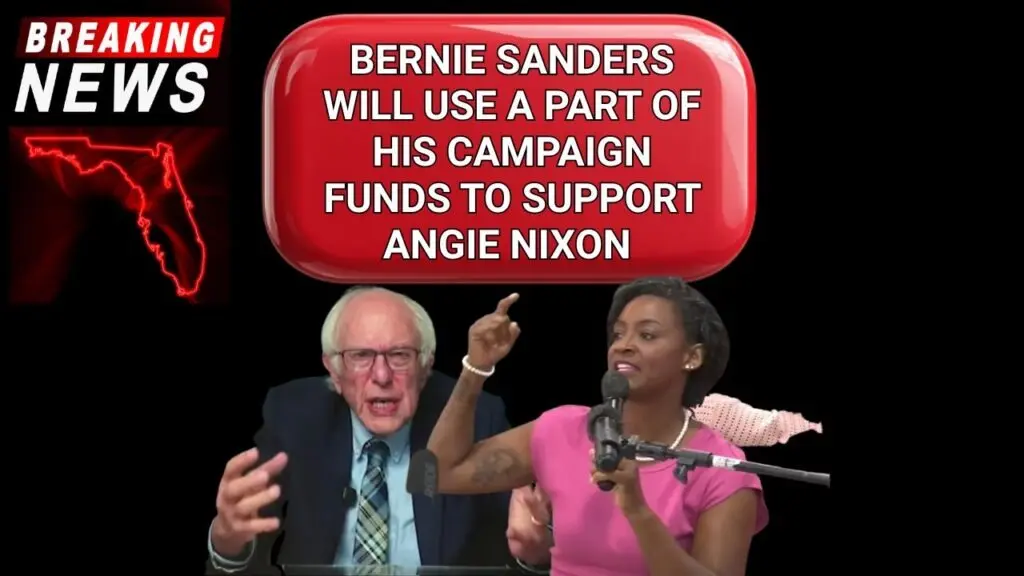
At the center of this financial mobilization in the Sunshine State is Democratic Socialist Angie Nixon, who is locked in a high-stakes, fiercely contested U.S. Senate race against Republican opponent Ashley Moody. According to recent reporting, Nixon is among a select tier of progressive standard-bearers designated to receive direct monetary infusions from Sanders’ well-funded campaign apparatus.
With nearly $23 million in cash on hand as of July, the Sanders campaign is uniquely positioned to inject hundreds of thousands of dollars into competitive Senate and high-level statewide contests. This intervention is designed to counteract the overwhelming influx of establishment and corporate capital that typically dominates federal races in traditionally expensive media markets like Florida.
While Nixon has historically trailed Moody in the preponderance of major public opinion surveys, a fresh wave of data—most notably a competitive survey conducted by St. Pete Polls—reveals an unexpected tightening of the race. This development suggests a dead heat, lending immediate urgency and viability to Sanders’ strategic investment.
Beyond Florida, the Sanders operation’s broader midterms playbook includes direct subsidies for Minnesota Lieutenant Governor Peggy Flanagan in her critical U.S. Senate bid, and Minnesota Attorney General Keith Ellison in his contentious reelection campaign. By strategically targeting these races, Sanders aims to fortify a progressive beachhead in the U.S. Senate while building a resilient grassroots infrastructure capable of withstanding well-funded opposition.
Detailed Chronology of the 2026 Progressive Midterm Mobilization
The trajectory of Bernie Sanders’ 2026 midterm strategy has evolved from a series of targeted primary endorsements into a comprehensive, heavily financed general election intervention. Understanding the sequence of events that brought the Vermont senator’s campaign cash to the doorstep of Angie Nixon’s Florida campaign requires examining the timeline of strategic decisions made within the broader progressive movement.
Early 2026: Consolidation of the Progressive Base
During the early months of 2026, progressive organizations and grassroots networks began identifying key open Senate seats and vulnerable incumbents across the country. As primary elections unfolded through the spring and early summer, democratic socialists and progressive Democrats achieved a series of surprising victories, securing party nominations in several historically difficult battleground states.
Among these victories was Angie Nixon’s successful primary campaign in Florida. Known for her outspoken advocacy on economic inequality, housing affordability, and criminal justice reform, Nixon captured the attention of national progressive kingmakers. However, securing the Democratic nomination was merely the first hurdle. Transitioning to a statewide general election against a formidable opponent like Ashley Moody required an unprecedented financial apparatus—one that local fundraising alone struggled to match against established party machinery.
July 1, 2026: The War Chest Revealed
Financial disclosures filed at the beginning of July revealed a stark reality: despite years of shifting national political dynamics, Bernie Sanders retained a formidable political war chest totaling nearly $23 million. Unlike traditional political action committees (PACs) bound by complex corporate donor structures, Sanders’ campaign funds—largely amassed through millions of small-dollar grassroots contributions—offered immense tactical flexibility.
According to insiders granted anonymity to discuss internal campaign logistics, senior advisors within the Sanders operation began formulating a plan to deploy these funds strategically ahead of the fall midterms. Rather than scattering resources across dozens of long-shot campaigns, the operation decided on a concentrated approach: funneling substantial cash infusions into a select group of competitive, high-profile races where progressive nominees had successfully advanced past their primaries.
Late September 2026: The Politico Revelation and National Expansion
The scope of Sanders’ financial intervention became public knowledge late in September, following a comprehensive report by Politico journalist Lisa Kashinsky. The report detailed how Sanders’ campaign apparatus was actively processing hundreds of thousands of dollars in direct transfers to key candidates.
The strategy was no longer theoretical; funds were actively moving. Minnesota’s Senate race—featuring Lieutenant Governor Peggy Flanagan—became an immediate beneficiary as the Sanders campaign moved to shore up her candidacy against well-funded conservative opposition. Simultaneously, the campaign confirmed that financial allocations were finalized for Angie Nixon’s U.S. Senate campaign in Florida, alongside Minnesota Attorney General Keith Ellison’s high-stakes reelection bid.

October 2026: Polling Shifts and Grassroots Momentum
The timing of Sanders’ financial injection coincided with a critical inflection point in the Florida Senate race. For months, mainstream political analysts had written off the Democratic challenger, pointing to traditional polling metrics that favored Ashley Moody. However, the release of a September survey by St. Pete Polls shattered conventional wisdom, showing Nixon and Moody locked in a dead heat at 45% apiece, with a razor-thin margin of undecided voters.
This statistical tightening transformed Nixon’s campaign from an uphill ideological crusade into a bona fide battleground priority. Sanders’ financial support arrived precisely when grassroots organizations required capital to expand field operations, launch digital media blitzes, and execute voter mobilization drives designed to capture low-propensity and young voters across Florida’s sprawling media markets.
Supporting Context, Polling Metrics, and Financial Dynamics
To fully grasp the significance of Sanders’ financial intervention in Florida and beyond, one must analyze the unique socioeconomic and political landscape governing the 2026 midterms. Campaigns of this magnitude are shaped by structural financial advantages, media market costs, and shifting demographic realities.
The Financial Disparity in Florida Statewide Races
Florida has long been regarded as one of the most expensive media markets in the United States. Running a competitive statewide campaign requires tens of millions of dollars dedicated to television advertising, digital outreach, mailers, and extensive field operations spanning the Florida Panhandle down through the Miami-Dade metropolitan area.
Republican nominee Ashley Moody has historically benefited from robust institutional backing, corporate donor networks, and a statewide conservative infrastructure built over decades of Republican dominance in Florida executive offices. For a progressive populist like Angie Nixon, bridging this financial chasm through traditional in-state donor networks presented an immense challenge.
This is where the nationalized nature of Sanders’ small-dollar fundraising machine proves invaluable. By tapping into a nationwide network of millions of donors who contribute small amounts ($10, $25, $50), Sanders’ campaign bypasses corporate PAC dependencies and funnels hard liquid capital directly where it is needed most. The infusion of national progressive money into Florida serves as a vital counterweight to the conservative financial establishment, allowing Nixon to maintain air superiority and build a robust ground game.
Analyzing the St. Pete Polls Survey
The political narrative surrounding the Florida Senate race shifted dramatically with the publication of the St. Pete Polls survey data. For months, establishment analysts pointed to consistent polling leads for Moody, categorizing the seat as safe or lean-Republican.
However, the late-September poll revealed a completely different dynamic:
- Angie Nixon: 45%
- Ashley Moody: 45%
- Undecided: 7%
- Third-Party Candidates: 3%
A tied race at this stage of a midterm cycle carries profound implications. First, it indicates that progressive economic populist messaging—focusing on issues such as property insurance crises, cost of living, healthcare access, and corporate accountability—resonates deeply with a substantial portion of the Florida electorate. Second, it highlights the importance of the 7% undecided block. With both major candidates deadlocked, the candidate who successfully mobilizes their base and captures persuadable voters through targeted ground operations will ultimately secure victory.
This is precisely where Sanders’ financial support is being directed. The funds are not merely subsidizing television ads; they are expanding voter registration drives, funding bilingual outreach efforts, and deploying field organizers to knock on doors in historically neglected urban and suburban precincts.
Official Statements and Ideological Alignment
The coalition building between national progressive leaders and state-level candidates reflects a broader alignment on the direction of the Democratic Party. Bernie Sanders’ public statements regarding the 2026 midterms articulate a clear defensive and offensive posture: protecting the ideological gains made during primary cycles while expanding the progressive footprint in the legislative branch.
In a brief interview addressing his campaign’s financial strategy, Sanders articulated his vision for the midterms with characteristic bluntness:

"I am very proud that many strong progressives have won Democratic primaries. We got to defend them right now. We got three Senate races in Michigan and Minnesota and Florida that I want to see us win, three great candidates, and they’re all taking on enormous amounts of money. So we need to strengthen the grassroots movement in those states. Got great congressional candidates in Wisconsin, Ohio, elsewhere… so we got a lot of work in front of us."
This statement underscores several core tenets of Sanders’ political philosophy:
- Defending Primary Victories: Sanders recognizes that winning a progressive primary is only half the battle. The conservative and moderate establishments often react aggressively to the emergence of democratic socialists and left-populist nominees, deploying out-of-state money and negative media campaigns to weaken them. Financial intervention is framed as a mandatory defense mechanism.
- Challenging Enormous Amounts of Money: Acknowledging the stark financial reality of modern American elections, Sanders highlights the David-versus-Goliath nature of these races. By pooling small-dollar resources, the progressive movement attempts to level the playing field against corporate-backed opponents.
- Grassroots Empowerment: True to his long-standing populist rhetoric, Sanders emphasizes that institutional money must be met with grassroots mobilization. The financial transfers to candidates like Angie Nixon, Peggy Flanagan, and Keith Ellison are explicitly tied to building permanent infrastructure at the local level rather than relying solely on passive media consumption.
For Angie Nixon, aligning with Bernie Sanders brings both distinct advantages and predictable pushback. Nationally, it unlocks access to a motivated, highly organized donor and volunteer base that spans all fifty states. Locally, it energizes the progressive core of the Florida Democratic Party, a faction that has frequently felt alienated by moderate party leadership.
Conversely, opponents such as Ashley Moody’s campaign have sought to weaponize Sanders’ democratic socialist label, attempting to paint Nixon as out-of-touch with mainstream Floridian values. However, Nixon’s campaign has countered this narrative by pivoting relentlessly to kitchen-table economic issues—arguing that the status quo championed by her opponent has failed working-class families struggling under the weight of soaring housing costs and inflation.
Future Outlook: The Stakes for the 2026 Midterms and Beyond
As the calendar turns toward the final weeks of the 2026 midterm election cycle, the convergence of national progressive money, tightening polling numbers, and intense ideological conflict sets the stage for a dramatic conclusion in Florida and across the country.
The Domino Effect on the U.S. Senate
The inclusion of Angie Nixon in Sanders’ financial portfolio signals a broader willingness among the progressive wing to compete aggressively in southern battleground states. Historically, national progressive groups have sometimes hesitated to heavily invest in states like Florida, viewing them as overly hostile terrain due to shifting demographic trends and conservative voter registration advantages.
However, the statistical deadlock captured by St. Pete Polls suggests that the political terrain in Florida may be more fluid than conventional wisdom dictates. If Nixon can pull off an upset victory against Moody, it would not only flip a crucial Senate seat but also redefine the national playbook for progressive campaigns operating in red-leaning or swing states. It would prove that populist economic messaging, when backed by robust grassroots infrastructure and national fundraising muscle, can break through entrenched political alignments.
Beyond Florida: The Minnesota and Regional Fronts
The success of Sanders’ strategy will also be measured heavily in the Upper Midwest. In Minnesota, the financial support flowing to Lieutenant Governor Peggy Flanagan’s Senate bid and Attorney General Keith Ellison’s reelection campaign forms a northern bulwark for the progressive movement. Minnesota represents a critical testing ground where well-established progressive governance models are being challenged by conservative opposition.
By simultaneously investing in Michigan, Minnesota, and Florida, Sanders is attempting to create a multi-front electoral strategy. Success in even two of these three Senate battles would dramatically alter the arithmetic of the U.S. Senate, granting the progressive caucus enhanced leverage in legislative negotiations, committee assignments, and policy formulation.
The Long-Term Legacy of Small-Dollar Power
Regardless of the ultimate outcome on election night, Sanders’ financial deployment in the 2026 midterms highlights the structural evolution of American political fundraising. The ability of a single political operation to accumulate tens of millions of dollars entirely through small-dollar contributions—and subsequently redirect those funds to sustain nationwide insurgent campaigns—demonstrates the viability of alternative funding models in modern politics.
For Angie Nixon and her campaign team in Florida, the immediate task is clear. With national progressive resources now fully deployed, the focus shifts entirely to execution: converting tied poll numbers into actual ballots cast, maintaining message discipline, and mobilizing the undecided and independent voters necessary to cross the finish line. As the final weeks of the campaign unfold, the race between Ashley Moody and Angie Nixon stands out as one of the most compelling and consequential political clashes of the 2026 cycle—a true test of whether grassroots populism can conquer entrenched institutional power in the Sunshine State.

0 Comments